My long visit with Uncle Ralph is winding down. But still two concerts to go!
The final chamber concert of this year’s Bard Music Festival will commence at 11:00 this morning (with a pre-concert talk at 10:30). “Vaughan Williams’ Legacy” will include works by Ruth Gipps, Michael Tippett, Samuel Barber (who Vaughan Williams met while lecturing at Bryn Mawr), Peggy Glanville-Hicks, and Constant Lambert. RVW himself will be represented by his last major instrumental work, the Violin Sonata in A minor.
The festival will conclude this afternoon with a semi-staged performance of the Falstaff opera “Sir John in Love,” after Shakespeare’s “The Merry Wives of Windsor.” That’s the one for which RVW set “Greensleeves.” The opera begins at 3:00 (with a pre-concert talk at 2:00). “Sir John” will be livestreamed. If you’re interested, you’ll find information at the link.
Another serendipitous reunion at the Bard Music Festival: for Saturday night’s concert, who else should be sitting in my row, but Warren Cohen, music director of the MusicaNova Orchestra!
The orchestra is based in Phoenix, Arizona, but Warren makes his home in New Jersey, which is why he was able to make the trip down to the studios of Princeton University’s WPRB, to share with me his experiences with English composer Richard Arnell and his works (of which he has conducted many), for Arnell’s centenary in 2017. It was an all-Arnell morning, which featured several of Warren’s recordings with his orchestra. I feel comfortable stating that Warren is a huge advocate of unusual and neglected repertoire, with a special fondness for English music. Remind you of anyone?
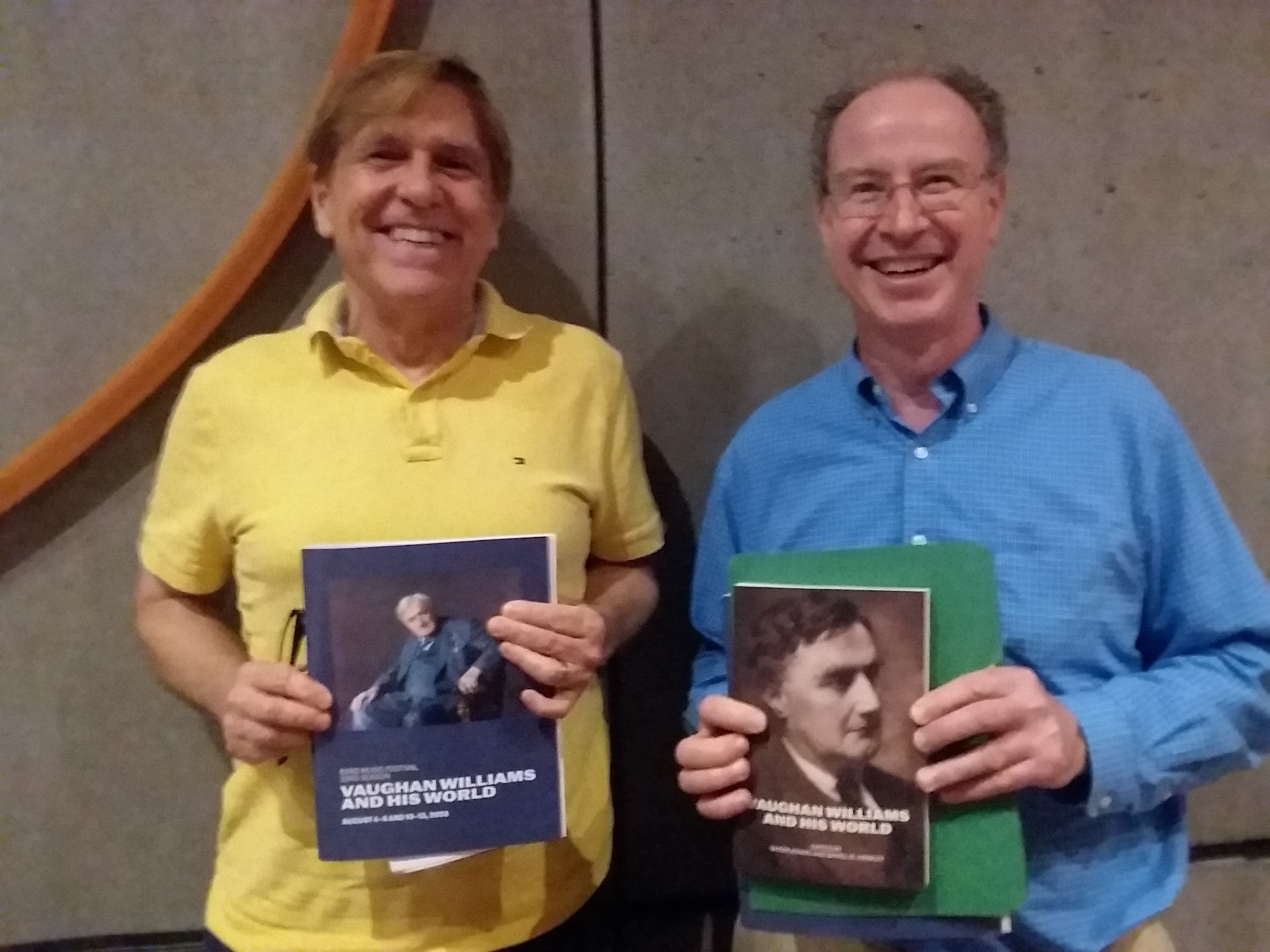
Anyway, here we are during intermission on Saturday, Warren, holding a copy of the lavish Bard Music Festival program, and me, with this year’s tie-in volume of scholarly essays, “Vaughan Williams and His World,” published by University of Chicago Press.
The concert itself was a Vaughan Williams enthusiast’s dream, featuring “Job, A Masque for Dancing” (with projections of William Blake’s artwork), the Concerto for Two Pianos (with soloists Danny Driver and Piers Lane), and the turbulent Symphony No. 4. Leon Botstein conducted The Orchestra Now (TŌN). Good luck ever hearing “Job” in the United States, or the concerto anywhere!
The Bard Music Festival will resume this weekend at Bard College in Annandale-on-Hudson, NY, with a couple of special supplementary events taking place at Church of the Messiah in Rhinebeck on Thursday evening and Friday afternoon.
Impending highlights from Bard’s marathon programs will include Vaughan Williams’ “Five Variants of Dives and Lazarus,” “Flos Campi,” and “The Lark Ascending” (alongside works by Edward Elgar, Grace Williams, Peter Warlock, Frederick Delius, and Gustav Holst, on Friday evening), the String Quartet No. 2 (alongside works by Gordon Jacob, Robert Müller-Hartmann, Egon Wellesz, Arnold Bax, Howard Ferguson, Béla Bartók, Edmund Rubbra, and a Bach transcription by Harriet Cohen, on Saturday afternoon), the Symphony No. 8 and “Sinfonia Antartica” (alongside works by Elizabeth Maconchy, William Walton, and Jean Sibelius, on Saturday evening), the Violin Sonata in A minor (alongside works by Ruth Gipps, Michael Tippett, Samuel Barber, Peggy Glanville-Hicks, and Constant Lambert, on Sunday morning), and the Falstaff opera “Sir John in Love” (Sunday afternoon).
Some of the concerts will be livestreamed. You’ll find the complete schedule here:
When Byron Adams caught sight of me during intermission at the opening concert of this year’s Bard Music Festival, he took my hand and said, “Well, we finally did it!” – suggesting we had been co-conspirators. Which in a sense is true. I knew immediately what he meant, as we had both been lobbying for Vaughan Williams to be the focus of the festival for years.
For his part, Byron, a longtime scholar of English music, had the ear of his colleague, festival co-artistic director Leon Botstein. For my part, I made it a point to suggest the composer whenever I happened to see or interview Botstein.
Byron paid me a terrific compliment when he told me that it was I that had made this year’s Bard Music Festival possible. I asked him why, and he said it was because of an email I had written. However, when I inquired if my name specifically had been mentioned, he confessed it had not – but it was because of people like me, who presumably pushed for it, that Vaughan Williams was made the subject of this year’s festival. Well, okay, I’ll take that, even if it’s manufactured glory. It will give me my moment to humble brag about it on Facebook.
Byron, emeritus professor of musicology at University of California, Riverside – as well as scholar in residence and regular advisor at the Bard Music Festival – is co-editor (with Daniel M. Grimley of Oxford University) of this year’s tie-in book of essays, “Vaughan Williams and His World,” published by University of Chicago Press.
Last week, Byron was interviewed about the festival for WAMC Northeast Public Radio. He beautifully encapsulates who Vaughan Williams was, and the composer’s significance, and manages to give a concise overview of the festival in only 11 minutes! Kudos also to host Sarah LaDuke for this intelligent conversation:
The Bard Music Festival will resume this weekend at Bard College in Annandale-on-Hudson, NY, with a couple of special supplementary events taking place at Church of the Messiah in Rhinebeck on Thursday evening and Friday afternoon. Some of the concerts will be livestreamed. The complete schedule is posted here:
Always an unexpected pleasure of attending the Bard Music Festival: chance encounters with old, likeminded friends.
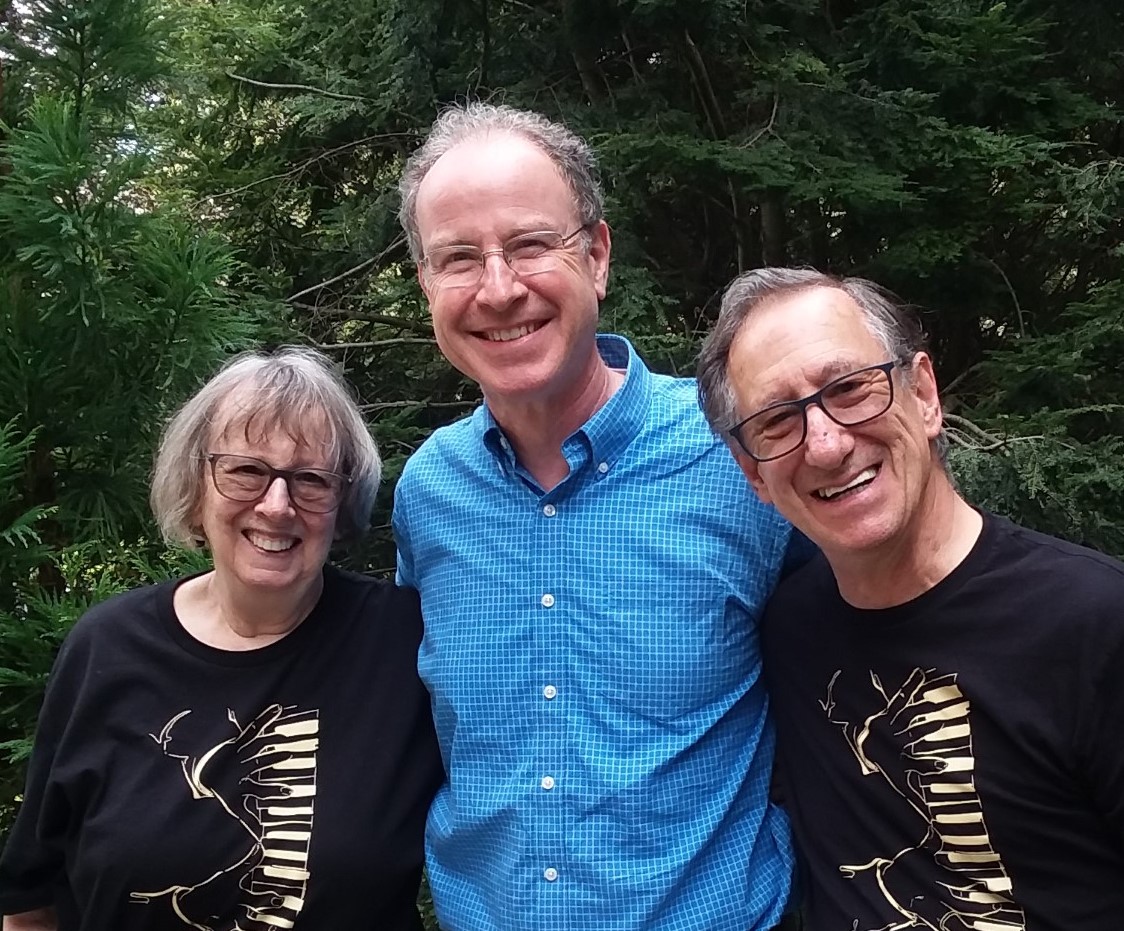
Here I am, between concerts on Saturday, with two of my former WWFM colleagues: Marjorie Herman, creator of “Sounds Choral” and music director of the Unitarian Universalist Congregation of Princeton, and Israel “Buzz” Herman, creator of “On the Wind” and music director of the Bloomfield Symphony Orchestra. Note that they are wearing the official t-shirt of last year’s festival, “Rachmaninoff and His World.” By Sunday, they had switched to the official Vaughan Williams T, with its lark ascending.
“Vaughan Williams and His World” will resume this weekend at Bard College in Annandale-on-Hudson, NY, with a couple of special supplementary events taking place at Church of the Messiah in Rhinebeck on Thursday evening and Friday afternoon. Some of the concerts will be livestreamed. See the complete schedule here:
Here’s some of the merch from this year’s Bard Music Festival. Of course, I already own most of the CDs. A particularly nice showing for those on Albion Records, the recording branch of the Ralph Vaughan Williams Society. Attractive design for the festival t-shirt, with a lark ascending, naturally, against a background of sky blue. I’m not a t-shirt guy, but I picked one up for the archive. Reading Eric Saylor’s Vaughan Williams book now. Saylor is one of this year’s resident scholars.
Of this past weekend’s concerts, Saturday night was the clear champion, with The Orchestra Now (TŌN) performing “Job, A Masque for Dancing” (with projections of the Blake illustrations), the Concerto for Two Pianos (with Danny Driver and Piers Lane the soloists), and the Symphony No. 4. Co-artistic director Leon Botstein conducted. “Job,” in particular, was sublime. Orchestras in the United States should hang their heads in shame for not programming this music.
Friday evening too had its rewards. I never much cared for Vaughan Williams’ “Concerto Accademico” on record, but hearing it played in person, with Grace Park the violinist, made me a convert. The “Serenade to Music” was luminously transcendent. The vocal soloists were all excellent, but soprano Brandie Sutton took it to the next level. What a presence, and what a voice!
It was also an inspired idea to open the festival with a communal singing of Vaughan Williams’ hymn “Down Ampney” (“Come Down, O Love Divine”), as one of the composer’s great achievements was his revitalization of the “The English Hymnal.” The man truly left his imprint on every musical facet of his time.
The Saturday morning panel, “Composer and Nation,” was also very special, with Saylor, Botstein, and Princeton University’s Deborah Nord participating. The discussion was moderated by Richard Aldous. The Bard Music Festival rewards on many levels, paying dividends on however much one decides to invest in it. If you’re there to take in some concerts of largely underexposed music, there’s plenty to enjoy. But if you want to dig a little deeper, the panels and pre-concert talks can be both absorbing and rewarding, and Saturday morning’s was among the best I’ve attended.
The daytime chamber concerts brought many pleasures, including exemplary performances of Samuel Coleridge-Taylor’s Clarinet Quintet (with clarinetist Todd Palmer) and Herbert Howells’ Piano Quartet (with pianist Danny Driver). Nicholas Phan was on hand yesterday afternoon to sing Vaughan Williams’ “On Wenlock Edge” (with pianist Piers Lane). All three works featured members of the Ariel Quartet, surely the hardest-working chamber ensemble at this year’s festival.
Next weekend’s concerts are primed to be a series of “Holy Grails” for fans of the composer. Featured highlights will include a concert of English string classics, RVW’s Symphony No. 8 and “Sinfonia Antartica” [sic], and the Falstaff opera “Sir John in Love.” Of course, there will be plenty of chamber music during the day. This year, there will also be a couple of supplementary concerts held at the Church of the Messiah in Rhinebeck on Thursday evening and Friday afternoon (including a performance of the Mass in G minor).
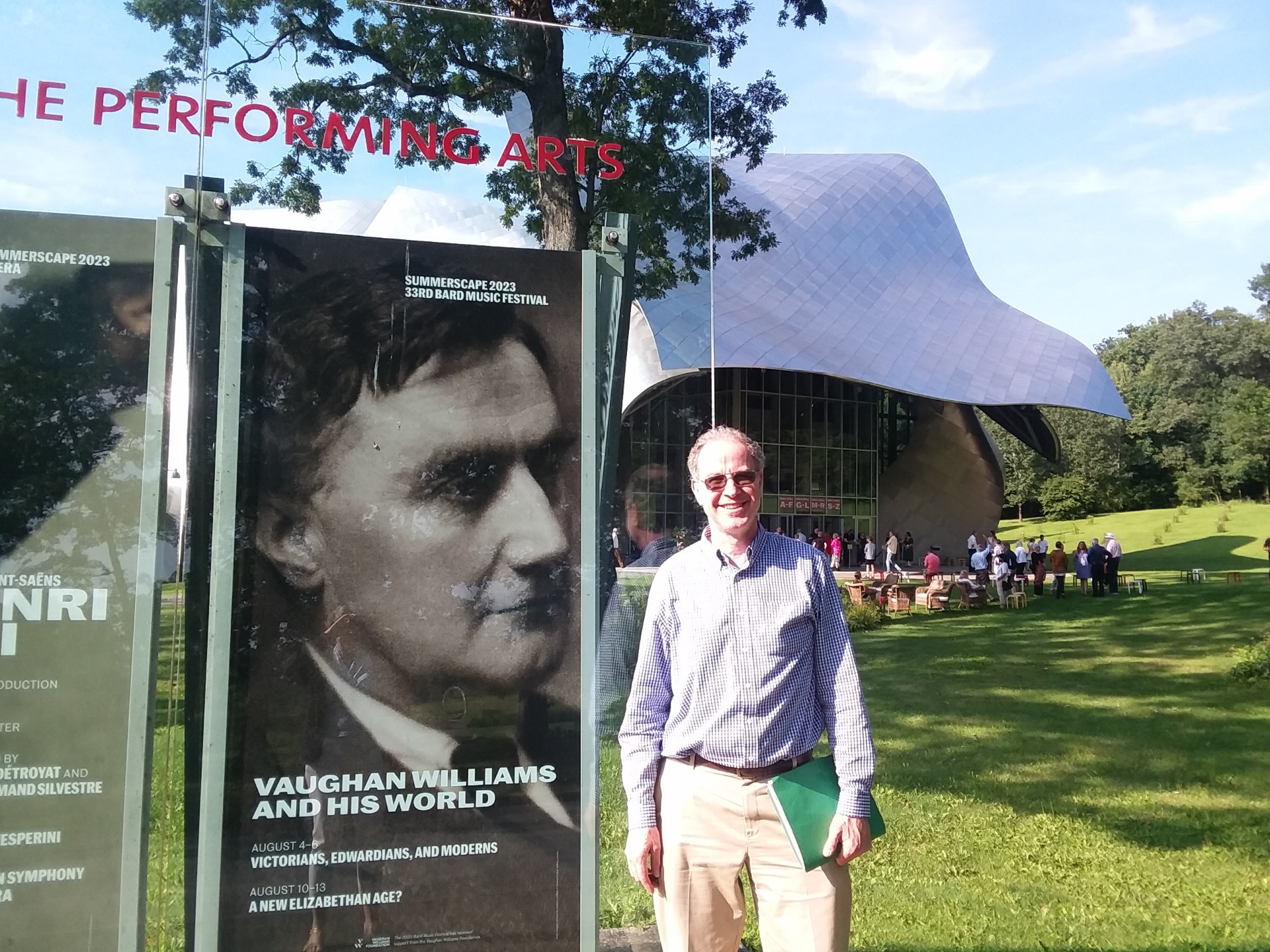
“Vaughan Williams and His World” continues at Bard College, in Annandale-on-Hudson, NY, through August 13. You’ll find the complete schedule at the link.