Here it is, at last! The Pauline Viardot post!
One of the problems with attending so many concerts at the Bard Music Festival is that there just isn’t time to write about everything. And this year, with a wedding thrown into the mix, with early check-outs and long-distance travel, it was especially difficult for me to keep up. So some of my reportage may have been a little slapdash, jumping o’er times, turning th’accomplishments of many programs into an hourglass, and so forth.
One concert I do want to write about, however, before the scent goes completely cold, is the one that concluded the first weekend of the festival (on Sunday, August 11) highlighting Viardot’s fairy tale opera “Le dernier sorcier” (“The Last Sorcerer”).
Viardot’s reputation as one of the leading mezzo-sopranos of her day has endured. She was born in Paris of Spanish ancestry. (Her maiden name was Garcia.) In fact, her entire family was made up of singers. Her parents and siblings gave the first performance of Mozart’s “Don Giovanni” in the United States, with the opera’s librettist, Lorenzo Da Ponte, in attendance, and her sister was the celebrated diva Maria Malibran.
At first, Pauline resisted her destiny. Her true passion was the piano. She studied with Liszt and played duets with Chopin and was widely acclaimed for her ability at the keyboard. It was only after her sister’s death (she and Malibran were separated by 13 years) that she finally gave in to pressure from her mother and took up the family trade.
Likewise, it was never really Viardot’s ambition to become a composer, but it seems only natural, for one so musically gifted, that she would have done so, and she amassed a respectable body of vocal and instrumental works. These include small-scale operas, designed for her students and children to perform in private settings.
As if all that weren’t enough, Viardot was a polyglot who spoke at least six languages fluently. One of these was Russian. (She made a great impression in St. Petersburg.) Combined with her other attractions and accomplishments, it made her irresistible to the writer Ivan Turgenev, who seems to have followed her around like a lovesick puppy, to the point of insinuating himself into the Viardot household. During the period the family lived in Baden-Baden, he built a villa next door. Turgenev provided the libretti for three of Viardot’s operas, including that for “Le dernier sorcier.”
The story deals with a faded sorcerer, Krakamiche, in his prime fearsome, living in a magic palace on land plundered from the forest elves; but with age and the diminution of his powers, the palace has dwindled into a dilapidated hut, and the sorcerer is barely able to conjure his daily bread. His servant, Perlimpinpin, once a formidable giant with the ability to uproot mountains, has lost not only his enormous stature, but also his wits. (At a point, he sings an aria in which he’s unable to finish any of his thoughts.) The roof leaks, and the disenfranchised elves seize every opportunity to annoy and harass Krakamiche.
Yet, even in his fallen state, the sorcerer continues to lust for wealth and power, if for nothing else to secure a legacy for his daughter, Stella. She, however, would be content with a happy and loving home. A prince, Lélio, hunts in the forest and falls in love with Stella, not realizing she is the sorcerer’s daughter. The Queen of the Elves intercedes and there is some business with a flower that bestows selective invisibility.
When the sorcerer discovers the ruse (in the meantime having been further duped by the elves), he makes a last-ditch effort to exert his power. He attempts to summon a monster to destroy the prince, but instead, only winds up humiliating himself, hilariously conjuring a sheep. Humbled, the sorcerer consents to the marriage and abandons the forest to live in the prince’s castle with the newlyweds. The hut disappears, and the elves rejoice, having regained their land.
It’s a whimsical premise, but as so often with fairy tales, it thinly veils a number of timely (or timeless?) observations on the corrupting influences of wealth, power, and what is now vilified as patriarchy, often at the expense of the natural world, freedom, and personal happiness. Not bad for a 150-year-old children’s fable.
The Bard performance was a co-production with Sing for Hope, an organization co-founded by sopranos Camille Zamora and Monica Yunus. Established in response to the events of 9/11, Sing for Hope has partnered with community-based organizations to bring hope, healing, and a sense of connection to millions. According to its website, the aim of its education program is to harness “the transformational power of the arts to foster positive change and growth among young people, educators and communities.”
Zamora and Yunus both took part in the Bard performance. Zamora, in particular, has been a champion of the piece, which she helped revive after a century and a half of dormancy. She continues to tour this production, using professional singers in the leads but incorporating the talents of the young in the chorus and staging.
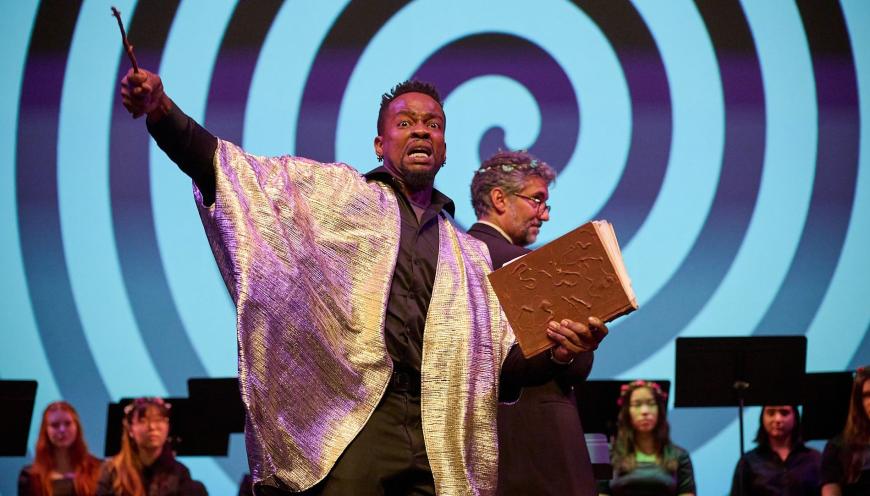
The result is long on charm. Projections based on the kids’ drawings (many of them in crayon) are transformed into animations of various flora and fauna that lend the whole experience a disarming “naif” quality. At Bard, the originally scheduled reader, Emmy-nominated actor Tituss Burgess of the Netflix comedy series “Unbreakable Kimmy Schmidt,” awoke that morning with a sore throat, but lemon was made from lemonade when his understudy, Sing for Hope’s Justin Walker, at 13, took his place in a stage-side comfy chair to provide the commentary and narration, reading from an oversized, stylized tome. His participation only lent to the childlike quality – and I mean that in a good way. This is what I imagine the home theatricals of the young Brontës or Alcotts might have been like.
There was nothing rough or unfinished about the singing. Baritone Babatunde Akinboboye assumed the title role of Karkamiche the sorcerer, raging impotently at his elvish tormenters. Yunus was Stella, his daughter. Tenor Noah Stewart sang Karkamiche’s scatterbrained valet, the former giant Perlimpinpin. Zamora was Queen of the Elves. Mezzo-soprano Adriana Zabala (another one of Zamora’s close friends) was Prince Lélio, a trouser role. And soprano Laquita Mitchell was Verveine, a kind of elf lieutenant.
The chorus of the elves, all participants in Bard’s vocal arts program, harassed Krakamiche with wadded up balls of paper and paper airplanes, and by dimming his candles and drenching his fire. Their singing was prepared by Lily Cadow. Sharyn Pirtle was the stage director, and Shawn Kaufman handled the lighting design. The pianist, who played for some 70 minutes from beginning to end, was Lucy Tucker Yates.
It must be a running gag to swap out the harmless animal conjured in place of Karkamiche’s intended monster. The libretto calls for a goat. Here, as noted, it was a sheep. A review of another Sing for Hope performance mentions a bee.
While never intended to be anything more than it is, the opera is brimming with good tunes. There is plenty of Mendelssohnian fairy music to characterize the elves. The prelude is full of portentous bluster, intruding on a lyrical fantasy, full of expectation and setting up the conflict to come. Prince Lélio is introduced by the suggestion of a hunting horn, and Krakamiche, for some reason, seems to be especially fond of waltzes. The opera builds to a moving a cappella quartet, in which the principals reconcile.
Zamora wrote the English language narration, which is perfect in a “Fairy Tale Theater” kind of way (R.I.P. Shelley Duvall). She also spearheaded a studio recording of the work, which I have also enjoyed, issued on Bridge Records, Inc. in 2018.
Viardot: Le dernier sorcier (The Last Sorcerer) <br> BRIDGE 9515
The recording features most of the Bard principals, but with the luxury casting of Eric Owens as Krakamiche and Jamie Barton as the Queen. On record, Zamora sings Stella. At Bard, her Queen – a role I actually kind of prefer (then, I suppose I always did have a thing for Billie Burke) – also introduced the opera.
For some reason, on the recording, the dispossessed and vengeful forest folk are identified as fairies, while at Bard they were elves.
Unfortunately, I missed the pre-concert talk, but I’m told there was time for a few numbers performed by the young singers. Following the opera, they all came up on stage in their Sing for Hope t-shirts to share in the bows. Keep up the good work, kids!
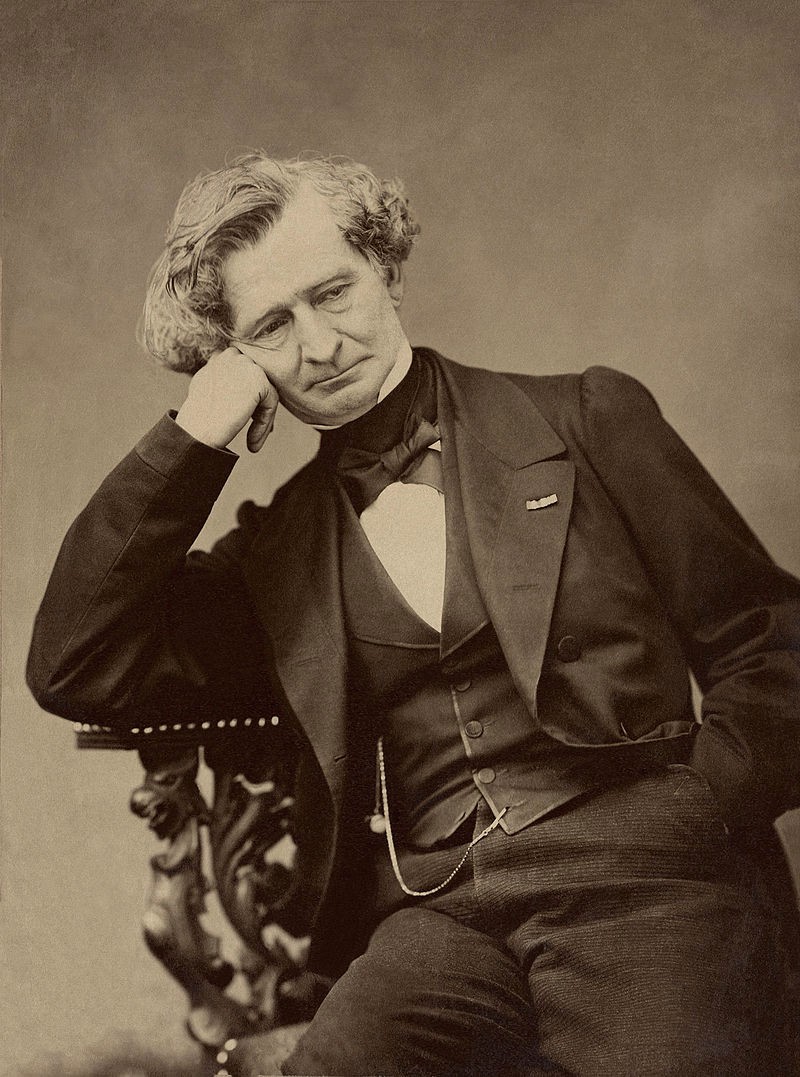
“Le dernier sorcier” formed the second half of the concert, “Women Musicians in Berlioz’s Time.” (Hector Berlioz, after all, was the focus of this year’s festival.) The first half of the program opened with Phoebus’ aria, “Elle est rapide,” from Louise Bertin’s opera “La Esmerelda” (after Victor Hugo’s “The Hunchback of Notre Dame”), with tenor Noah Stewart accompanied by pianist Anna Polonsky. Polonsky would return to perform the Toccatina, Mazurka, and Polonaise from Clara Schumann’s “Soirees musicales,” Op. 6.
Also heard were Berlioz’s “La mort d’Ophélie” (after Shakespeare, by way of Ernest Legouvé) and “La captive” (after Hugo), both sung by mezzo-soprano Rebecca Ringle Kamarei. She was joined in the latter by cellist Andrew Borkowski of The Orchestra NOW (TŌN). Ringle Kamarai brought the first half to a rousing conclusion with the aria “Crude sorte” from Rossini’s opera “L’italiana algeri.” Erika Switzer assisted in all three, from the keyboard.
Viardot was certainly well-represented at this year’s festival, in addition through her art songs, several of which were featured on Byron Adams’ Sunday morning survey of French chansons, romances et mélodies, including one based on a repurposed Chopin mazurka (undertaken with the composer’s permission and, to some degree, even supervision).
The first performance of “Le dernier sorcier” took place at Turgenev’s villa, with Viardot’s children participating, and another frequent Viardot collaborator, the painter and translator Louis Pomey, in the title role. Turgenev himself played the lead in a gala performance.
The first professional performance was arranged with the help of Franz Liszt and given at the Weimar Court Theater in 1869. Yet another private performance took place in London, where the Viardot family was waiting out the Franco-Prussian War. After that, the work seems to have been largely forgotten until its modern revival in the 21st century.
Turgenev was far from Viardot’s only admirer, either romantically or artistically. She was courted by, but dissuaded from marrying (on the advice of George Sand), the poet Alfred de Musset. Gounod created the title role of “Sapho” with her in mind, and Saint-Saëns dedicated “Samson and Delilah” to her. For a time she was close to Berlioz – until she wasn’t. She performed Gluck’s “Orphée et Eurydice” under his direction. Their friendship cooled after he changed his mind about casting her as Cassandra in “Les Troyens.” Brahms was in the audience for one of the performances of “Le dernier sorcier.” Viardot in turn sang in the premiere of his “Alto Rhapsody.”
Through her connections, friendships, and artistic contributions, Pauline Viardot proved indispensable to the music of her time – which is to say, of all time. She died in 1910 at the age of 88. This rare opportunity to see and hear “Le dernier sorcier” at the Bard Music Festival was pure enchantment.
Fisher Center at Bard
PLEASE NOTE: Although the performers are identical (Babatunde Akinboboye as Karkamiche, Camille Zamora as the Queen, and Monica Yunus as Stella), these stills from the production are NOT from the Bard Music Festival, but rather from a previous performance given at the Wallis Center of the Performing Arts in Beverly Hills, CA. Also shown is the cover art of the recording on Bridge Records and a detail from a portrait of Pauline Viardot.