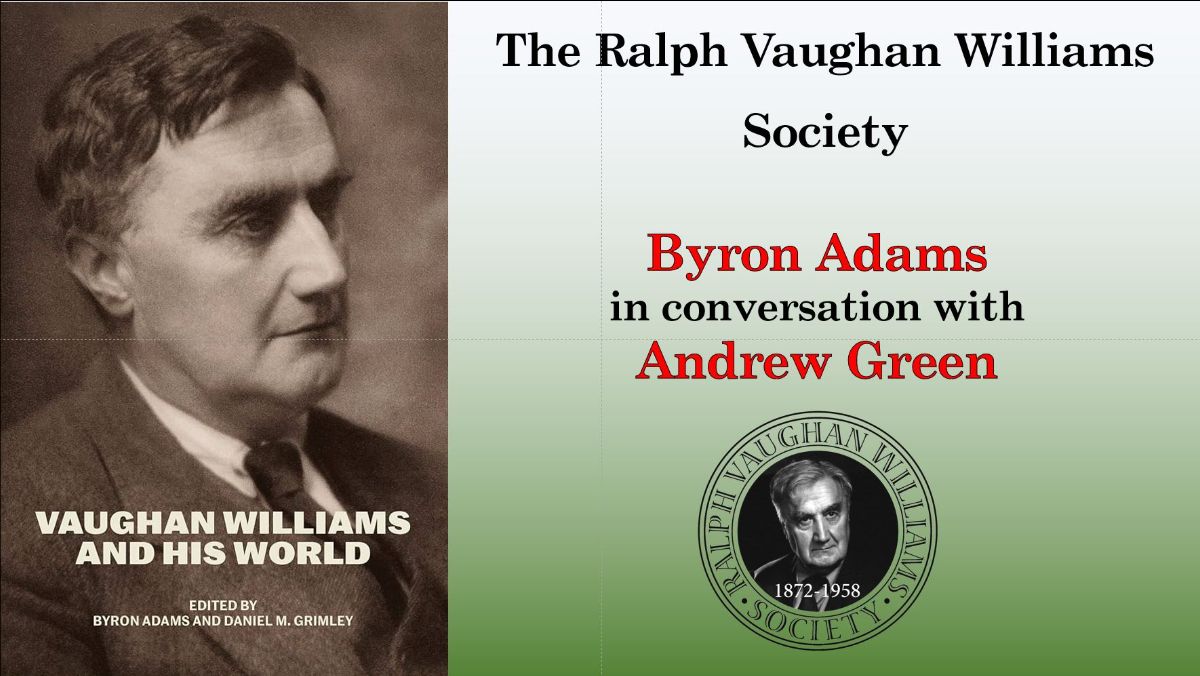
It’s summer and a Sunday. As I continue to work on my appreciation of conductor Roger Norrington (who died on Friday), which hopefully I will have in satisfactory shape soon, I thought I’d share this interview with musicologist Byron Adams, conducted by Andrew Green of the Ralph Vaughan Williams Society.
Adams, whose comments on this page are invariably illuminating (and always welcome), has been a passionate and lifelong advocate of Vaughan Williams, Elgar, and other British composers. If you ever attend concerts of the Philadelphia Orchestra, pay attention to who wrote the program notes. There’s a possibility it could be Byron!
Adams is also a composer himself, a retired professor of music at the University of California, Riverside. The conversation at the link rightly emphasizes his contribution to the Bard Music Festival, especially in the editing of a tie-in volume of critical essays for the 2023 festival, devoted to “Vaughan Williams and His World,” published by University of Chicago Press. But you may also learn a thing or two about Vaughan Williams’ experiences in America and certainly more about the Bard Music Festival.
Another one of Byron’s enthusiasms and areas of expertise is French music. He’ll be introducing a concert to be performed at Bard on the afternoon August 9 for a program he helped curate, titled “The French Connection,” designed to illuminate the experiences in Paris of – and French influences on – the subject of this year’s festival, the Czech composer Bohuslav Martinů. The concert will also include music by Alexandre Tansman, Albert Roussel, Maurice Ravel, and Josef Suk.
Adams is a Bard stalwart, having for many years served on the program committee for the festival.
Here’s a link to the complete schedule for “Martinů and His World,” which will take place at Bard College over two weekends, August 8-10 and 14-17.
In less than a month, the sleeping giant of Czech music will awake!
The 35th annual Bard Music Festival, “Martinů and His World,” will to be held largely on the campus of Bard College in Annandale-on-Hudson, NY, August 8-17.
Why is Bohuslav Martinů not better known? Perhaps it’s because he wrote so damn much in so many difference styles. With a career that took him from Czechoslovakia to Paris to the United States and then back again to Europe, absorbing a multiplicity of stylistic influences along the way, Martinů is not the easiest guy to pin down.
Some of his works have a strong Czech national flavor, revealing a spiritual descent from the line of Dvořák and Smetana. Others are evidently modernist, full of churning flywheels and motor rhythms, characteristic of a mechanized age. Others still flirt with popular styles, especially jazz. He’s a unique mash-up of Bohemian, French, and American influences. His “modernism,” such as it is, is seldom at the expense of broadening passages of great lyrical beauty.
Over two weekends, the Bard Music Festival will do what it does best: immerse audiences in works from all periods of the composer’s creative life, setting them off against music of his role models, his contemporaries, and those in turn he inspired. The listening experience will be enhanced by panel discussions, pre-concert talks, and lobby chit-chat with fellow enthusiasts over coffee and sandwiches.
Conductor and Bard president Leon Botstein will oversee orchestral, orchestral/choral, and opera performances, at the helm of the American Symphony Orchestra and Bard’s crackerjack graduate ensemble, The Orchestra Now. Evening concerts will take place at the Sosnoff Theater, the state-of-art concert hall housed in the Frank Gehry-designed Fisher Center for the Performing Arts.
Daylight concerts and panels will be held across campus in the more intimate surroundings of the 300-seat Olin Hall. Performers will include superb musicians and ensembles from the faculty of the Bard Conservatory, guests, and visiting artists with long relationships with the festival.
For the uninitiated, the prospect of getting one’s head around Martinů’s output can seem a little daunting. Yet the composer’s music is immediately appealing, generally easily digestible, and often a great deal of fun.
Treat yourself to this preview featuring Bard co-artistic directors Leon Botstein and Christopher H. Gibbs. The music bed is from Martinů’s “Three Frescoes of Piero della Francesca” – not part of the festival, but performed on a previous concert by Botstein and The Orchestra Now.
I’m especially looking forward to hearing Martinů’s Nonet, the Cello Sonata No. 3, the Flute Sonata, the jazz sextet “La revue de cuisine,” and a selection of his Etudes and Polkas for piano. Among the larger works will be the Symphonies Nos. 2 & 6, “The Epic of Gilgamesh,” the Violin Concerto No. 2, and a semi-staged performance of his opera “Julietta.”
This being Bard, there will be plenty of fascinating rarities by other hands, including a string quartet by Martinů student (and mistress) Vítězslava Kaprálová and a piano concertino I didn’t even know existed by his friend and champion Rudolf Firkušný.
Also featured will be works by Iva Bittová, Aaron Copland, David Diamond, Antonín Dvořák, Petr Eben, Karel Husa, Leoš Janáček, Jaroslav Ježek, Arthur Honegger, Kryštof Mařatka, Jan Novák, Maurice Ravel, Jaroslav Řídký, Erwin Schulhoff, Josef Suk, Alexandre Tansman, Joan Tower, and Frank Zappa!
For more information about “Martinů and His World,” including a more complete schedule, visit
The festival is the crown jewel in the diadem of Bard SummerScape, Bard’s annual celebration of the arts, now in progress. Fans of Czech music will also eagerly anticipate a fully-stage production of Bedřich Smetana’s “Dalibor,” that will precede the Martinů festival, July 25-August 3.
Some of the events, including one of the performances of “Dalibor” will be available for livestreaming.
The festival’s annual tie-in book of scholarly essays will be released on August 12, but there will likely already be copies available at the festival.
It’s past time that American concertgoers and programmers hold Martinů’s music in the same esteem as that of his better-known compatriots, Dvořák, Smetana, and Janáček. Here’s hoping that Bard lends traction to this giant’s seven-league boots.
Few have done more to rehabilitate neglected Strauss, especially neglected Strauss opera, than Leon Botstein. But after all, rehabilitating the neglected is what Botstein does. He’s made a career of it, on record, in concert, and as part of the mission of the Bard Music Festival, a kind of music mecca that attracts the curious to Bard College every summer for total immersion in a composer’s work and world. (This year’s festival, which will take place largely over two weekends, August 8-10 and 14-17, will be devoted to the sleeping giant of Czech music, Bohuslav Martinů.) Botstein is the festival’s founder and co-artistic director. In that capacity he conducts the operas and most of the orchestral programs, serves on panels, writes illuminating essays, and delivers pre-concert lectures. At 78, he’s still an intellectual dynamo. His lumbering gait and considered speech belie a seemingly inexhaustible well of energy. Botstein has served as Bard’s president since 1975. Yes, you read that correctly. He assumed the office at the age of 29.
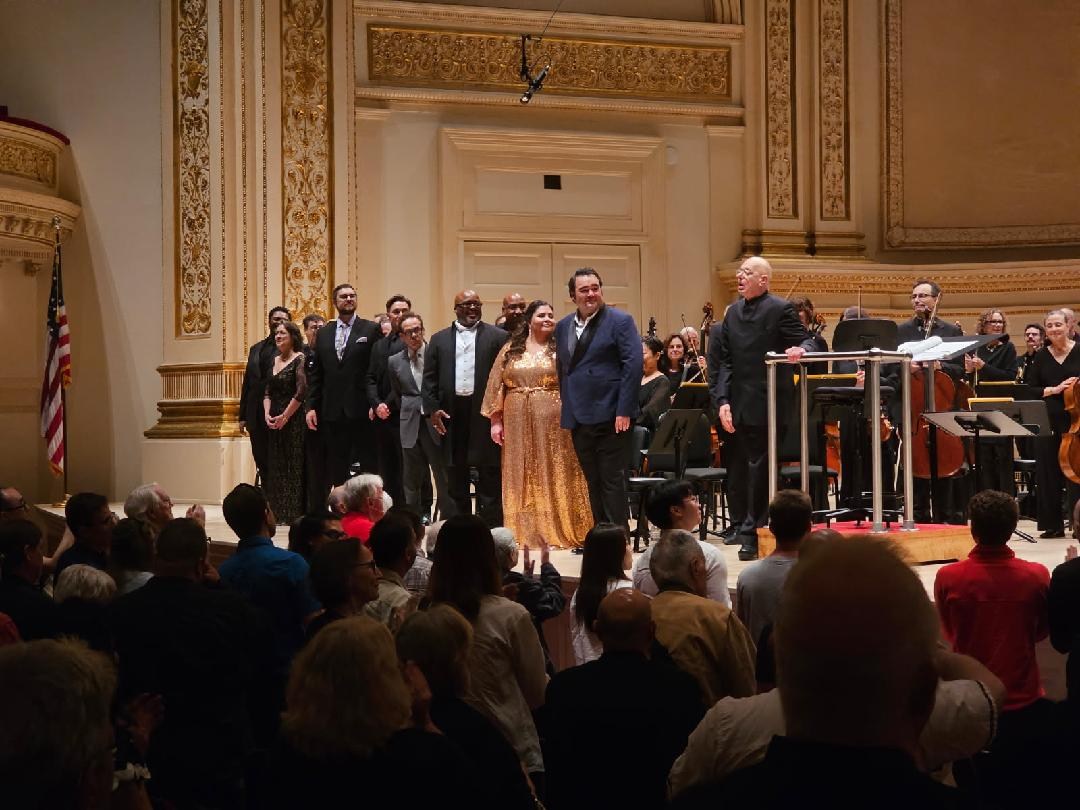
On Friday, Botstein took the stage of Carnegie Hall to guide the American Symphony Orchestra (a group he has directed since 1992) through the resurrection, in concert, of Strauss’ first opera, the problem child “Guntram.” The work was tepidly received at its premiere in Weimar in May 1894. Basically, everyone thought it was fine, if not particularly special. Pauline de Ahna sang the role of Freihild. Four months later she would become Strauss’ wife. (He announced their engagement on the day of “Guntram’s” premiere.)
In November, Strauss brought the work to his hometown of Munich, where he was serving as music director. Its reception there might be charitably characterized as brutal. So poorly did its single performance go down that the orchestra walked out on strike under the direction of its concertmaster (Strauss’ cousin). The two leads refused to reprise their roles, and a third singer was adamant about not returning until a better pension was negotiated. Ouch!
By then, Strauss had already tasted success with his tone poems “Don Juan” and “Death and Transfiguration.” “Till Eulenspiegel’s Merry Pranks,” “Also sprach Zarathustra,” “Don Quixote,” and “Ein Heldenleben” were yet to come. He was a decade away from “Salome,” the work that would change his operatic fortunes forever. (But first, he would have his revenge on conservative Munich with his scandalous opera “Feuersnot.”) He would go on to become perhaps the most successful opera composer of the 20th century.
Still, you know how it is. One never forgets the sting of rejection. Strauss just couldn’t get over “Guntram’s” failure. He tried to put it behind him with a humorous gesture, figuratively burying the pain with a symbolic gravestone erected on his property that bore the inscription:
“Here lies the venerable, virtuous young Guntram—
Minnesinger, who was gruesomely slain by the symphony orchestra of his own father
May he rest in peace!”
Strauss would enjoy wealth and celebrity, but that early humiliation stayed with him. In 1940, when he was in his mid-70s, at the other end of a very fruitful career, he revised “Guntram,” making some cuts and hoping its merits would finally be recognized. But its fortunes did not improve.
“Guntram,” then, is right in Botstein’s wheelhouse. “Salome,” “Elektra,” and “Der Rosenkavalier” don’t need his help. Rather, he’s been working his way through Strauss’ lesser-known efforts, including the aforementioned “Feuersnot,” “Die ägyptische Helena,” “Die schweigsame Frau,” “Friedenstag,” “Daphne,” and “Der Liebe der Danae.” He and the ASO recorded “Die ägyptische Helene” and “Der Liebe der Danae” at Avery Fisher Hall in 2001 and 2003, respectively, for Telarc Records.
Before I forget: it is essential that you get there early for any Leon Botstein performance. I guarantee his insightful pre-concert talks will enrich your experience of the music. On this occasion, had I missed his remarks, it would have gone right over my head that this was no mere Wagner knockoff, but rather a sly subversion of the Wagnerian aesthetic it would seem to embrace. I would have missed out on the entire social and historical context that allowed me to take vicarious pleasure in knowing that “Guntram” pissed off Strauss’ contemporaries. Of course, the music itself also happens to contain passages of great beauty, especially when heard live.
Botstein conducted “Guntram” from that 1940 revision of the work, the only performance edition. While the opera may not be a world-beater, we’re far enough along from the prejudices and animosities that pummeled it in the 1890s to at least give it a fair and objective hearing.
Strauss wrote his own libretto, which is full of the turgid Teutonic iconography familiar from so many German Romantic operas. A corrupt ruler, high-minded minnesingers, civil unrest, a saintly woman, thwarted love, and heavy swords that in my opinion never get enough use. Strauss further emulates Wagner through the employment of leitmotifs – musical snippets associated with certain characters or ideas that undergo transformation as they recur throughout the opera. Guntram’s is insistently memorable, helped no doubt by the fact that it’s basically the first three notes of the Enterprise fanfare from the original “Star Trek” television series. A leitmotif associated with Freihild’s love anticipates a similar one in Strauss’ “Die Frau ohne Schatten.”
Certainly, “Guntram” has got its share of castles and pageantry and lofty-minded singing societies – in this case, a pacifist rebel alliance united against a tyrannical duke. Too bad Guntram kills him. If it were Wagner, you would expect the hero, or any rate the self-sacrifice of the heroine, to change the world. But there is no redemption in “Guntram.” Instead, the protagonist retires, like Strauss’ vision of the Hero at the end of his epic tone poem “Ein Heldenleben” – which actually quotes “Guntram” in the section celebrating “The Hero’s Works of Peace.” The climactic moments of the opera also put one very much in the mind of “The Hero’s Retirement from this World and Completion.”
There are intimations of other Strauss works, as well. “Death and Transfiguration,” already written, finds its way in. There’s no question as to the identity of the composer. Strauss was already a master orchestrator, and his thumbprints are easily detectable without a magnifying glass. But the ghost of Wagner is forever lurking behind a column. One thing I forgot to mention is a dance that Strauss includes twice, which to my ears is a Romantic gloss on the same Tielman Susato dance Peter Warlock used as the basis for the last movement of his “Capriol Suite.” Can that be possible? How well known would Susato have been in the 19th century? Perhaps the similarity is just a coincidence? A chorus of monks also gets to intone some faux Gregorian chant. Great fun!
Despite all the music’s feints at “Tristan und Isolde,” especially in the third act, “Guntram” is an opera without any sense of Wagnerian transcendence or redemption. It’s more like there’s the POSSIBILITY of redemption, perhaps, someday, I’ll have to get back to you, as Guntram wanders off into a life of renunciation, reflection, and seclusion; but before he goes, he exhorts Freihild, who clearly reciprocates his attraction, to devote herself to charitable works. What a guy.
According to Botstein, this subversion of Wagnerian ideals would have been seen as heretical by his contemporaries. Read Alex Ross’ “Wagnerism: Art and Politics in the Shadow of Music” for a better understanding of just how pervasive Wagner’s influence was. No exaggeration, it permeated just about every aspect of human existence and thought – philosophy, fashion, architecture, politics, and of course the arts – apparently so much so that Strauss’ teacher, Alexander Ritter, an ardent Wagnerian, totally cooled on their friendship in the wake of “Guntram.” (On the other hand, Strauss’ rival, Gustav Mahler, respected its merits enough to include two of its preludes on a concert – at Carnegie Hall, as a matter of fact.) To mess with Wagner would have been to rock the pillars of the earth.
A frequent criticism leveled against Botstein, a prolific scholar who has published in multiple disciplines (in multiple languages, for that matter) and is the head of a liberal arts college, is that as a conductor he conducts like a hell of an academic. It’s his curiosity that drives the performances as opposed to penetrative insight. I can’t say that has always been my experience, and in fact more often than not, I have attended Botstein concerts that have left me juiced – often in both senses, as in electrified AND drained, as those Bard concerts can attain epic dimensions. On the other hand, an Ives’ Second Symphony I heard Botstein conduct at Carnegie last season lacked any suggestion, in its execution, of a work that can live and breathe in a unique, vital, and even transcendent way. Under Botstein’s direction, it was just there. Like John Knowles Paine on a bad day. That’s the risk you take, with the vagaries of live performance.
On Friday, I can attest, Botstein was like a surfer harnessing the energy of one bitching wave. I had been totally ignorant of John Matthew Myers, but he had a ringing heldentenor that rang effortlessly over the orchestra and carried out to every corner of the hall, gliding on Carnegie’s legendary acoustics. In fact, the acoustic flattered practically everyone. There was a lot of very good and attractive singing from a diverse cast. Katharine Goeldner sang with passion and commitment in the supporting role of the Old Woman. I was amused to recall Rodell Rosel, who sang the Duke’s Fool, as the Jester in Botstein and the ASO’s performance last season of Schoenberg’s “Gurre-Lieder.” When in need of motley antics, they must have him on speed dial. To keep it short, I could pretty much dole out praise across the board. Myers was the revelation, but for as stunning as he was, in the end anyone present would have had to concede the laurels should be cast at the feet of Angela Meade, who stunned especially at the end of Act II, when her character, Freihilde, the kind wife of the evil duke, was finally given something more to do than swoon. When she belts, “Ich liebe dich!,” that’s pretty much that. All you can do is go to intermission.
Strauss famously characterized himself as “a first-class second-rate composer.” You can practically detect the twinkle in his eye when he said it. The performance of “Guntram” on Friday night certainly bore out his assessment. In all, I found the opera worked marvelously well in concert – I found it rewarding and even revelatory – although I can imagine the challenges for anyone attempting an actual staging. For one thing, all three acts are hampered by dramatically-stagnant monologues (three for Guntram and one for Freihild), making it a textbook park-and-bark. Any staging is bound to come off seeming like a series of tableaux, with the other singers waiting around for long stretches, holding poses, or doing their best to look natural. But with voices like these, who cares? Sometimes all you need are big voices and a powerful orchestra. Anyway, I happen to groove on ersatz Wagner.
I must say, it was instructive, if perhaps a little foolhardy, to listen to this on the same weekend as the Philadelphia Orchestra’s performance of Wagner’s “Tristan und Isolde.”
Thank you, Leon Botstein, the American Symphony Orchestra, and the men of the Bard Festival Chorus. It was a wonderful evening!
Strauss was the focus of the Bard Music Festival in 1992. In 2011, Bard offered a series of staged performances of “Die Liebe der Danae” (“The Love of Danae”). In 2022, the opera was “Die Schweigsame Frau” (“The Silent Woman”). These can be viewed, with a number of other Bard opera productions, on YouTube.
This arrived in the mail the other day, as I continue to ramp up my preparations for this summer’s Bard Music Festival, to be devoted to the still undervalued Czech master Bohuslav Martinů.
This is the first Martinů biography in English, written by the composer’s friend, Miloš Šafránek. While I expect it to be fairly authoritative, then, it is certainly not the last word on the subject, as the book was published in 1944, when the composer was still very much alive. (He died in 1959.) Not only does it NOT take in his entire career (he’d only written two of his six symphonies up to that point), surely there’s a mountain of information amassed by scholars over the intervening decades. So our knowledge of the man and our perspective and assessment of the composer’s accomplishments are bound to be quite different. Still, it will be interesting to read this first-hand account.
It’s also a fun piece of history, as there’s a printed apology from the publisher in the front, explaining that wartime paper shortages have led to the decision to decrease the actual number of pages by increasing the number of words per page. The lean 127-page volume is illustrated with musical examples and glossy black-and-white photos and bolstered by a list of the composer’s “chief works,” a bibliography, and an index. So really, the text fills only about 120 pages.
I had this book in my inventory back in the 1990s, but I sold it to cellist Steven Isserlis. What goes around comes around, and in February – some 30 years later – I heard Isserlis perform Martinů’s Cello Sonata No. 1, with pianist Connie Shih, on a concert of the Philadelphia Chamber Music Society!
The Bard Music Festival, “Martinů and His World,” will be held at Bard College in Annandale-on-Hudson, NY, over two weekends, August 8-17.
I’ve yet to lay my hands on a copy of this month’s Princeton Echo, but apparently my article on Albert Einstein and Bohuslav Martinů made the cover. It’s a good time for me to mention it, as the story also appears in the Princeton weekly, U.S. 1, out today.
The timing couldn’t be better, since 3/14 is Pi Day (by coincidence, also Einstein’s birthday), and as always Princeton will pull out all the stops, this year with the celebration spanning two days, Friday and Saturday. So get ready for the Einstein look-alike contest, the Pi Day tours, the pie-throwing, pi memorization and recitation, and of course the fooderies offering deals on pie.
An amateur violinist who adored Mozart, Einstein knew and even played with a number of notable musicians and scientists, both in Princeton and abroad. While he wasn’t exactly at home with music of the 20th century, Einstein liked and respected Martinů, who taught composition at Princeton University from 1948 to 1951. The two shared much in common, and Martinu wound up writing a piece of music for him.
It just so happens that the composer, who is not exactly a household name, but perhaps should be, will be the subject of his own music festival, “Martinů and His World,” to be held at Bard College in Annandale-on-Hudson, NY, August 8-17.
You’ll find lots of information at the links below: