
At last, the truth can be told: from the back of this year’s lavish Bard program book. The sleeping giant of Czech music stirs! ALL HAIL MARTINU.
Tag: Czech Music
-
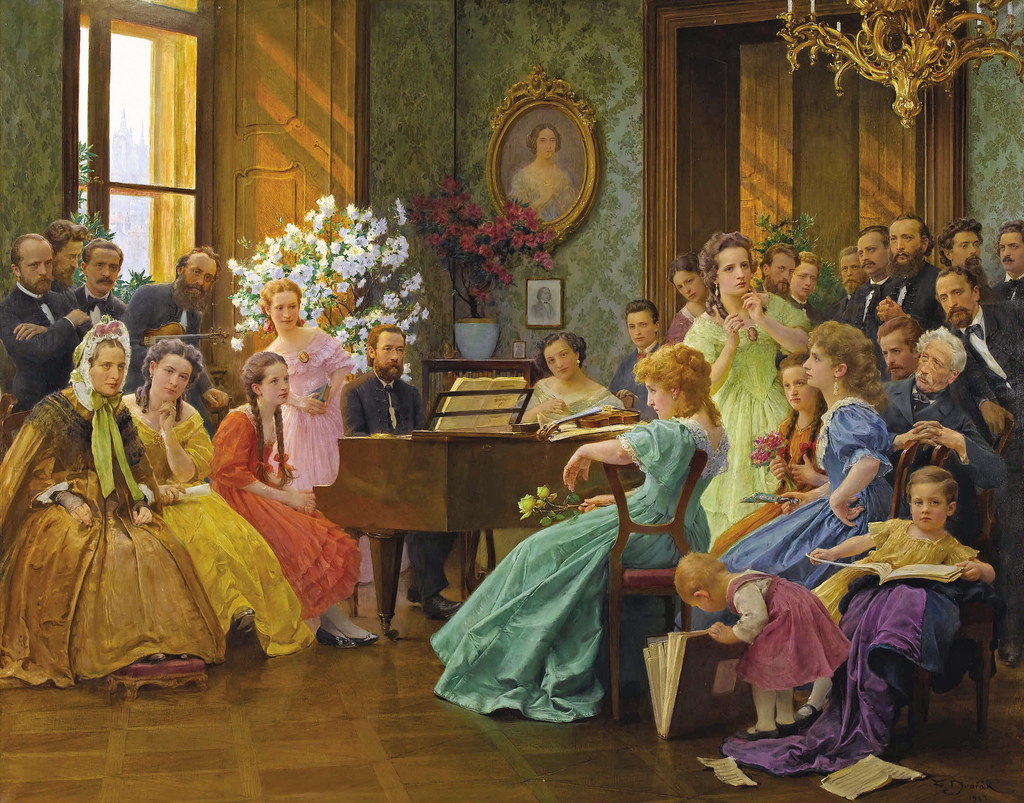
Smetana’s Sweetness Light for 200th Anniversary
Sadly, even by “great composers” standards, Bedřich Smetana didn’t get to enjoy much in the way of sweetness or light. On the contrary, he suffered much tragedy and turbulence in his life – untimely deaths of family and friends, political instability, an unhappy second marriage, chronic illness, deafness, madness, and his own early demise at the age of 60.
But he is celebrated as the founder of a Czech national school in music, the composer of abundant characteristic dances and other folk-inflected pieces. So for the 200th anniversary of his birth, on March 2, 1824, we’ll honor these aspects of his legacy with an hour of his “lighter” works.
Of course, not all of Smetana’s music can characterized as sweet OR light. He was an admirer and acolyte of Franz Liszt, and there is often a substantial Wagnerian influence, in some of his operas, especially. Some of the Czech dances we’ll enjoy wed Bohemian folk tradition with knuckle-busting keyboard Romanticism. And of the operas, we have but one very brief selection, the famous polka from “The Bartered Bride” – however taken from a complete recording of the work, so we’ll get to experience it from a fresh perspective, with the rarely-heard chorus.
Interestingly, the surname Smetana is also the word for a kind of cream, frequently of the sour variety, or perhaps a crème fraîche. I assure you, the emphasis this week will be on “Sweet Cream,” for the 200th anniversary of the composer’s birth.
It will be tragedy tomorrow, comedy today, on “Sweetness and Light,” this Saturday morning at 11:00 EST/8:00 PST, exclusively on KWAX, the radio station of the University of Oregon!
Enjoy it, wherever you are, here:
IMAGE: Bedřich Smetana, babe-magnet
-

Dvořák’s Pigeons Dark Tales and Hidden Depths
One of Antonín Dvořák’s great joys – when he wasn’t busy trainspotting, that is – was keeping pigeons.
At his summer home in Vysoká, he was pretty relaxed about providing free room and board to whatever winged companion would follow him home. And while he was away, he kept up a correspondence with a local miner to whom he entrusted care of the property. This included the house, the garden, and of course the pigeons. Dvořák’s letters were full of meticulous instructions as to how best to keep his little friends healthy and contented.
Word got out about Dvořák’s enthusiasm. At a concert in England, his wife was asked by a member of the royal family what types of things Dvořák really enjoyed. This resulted in the surprise delivery, back at home, of six braces of English pigeons!
In 1896, Dvořák wrote a series of symphonic poems inspired by the grim fairy tales of Karel Jaromir Erben. These include “The Water Goblin,” “The Noon Witch,” and “The Golden Spinning Wheel.” His opera, “Rusalka,” written a few years later, also bears Erben’s influence.
I imagine his fondness for Columbidae would have made it difficult to pass up “The Wood Dove” (also translated as “The Wild Dove”). The story, from Erben’s collection of poetic ballads, “Kytice,” tells of a woman who poisons her husband and marries another man. Day after day, a dove perches on the husband’s grave and sings a mournful song, until the wife, overcome with guilt, commits suicide by hurling herself into a river.
The premiere of Dvořák’s symphonic poem was given in Brno, on March 20, 1898, under the baton of Leoš Janáček.
Hard to believe that the composer of the Serenade for Strings and the sunny Symphony No. 8 could write these lurid potboilers after Czech fairy tales, and that he could find so much depth and melancholy in simple children’s stories.
Happy birthday, Antonín Dvořák!
Light Dvořák: Symphony No. 8
Dark Dvořák: “The Wood Dove”
-

Libor Pešek Beloved Conductor Dies at 89
Genial, esteemed, self-effacing and beloved – the conductor Libor Pešek has died.
Pešek was a regular presence on the podiums of his native land for some 70 years and did much to promote Czech music abroad.
In particular, he was instrumental in raising the awareness of the works of Josef Suk outside the Czech Republic, especially the wounded, even morbid scores of the composer’s maturity.
Suk, the pupil and son-in-law of Antonín Dvořák, lost both his mentor and his young wife, Otylie (Dvořák’s daughter), at the age of 30. Already, when Suk was a young man, Dvořák detected a melancholy strain in his music and set him the challenge of writing something sunny. The result was Suk’s Serenade for Strings, which became one of the composer’s most frequently performed works.
Suk could do Czech nationalism with the best of them, but as he entered his prime, his works became as gloomily introspective as anything by Gustav Mahler, without the ecstatic peaks. Pešek’s recording of the “Asrael Symphony” (which takes its name from the Angel of Death) did much to increase the work’s international reputation. It was a piece he performed not only in Liverpool, where he was music director, but also took with him (much to the chagrin of tour agents) to Spain and the United States.
Pešek, who studied with conductors Václav Smetáček and Karel Ančerl, began his professional career in the opera houses of Plzeň and Prague. He founded the Prague Chamber Harmony in 1958.
As his stature grew, he assumed posts with the Slovak Philharmonic (1981-82), the Czech Philharmonic (1982-90), the Royal Liverpool Philharmonic (1987-98), and the Czech National Symphony Orchestra (2007-19).
Pešek stepped down in Liverpool over budgetary difficulties, but continued to work with the orchestra in the capacity of laureate conductor for the next quarter century. Liverpool came to be regarded as “the best Czech orchestra this side of Prague.”
Among his many honors, he was made Knight Commander of the British Empire by Queen Elizabeth II. He retired from the podium at the age of 85. Most of his recordings were issued on the Supraphon and Virgin Classics labels.
Happily, he also appears to have been an amiable person, both professionally and personally, refreshingly lacking in ego and able to enjoy relaxed times with musicians, family, friends, and animals.
At the time of his death, Pešek was 89 years-old. R.I.P.
Pešek’s recording of Suk’s “Asrael Symphony” (with appropriately Halloweeny cover):
And a score from Suk’s happier days, “Pohádka,” or “Fairy Tale.” He arranged it from music he composed for a play called “Radúz and Mahulena,” in which true love conquers all. The work took on special significance for the composer, since he happened to be secretly in love with his teacher’s daughter and feared the day of reckoning, when all would be revealed. He needn’t have worried. Dvořák was delighted. Sadly, Suk’s happiness was to be short-lived.
Pešek also championed the music of Vítězslav Novák, another Dvořák pupil (and Suk’s classmate at the Prague Conservatory). See what you think of the “Slovak Suite.”
Also, Novák’s tone poem “Toman and the Wood Nymph,” in which a youth is seduced by an alluring dryad on St. John’s Eve:
Pešek certainly knew his way around the symphonies of Dvořák, if not always quite scaling the heights of the composer’s grandeur. I find he was often more satisfying in the “filler” material, as it were, and works like Dvořák’s lesser-known “American Suite.”
You don’t often encounter Dvořák’s earlier symphonies (i.e. those before No. 7), either in the concert hall or on the radio. I’ve always been partial to Pešek’s recording of No. 3. Here, the movements are posted separately (probably with ads in between). If you like it, you can let the feed run directly into No. 4.
-

Czech Center NY Celebrates Martinů
Among its multifarious attractions, Czech Center New York always seems to have something interesting musical going on.
I remember traveling in to have a look at the original manuscript of Dvořák’s “New World” Symphony, brought back to the U.S. for the first time since the composer returned home with it to Bohemia in 1895. The Czech Center reception followed a performance of the piece by the Czech Philharmonic at Carnegie Hall, the venue at which the symphony received its world premiere, by the New York Philharmonic, in 1893. At the time, Dvořák was serving as director of the National Conservatory of Music of America, then located at 47-49 West 25th Street.
It certainly was a memorable evening, as afterward I got to meet Jiri Bělohlávek, the orchestra’s chief conductor, and Véronique Firkušný, daughter of the late pianist Rudolf Firkušný. Furthermore, I actually shook hands with the composer’s grandson, who spoke no English but was his spitting image.
This year, the Czech Center has shifted its focus to composer Bohuslav Martinů and the 80th anniversary of his arrival in New York. Martinů – still the sleeping giant of Czech music, when compared to Dvořák, Smetana, or even Janáček – arrived here from France, which he fled just ahead of the Nazi occupation. Rudolf Firkušný was one of the musicians who came to Martinů’s aid in the U.S. No doubt in gratitude, Martinů dedicated this Third and Fourth Piano Concertos to him.
The commemoration is being marked by concerts, commentary, masterclasses, and online exhibitions. Here’s what’s been posted so far.
The Year of Bohuslav Martinů in New York:
https://new-york.czechcentres.cz/en/program/rok-bohuslava-martinu-v-new-yorku-opening
Things to come:
https://new-york.czechcentres.cz/en/blog/2021/02/80-let-od-cesty-martinu-z-evropy-do-ameriky
Véronique Firkusny and conductor Jakub Hrůša:
Works of Bohuslav Martinů / The Czech Way:
https://new-york.czechcentres.cz/en/program/dila-bohuslava-martinu-v-podani-ceskych-interpretu
Works of Bohuslav Martinů / The American Way:
https://new-york.czechcentres.cz/en/program/dila-bohuslava-martinu-v-podani-americkych-interpretu
I’ve been a Martinů nut since I first heard his “Rhapsody-Concerto” for Viola and Orchestra played by Joseph de Pasquale and the Philadelphia Orchestra back in the 1980s. It’s a puzzle to me why he is not more frequently performed here in the U.S. For anyone who loves Dvořák, there is much to enjoy in Martinů’s music. He’s Dvořák for a mechanized age. I think Dvořák himself, being so fond of trains, would have admired it.
If nothing else, check out this stylish video – complete with double-breasted suits, booze, and cigarettes – an invigorating performance of Martinů’s “Bergerettes,” courtesy of Czech Center New York.
FUN FACT: Martinů taught at Princeton University, commuting from New York, from 1948 to 1951.
More about Czech Center New York here:
https://new-york.czechcentres.cz/en/about-us
Dvořák’s “New World” Symphony returns to New York:
https://www.bohemianbenevolent.org/news/making-history-new-world-symphony-manuscript-in-bnh
Martinů’s “Rhapsody-Concerto”
And a work for theremin!
Tag Cloud
Aaron Copland (94) Beethoven (95) Composer (114) Film Music (150) Film Score (143) Film Scores (255) Halloween (102) John Williams (198) KWAX (233) Leonard Bernstein (105) Marlboro Music Festival (125) Movie Music (165) Mozart (91) Opera (215) Philadelphia Orchestra (90) Picture Perfect (174) Princeton Symphony Orchestra (110) Radio (90) Ross Amico (244) Roy's Tie-Dye Sci-Fi Corner (290) The Classical Network (101) The Lost Chord (269) Vaughan Williams (107) WPRB (397) WWFM (881)