Tag: Early Music

  • Oldest Melody Found Armenian Roots

    Oldest Melody Found Armenian Roots

    Early Music lovers take note. This is one of those items I’ve been sitting on, waiting for a slow news day. Well, that day is upon us – so here, without further ado, is the oldest known notated melody, attributed to ancient ancestors of the Armenians.

    This 3400 year-old toe-tapper was dedicated to the goddess of orchards. Now pardon me while I enjoy some peaches.

    World’s oldest surviving melody was composed by Armenian ancestors 3400 years ago

  • Early Music Festival NJ: Serpent & Song

    Early Music Festival NJ: Serpent & Song

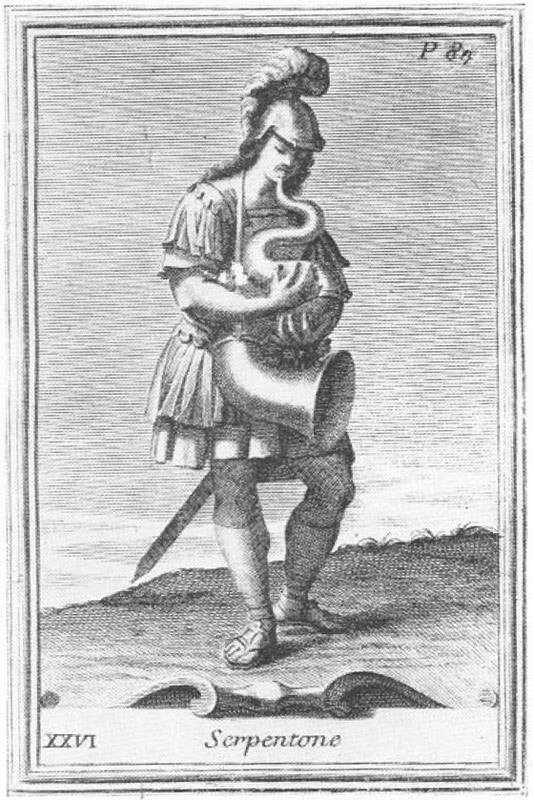
    If the early bird gets the worm, then Early Music gets the “serpent.”

    The Guild for Early Music will present its 14th annual Early Music Festival at Grounds For Sculpture in Hamilton, NJ, on Sunday, March 24. An afternoon of mini-concerts of Medieval, Renaissance, Baroque, and Early American music will be performed by over a dozen ensembles As always, the day will include sculpture tours, pop-up performances about the 42-acre grounds, and a “petting zoo” of early instruments – who knows, perhaps even a serpent (pictured).

    Join me today for the first of two Noontime Concerts on The Classical Network, which will feature representatives of the Guild as my special guests. We’ll hear a selection of madrigals and canzoni performed by Delaware River Consort and La Spirita, Buxtehude and Bach sung by Princeton Pro Musica Chamber Chorus, and Bach and Couperin played by Le Triomphe de l’amour.

    My co-hosts for today’s broadcast will be Judith Klotz and Janet Palumbo; on Friday, I’ll be joined by John Burkhalter and Abigail Chapman.

    The 14th annual Guild for Early Music Festival is free with paid admission to the park. To find out more about the event, look online at guildforearlymusic.org or groundsforsculpture.org; then listen in this Tuesday and Friday at 12 p.m. EDT.

    Following today’s concert broadcast, we’ll continue to honor Early Music Month, in our way, eyes locked in a distant mirror – albeit a bit of a funhouse mirror – as contemporary composers linger in the worlds of courtly dances, madrigals, and hymns.

    At the same time, we’ll be keeping it local, with music for string orchestra inspired by 12th century abbess Hildegard von Bingen, by Philadelphia-born Aaron Jay Kernis; a playful work for guitar, loosely tied to early dance forms, by Princeton University professor emeritus Paul Lansky; an organ processional in the French Baroque style by Philadelphia-based composer Robert Moran; and a Vespers setting by composer, writer, and radio personality Kile Smith – in a recording that brings together The Crossing and Piffaro, The Renaissance Band, no less.

    Everything will be faraway so close, from 12 to 4 p.m. EDT, on WWFM – The Classical Network and wwfm.org.
    Early Music America
    #EarlyMusicMonth

  • Early Music Month: American Renaissance Sounds

    Early Music Month: American Renaissance Sounds

    This Sunday night on “The Lost Chord,” we continue our celebration of Early Music Month with three works by contemporary American composers who look back to the Renaissance.

    William Kraft (b. 1923), long associated with the Los Angeles Philharmonic, composed “Vintage Renaissance” for the Boston Pops. The work incorporates two 15th century melodies: “Danza,” by Francesco de la Torre, and an anonymous “bransle.”

    George Frederick McKay (1899-1970), the so-called “Dean of Northwest Composers,” founded the composition department at the University of Washington, where he taught for over 40 years. His “Suite on Sixteenth Century Hymn Tunes” is based on works by Louis Bourgeois (c. 1510-1559), compiler of Calvinist hymn tunes and composer of the Protestant doxology known as the “Old 100th.”

    Lukas Foss (1922-2009), the German-born musical prodigy who settled in the United States in 1937, composed his “Renaissance Concerto” in 1986. The work, for flute and orchestra, falls into four movements: “Intrada;” “Baroque Interlude” (on a theme of Rameau); “Recitative” (after Monteverdi); and “Jouissance” (after a 1612 madrigal by a composer of the name David Melville).

    I hope you’ll join me, as American composers cast an affectionate look back, on “It’s Never Too Late to Be Early,” this Sunday night at 10:00 EDT, on WWFM – The Classical Network.

    Early Music America

  • NYC Early Music Concerts on WWFM

    NYC Early Music Concerts on WWFM

    The signal goes out for another Noontime Concert on The Classical Network, courtesy of Gotham Early Music Scene (GEMS).

    Today’s program will be drawn from two of GEMS’ Midtown Concerts. Duo Dialogues (made up of harpsichordist Alissa Duryee and Baroque cellist Jérôme Huille) will present a program of suites and sonatas by Giacomo Cattaneo, Johann Sebastian Bach, and Jean Barrière; then Gold and Glitter (Baroque flutist Sang Joon Park, Baroque violinist Daniel Lee, viola da gambist Martha McGaughey, and harpsichordist Arthur Hass) will convene for Francois Couperin’s “La Françoise” from the collection “Les Nations” of 1728.

    The concerts took place at St. Bartholomew’s Church, 50th Street and Park Avenue, in Midtown Manhattan, where free concerts are held every Thursday at 1:15 p.m. This Thursday, cellist Juliana Soltis and fortepianist Sylvia Berry will salute Hélène Liebmann, Marianna von Auenbrugger, and Maria Szymanowska on a program titled “In History’s Shadow: Forgotten Female Virtuosi.” To find a complete schedule of lunchtime performances, look online at midtownconcerts.org.

    GEMS also presents evening concerts. The ensemble Artek will offer music by the three B’s of German Baroque music – Bach, Bruhns, and Buxtehude – this Friday at 8 p.m. at Holy Trinity Church, Central Park West and West 65th Street, on the Upper West Side.

    Academy of Sacred Drama will present the U.S. premiere of Antonio Draghi’s “Oratorio di Guiditta,” inspired by the Biblical tale of Judith, Saturday at 7:30 p.m. at Corpus Christi Church, 529 West 121st Street.

    And Voices of Ascension will celebrate the paintings of Francisco Zurbarán, “Joseph and His Twelve Sons,” currently on display at the Frick Collection, with related works by Cristóbal de Morales, Alonso Lobo, Francisco Guerrero, Roque Ceruti, and George Frideric Handel, next Tuesday at 7:30 p.m. at Madison Avenue Presbyterian Church, 921 Madison Avenue (at 73rd Street).

    Gotham Early Music Scene is a non-profit corporation that supports and promotes artists and organizations in New York City devoted to early music – music of the Middle Ages, Renaissance, Baroque, and early Classical periods. For more information and GEMS’ events calendar, look online at gemsny.org.

    To the Batpole! It’s Baroque music from Gotham this afternoon at 12:00 EST. Then stick around until 4 – among my featured works, by request, will be a symphony by Edmund Rubbra and a concerto by Joachim Raff. Dark justice meets public service, on WWFM – The Classical Network and wwfm.org.
Tag Cloud

Aaron Copland (92) Beethoven (95) Composer (114) Film Music (123) Film Score (143) Film Scores (255) Halloween (94) John Williams (187) KWAX (229) Leonard Bernstein (101) Marlboro Music Festival (125) Movie Music (138) Opera (202) Philadelphia Orchestra (89) Picture Perfect (174) Princeton Symphony Orchestra (106) Radio (87) Ralph Vaughan Williams (85) Ross Amico (244) Roy's Tie-Dye Sci-Fi Corner (290) The Classical Network (101) The Lost Chord (268) Vaughan Williams (103) WPRB (396) WWFM (881)

DON’T MISS A BEAT

Receive a weekly digest every Sunday at noon by signing up here


RECENT POSTS