Grab a pitchfork and prepare for an alternatingly brisk, meditative and lusty morning. Just in time for the harvest, it’s a full playlist of Ralph Vaughan Williams on his birthday. We’ll stroll the fertile fields of Gloucestershire, Norfolk and Sussex, travel back in time to Tudor England, and share the composer’s turmoil – and hope – through two world wars.
Around 9:30, recorder player John Burkhalter, a stalwart of the area’s Early Music scene, will drop by the studio to talk a little but about the 12th Annual Guild for Early Music Festival, which will take place this Sunday at Grounds For Sculpture in Hamilton. Then we’ll hear Vaughan Williams’ piece for recorder ensemble, “Suite for Pipes,” a seldom heard work, in a recording that is now as rare as hen’s teeth.
Because of Yom Kippur, Marvin Rosen’s Classical Discoveries will be heard on Thursday morning this week, from 5:30 to 11:00. We’ll be pitching hay and pitching woo; some of the music may even as black as pitch (the Symphony No. 4, with the composer conducting). I’ll be on the pitcher’s mound from 6 to 11 EDT, on WPRB 103.3 FM and at wprb.com. We put a little “English” on it, on Classic Ross Amico.
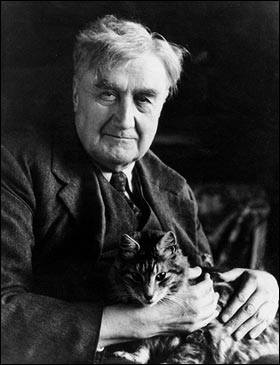
PHOTO: Vaughan Williams and Foxy engage in a shedding contest
March is Early Music Month. While the concept may seem quite remote from the world of film music, this week on “Picture Perfect,” we’ll endeavor to tie in with four scores that employ melodies and modes of the Middle Ages.
We’ll hear selections from “Becket” (1964), by Laurence Rosenthal. In the film, based on a play by Jean Anouilh, Richard Burton plays the Archbishop of Canterbury, and Peter O’Toole, King Henry II. The music is reliant on chant, with a quotation from the familiar Gregorian melody, “Dies Irae” (“Day of Wrath”), occurring fairly early in the action.
Then we’ll hear music from “The Hunchback of Notre Dame” (1939), by Alfred Newman. This time based on a novel – “Notre Dame de Paris,” by Victor Hugo – the film features Maureen O’Hara as Esmeralda and Charles Laughton as Quasimodo, with Cedric Hardwicke, Thomas Mitchell, Edmond O’Brien, and Harry Davenport in the supporting cast. The project was one of nine scored by Newman that year, which many historians regard as Hollywood’s finest. Again, the composer evokes the era through sacred choral passages and secular dances.
“The Warlord” (1965) starring Charlton Heston, Richard Boone and Rosemary Forsyth, is the tale a knight who falls in love with a peasant woman, and in order to keep her, claims his right of “droit du seigneur” – his prerogative to spend the first night with any new bride among his serfs. She falls in love with him, and all hell breaks loose.
It was an unusual project for the composer, Jerome Moross, who is best-known for the kind of breezy Americana sound employed in his best-known score, that for “The Big Country.” Here, he evokes the 11th century with an underscore that, again, takes its inspiration from authentic music of the era.
Finally, we’ll turn to “The Lion in Winter” (1965), adapted from a play by James Goldman, an historical drama set at the Christmas court of Henry II – again, as in “Becket,” played by Peter O’Toole. Henry spars with his estranged wife, the temporarily paroled Eleanor of Aquitaine (played by Katherine Hepburn), in a familial power struggle, which also involves their three sons, played by Anthony Hopkins, Timothy Dalton and Nigel Terry.
The film was the winner of three Academy Awards, including one for Best Original Score. The composer was John Barry. Yet again the music is steeped in that of the Middle Ages, yet given a distinctly modern edge.
I hope you’ll join me for these cinematic forays into Early Music, on “Picture Perfect,” this Friday evening at 6 EDT, with a repeat Saturday morning at 6; or that you’ll listen to it later as a webcast at wwfm.org.
#EarlyMusicMonth
Early Music America
While you’re waiting, here’s the cast of SCTV in “The Man Who Would Be King of the Popes” – which employs music from “The Lion in Winter!”
PHOTOS: Peter O’Toole as dueling Henrys, in “Becket” (left) and “The Lion in Winter”
This morning on WPRB, in honor of Early Music Month, we’ll be quaffing dances, quaffing chant, quaffing madrigals, and quaffing hymn tunes, as “contemporary” composers – composers who have worked over the course of the past century – look back for inspiration to music of the Middle Ages and the Renaissance.
Maurice Duruflé would fall soundly into that category. Duruflé, a former choirboy at the Cathedral of Rouen and one of the greatest organists of his time, drew on his love of chant in the composition of his Requiem. Lyn Ransom, founder and artistic director of VOICES Chorale, will drop by this morning in the 9:00 hour to talk a bit about the ensemble’s upcoming presentation of the work on Sunday, at Trenton’s Trinity Cathedral, in a reconstruction of a performance given under the direction of the composer while on a visit there with his wife in 1971.
Our playlist this morning will also include music inspired by Elizabethan dances, a guitar concerto based on Renaissance madrigals, a violin concerto on modes derived from Gregorian chant, and wind music based on some early lute pieces, among others. Around 9:45 or 9:50, we’ll enjoy a recording of Philadelphia composer, writer, and radio personality Kile Smith’s “Vespers,” ably performed by The Crossing and Piffaro, The Renaissance Band.
It’s a taste of Merrie Olde Princeton, from 6 to 11 ET, on WPRB 103.3 FM and at wprb.com. The bodkins are perpetually at odds, on Classic Ross Amico.
The pull of history is strong this morning. We’re celebrating Early Music Month, examining the influence of the Middle Ages and the Renaissance on “contemporary” composers – that is to say, composers who lived within the past 100 years. In fact, several of them (Sir Peter Maxwell Davies, William Kraft, and Kile Smith) are still very much with us.
Lyn Ransom, founder and artistic director of VOICES Chorale, will join me in the 9:00 hour to talk a little bit about the ensemble’s upcoming performance on Sunday, at Trenton’s Trinity Cathedral, of Maurice Duruflé’s Requiem, a work imbued with the composer’s lifelong love of chant, in a reconstruction of a performance given there under Duruflé’s direction in 1971.
Plenty more to come, including Respighi’s “Concerto Gregoriano,” Carl Orff’s “Kleines Konzert,” and Kile Smith’s “Vespers,” featuring Philadelphia-based Piffaro, The Renaissance Band.
It’s all tonsures and codpieces until 11:00 ET, on WPRB 103.3 FM and at wprb.com.
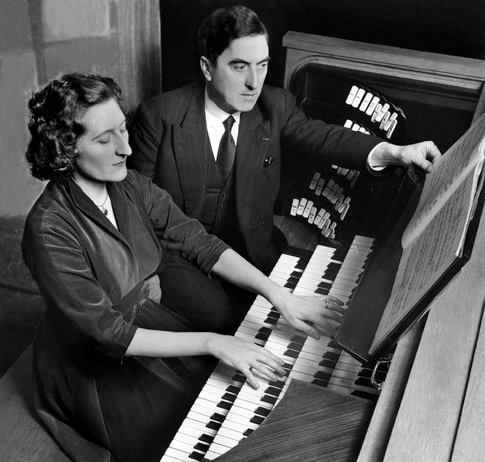
PHOTO: Husband and wife Maurice and Marie-Madeleine Duruflé
This week on WPRB, we’ll celebrate Early Music Month with a morning full of “contemporary” works – works composed over the course of the past century – that were influenced in some way or another by music of the Middle Ages and Renaissance.
We’ll hear works like Sir Peter Maxwell Davies’ “Renaissance Scottish Dances,” George Frederick McKay’s “Suite on Sixteenth Century Hymn Tunes,” Joaquin Rodrigo’s “Concierto Madrigal,” Vittorio Rieti’s “Variations on Two Cantigas de Santa Maria,” William Alwyn’s “Elizabethan Dances,” Igor Stravinsky’s “Momentum pro Gesualdo di Venosa ad CD annum,” Ottorino Respighi’s “Concerto Gregoriano,” William Kraft’s “Vintage Renaissance,” Carl Orff’s “Kleines Konzert,” Lukas Foss’ “Renaissance Concerto,” and Kile Smith’s “Vespers” (in a recording featuring Philadelphia-based Piffaro, The Renaissance Band) – or as many of those as we can get to.
Lyn Ransom, founder and artistic director of VOICES Chorale, will visit in the 9:00 hour to talk a little bit about the ensemble’s upcoming performance on Sunday, at Trenton’s Trinity Cathedral, of Maurice Duruflé’s Requiem, in a reconstruction of a performance given there under the direction of the composer in 1971. The Requiem’s otherworldly melodies are steeped in the language of medieval chant.
Even if you’re running late, it’s nice to know that the music will be running Early, from 6 to 11 ET on WPRB 103.3 FM and at wprb.com. We’re usually living in the past, on Classic Ross Amico.