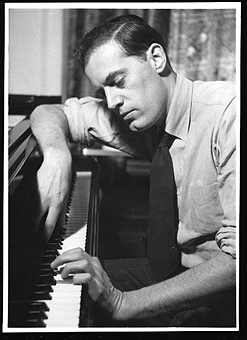
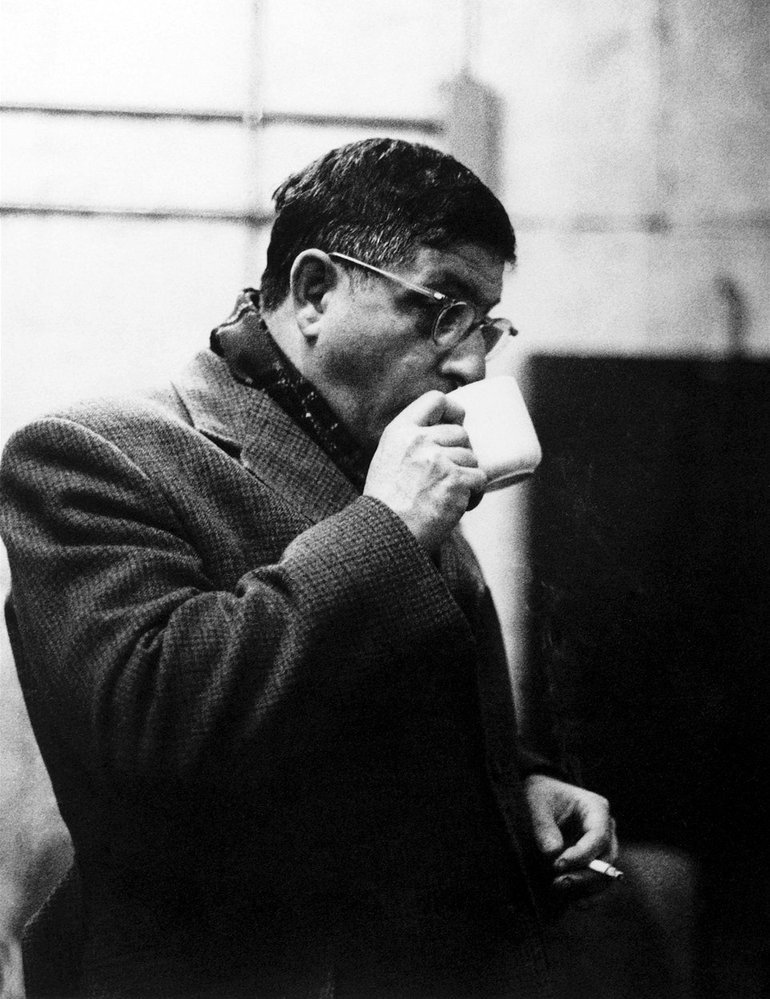
I first learned of Richard Arnell, born on this date in 1917, from a recording of his ballet “The Great Detective.” But he was also a renowned symphonist, who spent the war years here in the United States, cut off from his home in the U.K. while visiting the 1939 World’s Fair. Here, he cultivated important friendships with Bernard Herrmann, Virgil Thomson, and Sir Thomas Beecham (who, alongside Sir John Barbirolli and Leopold Stokowski, championed his concert works). He also wrote film music for Robert J. Flaherty and ballets for George Balanchine and Frederick Ashton.
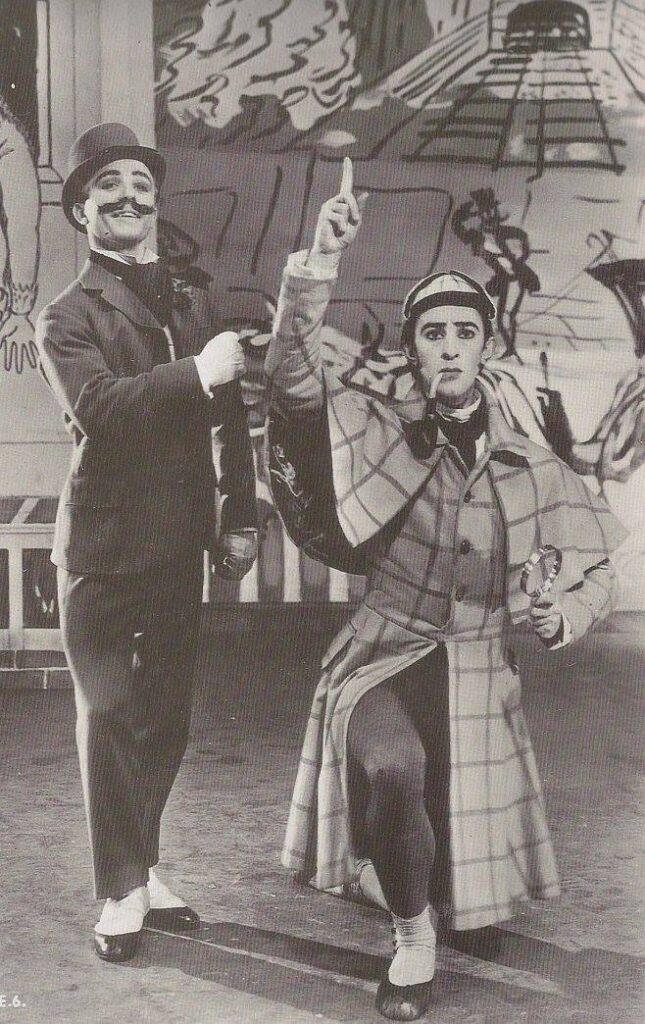
“The Great Detective,” commissioned by the Sadlers-Wells Ballet in 1953, is transparently influenced by the exploits of Sherlock Holmes, though not based on any particular book or episode in the Holmes canon. In fact, the inclusion of a gorilla places it more in line with Edgar Allan Poe’s “The Murders in the Rue Morgue” – although the tone of the ballet is certainly more tongue-in-cheek.
The complete ballet includes an “Overture;” “Police and the Doctor;” “The Distracted Ladies;” “Detective’s Mental Arithmetic;” “Pas de Deux: Distressed Ladies and Suspect;” “Pas de Trois: Distressed Ladies and Doctor;” “The Victims;” “The Fiend;” “Villains;” “Villains and Police;” “Dance of Deduction;” “Finale;” “The Fight;” and “Doctor’s Distress – Detective Safe.”
Arnell himself recorded a suite from the work in 1953. Martin Yates recorded it complete with the BBC Concert Orchestra in 2008.
Interestingly, “The Great Detective” would not be the only occasion on which a gorilla would be associated with Arnell’s music. Not so very long ago, I wrote about his Symphony No. 5, which the composer humorously compared to a rude simian he visited at the London Zoo. It has a great tune in the last movement, derived from the music hall, that Arnell’s father used to sing and whistle.
Arnell died in 2009 at the age of 91. We remember him with fondness on his birthday anniversary.
Before Bernard Herrmann emerged as a film composer of genius, he was music director at CBS Radio. There, he not only wrote incidental music for Orson Welles’ Mercury Theater (he would follow Welles to Hollywood in 1941 to write his first film score, for “Citizen Kane”), he also programmed and conducted broadcast concerts that were heavy on new, unusual, and neglected repertoire.
Herrmann was a staunch Anglophile for his entire life. There’s no way he would have ignored the Vaughan Williams sesquicentenary. Shame on you, American orchestras! In the 1960s, when he was fired by Hitchcock from “Torn Curtain,” and he had had enough of Hollywood in general, he made London his permanent home. But already in the 1940s, he was guest conducting the Hallé Orchestra, at the invitation of Sir John Barbirolli. He also guest conducted the London Symphony Orchestra, and made a number of recordings with the London Philharmonic and National Philharmonic Orchestras, including some stunning albums of his film scores.
English music featured regularly on Herrmann’s concerts. Here’s an attractive piece by Cyril Scott for the first full day of summer. You may recognize the English folk song on which it is based, “Early One Morning,” a cheerful enough melody somewhat at variance with its melancholy subject matter (a jilted lass lamenting the loss of her lover).
Despite having left a sizeable output of orchestral, chamber, and instrumental works, Scott is largely remembered, if at all, for his piano miniature “Lotus Land.” Another good summer piece, come to think of it. In my library, I have a copy of Scott’s book, “Music: Its Secret Influence Throughout the Ages,” inscribed by the composer to Eugene Ormandy.
Here, John Ogdon is the pianist, and Bernard Herrmann conducts the London Philharmonic Orchestra. Enjoy Cyril Scott’s “Early One Morning.” The big tune begins to coalesce around the four-minute mark.
I am sorry to say, the conductor David Lloyd-Jones has died. A founder of and driving force behind Opera North (originally English National Opera North) and its orchestra (once identified as the English Northern Philharmonia), he made many fine recordings for the Naxos, Marco Polo, Dutton, Chandos, and Hyperion labels. His cycle of Arnold Bax symphonies received particular acclaim and his series of English string music recordings revealed many delights.
His discography also includes works by William Alwyn, Lord Berners, Arthur Bliss, Frederick Delius, George Dyson, Edward Elgar, John Gardner, Gustav Holst, Constant Lambert, Alan Rawsthorne, Charles Villiers Stanford, Arthur Sullivan, Ralph Vaughan Williams, and William Walton. In the opera house, he also earned respect for his outstanding performances of the Russian repertoire.
Sadly, solid, high-profile interpreters of English music are thin on the ground these days. Happily, Lloyd-Jones lived to a ripe age. He was 87 years-old.
Lord knows, he was no fashion plate – but he sure could write music!
Ralph Vaughan Williams looked to England’s agrarian roots as a roundabout way of securing the future of its cultural identity.
As did so many composers who were caught in the wildfire of nationalism that swept across Europe from the mid-19th century forward, Vaughan Williams put the torch to the prevailing academicism that stretched its tendrils all the way from Germany to choke the musically “provincial” outlands. He emerged from an environment that had produced far too many knock-offs of Mendelssohn and Brahms. Vaughan Williams would revolutionize his compatriots’ perception of art music by embracing the sounds of the English countryside.
That said, much like Béla Bartók, he was no simplistic, twee purveyor of folk song. On the contrary, he recognized that the rhythms and inflections of his native land were already embedded his DNA. The songs he documented while roaming the fields and fens with his colleague, Gustav Holst, merely brought to the surface what was already innate. What he expressed in his original music was thoroughly internalized and deeply personal.
Some of Vaughan Williams’ best loved works are imbued with nostalgia for a faded world, but the composer pushed forward, as well, through two world wars and into the Great Beyond. He was not a conventionally religious man, but mysticism seems to color a fair amount of his music. Other pieces stare desolation unflinchingly in the face. Lessons with Maurice Ravel made him a thoughtful orchestrator, so that throughout his life he deployed his instrumental forces with considerable creativity and expertise. Given the proper attention, there is much to engage on all levels of his music.
He may not have been on intimate terms with a comb or perhaps even capable of tying his own tie, but beneath that tousled mop and behind those bushy eyebrows, his workshop was always kept in good working order.
Happy birthday, RVW. In all your rumpled glory, we salute you!
Incidental music to “The Wasps”
“Fantasia on a Theme by Thomas Tallis”
Mass in G minor
Symphony No. 4, conducted by the composer
Phantasy Quintet
Selections from the opera “The Poisoned Kiss,” virtually unknown, but full of good tunes
Adrian Boult conducts a selection from “Job: A Masque for Dancing”
Since I am such a musical anglophile, and since Halloween happens my favorite holiday, I suppose it’s hardly surprising that my thoughts would gravitate to the influence of the occult on English music.
Most notorious, perhaps, would be the case of Philip Heseltine, who composed under the name of Peter Warlock. Heseltine was born on this date in 1894. He lived a scandalous life – carousing, trolling his enemies, riding naked on a motorcycle, and using one of D.H. Lawrence’s manuscripts as toilet paper – while pursuing his fascination with “the science known as Black Magic.” His life ended when he was only 36 years-old, his body found in his flat – the cause of death: gas poisoning. He left behind 100 songs, a number of choral works, and a handful of orchestral pieces. Whether or not his end was accidental has never been unanimously accepted.
The first time Heseltine assumed the pen name Warlock was for a 1916 article on the chamber music of Eugene Goossens. Goossens, who would later be honored with a knighthood, spent the better part of a decade in Australia, conducting the Sydney Symphony Orchestra and directing the NSW State Conservatorium of Music.
It wasn’t all work and no play, however. During his leisure hours, Goossens entered into a passionate affair with Rosaleen Norton, soon to be known as the Witch of Kings Cross. Norton was an artist and occultist, whose paintings of demons and phalluses were decidedly out-of-step with the spirit of the time.
In 1955, a scandal involving a mentally ill woman who claimed she had participated in a Satanic Black Mass at Norton’s flat had a domino effect. Sure, Norton had her own coven, but she denied ever being a Satanist. She did however stand by her charms and hexes. Her paintings were removed from public exhibitions and photographs were confiscated from her home. Arrests on obscenity and blasphemy charges came fast and furious. The tabloids had a field day.
Unfortunately, Goossens became collateral damage. Incriminating letters, which he had asked Norton to destroy after reading, were found stashed beneath her sofa. Though he was in England when the storm broke, wholly ignorant of the antipodean moral panic, the authorities lay in wait upon his return. Among his luggage were found 800 “pornographic” photos, film, masks, and incense. As a high-profile musical figure, for all intents and purposes, the conductor’s Goossens was cooked.
Then there was the matter of the Hermetic Order of the Golden Dawn. The order, which sported Aleister Crowley among its members, was a secret society devoted to occult, metaphysical, and paranormal activities. A couple of weeks ago, I wrote about the composer John Ireland’s relationship with Welsh writer of the supernatural Arthur Machen, who also belonged to the society. Ireland wrote several works profoundly influenced by Machen’s philosophies and dedicated his piece for piano and orchestra, “Legend,” to him.
Even Sir Edward Elgar, composer of “Land of Hope and Glory,” had his brush with the occult, by way of supernatural writer Algernon Blackwood, also a member of the Hermetic Order. Elgar provided incidental music for “The Starlight Express,” based on Blackwood’s “A Prisoner in Fairyland.” The two men struck up a friendship, and though there is no evidence to link Elgar to actual involvement with the Golden Dawn, there are those who allege there to be Rosicrucian symbols in the “Enigma Variations,” completed years earlier, in 1899.
Sir Arthur Conan Doyle, Gustav Meyrink, Sax Rohmer, Bram Stoker, and William Butler Yeats were also members of the secret order. I imagine them all, like something out of Dennis Wheatley, gathering in their robes to offer up sacrifices to the Goat of Mendes!