He’s a reminder of what film music could be if only composers would be allowed to do their thing, instead of churning out yet another non-descript, inexpensive moan-and-groan that’s convenient to edit right up until the final print is struck. Somebody have the courage to let composers get back to composing, already. Maybe your movies will have more soul. For now, John Williams is the last of the lions.
Tag: Film Composers
-
Johnny Williams Before the Blockbusters
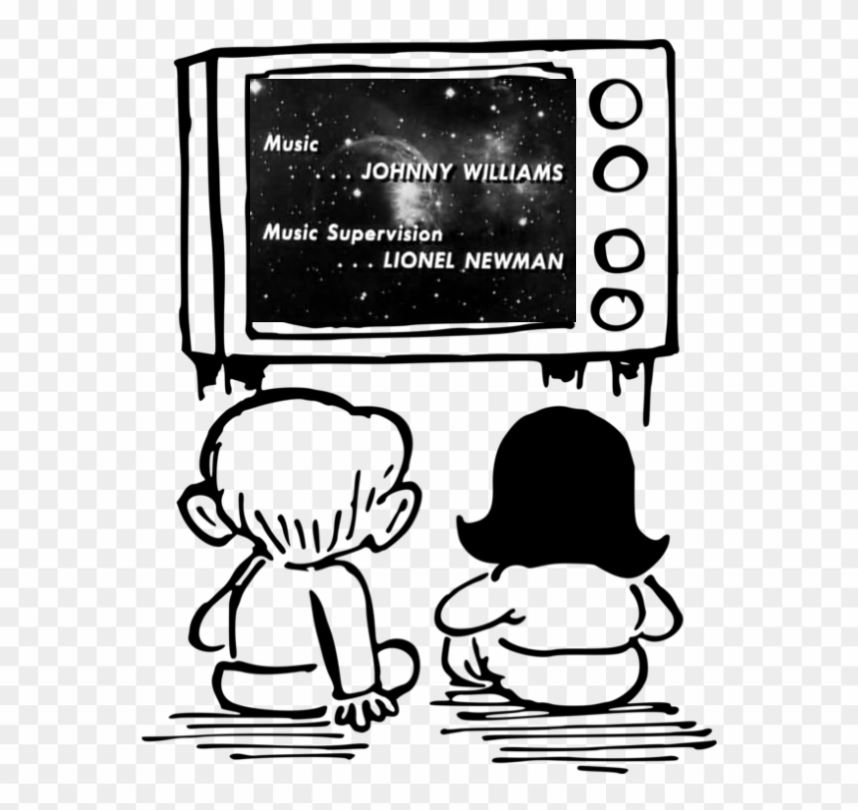
Before “Harry Potter.” Before “Jurassic Park.” Before “E.T.” Before “Raiders of the Lost Ark.” Before “Superman.” Before “Close Encounters of the Third Kind.” Before “Star Wars.” Before “Jaws.” Before even John Williams… there was Johnny Williams.
Well before Williams became America’s most famous living composer, he was busy honing his craft as an orchestrator, an arranger, a session pianist, and a composer in the bush league of television. This week on “Picture Perfect,” we’ll hear some of “Johnny” Williams’ music for “Lost in Space.”
Also on the program will be selections from “The Alfred Hitchcock Hour” by Bernard Herrmann, the theme from “Wagon Train” by Jerome Moross, and a medley of well-known television music by Jerry Goldsmith.
Don’t touch that dial! Movie composers think inside the box, on “Picture Perfect,” this Saturday evening at 6:00 EST, on WWFM – The Classical Network and wwfm.org.
-
Lionel Barrymore Hidden Talents
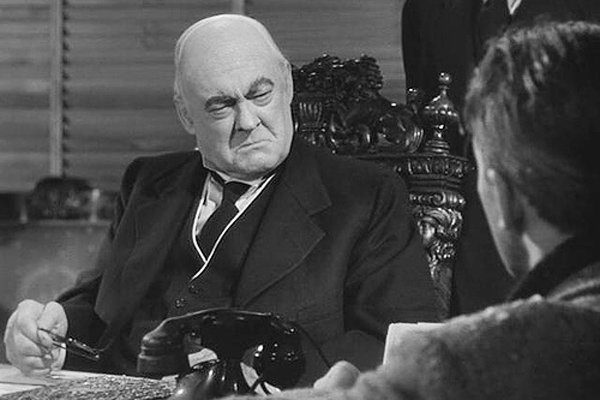
In “It’s a Wonderful Life,” Lionel Barrymore plays heartless Old Man Potter, a modern-day Scrooge, who views his fellow citizens of Bedford Falls as so much grist to be ground for his own profit. Barrymore the man, however, was full of generous human qualities, with a great enthusiasm and aptitude for the arts. I’d long known that he was also a composer, but it is only in doing a YouTube search this week that I discovered a broader cross-section of his output than the last time I checked, now perhaps six years ago.
Barrymore was born in Philadelphia in 1878. He was, of course, part of a venerable acting dynasty that also included his famous siblings, John and Ethel Barrymore. He’s also the great-uncle of Drew Barrymore.
He was especially fine in character roles, playing a variety of them on screen, in retrospect perhaps most memorable for his curmudgeons. He played the irascible Dr. Gillespie in the “Doctor Kildare” movies of the 1930s and ‘40s. He was Ebenezer Scrooge in annual radio broadcasts of “A Christmas Carol.” Of course, he is probably most familiar these days as the soul-crushing capitalist Mr. Potter. He was honored with an Academy Award for Best Actor for his performance in “A Free Soul” in 1931.
Despite his natural aptitude and widely acknowledged success in the field, it had never been his ambition to act. Instead, he was interested in being a visual artist. He even trained in Paris, and his prints and etchings were widely circulated.
As a composer, several of his piano works were published. His “Tableau Russe” was played, in both its piano and orchestral versions, in the film “Dr. Kildare’s Wedding Day.” His orchestral piece, “In Memoriam,” written to the memory of his brother John, was performed by the Philadelphia Orchestra. He also wrote an historical novel, “Mr. Cantonwine: A Moral Tale.”
Barrymore died in 1954. He had suffered from crippling arthritis for decades, which is why you’ll generally see him a wheelchair in most of his later films. He also broke his hip twice. He required morphine and cocaine to get through a shoot and to get to sleep at night. It was only through frequent injections of painkillers that he was able to get through “You Can’t Take It with You” on crutches.
Barrymore’s “Halloween Suite” can be heard here, beginning at the 36-minute mark. Barrymore is the narrator. Mario Lanza also appears on the concert. Miklós Rózsa conducts.
More ambitious is a Piano Concerto, the first movement of which is posted here
Barrymore’s “Fugue Fantasia”
“In Memoriam John Barrymore”
“Tableau Russe,” as heard in “Dr. Kildare”
Barrymore etchings
https://hotcore.info/babki/lionel-barrymore-etchings.htm
Some of his paintings recall classic illustration
https://www.artnet.com/artists/lionel-barrymore/
A sample of his still lifes
https://www.artsy.net/artwork/lionel-barrymore-still-life-in-a-brown-bucket
Artistic renderings of Barrymore, mostly by other hands
http://lionelbarrymore.blogspot.com/2016/12/look-ned-its-lionel-bizarre-barrymorish.html
Music for the ages? Who cares? I would be the first in line if Naxos were to put out such an album.
PHOTOS (counterclockwise from top) As Old Man Potter; as himself; behind the scenes of “Rasputin and the Empress” (1932), the only film he ever made with both his siblings; and at lunch with fellow composers Eugene Zador, Charles Wakefield Cadman, Nat Finston, Mario Castelnuovo-Tedesco, and Daniele Amfitheatrof.
-
Jerry Fielding Centennial Celebration
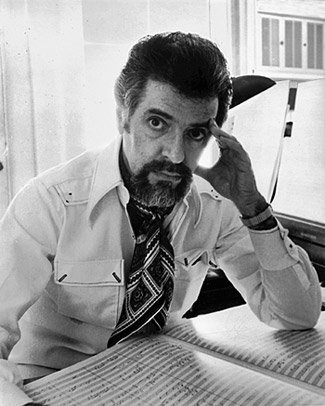
Today marks the 100th anniversary of the birth of Jerry Fielding.
Fielding was Sam Peckinpah’s composer of choice, though things didn’t always go smoothly between them. (Fielding claimed they resolved their differences with their fists.) Fielding is probably most celebrated for his score to Peckinpah’s landmark revisionist western “The Wild Bunch” (1969), for which he received his first Academy Award nomination. He was also nominated for his work on Peckinpah’s “Straw Dogs” (1971) and his first collaboration with Clint Eastwood, “The Outlaw Josey Wales.” (1976).
Another frequent collaborator was director Michael Winner, whose biggest hit was “Death Wish” (which Fielding did not score). For Winner, he wrote music for “Lawman” (1971), the first jazz-inflected western, the period drama “The Nightcomers” (1971), in which Marlon Brando shares a cigarette with an ill-fated frog, and “The Big Sleep” (1976), with Robert Mitchum.
Other notable films included “Scorpio” (1973), “The Bad News Bears” (1976), “The Demon Seed” (1977), “The Gauntlet (1977), and “Escape from Alcatraz” (1979).
Fielding was born Joshua Itzhak Feldman to Russian immigrant parents who settled in Pittsburgh. By 1930, “Joshua Itzhak” had already been discarded, but it was in 1947, when he went to work for Jack Paar, that he was asked to change his surname, which he was told was too Jewish. Fielding later stated he was frequently conscious of anti-Semitic prejudice while working in the entertainment industry, which is ironic since many of his employers and colleagues were Jewish.
In high school, he picked up the trombone, then switched to clarinet. He did well enough that he earned a scholarship to the Carnegie Institute of Instrumentalists. However, his attendance there was cut short by a mysterious illness that left him bedridden for two years. The radio was a constant companion, and he developed preferences for big band and Bernard Herrmann (who was then music director at CBS). Decades later, Fielding’s Oscar nomination for “Outlaw Josey Wales” placed him in direct competition with his early hero, as Herrmann was also nominated for his scores to Brian De Palma’s “Obsession” and Martin Scorsese’s “Taxi Driver.” Both composers lost to Jerry Goldsmith for “The Omen,” Goldsmith’s only Oscar.
Fielding began working as a freelance musician in Pittsburgh, where he played in a pit band with the likes of Henry Mancini, Errol Garner, and Billy May, and cut his teeth as an arranger. He left Pittsburgh to work for Alvino Rey’s swing band. When war broke out, he was deemed too frail for service. Instead, he became the chief arranger for Kay Kyser, whom he followed to radio.
He became the band leader for several shows. He worked with Groucho Marx as his music director on “You Bet Your Life,” both on radio and television. Though he himself was never a communist, he was called to testify before the House Un-American Activities Committee. He later joked that all the committee really wanted was to get him to name Groucho Marx as a communist, which he refused to do. Instead, he took the Fifth, and he was blacklisted. He suspected the real reasons for the Committee’s hostility had to do with his support for FDR, his joining the Radio Union (which all radio performers did), and his hiring of racially-integrated musicians for his bands. He survived the next decade, and even thrived, by playing regularly in Vegas, touring, and recording.
It was Betty Hutton, with the backing of Desilu Productions (i.e. Lucille Ball), who insisted on hiring him as music director for “The Betty Hutton Show.” Otto Preminger, who had escaped Nazism and possessed no love for the methods of the Committee, made it a point to hire blacklisted artists. Fielding gained entrance into motion pictures when Preminger asked him to score “Advise and Consent” (1962).
This also got him back onto television. Among his other TV credits were “McHale’s Navy” and “Kolchak: The Night Stalker.” He scored a couple of “Star Trek” episodes, including “The Trouble with Troubles.” He also wrote the theme music for “Hogan’s Heroes” and “The Bionic Woman.”
Fielding died of a heart attack in 1980 at the age of 57.
Hats off to Jerry Fielding on what would have been his 100th birthday.
“The Wild Bunch”
“The Nightcomers”
“Scorpio”
“The Outlaw Josey Wales”
“Hogan’s Heroes”
“The Bionic Woman”
Blacklisted Jerry throws a dance party
Rare interview with Jerry Fielding
-

Max Steiner & Dimitri Tiomkin Crossword Puzzle
A couple of years ago, I was generating Classic Ross Amico crosswords to post on Sundays. This one celebrates film composers Max Steiner and Dimitri Tiomkin, both of whom happened to be born on this date (Steiner in 1888 and Tiomkin in 1894).
The clues not only allude to specifics of their respective lives and careers, but they should also be of ample interest, I hope, to classic movie buffs. So even if you’re convinced you don’t know a lot about music, do check it out if, like me, you happen to watch a lot of movies from the ‘30s, ‘40s, and ‘50s.
To fill out the puzzle, follow the link and select “solve online” at the bottom of the page. You’ll then be able to type directly into the squares. Once you feel you’ve exhausted the puzzle, you’ll find the solutions by clicking on “Answer Key PDF.”
There’s enough distance now that even I was able to fill it out and enjoy the challenge. I probably should have indicated in the clues that some of the answers require full names or, in the case of titles, multiple words.
Open up a box of Sno-Caps, and try not to get buttered popcorn all over your keyboard. Happy birthday, Max Steiner and Dimitri Tiomkin!
Tag Cloud
Aaron Copland (93) Beethoven (95) Composer (114) Film Music (144) Film Score (143) Film Scores (255) Halloween (94) John Williams (195) KWAX (229) Leonard Bernstein (104) Marlboro Music Festival (125) Movie Music (159) Mozart (91) Opera (212) Philadelphia Orchestra (89) Picture Perfect (174) Princeton Symphony Orchestra (109) Radio (88) Ross Amico (244) Roy's Tie-Dye Sci-Fi Corner (290) The Classical Network (101) The Lost Chord (269) Vaughan Williams (105) WPRB (397) WWFM (881)