Until now, I thought John Boorman’s “Zardoz” was the most peculiar use of Beethoven’s 7th.
France: Hold my wine.

Until now, I thought John Boorman’s “Zardoz” was the most peculiar use of Beethoven’s 7th.
France: Hold my wine.

In paying such lavish tribute to Victor Herbert yesterday, on the 100th anniversary of his death, I failed to notice until later in the day that two notable American composers of our own time only recently passed.
One was Richard M. Sherman, of the famous Sherman Brothers, the super-successful songwriting team whose work graced such childhood classics as “Mary Poppins,” “Chitty Chitty Bang Bang,” “The Jungle Book,” “The Aristocats,” “Bedknobs and Broomsticks,” “The Slipper and the Rose,” “Snoopy Come Home,” and “Charlotte’s Web,” among many, many others. For Disney’s theme parks, they wrote “It’s a Small World (After All).”
I saw all of these films as a kid, and many of them in the theater. Another that I remember, which I caught on vacation in Wildwood, NJ, with my family, was an adaptation of “The Adventures of Tom Sawyer,” starring little Johnny Whitaker of “Sigmund and the Sea Monsters” fame. It featured songs by the Shermans and arrangements by John Williams, presumably hired on the basis of his Academy Award winning work on “Fiddler on the Roof.” Two years later, everyone would think twice about wading into the surf, thanks in large part to Williams’ music for “Jaws.”
Richard Sherman was preceded in death by his brother, Robert B. Sherman, in 2012. Together they received nine Academy Award nominations (with two wins, for “Mary Poppins,” including one for Best Original Song for “Chim Chim Cher-ee”), two Grammy Awards, and 23 gold and platinum certified albums.
Richard Sherman was 95 years-old.
The other notable American composer is Paul Schoenfield, who died in Jerusalem on April 29.
While his “Café Music” became something of a popular hit, I’ve also always been fond of his “Klezmer Rondos” for flute, baritone and orchestra. Equally, “Four Parables,” for piano and orchestra, is a wackily attractive piece, in a funhouse mirror sort of way.
In addition to his achievements as a composer, Schoenfield was also a talented pianist. Among his discography as a performer is a collection of the complete works for violin and piano of Béla Bartók, recorded with Sergiu Luca.
Although he composed much that is immediately accessible, Schoenfield clearly tended toward an introspective disposition. He was enthralled by mathematics and Talmudic studies. He moved to Israel following his retirement as professor of music at University of Michigan in 2021. (He was born in Detroit in 1947.)
I’m sorry he had to pass during such a turbulent time. Schoenfield was 77 years old. R.I.P.
“Café Music”
“Klezmer Rondos”
The first of Schoenfield’s “Four Parables”
Richard Sherman talks about being tasked with coming up with “It’s a Small World”
Sherman plays and sings in Walt Disney’s office
https://www.youtube.com/watch?v=6Bwl4MuYsQs
“Chim Chim Cher-ee”

Am I am such a tender ass, if my hair do but tickle me, I must scratch?
This week on “Picture Perfect,” we’ll celebrate William Shakespeare, just a few days shy of the anniversary of his birth, on April 23 (observed). Tune in for an hour of music from film adaptations of his comedies. We’ll enjoy selections from “As You Like It” (William Walton), “A Midsummer Night’s Dream” (Korngold), “The Taming of the Shrew” (Nino Rota), and “Much Ado About Nothing” (Patrick Doyle), even as we wryly acknowledge that the course of true love never did run smooth.
What fools these mortals be!
Verily, the wise ones know to stream it, wherever they are, at the link, this Friday evening at 8:00 EDT/5:00 PDT!
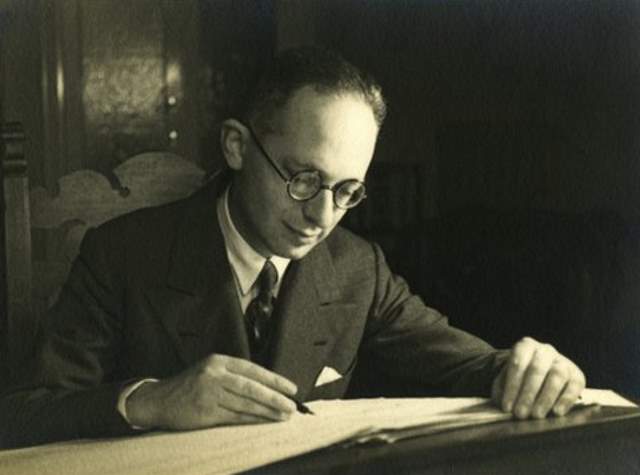
If ABC can blow-out its annual broadcast of “The Ten Commandments” 25 days before Passover, I can reflect on Mario Castelnuovo-Tedesco’s “The Prophets,” which was always a staple of my Passover playlist over the decades I enjoyed doing a live radio air shift. The second of Castelnuovo-Tedesco’s violin concertos was given its first performance at Carnegie Hall in 1933, with Jascha Heifetz the soloist and Arturo Toscanini on the podium. Its three movements are named for the Biblical figures Isaiah, Jeremiah, and Elijah.
But nevermind the Passover association. Castelnuovo-Tedesco is a composer for all seasons. His music is well-crafted, ingratiatingly tuneful, and a joy to listen to.
Furthermore, anyone who loves film music owes an incalculable debt to him. He wrote scores for some 200 movies (including “And Then There Were None,” with Barry Fitzgerald, and “The Loves of Carmen,” with Rita Hayworth), and as a teacher, his students included André Previn, Nelson Riddle, Herman Stein, Henry Mancini, Jerry Goldsmith, and John Williams.
Castelnuovo-Tedesco was yet another refugee displaced by fascism in Europe who enriched the American cultural landscape. We can thank Toscanini for sponsoring his passage to the United States in 1939. He got out just in the nick of time. Already Italian Jewish citizens had been stripped of many basic human rights. Well before the imposition of Italian racial laws in 1938, Castelnuovo-Tedesco’s music had been banned from radio and public performances of his works had been cancelled.
Internationally, his works were embraced by top-flight musicians such as Heifetz, Andrés Segovia, and Gregor Piatigorsky.
The first piece of his I ever heard was the Guitar Concerto No. 1. I remember listening to it on the radio on my first drive to WWFM, the day before my job interview, in 1995, undertaken on a Sunday afternoon to be sure I knew the route from Philadelphia. There’s a lot for me wrapped up in this composer.
Thank you, and happy birthday, Mario Castelnuovo-Tedesco!
Violin Concerto No. 2 “The Prophets”
Segovia masterclass on the Guitar Concerto No. 1
Radio interview with Segovia and the composer
Toscanini conducts an adventurous program, including Castelnuovo-Tedesco’s “Overture to a Fairy Tale” (later known as the “Midsummer Night’s Dream Overture”)
We’re entering Academy Awards weekend, and the winner is… YOU!
Why? Because I’ve recorded THREE BRAND NEW SHOWS for KWAX for your delectation.
Regardless of how you feel about the current state of the industry or the awards ceremony itself, you have to concede, there’s quite a rich history of impressive music written for film. And the Academy Awards is always the perfect excuse to go excavating.
I’ll be leaning heavily into the nostalgia, beginning today on PICTURE PERFECT. We’ll hear selections from what has been dubbed the greatest film music concert in history. Elmer Bernstein, Johnny Green, Bernard Herrmann, Henry Mancini, Alfred Newman, Alex North, David Raksin, Miklós Rózsa, Dimitri Tiomkin, Franz Waxman, and more turned out for the occasion – all of them to conduct their own music.
They were joined by Mahalia Jackson, Andy Williams, and Jack Benny. What could only be described as a Hollywood Bowl superconcert was broadcast live over the CBS television network on September 25, 1963.
Highlights were issued on what became a highly collectible LP. The content was expanded for a CD reissue on the Columbia Legacy label in 1995. However, based on my reading and the fact that I’m finding other selections in my personal library that were recorded at the venue on the same date, there’s still much that remains to be compiled. Put out whatever you’re holding back on a double-disc, please, Sony!
On today’s show, we’ll hear ten musical selections. I hasten to add, not everyone mentioned will be represented; nor were they even included on the commercial recordings. Tune in to KWAX at 8:00 pm EST/5:00 pm PST. (See the streaming information below).
Then be sure to join me tomorrow morning when I’ll present a potpourri of classic film themes on SWEETNESS AND LIGHT. Tune in sharp at 11:00 EST/8:00 PST to enjoy 90 seconds of introductory fanfares from the great studios of Hollywood’s Golden Age.
Finally, also tomorrow, on THE LOST CHORD, it’s another in an occasional series of programs devoted to concert works by composers better known for their work in film. Among the featured works will be “Pas de Deux,” a concerto for violin, cello and orchestra, by James Horner (“Star Trek II: The Wrath of Khan,” “Braveheart,” “Titanic”), and the Concerto for Flute and String Orchestra by Jerome Moross (“The Big Countrty,” “The Cardinal,” “The Valley of Gwangi”). That show will stream Saturday at 7:00 pm EST/4:00 pm PST.
That should give you plenty of time to load up on the popcorn and buffalo wings for Sunday night’s ceremony. Listen to all three of these NEWLY-RECORDED RADIO SHOWS, wherever you are, at the link!
PICTURE PERFECT, the movie music show – Friday on KWAX at 5:00 PM PACIFIC TIME (8:00 PM EST)
SWEETNESS AND LIGHT, the light music program – Saturday on KWAX at 8:00 AM PACIFIC TIME (11:00 AM EST)
THE LOST CHORD, unusual and neglected rep – Saturday on KWAX at 4:00 PM PACIFIC TIME (7:00 PM EST)
More about “the greatest film music concert in history”
http://www.filmmusicsociety.org/news_events/features/2013/092313.html
Aaron Copland (94) Beethoven (95) Composer (114) Film Music (149) Film Score (143) Film Scores (255) Halloween (97) John Williams (197) KWAX (232) Leonard Bernstein (105) Marlboro Music Festival (125) Movie Music (164) Mozart (91) Opera (215) Philadelphia Orchestra (90) Picture Perfect (174) Princeton Symphony Orchestra (110) Radio (90) Ross Amico (244) Roy's Tie-Dye Sci-Fi Corner (290) The Classical Network (101) The Lost Chord (269) Vaughan Williams (107) WPRB (397) WWFM (881)