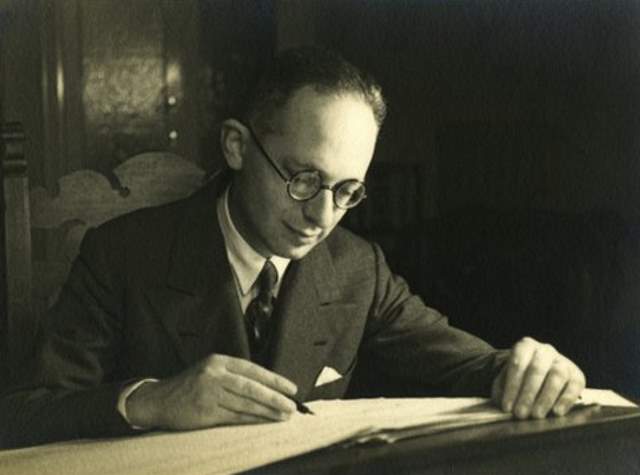
Any classical music station that would drop “Picture Perfect” must be dull as a blunt katana. Fortunately, those of us who care about the preservation and dissemination of classic film music can stay sharp with a playlist drawn from the films of Akira Kurosawa this week on KWAX.
“Seven Samurai” (1954) is a three-and-a-half-hour epic on a deceptively simple premise: a ragtag company of ronin is assembled to defend a farmers’ village against marauding brigands. Of course, that capsule synopsis doesn’t begin to hint at what a marvelous achievement it really is. “Seven Samurai” is regularly included on short lists of the greatest films of all time. It was remade in the United States as “The Magnificent Seven.” And though “The Magnificent Seven” enjoys great popularity, a terrific cast, and an unforgettable score, it stands only knee-high to the original, with music by Fumio Hayazaka.
“Seven Samurai” may have been Kurosawa’s first, full-out samurai film, but it was not his first crack at jidaigeki (literally “period drama”). Already, a samurai features as one of the characters in his earlier, international break-out hit, “Rashomon” (1950). In this instance, the discovery of a murdered samurai leads to a series of courtroom-style examinations, during which everyone present at the killing gives his or her own account of what transpired – including (through a medium) the murdered man himself! The conflicting testimonies reveal the slippery subjectivity of what we ordinarily accept as “truth.” The film, the first from Japan to receive wide exposure abroad, had such an impact that the term “Rashomon effect” entered the English language.
Kurosawa had great respect not only for American movies, but also Western classical music. This led him, on occasion, to request of his composers that they emulate certain well-known pieces. In the case of “Rashomon,” Hayazaka was encouraged, during one of the segments, to channel Ravel’s “Bolero.” “Rashomon” was remade as, among other things, “The Outrage,” a middling western starring Paul Newman.
Masura Sato sought out Hayazaka as a teacher on the merits of his music for “Rashomon.” Following his master’s early death from tuberculosis at the age of 41, Sato stepped in to fill the void and became Kurosawa’s new composer of choice. Sato would score eight of Kurosawa’s films (his first, a completion of Hayazaka’s score for “Record of a Living Being”). He too could be called upon to conjure the spirit of Western composers, with the ghost of Verdi hovering over “Throne of Blood,” Haydn and Brahms coloring “Red Beard,” and in the case of “Yojimbo” (1961), Franz Liszt lending attitude to masterless samurai Mifune, who wanders into a remote town and sets about playing two rival families off one another to his own profit.
“Yojimbo” provided the basis for the first of Sergio Leone’s spaghetti westerns, “A Fistful of Dollars.” What’s interesting about that is not only Leone’s scene-by-scene reliance on the original, but also Leone’s composer, Ennio Morricone, emulating Sato’s goofy juxtapositions and funky orchestrations. Kurosawa himself was inspired by the western tropes of John Ford movies and the pulp fiction of Dashiell Hammett.
As a bonus, we’ll hear just a little music from one of my least favorite Kurosawa films (beside “Rhapsody in August”), “Dodes’kaden” (1970). “Dodes’kaden” marked a break with Kurosawa’s classic style. For one thing, it was his first film shot in color – truly lurid Technicolor – and the first made after his break with Mifune. The title can be translated, roughly, as “clickety-clack,” the sound of an imaginary trolley car in the fantasy world of a mentally-challenged boy who literally lives in a dump. Though it earned an Academy Award nomination for Best Foreign Film, its commercial failure drove Kurosawa into a deep depression, even to the point of attempted suicide.
For as much as I personally dislike the film, the composer of its soundtrack, Toru Takemitsu is regarded as one of Japan’s most important classical concert composers. Interestingly, like Sato, Takemitsu was a protégé of Kurosawa’s friend and frequent colleague, Fumio Hayazaka.
If your local classical music station is low on local programming, we’ll keep you runnin’ on ronin, in syndication on KWAX, the radio station of the University of Oregon.
See below for streaming information.
Keep in mind, KWAX is on the West Coast, so there’s a three-hour difference for the Trenton-Princeton area. Here are the respective air-times of my recorded shows (with East Coast conversions in parentheses):
PICTURE PERFECT, the movie music show – Friday on KWAX at 5:00 PACIFIC TIME (8:00 PM EDT)
THE LOST CHORD, unusual and neglected rep – Saturday on KWAX at 4:00 PACIFIC TIME (7:00 PM EDT)
Stream them here!