Tag: Film Score

  • Patrick Doyle’s Shakespeare Soundtracks

    Patrick Doyle’s Shakespeare Soundtracks

    Our #Shakespeare400 celebration continues this week on “Picture Perfect,” as we focus on the music of Patrick Doyle composed for the films of Kenneth Branagh.

    Doyle joined Branagh’s Renaissance Theatre Company in 1987, for which he provided incidental music. In 1989, Branagh – and by extension, Doyle – made a leap to the big screen, where they achieved a remarkable feat, rethinking Shakespeare’s “Henry V.” Remember, this is the play that propelled Laurence Olivier to worldwide fame in 1944, both as a filmmaker and the Bard’s most celebrated interpreter, and William Walton’s score is regarded as one of the best of all time.

    Branagh’s version is quite different. Though equally rousing, it doesn’t shy away from Henry’s more complicated nature and the grittier aspects of what it means to go to war. It was a bold gamble, but one that paid off. Not only did this revisionist “Henry” receive nearly universal acclaim, the film was a box office success, and Branagh would be nominated for two Academy Awards, like his predecessor, in the categories of Best Actor and Best Director. Certainly the film’s score deserved to be recognized – but in the year of “The Little Mermaid,” it failed even to secure an Academy Award nomination.

    An interesting footnote: Doyle himself is the baritone who introduces “Non nobis Domine,” a prayer of thanksgiving, following the Battle of Agincourt.

    In 2006, Branagh directed an adaptation of “As You Like It.” As has become his custom, he took a celebrity approach to its casting, although perhaps not so widely uneven as some of the cameos in his big screen “Hamlet.” Kevin Kline appears as Jacques; Alfred Molina is the fool, Touchstone; and Branagh regulars, Brian Blessed and Richard Briers appear, as well.

    The most radical liberty taken with the play is that Branagh recasts the events to take place among English traders in 19th century Japan. The language remains firmly rooted in Shakespeare’s text, although there are striking cross-cultural elements, including ample kimonos, kabuki theatre, ninjas, and a sumo wrestler. Still, it’s a long way off from the astounding bomb that was Branagh’s American Songbook-interpolated “Love’s Labour’s Lost.”

    While Olivier’s “Hamlet” won four Academy Awards in 1948, including those for Best Picture and Best Actor, Branagh’s 1996 version is cinema’s first adaptation of the complete text. It is, perhaps, an uneven interpretation, with some puzzling casting choices – including walk-ons by Jack Lemmon, Robin Williams and Gerard Depardieu – but there are enough merits, certainly, to make the four-hour trek worthwhile.

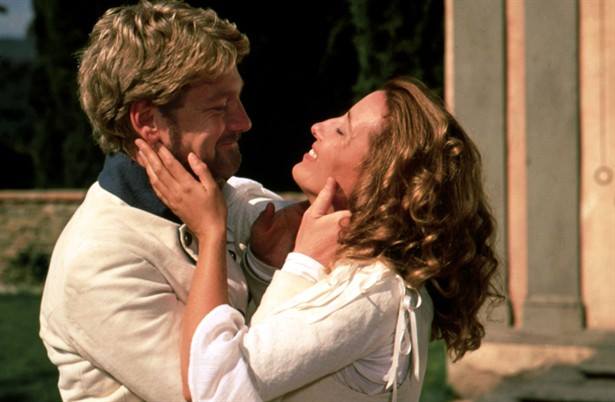
    Finally, Branagh teamed with his then-wife, Emma Thompson, for a titanic battle of wits as Benedick and Beatrice in his 1993 adaptation of “Much Ado About Nothing.” Again, the film features an eclectic supporting cast of classically trained actors and pop Hollywood phenomena. Briers, Blessed, and Imelda Staunton share screen time with Denzel Washington, Michael Keaton and Keanu Reeves. Yet, somehow, despite the different nationalities, ethnicities, and accents, the entire enterprise works. There is an exuberance to the over-the-top opening sequence which sets up a momentum that carries through the rest of the film.

    How could you not love a movie that opens like this?

    I hope you’ll join me for the Shakespeare scores of Patrick Doyle on “Picture Perfect,” this Friday evening at 6, with a repeat Saturday morning at 6; or that you’ll listen to it later as a webcast at wwfm.org.


    ‘Swounds! If it isn’t Emma Thompson’s birthday today!
  • Shakespeare’s Cinematic Legacy: Walton & Olivier

    Shakespeare’s Cinematic Legacy: Walton & Olivier

    April 23 marks the 400th anniversary of the death of William Shakespeare. We’ll honor the Bard on “Picture Perfect” over the coming weeks with music from film adaptations of his plays.

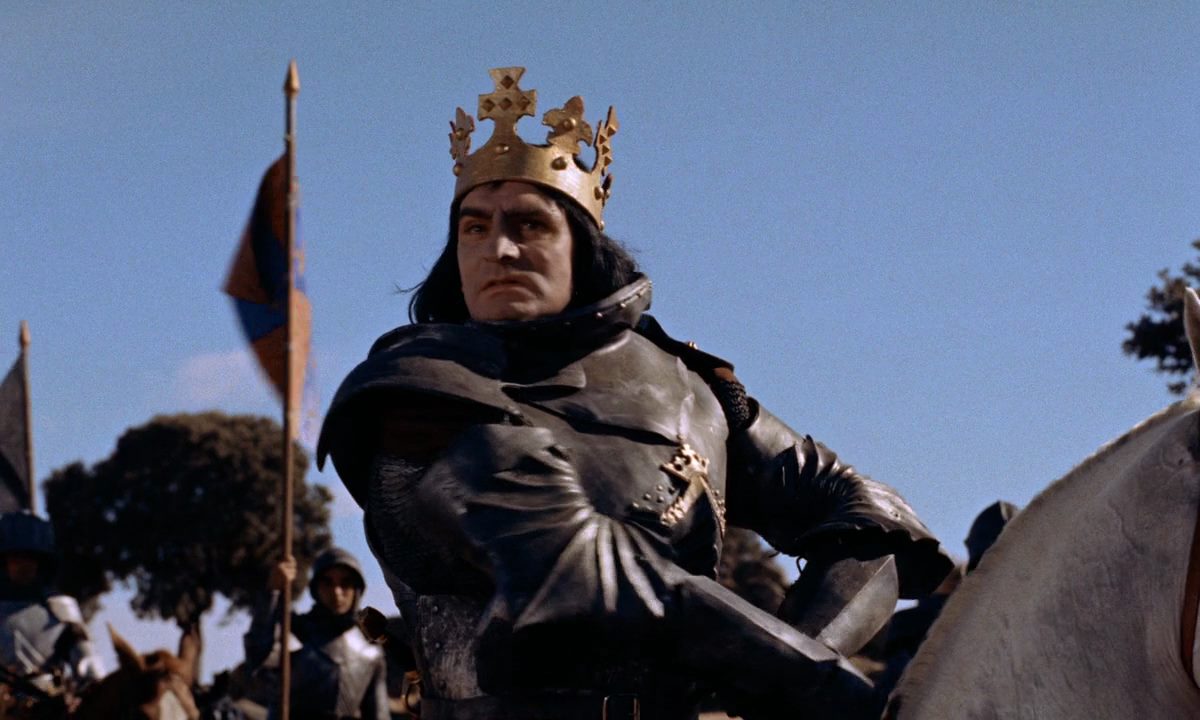
    William Walton may be the composer most associated with the cinematic Bard, thanks to his collaborations with Laurence Olivier. While Walton participated in three superb Olivier productions, beginning with “Henry V” in 1944, and continuing with “Hamlet” in 1948 and “Richard III” in 1955, the two had actually been brought together on an earlier Shakespeare project, in which Olivier appeared solely as an actor – a very charming version of “As You Like It.” The 1936 film was directed by Paul Czinner and starred his wife, Elisabeth Bergner, as Rosalind. Olivier appeared as the love-struck Orlando.

    Walton’s “Henry V” would become one of the most celebrated film scores of all time, certainly in terms of a so-called concert composer working in the cinema. The music is best known in a concert arrangement by Muir Mathieson, who conducted the orchestra on the film’s actual soundtrack. We’ll hear a recording that restores the composer’s original orchestration AND incorporates the chorus, as in the film.

    For Walton’s work on Olivier’s 1948 adaptation of “Hamlet,” the composer was nominated for an Academy Award for Best Original Score. The film won four Oscars in all, including that for Best Picture. Olivier directed himself in an Academy Award-winning performance. It was the first foreign film to be honored as Best Picture.

    Finally, we’ll turn to “Richard III,” from 1955, by which time both Olivier and Walton could be addressed as “Sir.” (Olivier was knighted in 1947; Walton received his knighthood in 1951.) Olivier gives a wry performance as the scheming Duke of Gloucester. While he very much enjoyed their ongoing partnership, Walton felt there was a limit to just how many ceremonial fanfares and battle charges he could compose. Across the head of the score he inscribed the instruction, in Italian, “Con prosciutto, agnello e confitura di fragole” – “With ham, lamb and strawberry jam.” Nevertheless, he manages to turn in yet another superb score.

    I hope you’ll join me for an hour of fanfares and battle charges, with an interlude of brooding over the skull of Yorick, this Friday evening at 6 EDT, with a repeat Saturday morning at 6; or that you’ll listen to it later as a webcast at wwfm.org.

    Here’s an appreciation of Walton’s Shakespearean achievements that ran in The Telegraph during the composer’s centenary in 2002, rightly noting his influence on John Williams:

    http://www.telegraph.co.uk/culture/music/classicalmusic/3574714/The-last-great-movie-composer.html

    #Shakespeare400

  • Morricone Walk of Fame & Oscar Buzz

    Morricone Walk of Fame & Oscar Buzz

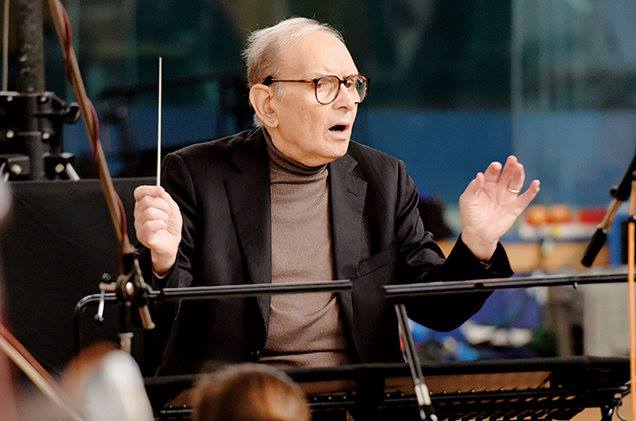
    The latest news in this, the Year of Morricone, is that the composer will receive a star on Hollywood’s Walk of Fame on February 26. Morricone, who at 87 years-old rarely travels outside of Europe, is expected to attend and remain through the February 28 Academy Award ceremony.

    Despite what this article suggests, Morricone has never won a competitive Oscar. He received an honorary award from the Academy in 2007. “The Hateful Eight” marks his sixth nomination. Having already collected this year’s Golden Globe and BAFTA awards, he is the Classic Ross Amico (and a lot of other prognosticators’) favorite to win.

    http://www.billboard.com/articles/news/6875516/ennio-morricone-hollywood-walk-of-fame-star

    Here’s an interview with Morricone, including footage from “The Hateful Eight” recording sessions. I almost hate to watch, because I won’t be able to get the music out of my head!

    http://deadline.com/2016/02/oscar-front-runner-ennio-morricone-talks-composing-tarantino-westerns-and-why-at-87-he-is-still-going-strong-1201701877/

  • Conan the Barbarian Organ: A Holy Film Score

    Conan the Barbarian Organ: A Holy Film Score

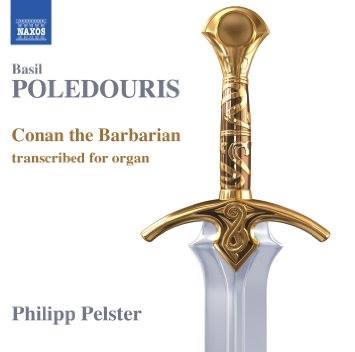
    If what’s been keeping you out of church is that there’s simply not enough music from “Conan the Barbarian” being played on the organ, Naxos Records has done your soul an enormous service.

    Organist Philipp Pelster has transcribed and recorded Basil Poledouris’ film score magnum opus for the King of Instruments. What’s that, you say, something GOOD actually came out of “Conan?” Well, yes, actually, as a matter of fact. Having seen the movie, I was skeptical, myself. But Poledouris’ film score is one of the best of the era. And that’s saying something.

    To bless the venture and keep it holy, here’s Arnold Schwarzenegger’s prayer to Crom:

    If you just can’t deal with the silliness, here’s the music without the visuals:

    Feel free to needle-drop. There’s great stuff all the way through it.

    Unfortunately, there are no clips of the organ transcription posted on YouTube. I guess I’ll just have to shell out the $12 and hope for the best. CROM! HEAR ME, CROMMM!!!!

  • Arthurian Movie Music Legends on Screen

    Arthurian Movie Music Legends on Screen

    “Whoso pulleth out this sword of this stone and anvil is rightwise king born of all England.”

    — Sir Thomas Malory, “Le Morte d’Arthur” (because simply pulling a sword from a stone isn’t enough)


    This week on “Picture Perfect,” we have music from movies inspired by the legends of King Arthur.

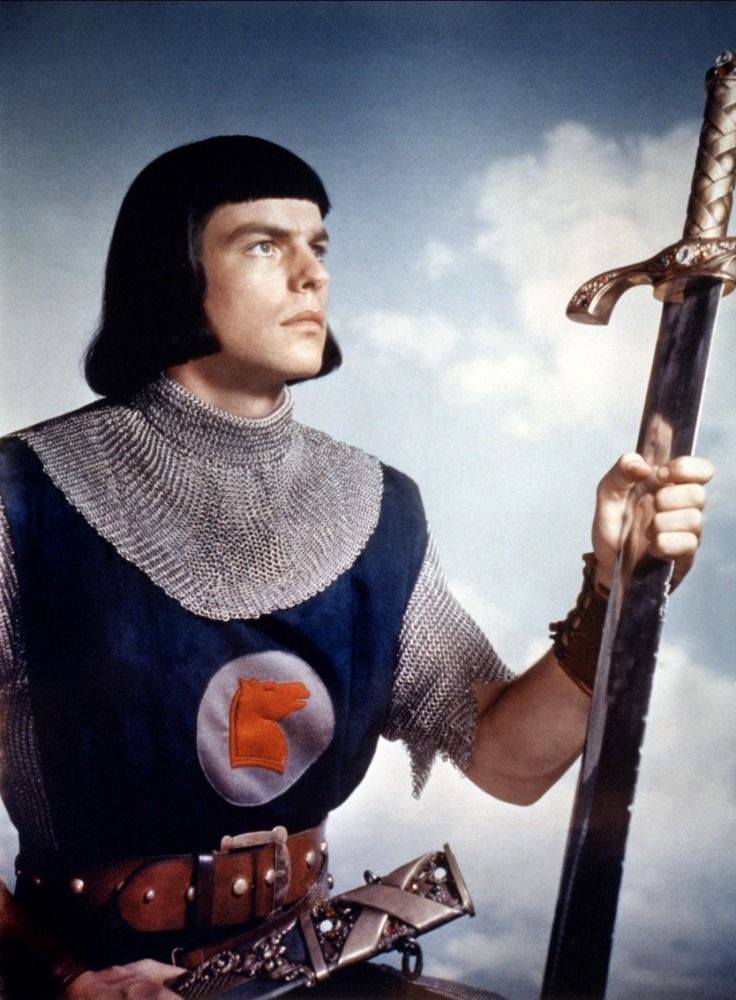
    The legends provide so much grist for “Prince Valiant” (1954), based on Hal Foster’s enduring comic strip, set in the days of Arthur, though Val himself is a Viking prince of the kingdom of Scandia. Janet Leigh plays Princess Aleta, James Mason the villainous Sir Brack, Victor McLaglen Val’s Viking pal Boltar, and Sterling Hayden a preposterous Gawain. For the title role, Robert Wagner dons the signature page-boy haircut. The score, by Franz Waxman, is every bit as vivid as the film’s Technicolor, and a clear prototype for the thrilling, leitmotif-driven music of John Williams.

    “The Mists of Avalon” (2001), adapted from Marion Zimmer Bradley’s novel, took the ingenious approach of retelling the Arthurian stories from the perspective of the often-marginalized female characters. The revisionist perspective breathed fresh life into the familiar tales, so that the book was greeted with critical and popular acclaim upon its release in 1983. A television miniseries, starring Julianna Margulies, Angelica Huston and Joan Allen, was produced for TNT, with music by Lee Holdridge.

    “First Knight” (1995) featured the unlikely cast of Sean Connery as Arthur, Richard Gere as Lancelot, and Julia Ormond as Guinevere. The film is unique, to my knowledge, in being based on the writings of medieval French poet Chretien de Troyes, as opposed to the more frequent source, Sir Thomas Malory.

    The score was by Jerry Goldsmith. It was actually a bit of a rush job for Goldsmith, who stepped up at the very last minute to replace Maurice Jarre. Jarre had been approached to write music for what was originally a three-hour cut of the film. However, he only had four weeks to do so. Goldsmith, very well-known for his ability to write at white heat, was able to complete the score, and record the music in the allotted time.

    For my money, the version most faithful to the spirit – if not always the letter – of “Le Morte d’Arthur” is “Excalibur” (1981). The film sports a peerless British and Irish cast, with an uncanny number of the supporting players going on to achieve world fame.

    Unfortunately the soundtrack is largely made up of pre-existing music by Wagner and Carl Orff (put to brilliant use, by the way) – with only a few atmospheric numbers composed by Trevor Jones. These, to my knowledge, have never been issued commercially. However, the same story was given the M-G-M treatment, as “Knights of the Round Table” (1953), with Robert Taylor as Lancelot, Ava Gardner as Guinevere, and Mel Ferrer as Arthur.

    While the film is nowhere in the same league as “Excalibur” – it’s far too glossy and pat – it does sport some satisfying 1950s spectacle, and a fine score by Miklós Rózsa.

    I hope you’ll join me, in the name of God, St. Michael and St. George, for music inspired by the legends of Arthur, on “Picture Perfect” – music for the movies – this Friday evening at 6, with a repeat tomorrow morning at 6; or enjoy it later as a webcast at wwfm.org.

Tag Cloud

Aaron Copland (92) Beethoven (95) Composer (114) Film Music (123) Film Score (143) Film Scores (255) Halloween (94) John Williams (187) KWAX (229) Leonard Bernstein (101) Marlboro Music Festival (125) Movie Music (138) Opera (202) Philadelphia Orchestra (89) Picture Perfect (174) Princeton Symphony Orchestra (106) Radio (87) Ralph Vaughan Williams (85) Ross Amico (244) Roy's Tie-Dye Sci-Fi Corner (290) The Classical Network (101) The Lost Chord (268) Vaughan Williams (103) WPRB (396) WWFM (881)

DON’T MISS A BEAT

Receive a weekly digest every Sunday at noon by signing up here


RECENT POSTS