Tag: George Gershwin

  • William Grant Still Still the One

    William Grant Still Still the One

    He’s Still the one.

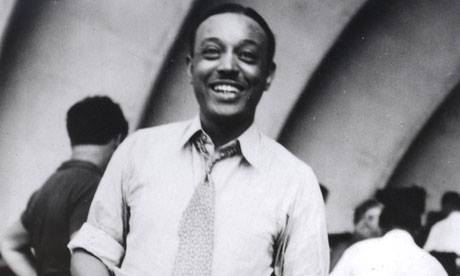
    Today is the birthday of William Grant Still (1895-1978), the so-called “Dean of Afro-American Composers.” Still emerged from unlikely circumstances (born in Woodville, Mississippi; raised in Little Rock, Arkansas) to become a major force in American music.

    Having abandoned a career in medicine for studies at the Oberlin Conservatory of Music and the New England Conservatory in Boston (where he studied with George Whitefield Chadwick), Still was a “first” in many ways.

    His was the first symphony written by a black composer to be performed by a major orchestra (the Eastman-Rochester). He was the first to be given the opportunity to conduct a major orchestra (the Los Angeles Philharmonic, at the Hollywood Bowl). His opera, “Troubled Island,” became the first to be produced by a major company (the New York City Opera). Another of his operas, “A Bayou Legend,” was the first to be performed on national television (as late as 1981).

    Any of these would be significant in and of themselves, but it just so happens that Still was a damn fine composer. Perhaps the least likely pupil of Edgard Varèse, he incorporated jazz and blues elements into his concert music, which also frequently reflected the African and African-American experiences.

    He cut his teeth writing arrangements for Paul Whiteman, W.C. Handy and Artie Shaw. According to Eubie Blake, one of Still’s improvisations in the pit band during Blake’s revue “Shuffle Along” became the basis for Gershwin’s hit tune “I Got Rhythm.” Still didn’t appear to be bitter about it, and in fact the two composers were on friendly terms and made it a point to attend performances of one another’s music.

    Still quotes the melody in the third movement of his Symphony No. 1, otherwise known as the “Afro-American Symphony.” In fact, it had always been his intention to do so, before Gershwin popularized it. (Blake went on to say the swipe was probably inadvertent, but Still had definitely gotten there first.)

    I’ve always been fond of the symphony, from the very first time I heard it. To me, it is every bit as much of a portrait of an artist as a young man as Virgil Thomson’s “Symphony on a Hymn Tune.” It’s a beautiful and wistful piece, built on lovely daydreams and uptempo, banjo-like riffs. This is the kind of music that Dvořák would have loved.

    Here it is, in a pioneering recording by Karl Krueger and the Royal Philharmonic Orchestra, after all these years, still my favorite:

    Mov’t I: https://www.youtube.com/watch?v=5s7o8UfKsV0
    Mov’t II: https://www.youtube.com/watch?v=xSQUrW8eBhU
    Mov’t III: https://www.youtube.com/watch?v=iEeaLvX82Lw
    Mov’t IV: https://www.youtube.com/watch?v=Fu_qzX5K39g

    And just to prove it was no accident, here’s the second movement of his Symphony No. 2, “Song of a New Race,” with Neeme Järvi and the Detroit Symphony:

    https://www.youtube.com/watch?v=uaHe5hvWu6w

    Now tell me Gershwin wouldn’t have killed to write that!

    Happy birthday, William Grant Still.
  • Vernon Duke April in Paris & Beyond

    Vernon Duke April in Paris & Beyond

    It’s April in Paris (and everywhere else for that matter).

    Vernon Duke was born Vladimir Dukelsky in what is now Belarus in 1903. In Kiev, he studied composition under Reinhold Gliere. He left the USSR in 1920, traveling to New York, where he was befriended by George Gershwin. In fact, it was Gershwin who suggested the name change. (Gershwin himself was born Jacob Gershowitz.)

    For a time, he ping-ponged back and forth to Europe, where he fulfilled a commission by Serge Diaghilev (for the ballet “Zephyr and Flora”). The work impressed Sergei Prokofiev, and the two became fast friends. Dukelsky’s Symphony No. 1 was given its premiere in Paris, under Serge Koussevitzky, on the same program as excerpts from Prokofiev’s “The Fiery Angel.”

    Around the same time, Duke began contributing material to musical comedies in London. This laid the groundwork for a return to New York in 1929. There, he continued to composed “serious” works, while insinuating himself into the Broadway scene. A number of his songs – “April in Paris,” “Autumn in New York,” “Taking a Chance on Love,” “I Can’t Get Started” – have since become standards.

    When Gershwin died in 1937, Duke stepped in to complete his unfinished score for “The Goldwyn Follies,” for which he contributed a couple of ballets (choreographed by George Balanchine) and the song, “Spring Again.” His greatest success came in 1940, with the Broadway show, “Cabin in the Sky.”

    A number of his concert works have been recorded in recent years. While bouncing around YouTube this morning, I came across this rare concert broadcast of his Symphony No. 3:

    Here’s a fine, digital recording by Metropolitan Opera cellist Samuel Magill of Dukelsky’s Cello Concerto:

    Mov’t I: https://www.youtube.com/watch?v=xwqtTdGa2Co
    Mov’t II: https://www.youtube.com/watch?v=78ggFix_8x4
    Mov’t III: https://www.youtube.com/watch?v=f0eXu5wSF_8

    Finally, Sarah Vaughan sings “April in Paris”:

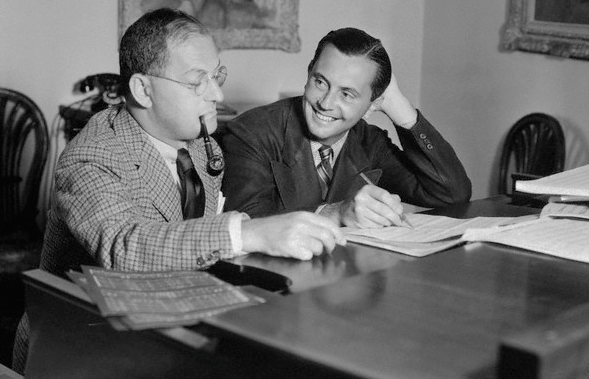
    PHOTO: Duke (right), with Ira Gershwin

  • Rhapsody in Blue on TCM Oscar Levant & Gershwin

    Rhapsody in Blue on TCM Oscar Levant & Gershwin

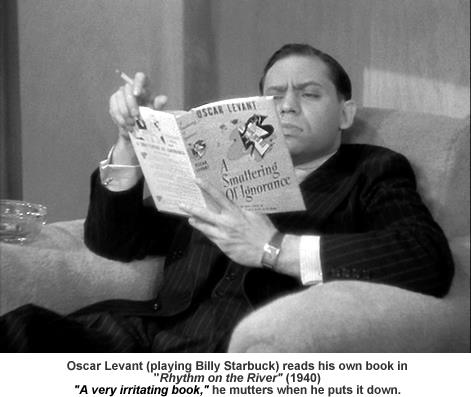
    Since there seemed to be a lot of interest when I posted about Oscar Levant the other week, on the occasion of his birthday anniversary, I thought I’d point out the fact that Turner Classic Movies: TCM is showing “Rhapsody in Blue” tonight at 10 ET. In this 1945 film, an alleged biography of George Gershwin, Levant plays a supporting role – as himself. The composer is played by Robert Alda, Alan Alda’s dad.

    http://www.tcm.com/this-month/article/24016%7C0/Rhapsody-in-Blue.html

    “Even the lies about Gershwin were being distorted.” – Oscar Levant

  • Vintage Gershwin Historic Recordings on The Lost Chord

    Vintage Gershwin Historic Recordings on The Lost Chord

    In keeping with The Classical Network’s Americana-themed, end-of-the-fiscal-year fundraiser, “The Lost Chord” this week will focus on historic recordings of the music of George Gershwin.

    Gershwin occupied a unique place in American music, rising from Tin Pan Alley scrapper to Broadway royalty. From there, he conquered the concert hall and even the opera house, with his blend of popular song, jazz, blues, spirituals and European classical forms.

    Like Franz Schubert a hundred years before, Gershwin managed to churn out an astonishing amount of music over a comparatively brief span. His songs, in particular, have been of enduring interest. His gift of lyricism and invention defied early critics as he bestrode the worlds of popular and classical music like an American colossus.

    Sadly, at the peak of his success, he died of a brain tumor at the age of 38.

    We’ll sample Gershwin’s artistry in recordings of the era, including several songs performed by Al Jolson, Fred Astaire and Ella Logan. (So many excellent recordings to choose from!)

    We’ll also have the world premiere recording of “An American in Paris” – performed by the Victor Symphony Orchestra (really members of the Philadelphia Orchestra), with the composer himself on the celesta – and the Concerto in F, performed as part of a memorial concert at the Hollywood Bowl, with the composer’s friend, Oscar Levant, as soloist.

    Three of these recordings date from 1937, the year of the composer’s death. All are from his era.

    That’s “Vintage Gershwin.” Enjoy it tonight on “The Lost Chord,” at 10 ET. As of July 4, the rebroadcast will move to 3 a.m. If that’s a bit late for you, feel free to listen to it as a webcast once it’s been archived at http://www.wwfm.org.

    I hope you will continue to support the station. Thank you!

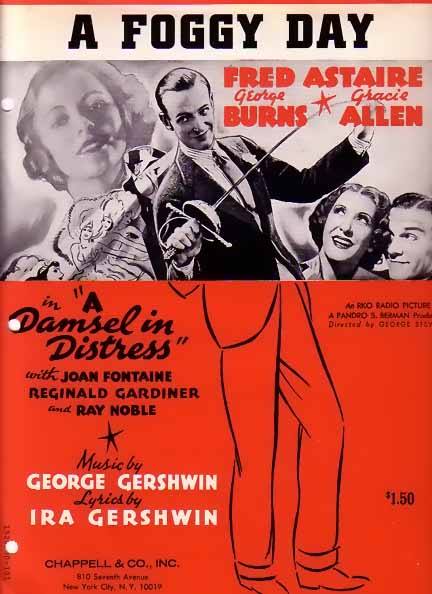
    Here’s Fred Astaire singing “A Foggy Day (In London Town),” from “A Damsel in Distress”:

  • Princeton Festival Presents Porgy and Bess

    Princeton Festival Presents Porgy and Bess

    It’s that time of year again. The Princeton Festival begins this weekend. The opera this time around is “Porgy and Bess,” with performances on June 22, 27 and 29. Read more about it in my overview in today’s Trenton Times. (More in-depth “Porgy” coverage in two weeks.)

    http://www.nj.com/times-entertainment/index.ssf/2014/06/princeton_festival_kicks_off_1.html

    PHOTO: George and Ira Gershwin flank “Porgy” novelist DuBose Heyward

Tag Cloud

Aaron Copland (94) Beethoven (95) Composer (114) Film Music (150) Film Score (143) Film Scores (255) Halloween (102) John Williams (198) KWAX (233) Leonard Bernstein (105) Marlboro Music Festival (125) Movie Music (165) Mozart (91) Opera (215) Philadelphia Orchestra (90) Picture Perfect (174) Princeton Symphony Orchestra (110) Radio (90) Ross Amico (244) Roy's Tie-Dye Sci-Fi Corner (290) The Classical Network (101) The Lost Chord (269) Vaughan Williams (107) WPRB (397) WWFM (881)

DON’T MISS A BEAT

Receive a weekly digest every Sunday at noon by signing up here


RECENT POSTS