Tag: Gustav Mahler

  • Bernstein’s Borrowed Mahler Score Returns Home

    Bernstein’s Borrowed Mahler Score Returns Home

    Neither a borrower nor a lender be.

    Leonard Bernstein never returned the Vienna Philharmonic’s score of Gustav Mahler’s “Das Lied von der Erde” (“Song of the Earth”) – the one used by Bruno Walter at the work’s premiere in 1911.

    Bernstein borrowed the score in 1966. After he died in 1990, apparently his family donated his collection of scores to the New York Philharmonic. Vienna’s “Das Lied” resurfaced in 2017, when it was put on display as part of an exhibition celebrating the orchestra’s 175th anniversary. It just so happened that the exhibition was co-curated by the Vienna Philharmonic, then also celebrating its 175th year. At a point, representatives from both orchestras noted the original ownership stamp and shared a good chuckle. Oh, that Lenny. Until then, the polite Viennese had never said anything about it.

    When the exhibition closed, the New York Philharmonic and the Bernstein family finally returned the score. Vienna took the high road. In a public statement, the Vienna Phil’s chairman issued a statement, “Not only are we thrilled to have back this historic score, which was originally used by Bruno Walter in the first Vienna Philharmonic performance of ‘Das Lied von der Erde,’ but we treasure its special connection to our friend and collaborator Leonard Bernstein, who maintained close relationships with the Vienna and New York Philharmonics and whose memory we cherish.”

    Good save.

    Lenny had marked it all up, of course. This is why I don’t lend books or recordings – especially to Leonard Bernstein.


    Bernstein conducts “Das Lied” in 1972 (with English subtitles)

    https://www.youtube.com/watch?v=Npy4gjZ81F0

    Bruno Walter conducts it live in Vienna in 1952

    Christa Ludwig disagrees with Bernstein’s tempo

    Return of the manuscript as reported in the New York Times in 2017

    https://www.nytimes.com/2017/03/28/arts/finally-returning-bernsteins-overdue-mahler.html

  • Mahler Resurrection Bernstein Finale Ecstasy

    Mahler Resurrection Bernstein Finale Ecstasy

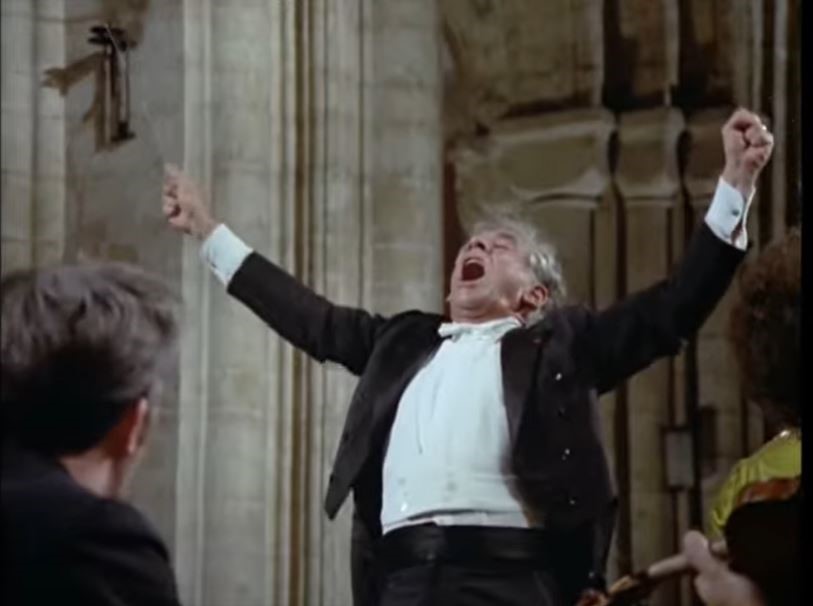
    The finale of Gustav Mahler’s spinetingling “Resurrection” Symphony, conducted by Leonard Bernstein. Of course, the piece is so much more powerful – ecstatic and exhausting – when you take the full, 90-minute pilgrimage, but even excerpted, as here, it still puts my hair on end. Eat your heart out, Bradley Cooper. And happy birthday, Gustav Mahler!

    The whole thing, probably riddled with YouTube ads:

  • Harold Arlen Plagiarism? Mahler Too?

    Harold Arlen Plagiarism? Mahler Too?

    Poor Harold Arlen. The coals haven’t yet cooled beneath accusations of plagiarism, in regard to his immortal, Academy Award winning classic “Over the Rainbow,” and now there’s an illustration in this video tying “Ding-Dong! The Witch Is Dead” to Mahler’s 7th! Purely tongue-in-cheek, I suspect. Both songs, of course, are exceedingly well-known, first of all, for their inclusion in “The Wizard of Oz” (1939), which was recognized with music awards for both original song (“Over the Rainbow,” with lyrics by E.Y. Harburg) and score (Herbert Stothart riding their coattails to victory in the year of “Gone with the Wind”).

    Last month, there was a Kansas-style dust-up over whether or not Arlen may have lifted his indelible melody from an obscure Norwegian pianist-composer he may have heard as a boy. I must say, the similarity to Signe Lund’s Concert Etude, Op. 38, is uncanny. (Listen to it at the link below.)

    But, as has been pointed out on many occasions, there are only 12 notes in the scale, and we all hear an awful lot of music in our lifetimes, so coincidences and inadvertent similarities do occur. Why, I myself once unwittingly composed “The Girl with the Flaxen Hair” in my Philadelphia apartment. Too bad Debussy got there first.

    Of course, popular songs get up to this sort of thing all the time. Rachmaninoff has been especially hard hit.

    While we’re on the subject of Mahler, Sammy Fain’s World War II classic “I’ll Be Seeing You” sounds an awful lot like the overarching melody in the last movement of Mahler’s 3rd – a similarity pointed out by musicologist Deryck Cooke in 1970. Coincidence or theft? It’s there for anyone with ears to draw their own conclusions.

    Looking forward to hearing Mahler 7 at the Philadelphia Orchestra this week, with my old chum Robert Moran.


    Philly’s principal timpanist, Don Liuzzi, with tongue in cheek: “Ding! Dong! The Wicked Witch?”

    The case against Arlen

    https://www.hollywoodreporter.com/movies/movie-features/the-wizard-of-oz-over-the-rainbow-plagiarized-1235843128/

    Signe Lund’s Concert Etude, Op. 38, rediscovered… somewhere over the rainbow?

    “I’ll Be Seeing You”

    Borrowed from Mahler’s Symphony No. 3?

  • Mahler Meets Sibelius A Composer Clash

    Mahler Meets Sibelius A Composer Clash

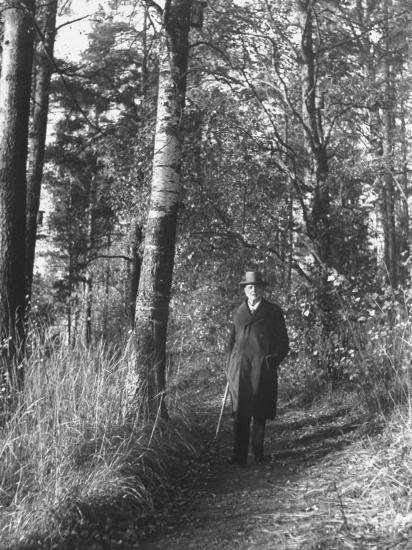
    In 1907, Gustav Mahler visited Helsinki, where he met Jean Sibelius. The two towering composers went for a walk in nature, when unsurprisingly the talk turned to shop.

    It was Mahler who lent an exclamation point, as they swapped observations on the symphony. Poor Sibelius was taken off-guard, as he was merely contemplating the nuts and bolts. “I admire its severity of form and profound logic,” he said. To which Mahler, seizing the advantage, replied, “A SYMPHONY MUST BE LIKE THE WORLD. IT MUST EMBRACE EVERYTHING!”

    If I know Sibelius, after that, his private thoughts were full of vodka and cigars.

    Happy birthday, Gustav Mahler, one intense S.O.B.

  • Mahler’s Huts: Solitude & Symphony

    Mahler’s Huts: Solitude & Symphony

    One of my most popular posts, written in 2014, was about composers’ huts – creative spaces that sit apart from a principal house so that an artist can work in solitude, free from distraction.

    Because of his busy schedule as a conductor, Gustav Mahler composed mostly in the summers. Here’s an amusing but also disheartening video, made in 2011, about Mahler’s composing hut in Altschluderbach, near Toblach, in South Tyrol, Italy. Here, during the summers of 1908 through 1910, he created the song-symphony “Das Lied von der Erde” (“Songs of the Earth”), the Symphony No. 9, and what he was able to complete of the Symphony No. 10. Allegedly, he kept three pianos in this hut, but I don’t see how that would be possible. Maybe they were uprights!

    A music festival is held in his honor every summer in Toblach, yet somehow this hut wound up in a wildpark (!), where it has been allowed to fall into ruin. So we have the chicken house… the pig house… and the house of Gustav Mahler. See if you can tell them apart. The videographer makes some pointed allusions to “world cultural heritage.”

    Mahler loved nature, but come on!

    Happily, there are two other composing huts, which have been treated with a little more respect. Mahler spent the summers of 1893 through 1896 in Steinbach, at Lake Attersee, in Upper Austria. Here he worked at his song settings “Des Knaben Wunderhorn” (“The Youth’s Magic Horn”), as well as on the Symphonies Nos. 2 and 3.

    Even so, restoration and preservation were not considered until 1985. In the meantime, it had been used variously as a washing house, a sanitary facility, and a slaughterhouse!

    https://en.wikipedia.org/wiki/Composing_hut_of_Gustav_Mahler_(Attersee)

    From 1900 through 1907, Mahler’s summers were spent in Maiernigg, near Maria Wörth, in Carinthia, Austria. Here too his hut is much better tended. Mahler composed his Symphonies Nos. 4 through 7 on the premises, as well as portions of the Symphony No. 8.

    Again, the composing hut was declared a cultural heritage only in 1981. It was renovated in 1985 and opened to the public in 1986.

    1901-1907 House Gustav Mahler Maiernigg – Villa Mahler No. 31 (Composing cottage)

    The world continues to do its damnedest to promote mediocrity, as too often reminders of our greatest achievements are allowed to collapse. But for now, anyway, provided orchestras have enough money in their budgets, Gustav Mahler’s symphonies endure.

    Happy birthday, Gustav Mahler.


    PHOTOS: Mahler regards his composer cottages in (top to bottom) Altschluderbach, near Toblach (1908-10), Maiernigg, near Maria Wörth (1900-07), and Steinbach, at Lake Attersee (1893-96)

Tag Cloud

Aaron Copland (92) Beethoven (95) Composer (114) Film Music (120) Film Score (143) Film Scores (255) Halloween (94) John Williams (185) KWAX (229) Leonard Bernstein (100) Marlboro Music Festival (125) Movie Music (135) Opera (198) Philadelphia Orchestra (88) Picture Perfect (174) Princeton Symphony Orchestra (106) Radio (87) Ralph Vaughan Williams (85) Ross Amico (244) Roy's Tie-Dye Sci-Fi Corner (290) The Classical Network (101) The Lost Chord (268) Vaughan Williams (103) WPRB (396) WWFM (881)

DON’T MISS A BEAT

Receive a weekly digest every Sunday at noon by signing up here


RECENT POSTS