Yom Kippur began last night at sunset. The holiest day of the Jewish calendar, Yom Kippur concludes a period of ten Days of Awe and Repentance that began on Rosh Hashanah, the Jewish New Year. It is a day of fasting, prayer, and reflection. Yom Kippur is one of four times in a year that Yizkur, a memorial prayer for the dead, is recited. Here’s a musical reflection by David Stock.
Yom Kippur is also the inspiration for the central movement of one of my favorite pieces by Ernest Bloch, the “Israel Symphony” of 1916. The first movement is titled “Prayer in the Desert” and the last “Succoth,” named for the Jewish harvest festival, which begins this year on the evening of October 6th.
May you be inscribed in the Book of Life.
IMAGE: “The Day of the Great Forgiveness of the Jews or Celebration of Yom Kippur in a Synagogue on Rue Saint Louis en l’Ile, Paris,” artist unknown
Shana tova! Wishing a sweet 5786 to all who celebrate.
As a classical music radio host, I’ve had many opportunities to broadcast selections from a fascinating 50-CD box set assembled from the Milken Archive of American Jewish Music for Naxos Records. (I believe these were also issued separately.) I do not own the box, but over the years, I’ve managed to collect most of the individual discs for my own library. Of course, the set was not intended to be comprehensive – how could it be? – but Milken (founded in 1990) continues its mission to document, preserve, and disseminate a vast body of music related to the American Jewish experience – including, among others, historical and traditional music associated with synagogue and seder, songs of a more secular nature for the Yiddish theater, and classical concert music.
One Milken revelation was a string quartet by Darius Milhaud, best known in classical music circles as one of the group of iconoclastic French composers that gained notoriety in Paris in the 1920s as “Les Six.” This loose collective followed in the footsteps of Erik Satie in subverting the pretensions of the concert hall. Les Six pushed back against miasmic Wagnerism of the fin de siècle era, employing the lighter textures and lucid forms of neoclassicism, and often emulating the breezy, contemporary ambience of café, boulevard, and circus. In Milhaud’s case, he also really leaned into the popular music of Brazil, which he encountered while serving as secretary to ambassador Paul Claudel. Another enthusiasm was the music of his native Provence (hence, the “Suite provençale”).
Less well-known is his connection to his Jewish heritage. Milhaud was born into a long-established family of the Comtat Venaissin (County of Venaissin, an enclave surrounding the city of Avignon), with roots traceable to the Middle Ages. The Comtat’s Carpentras synagogue, built in the 14th century, is the oldest in France. Interestingly, Milhaud’s lineage on his father’s side was neither Ashkenazi nor Sephardi, but rather uniquely Provençal – possessing its own historical and cultural traditions – as the settlement dates to the early Common Era. Milhaud’s mother was partly Sephardi on HER father’s side, by way of an Italian forebear.
Milhaud wrote several works on Jewish themes. His “Études sur des themes liturgiques du Comtat Venaissin” (“Studies on Comtat Venaissin Liturgical Themes”) incorporates melodies from the region’s Rosh Hashanah and Yom Kippur observances. It was composed on a commission from the Braemer Foundation of Philadelphia. In light of his unusual heritage, Milhaud was asked to distill his memories of family celebrations and services at the synagogue in Aix-en-Provence into a string quartet. The work received its premiere at Congregation Adath Jeshurun in Elkins Park, just outside Philadelphia, in 1973. Milhaud died in 1974 at the age of 81.
When Shostakovich’s birthday elides with Yom Kippur, you get a very somber post indeed.
Shostakovich always felt a special kinship with the Jewish people and, while he himself was not of the faith, he pushed back against antisemitism, either overtly, defending friends and colleagues, such as the composer Mieczyslaw Weinberg, from persecution, or more stealthily, by embracing Jewish influences in his own music.
This took real courage, as Shostakovich’s own standing with the Soviet authorities was a precarious one. He would be condemned several times over the course of his career for “formalism,” an amorphous term that could be molded to suit anything that might be described as Western, modernist, or otherwise subversive to the cause of Socialist Realism – uncomplicated art of direct and inspirational nature, easily digestible to the proletariat.
In 1943, having scored a great patriotic success with his Symphony No. 7, the “Leningrad Symphony,” performed in the city during the actual siege, Shostakovich set to work on the more profoundly introspective Piano Trio No. 2. This he dedicated to the memory of his close friend Ivan Sollertinsky. Like Shostakovich, Sollertinsky had been evacuated from Leningrad, but he died suddenly in Siberia, of a heart attack, at the age of 41.
Shostakovich mourned as only he could. The Piano Trio shares in common with the later String Quartet No. 8 an inexorable, klezmer-influenced “danse macabre.” Among Sollertinsky’s many talents and pursuits – as a musicologist, a critic, a linguist, a professor, and the artistic director of the Leningrad Philharmonic – he was an ardent enthusiast of the music of Gustav Mahler.
It was also a time, with the retreat of the Nazis from the Eastern Front, when the horrors of the camps at Majdanek and Treblinka were just becoming known. It’s been observed that the klezmer influence may also be an allusion to Sollertinsky’s birthplace of Vitebsk, where a Nazi massacre of Jews had taken place in 1941.
Shostakovich’s political capital must have been high, because the work was awarded a Stalin State Prize in 1946.
In 1948, things were considerably shakier, as Shostakovich had been denounced, under the Zhdanov decree, for the second time. Furthermore, it was a period of heightened antisemitism in the Soviet Union, as Stalin targeted Jewish intellectuals and artists. So it was at great personal risk to himself that Shostakovich conceived the song cycle “From Jewish Folk Poetry.” Unsurprisingly, the songs were not given their first public performance until 1955, two years after Stalin’s death. However, the first eight of them were performed at a private birthday celebration at the composer’s home in August of 1948.
While Shostakovich’s on-again, off-again history with the Soviet authorities made him justifiably cautious, the String Quartet No. 4 grew out of a newfound confidence, the result of Stalin having personally selected him as a cultural ambassador to the West. He would travel to the United States for the first time, as part of a Soviet delegation to a “Cultural and Scientific Congress for World Peace,” on March 25, 1949. As always, the situation had to be navigated very carefully. A sign of favoritism from Papa Joe often had the effect of setting a recipient up for a very big fall.
Still, Shostakovich was determined to leverage his new-found currency. He took the opportunity to persuade Stalin that if he were going to be sent out into the decadent West, then perhaps it would be a good idea to lift the ban on performances of his music at home. Otherwise, the situation might appear a little peculiar to outsiders. Stalin recognized the logic in this, and Shostakovich was rehabilitated.
Shostakovich was not by any measure a stupid man. Yet the artistic impulse was not to be denied. He wasted no time in embarking on a new string quartet, which he loaded up with inscrutable subtexts, Jewish folk songs, and all sorts of things that had a history of angering the “wise leader and teacher.” Fortunately for the composer, after the quartet was played before a small audience of increasingly uneasy friends on May 15, 1950, they convinced him not to allow it to be performed publicly, and he prudently put it away in a drawer for another day. That other day would come on December 3, 1953 – nine months after Stalin was safely interred.
Even with the death of Stalin, the skies did not entirely clear. As late as 1962, there was political blowback, when Shostakovich decided to set poetry by Yevgeny Yevtushenko in his Symphony No. 13, known as the “Babi Yar” – the site of another sustained massacre of Jews in 1941. Yevtushenko at the time had become the object of a campaign to discredit him for supposedly placing the suffering of the Jewish people above that of Russians. Khrushchev himself threatened to halt the symphony’s performance. In the event, the premiere was tense, but the audience was sympathetic and the occasion was a triumph. However, by the third performance, Yevtushenko had supplied revisions to the text for some of the more controversial passages.
Whether as an act of solidarity or a gesture of subversion, Shostakovich would often incorporate Jewish music or treat Jewish subjects in his major works. How could he not empathize with a people who had endured such suffering, yet expressed themselves so poignantly in music?
Happy Yom Kippur birthday, Dmitri Shostakovich.
Piano Trio No. 2, with Shostakovich at the piano
String Quartet No. 4
“From Jewish Folk Poetry,” with Shostakovich at the piano
Symphony No. 13 “Babi Yar,” with Yevtushenko’s original texts
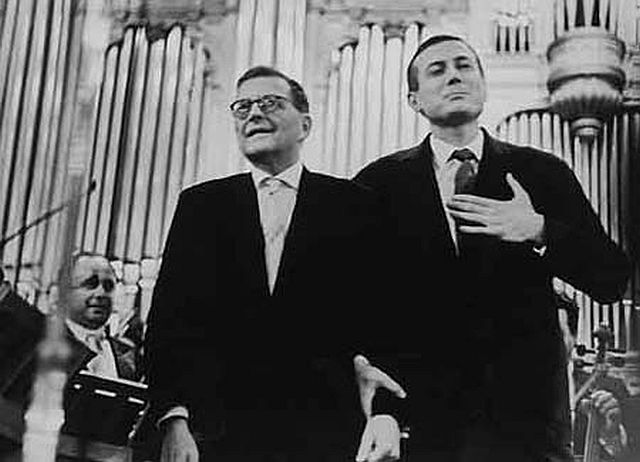
PHOTO: Shostakovich and Yevtushenko at the premiere of the Symphony No. 13 “Babi Yar”
The other day, for Rosh Hashanah, I posted a photo of Leonard Bernstein playing the shofar at a rehearsal for his “Mass” at the Kennedy Center in 1971. A lot of Bernstein’s concert music grapples with a crisis of faith in the modern world, so it’s hardly surprising that, in composing, he would often recall and incorporate into his mature works reminiscences of the synagogue and the traditions of his youth and apply them in addressing more universal humanistic concerns.
The shofar, typically fashioned from a ram’s horn, is especially significant during the Jewish High Holy Days, ten days of awe and repentance, as it is sounded on Rosh Hashanah to welcome the new year and again to conclude Yom Kippur services, marking the end of a day of fasting and prayer.
More broadly, anyone with a passing familiarity with the Judeo-Christian tradition, even if merely through the viewing of Hollywood biblical epics, likely has had some exposure to the instrument. Generally speaking, whenever you see “trumpet” or “horn” mentioned in an English translation of the Bible, what’s meant is the shofar. The instrument is often associated with the voice of God, the end of the world, or the raising of the dead. Its clarion blast accompanies celebratory or cataclysmic events. Its presence is noted to enhance a sensation of awe in the face of the sublime.
The opening of Bernstein’s “West Side Story” evokes the call of the shofar – which makes sense when you consider that the show was originally conceived as “East Side Story,” with the clashing factions Jews and Irish Catholics in Lower East Side Manhattan. To bring it more in line with contemporary urban gang warfare of the 1950s, the setting was moved uptown to San Juan Hill (Lincoln Square), and the rival gang membership reimagined as white American and Puerto Rican immigrant.
Less obvious is the reason Bernstein emulates the shofar in “Candide!”
Bernstein was far from the only one to recognize the shofar’s expressive potential. The ram’s horn has been embraced by many composers, whether employing the actual instrument or suggesting it, as Bernstein did, in their orchestrations.
Not surprisingly, some seized upon the shofar when treating biblical subjects. Sir Edward Elgar, a Roman Catholic, employs one in his oratorio “The Apostles” – though the part is usually taken by a flugelhorn.
Sir William Walton’s cantata “Belshazzar’s Feast” opens with a suggestion of the shofar on the trombones.
In his Requiem, Hector Berlioz, an atheist, conceived of four spatially separated brass bands to convey the effect of blaring shofars at the end of the world.
“The Gates of Justice,” David Brubeck’s plea for racial harmony, includes a part for shofar. However, in performance, the part is often taken by a French horn.
Of course, Elmer Bernstein employed the shofar in his film score for “The Ten Commandments.” John Williams paid homage when he gave Bernstein’s shofar calls to the Ewoks in “Return of the Jedi.”
Jerry Goldsmith included the instrument in his music for “Planet of the Apes” and “Alien.”
Another film composer, Franz Waxman, emulates the shofar in his oratorio “Joshua,” during the siege of Jericho.
Then there’s a whole genre of shofar concerto, explored by a number of contemporary composers, among them Ofer Ben-Amots, Miguel Kertsman, and Meira Warshauer.
Composers Herman Berlinski, Alvin Curran, and Matthew H. Fields have used the shofar, or suggested the shofar, in their works for their own expressive ends.
Yes, yes, shofar so good. The instrument’s range may be comparatively limited, but it more than makes up for the fact through its powerful associations.
The Jewish festival of Purim begins at sunset. Which means tomorrow morning I will hit the road in search of Central Jersey’s tastiest hamantaschen.
Hamantaschen, in case you don’t know, are triangular, filled-pocket pastries associated with Haman, the villain of the Purim story as related in the Book of Esther – “tash” meaning “pocket” or “pouch” in Yiddish. In Hebrew, they’re sometimes referred to as “Haman’s ears.” And what an appetizing image that is, especially when biting into the fruity center!
The cookie is often filled with apricot, raspberry, poppy seed, or my personal favorite, prune – which may sound a little geriatric, but trust me, with a good cup of coffee, it infuses one with a ridiculous sense of well-being.
The best hamantaschen I ever had were from Rindelaub’s Bakery, then located right across the street from one of my many Philadelphia apartments, on South 18th Street, just a few doors north of Rittenhouse Square. That was decades ago, when I was in my 20s. A prune-centered hamantasch and a large cup of coffee consumed in the square on a sunny afternoon was a recipe for pure bliss. Alas, once a Philadelphia institution, Rindelaub’s is no more.
Or is it? I see, doing a Google search, there’s an article about it that ran in the Philadelphia Inquirer in 2008, but it’s paywalled. If someone subscribes, please let me know to what far-flung suburb the bakery has retreated.
In the name of all that’s holy, avoid hamantaschen from the local grocery store. They’re generally pretty terrible – hard jelly in a tasteless cookie that will turn to powder as soon as you bite into it. But if you can find them at an actual bakery, give them a shot.
In the Trenton-Princeton area, I have had mixed success trying to recapture Rindelaub’s perfection of flavor and ratio of pastry to filling. Again, if someone knows of a great Jewish bakery in the area, let me know.
Ever hear of the whole megillah? Or Magilla Gorilla? In Hebrew, the Megillah is one of five books read on special Jewish feast days. On Purim, it’s Megillat Esther, the reading punctuated with boos and the grinding of groggers at each mention of Haman.
The best-known musical response to Purim is still probably George Frideric Handel’s “Esther,” from 1732. Handel’s first English oratorio recounts the events of the Biblical book, by way of an Old Testament drama by Jean Racine. The Hebrew Esther becomes Queen of Persia and thwarts the machinations of the king’s jealous vizier, which would have resulted in the extermination of her people.
In 1954, Jan Meyerowitz composed his “Symphony: Midrash Esther.” Meyerowitz’s family experienced an analogous threat in Germany in the 1930s, but their solution was the opposite of Esther’s. Rather than reveal their Jewishness, they chose to conceal it, converting to Christianity shortly before Meyerowitz’s birth. So carefully kept was the secret that the composer himself didn’t learn of his true heritage until the age of 18.
Meyerowitz studied in Berlin, then in Rome with Ottorino Respighi and Alfredo Casella. He emigrated to the United States in 1946, where he found employment at Tanglewood, then Brooklyn College and the City College of New York. The symphony was first performed in 1957, by the New York Philharmonic under the direction of Dimitri Mitropoulos.
You can listen to it here, on tracks 5 to 8
As a bonus, track 1 is “Queen Esther’s Prayer” from “Four Biblical Tableaux” by Aaron Avshalomov, from 1928, .
Cristiano Giuseppe Lidarti’s “Ester” is believed to be the first work in oratorio form to be set to a Hebrew libretto (by Rabbi Jacob Saraval). Composed in 1774, it was rediscovered only in 1997!
Finally, here’s Eugen d’Albert’s overture after Franz Grillparzer’s “Esther.” D’Albert was a mighty pianist, who studied with Franz Liszt. He composed no less than 21 operas. He was married six times. He met his match in Teresa Carreño, “The Valkyrie of the Piano,” herself married four times. What a Ragnarok their union must have been!
I only recently came across another piece of music inspired by Esther, somewhere in my CD collection, and it’s making me crazy, because now I can’t remember what it is! It was something from the late 19th or early 20th centuries. I’ll add it here should I remember it.
Remember tomorrow to pour a cup of coffee and taste deeply of Haman’s ear for Purim!
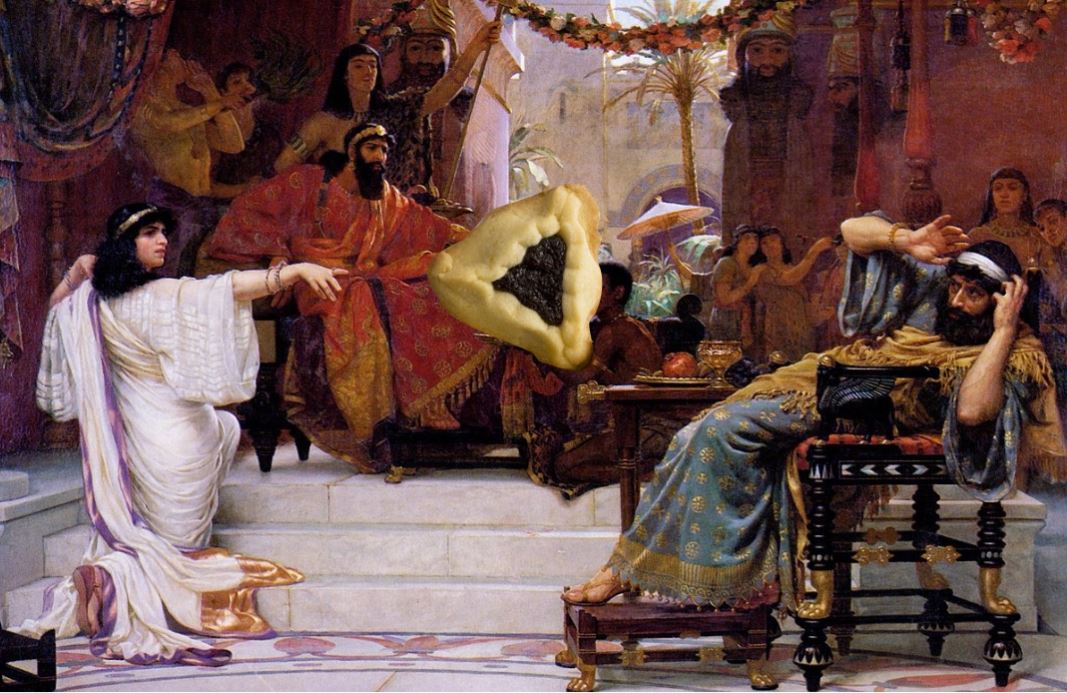
IMAGE: “Esther Denouncing Haman to King Ahasuerus” (1888) by Ernest Norman, with hamantasch added by me