Tag: John Williams

  • Williams & Morricone Film Music Legends

    Williams & Morricone Film Music Legends

    I’ve been sitting on these articles for a week or two, waiting for an opportunity to share them. If you’re into film music or love the movies, you may find them equally of interest.

    John Williams talks to Steinway:

    https://www.steinway.com/news/features/owners/john-williams

    Criterion assesses Ennio Morricone:

    https://www.criterion.com/current/posts/7379-beyond-the-western-the-staggering-range-of-ennio-morricone


    LAST OF THE LIONS: Williams congratulates Morricone, as he wins his only competitive Oscar for “The Hateful Eight,” in 2016

  • John Williams’ Western Film Scores

    John Williams’ Western Film Scores

    Looking back on the cinematic western, by the mid-1970s it was definitely time to water the horses. For much of the preceding decade, most of the important statements in the genre had gone elegiac, revisionist, spaghetti, or some combination of the three.

    With the release of “Star Wars” in 1977, elements of the western survived, but beyond a handful of exceptions, the western, like the swashbuckler, had moved to outer space.

    Though John Williams became inextricably linked with the intergalactic spectacle, it is little known that he, in common with most of his contemporaries, scored a number of actual, old school westerns. This week on “Picture Perfect,” we’ll listen to music from four of them.

    Westerns don’t get much more primal than when revenge becomes a motivator. Mark Rydell’s “The Cowboys” (1972), one of the better of John Wayne’s later films, draws blood when Bruce Dern commits an unspeakable crime against the American West. If you’re a collector of Boston Pops records, you may be familiar with the rousing overture Williams assembled from his score.

    Before he slipped into a lazy pattern of inviting his celebrity friends to goof off in front of the camera and then cashing the paycheck, Burt Reynolds made a number of effective dramatic films. In “The Man Who Loved Cat Dancing” (1973), Reynolds plays a laconic train robber haunted by a secret in his past, who finds a second chance with Sarah Miles, the wife of one of his pursuers, who rides along with his gang. Williams provided a really groovy opening number for this one.

    Despite the how-could-it-possibly-miss teaming of Marlon Brando and Jack Nicholson – with “Bonnie and Clyde” director Arthur Penn at the helm – “The Missouri Breaks” (1976) bombed with both critics and audiences. (If you ever wanted to see Brando in drag, then this is the film for you.) Williams took a different approach with this one, providing a more intimate, if off-kilter score, tinged with jazz and pop elements, and featuring guitar, banjo, harmonica, honky tonk piano, electric harpsichord, etc.

    “The Rare Breed” (1966), on the other hand, is straight-down-the-middle, with James Stewart and Maureen O’Hara introducing Hereford cattle to the American west. Brian Keith, as Stewart’s rival, sports a red beard and a Scottish burr, for some reason. Williams, however, is wholly himself, providing an uplifting, wide-open main theme. Would that film composers still wrote like this.

    Saddle up for selections from John Williams westerns this week, on “Picture Perfect,” music for the movies, this Saturday evening at 6:00 EDT, on WWFM – The Classical Network and wwfm.org.


    PHOTOS: (clockwise from left) Reynolds loves Cat Dancing; Brando in touch with his feminine side; the Duke; and an unrecognizable Brian Keith

  • Happy Star Wars Day Art Music and Memories

    Happy Star Wars Day Art Music and Memories

    It’s Star Wars Day. May the Fourth be with you!

    Personally, I can’t believe that the designation was made on account of a Dad-worthy pun. The first “Star Wars” opened on May 25, 1977, surely a more appropriate anniversary? But any excuse to celebrate “Star Wars” is fine by me, I suppose, as long as I don’t have to celebrate anything released after 1983.

    Until yesterday, I was completely unaware of artist Christopher Shy, but he is one extraordinarily talented individual. Pictured are just a few of his “Star Wars” paintings. The one that employs the original Ralph McQuarrie designs is a hoot!

    Check out his Facebook page for further original interpretations of Godzilla, “Ghostbusters,” Superman, “Star Trek,” “The Thing,” “The Creature from the Black Lagoon,” and many more. Also, make it a point to visit his website, artofronin.com. This will take you directly to a gallery of his work:

    https://www.artofronin.com/showcase

    While you’re at it, why not also spin some of John Williams’ “Star Wars” music? Williams’ original score is a postmodern masterpiece, with echoes of Korngold, Holst, Stravinsky, and William Walton, bound together, permeated, and propelled into delirious transcendence by his stirring, soulful, indelible themes.

    Generally speaking, I enjoy listening to the soundtrack albums in the form they were originally released. It’s nice to have the music note-complete, as has become the fashion on CD , but there was a certain artistry to the arrangements, layouts, and development of commercially-issued soundtracks of the LP era that made them special experiences unto themselves.

    That said, “The Empire Strikes Back” is one of the few note-complete film music recordings that I can listen to straight-through without getting fatigued. In that regard, it must be my favorite of the “Star Wars” scores.

    The original “Star Wars” soundtrack, from 1977, holds great nostalgic significance for me. I spent countless hours writing, drawing, and dreaming to that music. “Star Wars,” to great extent, introduced me to orchestral music, and it changed my life. But, also for me, “The Empire Strikes Back” is the standalone masterpiece, if taken on a purely musical level.

    Here’s how it was originally heard on LP, back in 1980:

    https://www.youtube.com/watch?v=ttZEjs13oO8

    Here it is, note-complete, as on CD – unfortunately with the tracks posted separately, allowing plenty of opportunities for interpolated YouTube ads:

    May the Fourth be with you, indeed!

    Certainly, I wouldn’t want to be without the music for either of the first two films. And by “first two,” I’m speaking in terms of release dates, NOT the geek-pedantic episode numbers. The title “A New Hope” is, quite simply, not in my vocabulary.

    Whatever your bliss, I wish you a happy Star Wars Day. Just keep your midichlorians off this page!

  • Film Composers Beyond the Screen

    Film Composers Beyond the Screen

    Played out on the Oscars?

    This Sunday night on “The Lost Chord,” enjoy a triple-feature of concert works by composers better recognized for their work in film.

    First, Jerome Moross was ensured a kind of immortality in the hearts of moviegoers for his Academy Award nominated score for “The Big Country.” He composed music for 16 films in all – comparatively few, actually, on account of a bicoastal career. (He was based in New York City.)

    Off-screen, he wrote music for five ballets, a symphony, a flute concerto, various works for orchestra and chamber ensemble, and a one-act opera, “Sorry, Wrong Number.” His best-known musical theatre piece is “The Golden Apple,” which spawned the ever-green “Lazy Afternoon.”

    Tonight, we’ll hear his delightful “Sonatina for Clarinet Choir” of 1966.

    Very little need be said of John Williams. The most successful film composer of all time, Williams has been a household name since the 1970s, thanks to the one-two punch of “Jaws” and “Star Wars.” But by then, he was already two decades into a career that’s now spanned 65 years. With 52 Academy Award nominations and five wins, he is the second most nominated figure in the history of the Academy, behind only Walt Disney.

    For the concert hall, Williams has written music for just about every instrument, including an impressive body of concertos. Tonight, we’ll hear his “Essay for Strings,” composed in 1965, when he was 33 years-old.

    Finally, English composer Laurie Johnson (pictured) – still with us at 94 – is appreciated for his contributions to, among others, Stanley Kubrick’s “Dr. Strangelove,” the Hammer cult favorite “Captain Kronos – Vampire Hunter,” and the classic TV series “The Avengers.”

    Gramophone Magazine described his “Symphony: Synthesis,” composed in 1971, as a masterpiece. “The work becomes increasingly fascinating with each listening,” writes the critic. “This is perhaps the first truly successful combination of the Jazz and European music traditions.”

    The recording we’ll hear, made under the composer’s direction, features a number of prominent jazz artists, including Tubby Hayes, Don Lusher, Joe Harriott, Kenny Wheeler and Stan Tracey.

    It’s not always about images. Film composers cast themselves against type, on “Typecast IV: The Curse of Typecast.” It will be there for you when the Oscars sputter, this Sunday night at 10:00 EDT; or enjoy it later, as a webcast, on WWFM – The Classical Network and at wwfm.org.

  • Miklós Rózsa Centennial Celebration

    Miklós Rózsa Centennial Celebration

    Today is the birthday of the great Miklós Rózsa (1907-1995).

    Rózsa receives his third Academy Award, from the hand of Gene Kelly. (BONUS: André Previn wins for his work on “Porgy and Bess.”)

    Later, Rózsa conducted a suite from his most celebrated film score on the PBS series “Previn & the Pittsburgh.”

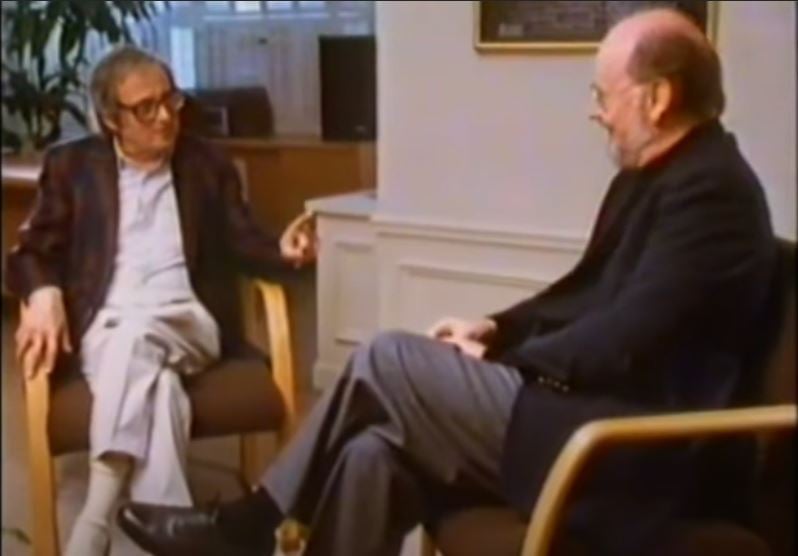
    Previn interviews Rózsa, in the presence of John Williams. (Fun anecdote about Bernard Herrmann and slight regard for Herbert Stothart.)

    Happy birthday, Miklós Rózsa!


    PHOTO (right to left): Rózsa, Previn, and Williams in 1979

Tag Cloud

Aaron Copland (92) Beethoven (95) Composer (114) Film Music (124) Film Score (143) Film Scores (255) Halloween (94) John Williams (188) KWAX (229) Leonard Bernstein (101) Marlboro Music Festival (125) Movie Music (139) Opera (202) Philadelphia Orchestra (89) Picture Perfect (174) Princeton Symphony Orchestra (106) Radio (87) Ralph Vaughan Williams (85) Ross Amico (244) Roy's Tie-Dye Sci-Fi Corner (290) The Classical Network (101) The Lost Chord (268) Vaughan Williams (103) WPRB (396) WWFM (881)

DON’T MISS A BEAT

Receive a weekly digest every Sunday at noon by signing up here


RECENT POSTS