Tag: KWAX

  • Fountain Music Burbling or Gurgling Summer Sounds

    Fountain Music Burbling or Gurgling Summer Sounds

    In writing this, I am wondering if it’s more accurate to state that fountains burble or gurgle? This is the kind of heavy-lifting I do behind the scenes to make my light music shows seem so buoyant and effortless.

    This week on “Sweetness and Light,” as I weigh the finer points, peering through the magnifying glass into my O.E.D., I hope to lessen your own burdens with a refreshing and restorative playlist for the hazy, lazy days of summer. Join me for an hour of “fountain” music by Robert Farnon, Franz Liszt, Maurice Ravel, Charles Tomlinson Griffes, Hans Christian Lumbye, Arthur Meulemans, and Carl Bohm. I’m deliberately omitting Respighi, since it was his birthday on Wednesday, and someone is bound to have programmed “Fountains of Rome” – but fear not, the opulence of Meuleman’s “Pliney’s Fountain” will give old Ottorino a run for his money!

    I may be a fount of indecision, but you can be certain of plenty of burbling or gurgling music on “Sweetness and Light,” this Saturday morning at 11:00 EDT/8:00 PDT, exclusively on KWAX, the radio station of the University of Oregon!

    Stream it wherever you are at the link:

    https://kwax.uoregon.edu/


    IMAGE: “Doves of Pliny” from Hadrian’s Villa in Tivoli, after second century BCE mosaic by Sosus of Pergamon (reproduced many times)

    FUN FACT! IMPRESS YOUR FRIENDS! Tivoli was also the location of the villa that inspired Liszt’s “Les jeux d’eaux à la Villa d’Este” (“The Fountains of the Villa d’Este”), also to be heard in this hour.

  • Les Six: French Composers on KWAX

    Les Six: French Composers on KWAX

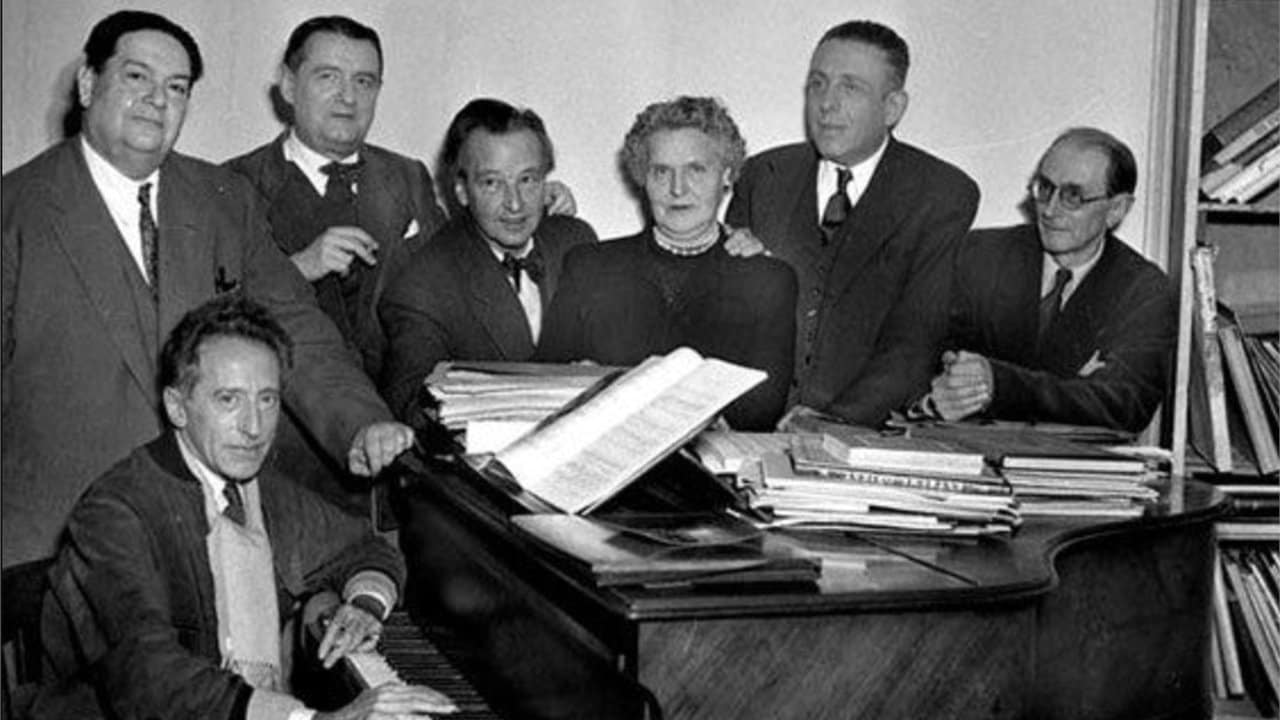
    With Bastille Day coming up on Monday, the focus this week on “The Lost Chord” will be Les Six, that collective of French composers who rose to prominence in Paris in the 1920s, followers of Jean Cocteau and Erik Satie – in reality, each following their own aims, but loosely organized around a reactionary stance against Wagnerism in music and the so-called Impressionism of Debussy and Ravel.

    But never mind all that. What’s important is that they wrote plenty of delightful music, mostly in a neoclassical style.

    We’ll have a chance to get up close and personal, as we listen to music by Les Six, performed by members of Les Six, with Georges Auric and Jacques Février playing music of Erik Satie into the bargain.

    You can always count on The Six. I hope you’ll join me for “Six by Six” on “The Lost Chord,” now in syndication on KWAX, the radio station on University of Oregon!


    Clip and save the start times for all three of my recorded shows:

    PICTURE PERFECT, the movie music show – Friday at 8:00 PM EDT/5:00 PM PDT

    SWEETNESS AND LIGHT, the light music program – Saturday at 11:00 AM EDT/8:00 AM PDT

    THE LOST CHORD, unusual and neglected rep – Saturday at 7:00 PM EDT/4:00 PM PDT

    Stream them, wherever you are, at the link!

    https://kwax.uoregon.edu/


    PHOTO: Standing, left-to-right, Darius Milhaud, Georges Auric, Arthur Honegger, Germaine Tailleferre, Francis Poulenc, and Louis Durey, with Jean Cocteau at the piano

  • July 4th Weekend Seaside Serenity on KWAX

    July 4th Weekend Seaside Serenity on KWAX

    It’s the Fourth of July weekend, and the beaches are open!

    I hope you’ll join me this morning on “Sweetness and Light” for some serene inspirations evocative of surf and sand.

    For the locals (I am, after all, based in Princeton), I’ll have two works that are Jersey shore specific, including the “Cape May Suite” by Rick Sowash (who lives in Cincinnati; so there!) and “The Atlantic City Pageant” by John Philip Sousa – named for the famous beauty pageant and given its first performance on Atlantic City’s Steel Pier.

    We’ll also hear from Virgil Thomson, Émile Waldteufel, Ronald Binge, Clive Richardson, Ralph Vaughan Williams, and Morton Gould.

    Oh yeah, and I almost forgot John Williams, who wryly puts “Tourists on the Menu” in a promenade from the proto-summer blockbuster “Jaws.”

    No teeth in any of the music, however, on “Sweetness and Light.” Meet me at the seaside this Saturday morning at 11:00 EDT/8:00 PDT, exclusively on KWAX, the radio station of the University of Oregon!

    Stream it, wherever you are, at the link:

    https://kwax.uoregon.edu/

  • Summer Reading Music KWAX University of Oregon

    Summer Reading Music KWAX University of Oregon

    Now that it’s summer, it’s time to catch up on our reading! Whether it’s a beach book or a timeless literary classic, reading for pleasure is its own reward. This week on “Sweetness and Light,” imagine yourself in a lawn chair, under a good shade tree, perhaps with a beverage at your side, and enjoy an hour of music, hand-picked to get you in the spirit.

    It will be a veritable lending library of compositions for concert hall, opera house, musical theater, salon, and film, with works inspired by J.K. Rowling’s Harry Potter, Mark Twain’s Huckleberry Finn, Lewis Carroll’s Alice in Wonderland, Leo Tolstoy’s “War and Peace,” Voltaire’s “Candide,” Victor Hugo’s “The Hunchback of Notre-Dame,” Jonathan Swift’s “Gulliver’s Travels,” Peter Benchley’s “Jaws,” Harper Lee’s “To Kill a Mockingbird,” and Henry Fielding’s “Tom Jones.”

    Celebrate two of life’s great pleasures – music and books! Set aside your cares. They’ll still be here when you get back. Get yourself in the mindset to unplug and enjoy some quiet time. Prime yourself for a carefree summer of reading, on “Sweetness and Light,” this Saturday morning at 11:00 EDT/8:00 PDT, exclusively on KWAX, the radio station of the University of Oregon!

    Stream it wherever you are at the link:

    https://kwax.uoregon.edu/


    Image torn from today’s headlines

  • Fantasy Film Music From Lost Worlds on KWAX

    Fantasy Film Music From Lost Worlds on KWAX

    Summer arrives today at 10:42 p.m. EDT. But who’s keeping track? This week on “Picture Perfect,” time means nothing, as we’re bound for an hour of music from fantasy films set in lost worlds.

    In “King Kong” (1933), filmmaker and entrepreneur Carl Denham hires a ship to an uncharted island, known only from a secret map in his possession. There the crew discovers the titular gorilla and other outsized, should-be-extinct creatures. Kong is abducted from his natural habitat – and you know the rest. The composer, Max Steiner, pulls out all the stops. “Kong” was one of the first films to demonstrate how truly powerful an orchestral soundtrack could be.

    Then we travel to the earth’s core, courtesy of Jules Verne and “Journey to the Center of the Earth” (1959). James Mason plays the professor who leads the expedition. The film sports one of Bernard Herrmann’s most outlandish soundscapes, the orchestra consisting of winds, brass and percussion, but also cathedral organ, four electric organs, and an obsolete Renaissance instrument called the serpent. Watch out for that giant chameleon!

    “One Million Years B.C.” (1966) is a guilty pleasure if ever there was one. Produced by Hammer, the studio that gave us all those repugnant yet somehow delicious Peter Cushing-Christopher Lee horror team-ups, the film features special effects by the legendary Ray Harryhausen and an equally legendary fur bikini, sported by Raquel Welch. The music is by Mario Nascimbene, who wrote one of my favorite scores for Kirk Douglas, for “The Vikings.” We’ll be listening to the film’s climactic volcano sequence.

    As he did with the Indiana Jones films, director Steven Spielberg turned to B-movie source material as his visual inspiration for “Jurassic Park” (1993), based on the novel by Michael Crichton. The herky-jerky dinosaur effects of yore are replaced by state-of-the-art computer-generated imagery, in this story of a remote island safari park gone wrong.
    Sure, we’ve come a long way from Raquel Welch being carried off by a Pteranodon, but admit it, we all still want to see people fight dinosaurs. Instead of fudging history, now we can feel superior by fudging science. “Jurassic Park” plays on modern scientific thinking, with DNA extracted from mosquitoes trapped in amber, cloning, and the theory that dinosaurs were not lizards, after all, but rather birds. The music is by long-time Spielberg collaborator, John Williams.

    If you happen to forget a compass, or a watch, don’t panic! In the words of Ian Malcolm, life finds a way. Join me for “Lands That Time Forgot,” on “Picture Perfect,” music for the movies, now in syndication on KWAX, the radio station of the University of Oregon!


    Clip and save the start times for all three of my recorded shows:

    PICTURE PERFECT, the movie music show – Friday at 8:00 PM EDT/5:00 PM PDT

    SWEETNESS AND LIGHT, the light music program – Saturday at 11:00 AM EDT/8:00 AM PDT

    THE LOST CHORD, unusual and neglected rep – Saturday at 7:00 PM EDT/4:00 PM PDT

    Stream them, wherever you are, at the link!

    https://kwax.uoregon.edu/

Tag Cloud

Aaron Copland (92) Beethoven (95) Composer (114) Film Music (123) Film Score (143) Film Scores (255) Halloween (94) John Williams (187) KWAX (229) Leonard Bernstein (101) Marlboro Music Festival (125) Movie Music (138) Opera (202) Philadelphia Orchestra (89) Picture Perfect (174) Princeton Symphony Orchestra (106) Radio (87) Ralph Vaughan Williams (85) Ross Amico (244) Roy's Tie-Dye Sci-Fi Corner (290) The Classical Network (101) The Lost Chord (268) Vaughan Williams (103) WPRB (396) WWFM (881)

DON’T MISS A BEAT

Receive a weekly digest every Sunday at noon by signing up here


RECENT POSTS