Tag: Leon Botstein

  • Bard Music Festival Martinů Deep Dive

    Bard Music Festival Martinů Deep Dive

    Another exhaustive – and exhausting – Bard Music Festival has come to end. In fact, so depleting can be this two-weekend gauntlet of marathon concerts, panels, and conversations – on top of the vagaries of travel, traffic, and simple bodily upkeep – that it can sometimes take me a good day or two to sufficiently recover. The trade-off can be a certain loss of fire in my reportage, but I hope not. I’ll do what I can here to stir the coals and recollect “Martinů and His World” in tranquility.

    I’m not sure where I found the energy (lack of time is a powerful incentive), but somehow, I managed to fire off my reactions to Friday and Saturday at white heat early on Sunday morning. These I posted in raw form until I could touch them up and smooth them out a little bit the next day. This allows me to narrow my focus to Sunday, the final day of the festival. I’ll start off by saying I didn’t sleep well on Saturday night, or didn’t sleep enough. I have this thing sometimes, where I just snap awake at 4:00. All the more remarkable, then, that I was able to make it through the day – and then drive home – with as much energy and focus as I did. But it wasn’t always easy.

    I’ve said it before, and I’ll say it again: Bard is not for the faint of heart. Certainly, anyone can attend a concert there and get real enjoyment from it and even walk away feeling as if they’ve experienced something special. But if you’re in for the full run of every concert, lecture, and panel, you’d better bring your Bard big-boy pants. Also, plan your meals and caffeine intake and do everything you can to get some good nights’ sleep.

    Sunday morning’s chamber music concert wound up being a bit more demanding than the standard Bard matinee. You have to understand, these concerts are planned by academics, often supporting specific theses, and once they’ve secured the resources and assembled the performers and have you in the hall, they’re going to pile it on as much as they can. So don’t go into it expecting a pedestrian concert experience. You’re not there for mindless pleasure. You won’t be offered a tray of koláče. Sure, a musical pastry might serve to break things up a bit. Certainly, it would be enjoyable to listen to. It might even cleanse the palate, so that you can reset and be in the right frame of mind to take in yet another unknown work by a mostly-forgotten composer writing in perhaps a similar, uningratiating style to the one that came before. But comfort was not the aim of Sunday morning’s concert.

    In recent years, Bard’s Sunday mornings have been full of delightful chansons and romances (“Berlioz and His World”) and English chamber music and British art song (“Vaughan Williams and His World”). With Bohuslav Martinů, there could very easily have been some Dvořák or some Copland that would have set easily on Sunday brunch.

    But the theme was “Martinů’s Legacy,” an impressive menu, admittedly, constructed with great care and scrupulous attention to detail; but I’m afraid with the dishes, served as they were, one piled on top of another, and then another, there was the danger of the inherent piquancy of any individual work being blunted by the next.

    The program opened with “Ten Bagatelles,” juvenilia compiled by Alexander Tcherepnin from his teen years, pieces which, if the truth be told, were not all that interesting. (He got better as an adult.)

    Then Iva Bittová sang Martinů’s “Four Songs on Czech Folk Poetry,” with child-like simplicity, in a voice you would not expect from a middle-aged woman (still uncannily youthful at 67). But Bittová was new to me. I didn’t realize that in her native Czechia she is a celebrated avant-gardist. It wasn’t until she took up her violin for one of her own settings that I was confronted with the full scope of her pixilating force, slipping off her shoes to pace the stage in a toe-ring and employing a variety of extended techniques, with unconventional blocking, foot-stomping, and primeval vocalizations. I found her a paradoxical blend of disarming and disturbing. She’s like a Czech Meredith Monk, though clearly her own, feral animal. I should have suspected what I was in for when she presented her accompanist in the Martinů with a sprig of purple loosestrife, as opposed to, say, roses, another child-like gesture.

    After Bittová, it was hard to downshift to Chou Wen-chung’s Suite for Harp and Woodwind Quintet, exquisitely imagined, delicately scored, with a kind of Chinese impressionism leavened with suggestions of folk music. You can tell when musicians (in this case, harpist Susan Drake and friends) feel they did a really good job, when at the end of a performance they’re all already smiling.

    Witold Lutoslawski’s “Dance Panels,” another folk-inflected piece, for clarinet and piano, is one of the few works on the program that turns up on recitals and radio from time to time. Alone, it makes an impression. Here, it was just another act in the vaudeville. (Still, well-played.)

    Frank Zappa’s “Ruth is Sleeping” was impressive for its embrace of some pretty serious atonality. Originally composed for synclavier, it was performed on Sunday in a transcription for piano four-hands. (The title refers to Ruth Underwood, a percussionist in Zappa’s band, The Mothers of Invention, who slept under her instrument.) At times, the work begins to suggest jazz improvisation. In any case, I’d be surprised if Ruth could sleep through it. Revisiting it on a recording, I like it a lot better now than I did on Sunday morning.

    That said, I found the 1933 “Etude” that followed it, by Jaroslav Ježek, more rock-and-roll, along the lines of Prokofiev in firebrand mode, though without the evident melodic gift.

    Joan Tower’s “Petroushskates,” for flute, clarinet, violin, cello, and piano, sprang from her enjoyment of figure skating and her admiration for Igor Stravinsky (especially the ballet “Petroushka”). The piece, which is most amusing at its start and finish (with an allusion to “The Rite of Spring”) was played with the composer in attendance. Tower has long served on the Bard faculty. If she had actually taken the stage, I might have gotten a worthwhile photo of her to share. But she didn’t, and that’s fine too.

    The program was brought to a close with Martinů’s Quartet for Oboe, Violin, Cello, and Piano. Interestingly, the first performance featured oboist Mitchell “Mitch” Miller, later of “Sing Along with Mitch” fame, and violinist William Kroll, who wrote the famous encore piece “Banjo and Fiddle.” At 12 minutes, it was not the briefest work on the program, but laboring against the cumulative effect of the others, it still went by agreeably and quickly.

    Lots of interesting material here, but again it risked being too much of a good thing. It played to intellectual curiosity more than visceral pleasure. There’s nothing wrong with that, as long as one comes into it with an open mind and an empty bladder. (Yet again, the concert, performed without intermission, ran long, and my morning cups of coffee were looking for the exit.)

    After a break for lunch (and more coffee), I headed over to the Richard B. Fisher Center for the Performing Arts’ Sosnoff Theater for the next challenge, probably the most highly-praised of Martinů’s 14 operas, “Julietta.”

    This one really snuck up on me. Walking in already battered after the morning concert and on about four-hours’ sleep, I felt harried and unamused for a good portion of the first act, with my eyes having to bounce back and forth between the rapid exchange of multi-lingual dialogue, sung and spoken by too many characters, to the English supertitles high above the stage. But by the end of the act, finally, there was some human connection, and things got much better from there.

    The opera is based on Georges Neveux’s 1927 play “Juliette ou la Clé des songes” (“Juliette, or the Key to Dreams”). Martinů himself crafted the libretto, first in French and then later Czech. It was given its first performance in Prague in 1938. I don’t know about the play, but the opera could be described as an absurdist psychological dramedy about the hunger for human connection. There aren’t any real stand-apart arias or set-pieces – like surrealism itself, it’s hard to pin down – yet there is kind of elusive continuity. The nature of the character of Julietta is a very interesting one. I would have never suspected from the beginning of the opera, which as I say, I found a tad annoying, that it would turn out to be such a richly satisfying creation. I got the requisite shudder at the end which is always my gauge for an exceptional musical experience.

    Martinů has an immediately recognizable “sound,” but when he steps away from traditional forms like those of the symphony, the concerto, the string quartet, the sonata, he really is quite expert at creating unique dramatic worlds. While a bit of a slippery shapeshifter himself, Martinů is about the last guy I would peg as a surrealist. There are photos of him wearing his street clothes as he lies on the beach. (On second thought…)

    The opera also happens to have a lot of humor in it, some of it of a slightly queasy nature (again, surrealism), but there were also some genuine, uncomplicated laughs, such as when bass Kevin Thompson as the convict offers to show Michel his tattoos.

    A procession of walk-on and recurring side-characters, wearing fezzes, pith helmets, and sailors’ caps, put me in mind of a Wes Anderson movie. But the enduring impression is more Kafkaesque. Where else but in Kafka would you find yourself at the Bureau Central des Rêves? A dream bureau would seem the very height of insurmountable bureaucracy. The writings of Philip K. Dick also sprang to mind, though of course these came much later, because of Dick’s tendency to blur the lines between reality and perception, or more accurately, reality and alternate, simulated, or counterfeit reality.

    Interestingly, as a big Korngold fan, I also noted some parallels with the opera “Die tote Stadt” (semi-staged at Bard as the finale of “Korngold and His World” in 2019). A substantial portion of both stories takes place in dreams, there is an obsessive lover whose frustrated passion drives him to extreme measures, and the side characters are all commedia dell’arte or stock comic types. However, the ultimate decisions of the operas’ protagonists couldn’t be more unalike.

    Anyway, dreams are the currency of surrealism. As one of the characters remarks, “You think dreams are just a fantasy?”

    The singers were all exemplary, right down to the smaller roles – with the exception of one, who was basically a walk-on. (I think he must have been recruited from the choir and lacked the power of his colleagues.) Erica Petrocelli was excellent as Julietta. You can understand why anyone would idealize her. However, despite hers being the title role, she’s not really the lead. In this regard, the laurels must go to Aaron Blake as Michel, Julietta’s would-be lover, who chooses the possibility of attaining the illusion of love over reality. Blake, who is on-stage for just about the entire opera, is a tenor of superlative gifts. He rises to unforeseen challenges in the work’s final act, wowing with some extraordinary vocal stamina. If you want to know more about the rest of the singers, check the program at the link below. None of them were any less than rock solid.

    The “semi-staging” – which may as well be considered staged (how much more action is required?), except for the fact that the orchestra shared the boards, and yeah, I suppose, the singers were never far from their scores – employed projections by John Horzen. The virtual backdrops were like Post-Impressionist child’s renderings of a French seaport town, some trees around a well in the forest, and the exterior of the Bureau Central des Rêves (Central Bureau of Dreams), with Little Nemoesque animated interludes involving a paddlewheel boat breaching clouds and skirting the moon. The production’s stage director was Marco Nistico.

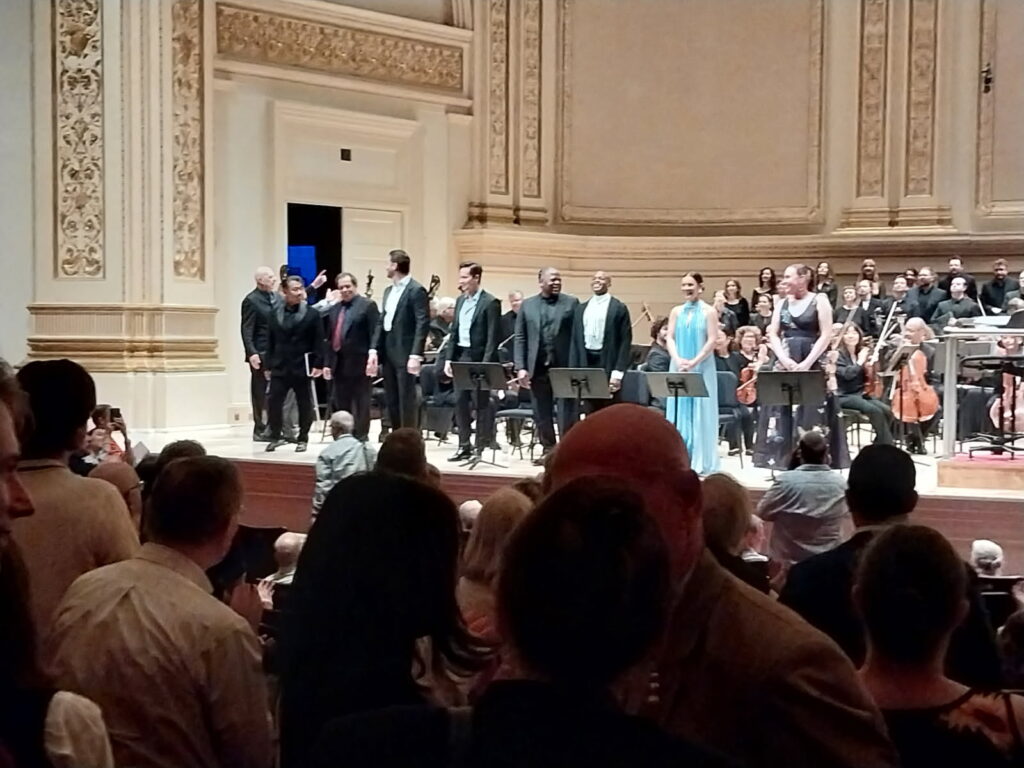
    Leon Botstein conducted the American Symphony Orchestra, of which he has been the music director since 1992.

    One of the things I really like about Botstein – and there are many – is how sincerely he appreciates his colleagues’ artistry. He is always generous with his acknowledgments of young artists, as he was last week, with musicians and soloists performing with The Orchestra Now, and this week, taking the time to shake hands and speak with each of the artists during curtain calls. His public image is that of somewhat of a loveable curmudgeon – as if Eeyore were trapped inside the body, and made the sartorial choices, of a Bond villain. But there’s a lot of love in that man, and clearly he’s living his best life.

    Lest I leave you with the wrong impression, I loved this year’s festival. Bard did what Bard does best and really swung for the fences, with the focus on an undeservedly neglected composer and a colorful supporting cast of largely unfamiliar players – by which I mean not the musicians, but the composers themselves.

    The only indisputable repertory piece presented over the course of two weekends of concerts was Maurice Ravel’s Violin Sonata. You might recognize some of the others (Witold Lutoslawski’s “Dance Panels,” Joan Tower’s “Petroushskates”), but none of them are exactly overdone.

    According to Bard co-artistic director Christopher H. Gibbs, the festival presented 33 works by Bohuslav Martinů in 7 days, which was more Martinů heard over a comparable period of time at any point in history anywhere in the world.

    At least two of the works emerged as masterful, far exceeding expectations if only known previously from recordings: on Weekend One, the “Double Concerto for Two String Orchestras, Piano, and Timpani,” and on Weekend Two, “The Epic of Gilgamesh.” I mean, with a shelf and a half of Martinů at home, I was already familiar with some of the others (the Flute Sonata, the Cello Sonata No. 3, the Nonet), which are already among my favorites. That’s not to say I do not look forward to deepening my acquaintance with many others heard (by me) for the first time during the festival. The symphonies deserve to take their places alongside those of those of other well-known composers that for some reason seem to exist just along the periphery of the mainstream. They’re every bit as interesting and well-crafted as those of Carl Nielsen, for instance.

    Next year at Bard, it’s “Mozart and His World,” with Gershwin on the way in 2027. I’m hoping the latter will provide a good excuse to explore some neglected American byways, on top of all the other intriguing directions the programming could possibly go.

    When announcing Mozart, Botstein made a quip to the effect that we shouldn’t worry about the focus being on such a popular composer; they’ll still be sure to come up with plenty of things to disappoint everyone. Two guarantees at Bard: you’re going to get some very unusual stuff, and you’re going to get a lot of it. Let the pleasure-pain continue!

    Thank you, Bard, from the bottom of my wizened little heart, for “Bohsulav Martinů and His World,” yet another festival subject I never thought I would live to see.

    Here’s a pdf of this year’s 70-page program booklet. In keeping with the concerts themselves, it is no trifling undertaking, full of interesting biographical, historical, and musical information, and lavishly illustrated with photos and period artwork. Especially amusing are Martinů’s doodles and self-portraits. You won’t want to miss the panels in which he wrestles with a bear-like piano (pp. 34-37)!

    https://fishercenter.bard.edu/wp-content/uploads/2025/08/8-7-25_SinglePages_Martinu.pdf

    Fisher Center at Bard

  • Bard Music Festival Highlights

    Bard Music Festival Highlights

    All good things must come to an end – but Bard isn’t going without a fight!

    Yet to come on this year’s Bard Music Festival at Bard College in Annandale-on-Hudson, NY: a Sunday morning chamber music concert, “Martinů’s Legacy,” which will include works by Alexander Tcherepnin, Iva Bittová, Chou Wen-chung, Witold Lutoslawski, Frank Zappa (!), Jaroslav Ježek, and Joan Tower, with two pieces of Martinů himself (“Four Songs on Czech Folk Poetry” and the Quartet for Oboe, Violin, Cello, and Piano, first performed by Mitch Miller, later of “Sing Along with Mitch” fame). Then, this afternoon, Martinů’s surrealist opera “Julietta,” in a semi-staged production – all blessed three hours and 15 minutes of it (with two intermissions).

    Friday night was a rough one, but educational. The first half of the program featured Martinů’s music for men’s chorus, including his “Field Mass,” composed for forces (baritone solo, wind instruments, field organ, piano, and percussion) that made performance literally in the field by stationed troops possible (if unlikely). The Czech-language text, by Jiří Mucha (father of artist Alphons Mucha) combines the Lord’s Prayer with soldierly interpolations, supposedly in the style of psalms – I guess if King David would have been moved to write about the hardships of trench warfare and homesickness. On the other hand, appeals for divine assistance in the smiting of one’s enemies is timeless. I concede this work is necessary to experience in order to comprehend the full, wide-ranging variety of the composer’s character and accomplishments.

    But in the company of some not-very-swaggering “Brigand Songs,” in which freebooters (?) seemingly spend more time reflecting on their inevitable fate at the gallows than they do on any kind of carousing, and then part two from “The Prophecy of Isaiah” (Isaiah always good for a few laughs), the cumulative effect was somewhat stupefying. For proper brigandage, give me Szymanowski’s “Harnasie” or even Shostakovich’s “The Execution of Stepan Razin” – with its defiantly laughing severed head – any day. For Isaiah, Walton’s “Belshazzar’s Feast” still reigns supreme (while toppling its blasphemous king).

    The second half was better, or at any rate, more interesting. “Mariken de Nimègue” is the French version of a mystery play that’s part “Faust” and part “Little Red Riding Hood,” with the Devil in the role of Big Bad Wolf. Baritone Tyler Duncan, a Bard staple, is a natural Devil. Soprano Anna Thompson effectively portrayed the conflict and anguish of Mariken, a good girl who sacrifices purity and piety for the simple pleasures of being bad in the big city. In the meantime, there’s a parallel drama between Jesus (bass-baritone Ben Strong), who’s had enough of humanity’s ingratitude and iniquity and is about to break out the divine broadsword, but fortunately is talked down by compassionate Mary (mezzo-soprano Isabelle Kosempa). Actor Bhavesh Patel narrated the action with clear, commanding diction.

    The Bard Festival Chorale, prepared by James Bagwell, was great, as always, and Zachary Schwartzman conducted a mean “Mariken,” but cumulatively, the whole thing just left me feeling wrung out.

    Last night’s concert, on the other hand, was awesome in every sense of the word. Leon Botstein was back on the podium for a mostly-Martinů program. I confess the prospect of Jan Novák’s “Ignis pro Ioanne Palach,” inspired by the self-immolation of student Jan Palach in protest against the Soviet occupation of Czechoslovakia, was not exactly cheering; but in execution, it was actually quite good. The music – another work for chorus and orchestra – was direct, powerful, and worthwhile.

    Then mezzo-soprano Taylor Raven took the stage for an aria from Martinů’s one-act opera “Ariane,” which elicited an ecstatic ovation – hard-earned with its high notes – as Raven is a formidable talent.

    Soloist Itamar Zorman played Martinů’s Violin Concerto for all that it was worth. Perhaps more. It was a recording of the slow movement of this piece that inspired festival scholar-in-residence Michael Beckerman to take up study of the composer. I agree with him in that the songful slow movement, marked andante moderato with a virtuosic central section, is the most compelling part of the work, an absolutely gorgeous Czech arioso that pulls the listener in. As always with Martinů, moods shift, but the movement is comparatively untroubled territory, a paradise I wouldn’t mind revisiting.

    But it was the second half of the program that really knocked me back on my heels, as I was totally unprepared for the power of Martinů’s “The Epic of Gilgamesh,” a Mesopotamian blockbuster with women’s and men’s choruses and lots of surprising touches in the orchestration. Martinů’s libretto, based on an English translation of the ancient epic by Reginald Campbell Thompson, focuses on Gilgamesh’s bromance with former rival Enkidu (they bond after a fight so fierce that doors are splintered and walls crumble). Enkidu’s death, precipitated by the gods to humble the hubristic king, leads to an extended denouement in which vocal soloists and chorus attempt to process the concept of mortality. But the work is so inventively scored and the dual choirs so brilliantly employed that it does not outstay its welcome.

    Bard’s performance was enhanced by tasteful projections that did not at all distract from the drama, and in fact put me in the mind of the superb performance of Ralph Vaughan Williams’ “Job” that was given in that space a few seasons ago. (That production employed projections based on the William Blake illustrations.)

    More along the lines of RVW’s “Sinfonia antartica” (Italian spelling, with only one “c”), Taylor Raven engaged in a wordless lament. The men, especially baritone Norman Garrett, were left to cycle through loss, disbelief, and fear of the inevitability of death. Bhavesh Patel again narrated.

    This is great work, and I don’t understand why it’s not heard more often. I’ve had a recording of it on my shelf for years, but somehow I’d never gotten around to listening to it. I’m all the happier to have snapped up from the merch table earlier in the day a CD issued by the Bohuslav Martinů Foundation and Institute that includes a 1959 recording of the work, featuring Marilyn Horne and Walter Berry, conducted by Martinů patron Paul Sacher. Something to listen to tonight on the ride home!

    Following another informative panel yesterday morning, with Beckerman, NYU’s Larry Wolff, and artist-in-residence Aleš Březina, that also posited all sorts of interesting ideas, the highlights of yesterday afternoon’s chamber music concert were Martinů’s “Three Madrigals,” with violinist Shannon Lee and violist Luosha Fang (who has left some memorable impressions in her multiple appearances on this festival on her other instrument, the violin), and the Cello Sonata No. 3, with cellist Nicholas Canellakis and pianist Michael Stephen Brown. The program also included David Diamond’s Flute Quintet and Martinů’s Nonet, but the former pieces came off best in yesterday’s performances.

    Chamber music concerts are held in the intimate space of Olin Hall and the larger pieces at the Sosnoff Theater in the campus’ Richard B. Fisher Center for the Performing Arts.

    Okay, I’ve got to run! If this reads as if it was written in haste, it was. I’ll touch it up tomorrow, adding diacritical marks to the Czech names, and post a few other anecdotes and impressions, as I nurse myself back from two weeks’ worth of intensive immersion in the music of this neglected Czech master!

    Fisher Center at Bard

  • Bard Music Fest: Martinů’s World Explored

    Bard Music Fest: Martinů’s World Explored

    I was so self-indulgent in my last post with my impressions of Friday night’s opening concert of the Bard Music Festival (this year, “Martinů and His World”), impressions which somehow wound up being both comprehensive and a mite jejune, I realize that if I continue in that fashion I couldn’t possibly relate everything before the festival commences its second weekend. So for everyone’s sake, I should probably rein it in and restrict myself to the high points and otherwise notable features of this past Saturday and Sunday. It’s good sometimes to have to work within set limitations.

    Saturday morning at Bard is devoted to scholarly panel discussions held at Olin Hall, Bard College’s 300-seat auditorium, where daytime chamber concerts are also performed. These sessions are not only informative, they are entertaining, with back-and-forth between the scholars and an audience Q & A. The better panels, as this one was, are full of wit and personality. The panel consisted of festival scholar-in-residence Michael Beckerman, Cambridge’s Marina Frolova-Walker, and festival co-artistic and music director Leon Botstein, who always manages to steal the show. The moderator was co-artistic director Christopher H. Gibbs. I wish I could share more – I took a lot of notes – but for reasons of concision, I will force myself to refrain.

    With only an hour’s break before the afternoon chamber concert, preceded by the unmissable Byron Adams’ preconcert talk, I was pretty much nailed to the spot, forced to subsist on a Bard torture wrap from the refreshments table – not really horrible as those things go, but not great either. Definitely food on the run. Happily, I made another Bard friend over a chance conversation about American composers. (The festival’s focus in two years will be George Gershwin.) It’s not every day that you find someone who can speak knowledgeably about Ross Lee Finney’s Symphony No. 1 and can share not one, but TWO personal Walter Piston anecdotes. I look forward to speaking with him again this weekend. We’ve already struck up quite the email correspondence.

    One of the high points on the Saturday afternoon chamber concert was the Bassoon Sonatine by Alexandre Tansman, a work that was new to me, really sold by Thomas English, a phenomenal bassoonist, with Danny Driver at the keyboard. Also Martinů’s Flute Sonata, always one of my favorite works by the composer, written on Cape Cod in 1945. This was performed by Brandon Patrick George, whom I remember from his fine performance of a riveting solo flute suite by Egon Wellesz during “Vaughan Williams and His World” in 2023. Again, Danny Driver was the pianist. The program also included attractive works by Josef Suk (an early Piano Quartet), Jaroslav Řídký, Albert Roussel, and one of the few repertory works to be heard during this year’s festival, Maurice Ravel’s Violin Sonata. If all the performers really were outstanding, is it possible to assert that any of them stood out? And yet they did. All of them. I am sorry not to have the space to credit them all here.

    Saturday night’s orchestral program, at the 900-seat Sosnoff Theater in the campus’ Fisher Center for the Performing Arts, was dedicated to Martinů’s friend (the two escaped Europe together) and champion, Rudolf Firkušný, also a valued friend of the Bard Music Festival, appearing as he did as part of “Dvořák and His World,” back in 1993, and honored, following his death, at “Janáček and His World” in 2003. Saturday’s concert included a real rarity in Firkušný’s recently-rediscovered Piano Concertino, written when he was just 17. This was quite the enjoyable showpiece, conceived in a post-Romantic, almost proto-Hollywood idiom. I can understand why he shelved it, when even Rachmaninoff was being ridiculed for this kind of thing, but Firkušný certainly didn’t embarrass himself. The flamboyant Piers Lane reached into his psychedelic wardrobe for a blue sort of tie-dye jacket and what looked like glow-in-the-dark socks. You be you, Piers!

    But even Lane seemed conservative next to Jeonghwan Kim, the gesticulating bleach-blond soloist who tackled Martinů’s fantastical Piano Concerto No. 4, one of several works the composer wrote for Firkušný, which on this occasion certainly lived up to its subtitle, “Incantation.”

    The program opened with Erwin Schulhoff’s Symphony No. 2, full of jazzy inspiration, with solos for trumpet and saxophone, and also a part for banjo. All in all, another delightful Bard discovery.

    The concert also included Martinů’s somber “Memorial to Lidice,” a commemoration of the village and its inhabitants wiped out by the Nazis in reprisal for the assassination of Reinhard Heydrich, “Hitler’s Hangman,” by operatives of the Czech resistance, and the Symphony No. 6, subtitled “Fantaisies-symphonique.” The 6th is the composer’s strangest symphony, with its interludes of roiling notes, which remind many listeners – and musicologists too – of swarming bees. Leon Botstein conducted his post-graduate group, The Orchestra Now. Great stuff!

    Sunday’s chamber music concert, hosted by Bard’s scholars-in-residence, Michael Beckerman and Aleš Březina, consisted of works by Martinů and his student/lover Vítězslava Kaprálová. The highlight for me was Martinů’s “Les rondes” – not literally anything to do with rounds, as in “Row, Row, Row Your Boat,” but rather an allusion to round-dances. It’s a folk-inflected work, filtered through a Stravinskyan neoclassicism. It’s scored for seven instruments: oboe, clarinet, bassoon, trumpet, two violins, and piano.

    I also enjoyed Beckerman and Březina’s introductory attempt to lend authenticity to “Variations on a Slovak Theme,” one of Martinů’s final works, by singing a rough-edged folk duet.

    Perhaps now would be a good time to mention clarinetist Yoonah Kim, who emerged as an artist of real grace and subtlety. She shone not only in “Les rondes” (it was a pleasure to hear here alongside bassoonist Thomas English and oboist Alexandra Knox) but also in Aaron Copland’s Sextet – the composer’s reduction of his “Short Symphony,” undertaken by Copland after it was deemed unplayable by Serge Koussevitzky and Leopold Stokowski (only to have Carlos Chávez prove them wrong), which was among the works featured on the concluding program, back at the Sosnoff. There, Kim sat center stage, before the piano (Piers Lane donning another flashy jacket) and flanked by members of the dynamic Balourdet Quartet.

    Everything about that concluding concert was a joy. The program opened with the suite from Martinů’s “La revue de cuisine,” a 1927 ballet about love and intrigue among the kitchen utensils. Scored for a sextet of clarinet, bassoon, trumpet, violin, cello, and piano, the inner numbers are based on popular dances and flanked by a jaunty, syncopated march. This is fun music. How many ways can I say that all the musicians were superb? It was evident not only here, but in their other appearances throughout the festival.

    Unfortunately, in one of the very few snafus of the weekend, violinist Yuoshang Fang must have gotten her foot tangled up in her dress, or her electronic tablet just didn’t read the signal from her Bluetooth page-turner, and one of the “La revue” movements had to be started over again. This is the 21st century equivalent of when the sheet music used to fall off the stand, and I’ve been waiting for it to happen since these screens have proliferated. That said, it’s the first time I’ve actually witnessed it. It was easily remedied, with a quip from Thomas English and the musicians taking it from the top. Everyone played, and the audience gratefully received it, as if nothing had ever happened.

    This final program had a high ratio of excellent and enjoyable pieces. Orion Weiss played Martinů’s Piano Sonata No. 1. In a bit of luxury casting, Mahan Esfahani was the soloist in Martinu’s Harpsichord Concerto. I’m wondering if this is the first 20th century harpsichord concerto I’ve ever heard live? It can’t be, can it? (Yes, I have heard harpsichords live in Baroque music.) Anyway, I was struck, having learned so much of this repertoire from recordings, how quiet an unamplified harpsichord can be, in relation to the more modern instruments. It was not inaudible. The balance was just unanticipated, as recording engineers are forever boosting the levels. Another fine performance, by the way.

    As the presence of a harpsichord would suggest, there was neoclassicism in abundance. The program also included Arthur Honegger’s delightful “Concerto da Camera,” with Keith Bonner, flute, and Alexandra Knoll, oboe – a pastoral diversion devoid of expressive dissonances of a kind heard in some of the composer’s other pieces (including even his “Christmas Cantata”).

    The last word was given to Martinů and his “Tre ricercari,” its Baroque affinity suggested right there in the title. In all, this was a winning program, again well exceeding the projected two-hour running time.

    The festival has been a little light on the merch this time around. Ordinarily there are tables of CDs offered by Rhinebeck’s Oblong Books, but on the first weekend, anyway, there were no shiny jewel cases to entice the crows. And no, I don’t think it’s because the compact disc is an outmoded format. If you were there in past years, you would know that the inventory gets whittled down quite a bit over the two weekends. I wonder if there was an issue with the store getting stuck having to handle too many returns to the distributors or having to absorb the unsold material into their own inventory. I imagine under normal circumstances, Martinů is not exactly flying off the shelves!

    However, there is still the festival-related book, “Martinů and His World,” edited by scholars-in-residence Beckerman and Březina, which this year includes not only essays about the composer and his works (there’s a healthy section on his operas), but also a recently-rediscovered personal diary and interviews with those who knew him during his American years.

    And of course, there’s the “Martinů and His World” t-shirt, sporting one of the composer’s humorous doodles (really self-caricatures). It’s a keeper, bound to be a conversation-starter (albeit a one-sided conversation). Amaze and zombify your friends!

    What am I especially looking forward to hearing this weekend? “The Epic of Gilgamesh,” for one, with tenor John Matthew Myers, who sang Smetana’s Dalibor last month at Bard (and knocked my socks off as Strauss’ Guntram, also conducted by Botstein, at Carnegie Hall in June), alongside Martinů’s Violin Concerto No. 2, both highlights on Saturday night. Michael Beckerman revealed during this past Saturday’s panel that it was a chance encounter with the slow movement of the concerto on a recording that turned him on to the composer and determined the direction of his life.

    On Saturday afternoon’s chamber music program, I am looking forward to hearing Martinů’s Cello Sonata No. 3 and one of my personal favorites, the Nonet (No. 2). Of the other composer’s works, I eagerly anticipate David Diamond’s Flute Quintet, Witold Lutoslawski’s “Dance Panels,” and Joan Tower’s “Petroushskates.” And to conclude the festival on Sunday afternoon, Martinů’s opera “Julietta,” in a semi-staged production.

    Okay, I ran long again. Kind of like one of Bard’s programs. At least I managed to cram in the rest of the information I wanted to convey. The Bard Music Festival continues this weekend at Bard College in Annandale-on-Hudson, NY. For more information, visit:

    Bard Music Festival

    Fisher Center at Bard

  • Martinů at Bard: Weekend 1 Impressions

    Martinů at Bard: Weekend 1 Impressions

    Okay, here we go: my impressions of this year’s Bard Music Festival, “Martinů and His World,” Weekend 1. If you’re looking for festival background, see yesterday’s post.

    One of the things I’ve always found refreshing about the Bard approach to its honored subject (this year, the chameleonic composer Bohuslav Martinů) is its mix-and-match philosophy of programming. With the exception of Saturday night concerts, for which larger forces are amassed for the duration – an orchestra, with perhaps the addition of soloists and/or a chorus – it’s not uncommon to experience instrumental, vocal, chamber, and orchestral music on the same program.

    Concerts frequently push, and sometimes exceed 150 minutes. At Bard, there is no such thing as too much of a good thing. There is an intermission, of course. Sometimes. This past Sunday morning’s concert ran two hours without break. It was projected to run 90 minutes.

    The Friday night opener took place at Bard College’s 900-seat Sosnoff Theater, inside the Frank Gehry-designed kaiju armadillo that is the Richard B. Fisher Center for the Performing Arts. Festival inaugural concerts always serve as introductory affairs, so we were treated to Martinů across various genres and periods.

    The program commenced with Orion Weiss, a pianist whom I’ve heard at Bard pretty much every year since I first encountered him there in 2008, during “Prokofiev and His World.” That would have been my first visit to the festival, which was established in 1990. Throughout the weekend, Weiss exhibited a remarkable grasp of the Martinů idiom. For starters, he played two selections (both in F major) from the composer’s “Etudes and Polkas.” I would have liked to have heard more of these, so delectable they were. I’ve enjoyed them very much on record. But on Friday, they were mere appetizers.

    As was the folk-inflected “Primrose,” a collection of five brief, though characterful songs for two voices, violin (an inspired choice on the part of the composer), and piano. This is music with roots in the soil of Moravia and shoots in the New World. The vocal duets were sung by soprano Jana McIntrye and mezzo-soprano Taylor Raven, with foundations and embellishments provided by violinist Luosha Fang and pianist Erika Switzer.

    In browsing the promotional material during the weeks and months leading up to the festival, it did not register that the third work on the program, titled “Fantasia,” was indeed Martinů’s Fantasia for Theremin, Oboe, String Quartet, and Piano. If you don’t know the theremin, it’s that electronic instrument often used in old science fiction movies to denote UFOs and mad science. Tones are conjured and bent without physical contact by manipulating electromagnetic fields with hands held in varying proximities to the machine’s dual antennae. You have to give Martinů credit for employing this most unusual device for its musical capabilities, as opposed to gimmicky ends.

    Believe it or not, this is not the first time I’ve encountered the piece. I heard it performed in 2013 by the Concordia Chamber Players with the New Jersey Symphony’s Darryl Kubian on the theremin. Granted, that was in a more intimate venue (Trinity Church in Solebury, PA), but the instrument, and by extension the work itself, made more of an impression on that occasion. That said, I must confess, despite some intriguing interplay between the theremin and the oboe, for me the piece kind of outstays its welcome. But not by much. Maybe I’m just one of those vulgarians who actually craves more mad science. On Friday, Dorit Chrysler was the thereminist. She shared the stage with oboist Alexandra Knoll, the Balourdet Quartet, and again, pianist Orion Weiss.

    The first half of the concert concluded with Weiss and members of the Balourdet in a profoundly absorbing performance of Martinů’s Piano Quartet No. 1. This is a work of urgency and uncertainty that yet manages to attain real beauty with its flashes of irrepressible humanity. In my notebook, I jotted down the impression that Shostakovich might have recognized the emotional soundscape of the work’s second movement. A ray of hope appears in the third, and it occurred to me, perhaps quirkily, that Martinů’s piano passages, when he is in hopeful mode, put me in the mind, somewhat, of Vince Guaraldi’s “Cast Your Fate to the Wind,” if only in spirit. I mean that generally, not just in this piece. But Martinů is never the same for long. As it was, hope was not to continue untroubled, and peace was not guaranteed. Optimism pierced the gloom, shining sporadically, like shafts of light through clouds.

    For me, this was the high-point of the program thus far, and perhaps it would have carried the evening, had it not been for the Double Concerto for Two String Orchestras, Piano, and Timpani. Positioned as it was after interval, on top of everything else, the Double Concerto had the advantage of contrast with the smaller-scale works on the concert’s first half, which enhanced its impact enormously. As I observed in yesterday’s post, it was like the effect of having viewed a 35 mm film and then having the screen suddenly open up to the dimensions of Cinemascope.

    The visual of pianist Michael Stephen Brown seated in an antiheroic position, behind the instrument, the piano perpendicular in relation to the seats in the auditorium, so that hands and keys were invisible to the audience, emphasized his neoclassical function as a musician in, as opposed to apart from, the orchestra, as in a Baroque concerto grosso. But there was nothing remotely 18th century about the content of the music, with its white hot divisi strings ratcheting up the intensity. I own several recordings of the Double Concerto, but it wasn’t until I heard it live in concert, here for the first time, that I realized what an outstanding work it truly is. Again, as I remarked yesterday, this is searing, full-bodied music that can stand toe-to-toe with the finest works of Béla Bartók. Music director Leon Botstein (also Bard’s co-artistic director) and the young musicians of The Orchestra Now, Bard’s graduate training ensemble, gave it as fine a performance as I ever expect to hear.

    In the wake of this emotionally-taxing work and the staggering success of its execution, I was all set to decompress with the Symphony No. 2, one of the composer’s more carefree inspirations. It’s a piece that bears the influence of Martinů’s Czech antecedents (especially Dvorak), but also conjures the kind of wide-open positivity we associate with a lot of American music of the era. By then, 1943, Martinů was safely across the Atlantic and composing in the United States. The work was written for the Czech community of Cleveland and first performed by the Cleveland Orchestra conducted by Erich Leinsdorf.

    To be fair, Botstein and his musicians had set the bar awfully high. So when the symphony commenced, my heart sank a little, as I began to suffer flashbacks to a performance of Charles Ives’ Symphony 2 these same forces had given last season at Carnegie Hall that just refused to spring to life. One of my favorite American symphonies wound up sounding like John Knowles Paine on a bad day. I feared a recurrence on Friday, with the first movement of the Martinů symphony played, to my ears, with more diffidence than such a characterful, optimistic piece should have been. It lacked forward momentum, which is not something you generally experience with this composer.

    Or at least, that was my impression. Who knows. Maybe it was just me. (I HAD eaten some undercooked salmon for dinner.)

    HOWEVER, I am very happy to report, things improved markedly in the second movement, which of course could handle a more relaxed tempo. The third movement, lively in its mechanized energy, was better still. It made me wonder if my reaction to the first was but “an undigested bit of beef, a blot of mustard, a crumb of cheese, a fragment of underdone potato.” The last movement was exuberant, exciting, and ebullient. The performance had rebounded – possibly; again I concede that it could have been fine all along – and the work was brought to a satisfying close. Not quite on the level of the Double Concerto, mind you, but still, a job well-done.

    At various points throughout the concert, Botstein offered some remarks while the stage was being reset. The man is a master of extemporization. If you’re ever looking to fill five, ten, or even thirty minutes with engaging perambulation, then Botstein is your man. A lifetime of public speaking and a devotion of one’s thoughts to interesting things will do that. Before the concert, he was presented with a framed certificate by New York Assemblymember Didi Barrett in honor of his 50 years as president of Bard College.

    Apologies. This is getting long again. I’ll have to wrap it up tomorrow, likely in a more concise fashion. Otherwise, I’ll never get it all in before Weekend 2!

    The Bard Music Festival, “Martinů and His World,” will continue this weekend at Bard College in Annandale-on-Hudson, NY. For more information, visit

    Bard Music Festival

    Fisher Center at Bard

  • Bard Music Festival: Exploring Martinů and His World

    Bard Music Festival: Exploring Martinů and His World

    Tackling a topic as vast as the Bard Music Festival can be intimidating. Also, life tends to get in the way, often keeping me from being my best self, particularly in the narrow windows during which my brain is actually firing at peak capacity. All disclaimers aside, let’s see what I can do.

    The Bard Music Festival, now in its 35th year, is the crown jewel of Bard SummerScape, an eight-week celebration of the arts, held on the campus of Bard College beginning in late June. The Bard Festival itself, which spans two weekends in August, focuses on certain composers and their worlds – encompassing works by their associates, contemporaries, influences, and those who were influenced by them. The subject’s life and artistry are explored by way of marathon concerts, but also through pre-concert talks, Saturday morning panels with visiting and resident scholars, a book of related essays, and a 70-page festival program booklet which is so much more than a utilitarian compilation of concert listings, lavishly-illustrated and brimming with valuable information about every aspect of the subject.

    This year’s focus is the neglected Czech master, Bohuslav Martinů, whose life took him from the comparative isolation of a childhood spent in a provincial bell tower, to a period of lackluster studies in the city of Prague, to an artistic flowering in Paris, to a flight from war and authoritarianism in Europe to safety and recognition in the U.S., to final years spent in Switzerland on the estate of conductor and music patron Paul Sacher. That’s quite a journey, and Martinů was an expert assimilator, sensitive to stimuli from a broad array of influences, all siphoned through a lively, fecund, and voracious sensibility. All converge in his highly unique, multifaceted creations, which are full of human touches, while often seeming to churn with the vitality of a mechanized age.

    Alas, Martinů has shared the fate of so many composers who clove to tonality in the 20th century. A multiplicity of factors that contributed to the “Great War” sent strains of decadence and malaise out into the arts. There was a little bit of a reprieve during World War II, when a certain amount of populism was tolerated, in the interest of keeping up the morale of the unwashed. But after two devastating conflicts, the Holocaust, and the atomic bomb, arbiters and academics tended to marginalize composers who did not cast off tradition, which they perceived as upholding destructive tendencies, to embrace the brave new world of the avant-garde. Ironically, the sterility of the Ivory Tower was viewed as the only way forward.

    Thankfully, we are, for the most part, beyond all that, and composers of Martinů’s generation, who continued to seek new ways within a continuity of tradition and form, are gradually being reassessed. However, the process has been a slow one. Many still get lost in the cracks between the classics and the “new” – younger, trendier composers – while concert programmers wrangle with the challenges of fulfilling their obligations to the living and programming enough Beethoven and Mahler to guarantee a full house.

    Bard is in the unique position that it doesn’t have to worry about all that. With Leon Botstein at the helm, fashion and factionalism are shown the door in favor of unbiased inquiry and clear-eyed appreciation. Not only is he insatiably curious, he is also Bard’s president, as he has been for the past 50 years. (He assumed the position at the age of 28!) Botstein serves as co-artistic director of the festival with Christopher H. Gibbs. He is also its music director.

    Many of the concerts feature the young players of Bard’s graduate training ensemble, The Orchestra Now, a post-conservatory group of highly-skilled performers. Others feature the American Symphony Orchestra, a professional group founded by none other than Leopold Stokowski, which Botstein has directed since 1992. Soloists and chamber instrumentalists are equally questing, vibrant, and first-rate. Many are long-time Bard associates or faculty. Pianists Piers Lane and Danny Driver have long recorded unusual and neglected repertoire for Hyperion Records, among others. Occasionally, there are genuine “celebrity” guests. I’ve seen Michael York and David Strathairn there. This past weekend, Mahan Esfahani, whose recordings on Hyperion and Deutsche Grammophon have helped develop a world following, was the soloist in Martinů’s Harpsichord Concerto.

    Daytime panels and chamber concerts are held in the 300-seat Olin Hall, in Bard’s Franklin W. Olin Humanities Building. Evening concerts are held at the 900-seat Sosnoff Theater in the campus’ Frank Gehry-designed Richard B. Fisher Center for the Performing Arts, which I have often described as a gigantic, reflective armadillo. Under certain conditions, it’s hard to get a good photo, because of the venue’s sleek, reflective surfaces.

    My plan today had been to give an account of the festival’s first weekend, but already this is getting a little long. So watch this space! More tomorrow. The Bard Music Festival, “Martinů and His World,” will continue this weekend, with choral, chamber, instrumental, and orchestral works – and even one of Martinů’s 14 operas, “Julietta.”

    For more information, visit

    Bard Music Festival

    Fisher Center at Bard

Tag Cloud

Aaron Copland (92) Beethoven (94) Composer (114) Conductor (84) Film Music (105) Film Score (143) Film Scores (255) Halloween (94) John Williams (178) KWAX (227) Leonard Bernstein (98) Marlboro Music Festival (125) Movie Music (120) Opera (194) Picture Perfect (174) Princeton Symphony Orchestra (102) Radio (86) Ralph Vaughan Williams (83) Ross Amico (244) Roy's Tie-Dye Sci-Fi Corner (290) The Classical Network (101) The Lost Chord (268) Vaughan Williams (97) WPRB (396) WWFM (881)

DON’T MISS A BEAT

You’re always welcomed to read my daily dispatches here or on social media, where you can comment and we will be in conversation! But also, please subscribe here to receive direct e-mails either daily or weekly. Thank you always for reading and commenting!

Choose whether to receive one e-mail per day, or one per week:

RECENT POSTS