Tag: Leon Botstein

  • Strauss’ “Guntram”: A First-Class Second-Rate Opera?

    Strauss’ “Guntram”: A First-Class Second-Rate Opera?

    Few have done more to rehabilitate neglected Strauss, especially neglected Strauss opera, than Leon Botstein. But after all, rehabilitating the neglected is what Botstein does. He’s made a career of it, on record, in concert, and as part of the mission of the Bard Music Festival, a kind of music mecca that attracts the curious to Bard College every summer for total immersion in a composer’s work and world. (This year’s festival, which will take place largely over two weekends, August 8-10 and 14-17, will be devoted to the sleeping giant of Czech music, Bohuslav Martinů.) Botstein is the festival’s founder and co-artistic director. In that capacity he conducts the operas and most of the orchestral programs, serves on panels, writes illuminating essays, and delivers pre-concert lectures. At 78, he’s still an intellectual dynamo. His lumbering gait and considered speech belie a seemingly inexhaustible well of energy. Botstein has served as Bard’s president since 1975. Yes, you read that correctly. He assumed the office at the age of 29.

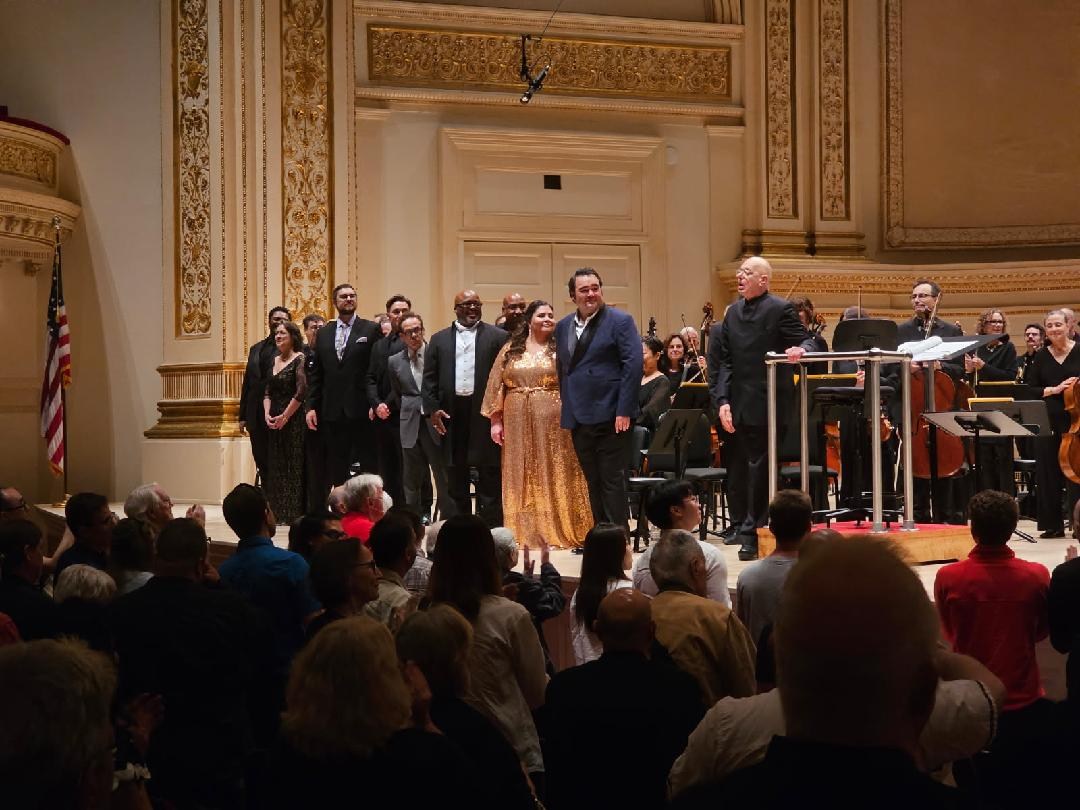
    On Friday, Botstein took the stage of Carnegie Hall to guide the American Symphony Orchestra (a group he has directed since 1992) through the resurrection, in concert, of Strauss’ first opera, the problem child “Guntram.” The work was tepidly received at its premiere in Weimar in May 1894. Basically, everyone thought it was fine, if not particularly special. Pauline de Ahna sang the role of Freihild. Four months later she would become Strauss’ wife. (He announced their engagement on the day of “Guntram’s” premiere.)

    In November, Strauss brought the work to his hometown of Munich, where he was serving as music director. Its reception there might be charitably characterized as brutal. So poorly did its single performance go down that the orchestra walked out on strike under the direction of its concertmaster (Strauss’ cousin). The two leads refused to reprise their roles, and a third singer was adamant about not returning until a better pension was negotiated. Ouch!

    By then, Strauss had already tasted success with his tone poems “Don Juan” and “Death and Transfiguration.” “Till Eulenspiegel’s Merry Pranks,” “Also sprach Zarathustra,” “Don Quixote,” and “Ein Heldenleben” were yet to come. He was a decade away from “Salome,” the work that would change his operatic fortunes forever. (But first, he would have his revenge on conservative Munich with his scandalous opera “Feuersnot.”) He would go on to become perhaps the most successful opera composer of the 20th century.

    Still, you know how it is. One never forgets the sting of rejection. Strauss just couldn’t get over “Guntram’s” failure. He tried to put it behind him with a humorous gesture, figuratively burying the pain with a symbolic gravestone erected on his property that bore the inscription:

    “Here lies the venerable, virtuous young Guntram—
    Minnesinger, who was gruesomely slain by the symphony orchestra of his own father
    May he rest in peace!”

    Strauss would enjoy wealth and celebrity, but that early humiliation stayed with him. In 1940, when he was in his mid-70s, at the other end of a very fruitful career, he revised “Guntram,” making some cuts and hoping its merits would finally be recognized. But its fortunes did not improve.

    “Guntram,” then, is right in Botstein’s wheelhouse. “Salome,” “Elektra,” and “Der Rosenkavalier” don’t need his help. Rather, he’s been working his way through Strauss’ lesser-known efforts, including the aforementioned “Feuersnot,” “Die ägyptische Helena,” “Die schweigsame Frau,” “Friedenstag,” “Daphne,” and “Der Liebe der Danae.” He and the ASO recorded “Die ägyptische Helene” and “Der Liebe der Danae” at Avery Fisher Hall in 2001 and 2003, respectively, for Telarc Records.

    Before I forget: it is essential that you get there early for any Leon Botstein performance. I guarantee his insightful pre-concert talks will enrich your experience of the music. On this occasion, had I missed his remarks, it would have gone right over my head that this was no mere Wagner knockoff, but rather a sly subversion of the Wagnerian aesthetic it would seem to embrace. I would have missed out on the entire social and historical context that allowed me to take vicarious pleasure in knowing that “Guntram” pissed off Strauss’ contemporaries. Of course, the music itself also happens to contain passages of great beauty, especially when heard live.

    Botstein conducted “Guntram” from that 1940 revision of the work, the only performance edition. While the opera may not be a world-beater, we’re far enough along from the prejudices and animosities that pummeled it in the 1890s to at least give it a fair and objective hearing.

    Strauss wrote his own libretto, which is full of the turgid Teutonic iconography familiar from so many German Romantic operas. A corrupt ruler, high-minded minnesingers, civil unrest, a saintly woman, thwarted love, and heavy swords that in my opinion never get enough use. Strauss further emulates Wagner through the employment of leitmotifs – musical snippets associated with certain characters or ideas that undergo transformation as they recur throughout the opera. Guntram’s is insistently memorable, helped no doubt by the fact that it’s basically the first three notes of the Enterprise fanfare from the original “Star Trek” television series. A leitmotif associated with Freihild’s love anticipates a similar one in Strauss’ “Die Frau ohne Schatten.”

    Certainly, “Guntram” has got its share of castles and pageantry and lofty-minded singing societies – in this case, a pacifist rebel alliance united against a tyrannical duke. Too bad Guntram kills him. If it were Wagner, you would expect the hero, or any rate the self-sacrifice of the heroine, to change the world. But there is no redemption in “Guntram.” Instead, the protagonist retires, like Strauss’ vision of the Hero at the end of his epic tone poem “Ein Heldenleben” – which actually quotes “Guntram” in the section celebrating “The Hero’s Works of Peace.” The climactic moments of the opera also put one very much in the mind of “The Hero’s Retirement from this World and Completion.”

    There are intimations of other Strauss works, as well. “Death and Transfiguration,” already written, finds its way in. There’s no question as to the identity of the composer. Strauss was already a master orchestrator, and his thumbprints are easily detectable without a magnifying glass. But the ghost of Wagner is forever lurking behind a column. One thing I forgot to mention is a dance that Strauss includes twice, which to my ears is a Romantic gloss on the same Tielman Susato dance Peter Warlock used as the basis for the last movement of his “Capriol Suite.” Can that be possible? How well known would Susato have been in the 19th century? Perhaps the similarity is just a coincidence? A chorus of monks also gets to intone some faux Gregorian chant. Great fun!

    Despite all the music’s feints at “Tristan und Isolde,” especially in the third act, “Guntram” is an opera without any sense of Wagnerian transcendence or redemption. It’s more like there’s the POSSIBILITY of redemption, perhaps, someday, I’ll have to get back to you, as Guntram wanders off into a life of renunciation, reflection, and seclusion; but before he goes, he exhorts Freihild, who clearly reciprocates his attraction, to devote herself to charitable works. What a guy.

    According to Botstein, this subversion of Wagnerian ideals would have been seen as heretical by his contemporaries. Read Alex Ross’ “Wagnerism: Art and Politics in the Shadow of Music” for a better understanding of just how pervasive Wagner’s influence was. No exaggeration, it permeated just about every aspect of human existence and thought – philosophy, fashion, architecture, politics, and of course the arts – apparently so much so that Strauss’ teacher, Alexander Ritter, an ardent Wagnerian, totally cooled on their friendship in the wake of “Guntram.” (On the other hand, Strauss’ rival, Gustav Mahler, respected its merits enough to include two of its preludes on a concert – at Carnegie Hall, as a matter of fact.) To mess with Wagner would have been to rock the pillars of the earth.

    A frequent criticism leveled against Botstein, a prolific scholar who has published in multiple disciplines (in multiple languages, for that matter) and is the head of a liberal arts college, is that as a conductor he conducts like a hell of an academic. It’s his curiosity that drives the performances as opposed to penetrative insight. I can’t say that has always been my experience, and in fact more often than not, I have attended Botstein concerts that have left me juiced – often in both senses, as in electrified AND drained, as those Bard concerts can attain epic dimensions. On the other hand, an Ives’ Second Symphony I heard Botstein conduct at Carnegie last season lacked any suggestion, in its execution, of a work that can live and breathe in a unique, vital, and even transcendent way. Under Botstein’s direction, it was just there. Like John Knowles Paine on a bad day. That’s the risk you take, with the vagaries of live performance.

    On Friday, I can attest, Botstein was like a surfer harnessing the energy of one bitching wave. I had been totally ignorant of John Matthew Myers, but he had a ringing heldentenor that rang effortlessly over the orchestra and carried out to every corner of the hall, gliding on Carnegie’s legendary acoustics. In fact, the acoustic flattered practically everyone. There was a lot of very good and attractive singing from a diverse cast. Katharine Goeldner sang with passion and commitment in the supporting role of the Old Woman. I was amused to recall Rodell Rosel, who sang the Duke’s Fool, as the Jester in Botstein and the ASO’s performance last season of Schoenberg’s “Gurre-Lieder.” When in need of motley antics, they must have him on speed dial. To keep it short, I could pretty much dole out praise across the board. Myers was the revelation, but for as stunning as he was, in the end anyone present would have had to concede the laurels should be cast at the feet of Angela Meade, who stunned especially at the end of Act II, when her character, Freihilde, the kind wife of the evil duke, was finally given something more to do than swoon. When she belts, “Ich liebe dich!,” that’s pretty much that. All you can do is go to intermission.

    Strauss famously characterized himself as “a first-class second-rate composer.” You can practically detect the twinkle in his eye when he said it. The performance of “Guntram” on Friday night certainly bore out his assessment. In all, I found the opera worked marvelously well in concert – I found it rewarding and even revelatory – although I can imagine the challenges for anyone attempting an actual staging. For one thing, all three acts are hampered by dramatically-stagnant monologues (three for Guntram and one for Freihild), making it a textbook park-and-bark. Any staging is bound to come off seeming like a series of tableaux, with the other singers waiting around for long stretches, holding poses, or doing their best to look natural. But with voices like these, who cares? Sometimes all you need are big voices and a powerful orchestra. Anyway, I happen to groove on ersatz Wagner.

    I must say, it was instructive, if perhaps a little foolhardy, to listen to this on the same weekend as the Philadelphia Orchestra’s performance of Wagner’s “Tristan und Isolde.”

    Thank you, Leon Botstein, the American Symphony Orchestra, and the men of the Bard Festival Chorus. It was a wonderful evening!


    Strauss was the focus of the Bard Music Festival in 1992. In 2011, Bard offered a series of staged performances of “Die Liebe der Danae” (“The Love of Danae”). In 2022, the opera was “Die Schweigsame Frau” (“The Silent Woman”). These can be viewed, with a number of other Bard opera productions, on YouTube.

    “Die Schweigsame Frau”

    “Die Liebe der Danae”

    Bard Music Festival 2025: Martinů and His World

    Bard Music Festival

    Fisher Center at Bard

    HAPPY BIRTHDAY, RICHARD STRAUSS!


    Photo by H. Paul Moon (who was also very kind to supply my ticket)
  • Martinů Festival at Bard: A Sleeping Giant Awakens

    Martinů Festival at Bard: A Sleeping Giant Awakens

    The sleeping giant of Czech music gets his own festival!

    Why is Bohuslav Martinů not better known? It’s one of the questions, I’m sure, that will be explored at the 35th annual Bard Music Festival, “Martinů and His World,” to be held largely on the campus of Bard College in Annandale-on-Hudson, NY, August 8-17.

    Over two weekends, conductor and Bard president Leon Botstein will oversee orchestral, orchestral/choral, and opera performances, at the helm of the American Symphony Orchestra and presumably Bard’s own The Orchestra Now (TŌN). Evening concerts will take place at the Sosnoff Theater, the state-of-art concert hall housed in the Frank Gehry-designed Fisher Center for the Performing Arts.

    Daylight concerts and panels will be held across campus in the more intimate surroundings of the 300-seat Olin Hall. Performers will include superb musicians and ensembles from the faculty of the Bard Conservatory, guests, and visiting artists with long relationships with the festival.

    Part of the Martinů problem is surely that he was so prolific, it’s difficult to summarize his significance by ferreting out the important works. For the uninitiated, getting one’s head around the composer’s output can be disorienting and overwhelming. Yet Martinů’s music is immediately appealing, generally easily digestible, and often a great deal of fun.

    Some of the works have a strong Czech national flavor, revealing a spiritual descent from the line of Dvořák and Smetana; others are evidently modernist, full of churning flywheels and motor rhythms, characteristic of a mechanized age; others still flirt with popular styles, especially jazz. He’s a unique mash-up of Bohemian, French, and American influences. His “modernism,” such as it is, is seldom at the expense of broadening passages of great lyrical beauty.

    I’m happy to see a few of my favorites represented: the Nonet, the Cello Sonata No. 3, the Flute Sonata, and the jazz sextet “La revue de cuisine.” Among the larger works will be the Symphonies Nos. 2 & 6, “The Epic of Gilgamesh,” and a semi-staged performance of his opera “Julietta.”

    This being Bard, there will be plenty of fascinating rarities by other hands, including a string quartet by Martinů student (and mistress) Vítězslava Kaprálová and a piano concertino I didn’t even know existed by his friend and champion Rudolf Firkušný.

    Also featured will be works by Iva Bittová, Aaron Copland, David Diamond, Antonín Dvořák, Petr Eben, Karel Husa, Leoš Janáček, Jaroslav Ježek, Arthur Honegger, Kryštof Mařatka, Jan Novák, Maurice Ravel, Jaroslav Řídký, Erwin Schulhoff, Josef Suk, Alexandre Tansman, Joan Tower, and Frank Zappa.

    For more information about “Martinů and His World,” visit

    https://fishercenter.bard.edu/whats-on/programs/bard-music-festival/?utm_source=wordfly&utm_medium=email&utm_campaign=2025-02-11SU25Announcement&utm_content=version_A

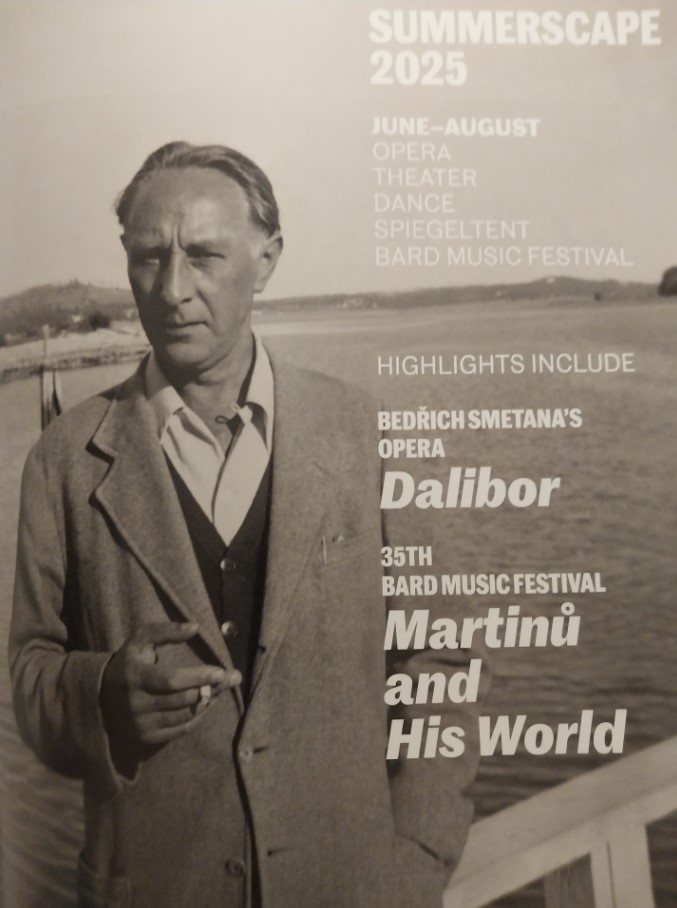
    The festival is the crown jewel in the diadem of Bard SummerScape, Bard’s annual celebration of the arts, which will take place July 27- August 17. Fans of Czech music will also eagerly anticipate a fully-stage production of Bedřich Smetana’s “Dalibor,” that will precede the Martinů festival, July 25-Aug 3.

    https://fishercenter.bard.edu/whats-on/programs/summerscape/

    Some of the events, including one of the performances of “Dalibor” will be available for livestreaming.

    The sleeping giant stirs. Set your alarms for Martinů!

    Fisher Center at Bard

  • Ives at 150 TŌN Conducts a Mixed Bag

    Ives at 150 TŌN Conducts a Mixed Bag

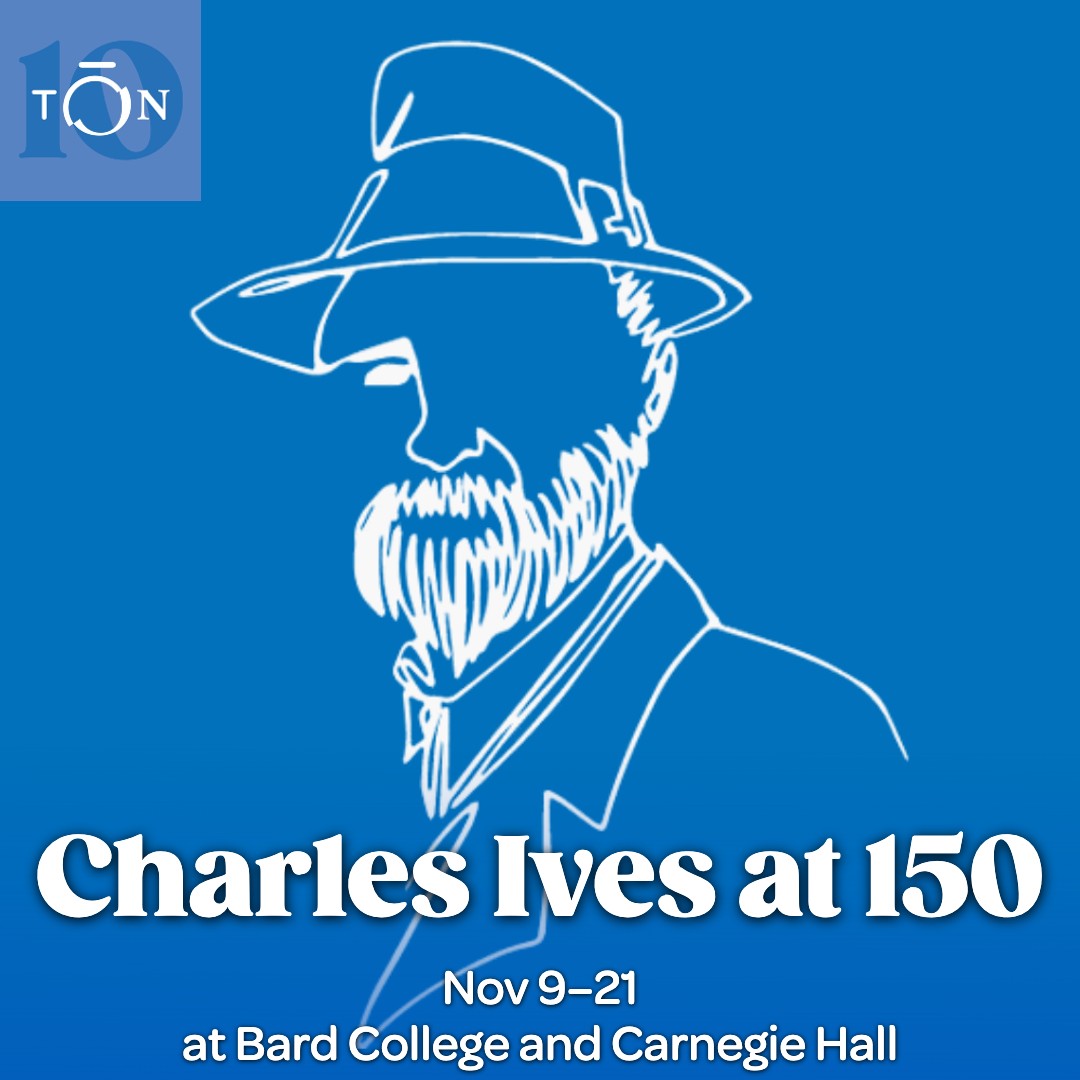
    It was a damp trek to Carnegie Hall last night for an all-Ives concert with The Orchestra Now (TŌN). But I would have traveled through driving snows to attend it. As you may be aware at this point, this year marks the 150th anniversary of Ives’ birth (on October 20th). Ives was not only one of America’s most venerated and wholly unique composers, he was also a pioneer in the field of life insurance. Thankfully, no one was injured in the performance of last night’s music.

    Ives’ day job allowed him the freedom to experiment wildly in his more ambitious compositions. The first half of program was devoted to wave after wave of controlled chaos – layers of sound, clashing harmonies, confused rhythms, and disorienting spatial effects – with of course plenty of recognizable hymn tunes, parlor songs, and patriotic marches tossed into the mix.

    “The Fourth of July” is evocative of “a boy’s Fourth” in Danbury, Connecticut, in the decades following the Civil War. (In Ives’ commentary he fondly recollects fingers blown off, widespread drunkenness, and a fire at the town hall.) “Central Park in the Dark” juxtaposes the pursuits of man, represented by musical glimmers overheard in the middle distance (including the ragtime hit “Hello, Ma Baby,” still recognized by those of us who grew up with Merrie Melodies’ Michigan J. Frog), against a transcendental backdrop of strings, representing the eternal and ineffable. The Orchestral Set No. 2 concludes with the composer’s impressions of an episode he experienced in New York on the day the Lusitania was sunk (torpedoed by a German U-boat), killing over a thousand people. The news inspired a mass of commuters from all walks of life to spontaneously join in the singing of “The Sweet By-and-By.”

    These were all masterfully rendered by The Orchestra Now, actually a Bard College graduate program, with the performers advertised as products of the world’s top conservatories. They were conducted by the orchestra’s founder and music director, Leon Botstein, who is also Bard’s president. Botstein is a brilliant and versatile thinker and always an engaging, entertaining, and often provocative speaker. He has great ideas. But there are occasions when his questing intellect seems to get in the way of the more animal enjoyments: a deeper delve into the heart of the music and a visceral commitment to its sweep and passion. The performances of the three pieces I mention above left nothing to be desired. They were cacophonous, by turns hilarious and awe-inspiring, and in the end sublime.

    However, on the concert’s second half, when he came to conduct Ives’ Symphony No. 2, a work so rich in romance and nostalgia – as a breathtaking distillation of all the music, classical, sacred, and vernacular, that made Ives the unique composer he was – interpretively, I felt Botstein came up rather short. The orchestra played well, all the notes were in place, but much of the work was underarticulated. In a word, it lacked panache, and as a result, its character suffered.

    This is frankly surprising, in that the concert was presented in a similar manner to those that make up the superlative Bard Music Festival (presented every August at Bard, with the emphasis on a different composer and his or her world). In this case, Ives authority J. Peter Burkholder (eminent Ives scholar and president of the Charles Ives Society) provided pre- and inter-performance commentary, and baritone William Sharp sang a number of the songs and hymns assimilated into Ives’ compositions (with Daniel Berman, another Ives authority, at the keyboard). Burkholder would make a point, Sharp would sing, and then Botstein would cue the orchestra to play a corresponding passage, prior to the performance of the complete piece. (Also before the symphony, Sharp, in fine voice all evening, provided an unexpected bonus in an old favorite from Ives’ 117 songs, “The Circus Band.”)

    So our ears were attuned; but then, during the actual performance, when it came to those parts of the symphony we were told to listen for, the details were frequently just glossed over. (The brisk tempo of the opening Andante moderato did not bode well.) As a result, the work came across as mostly indistinguishable from the competent but hardly outstanding symphonies of the composers of the Second New England School, from which, on an academic level (Ives studied with a long-suffering Horatio Parker at Yale), Ives sprang, rather than one of our truly great American symphonies. It lacked poetry and it lacked resonance. (Interestingly, on this rainy night, it appeared that Botstein never removed his galoshes. It became an inadvertent metaphor for his practical, even earthbound, approach to musicmaking, at least on this particular occasion.)

    Granted, I cut my teeth on Leonard Bernstein’s early recording of the symphony, on Columbia Records, and Lenny often went out of his way to make a piece of music his own, often to the extent of making little alterations to suit his sense of drama and wringing everything out of it and then some. Undoubtedly this colors my perception. It’s fairly common for anyone who loves a piece of music to hold the first performance of it he or she ever heard on a pedestal, especially if it’s a recording made familiar through countless repetitions. But I have heard my share of recorded performances of Ives’ 2nd, and this was not one of the great ones. (At least it was not janglingly wrongheaded, like Bernard Herrmann’s.)

    I am thankful to Botstein for the outstanding program and for so much else that he does so very well. I hasten to add, this was the first time, in 40 years of concertgoing, that I heard ANY of these pieces played live. So that’s a big win. It was a concert with much to recommend and a very special evening. But a genuinely transcendent performance of the symphony would have sent me out of the hall oblivious to the raindrops and walking on air.


    PHOTOS: Concert poster; Classic Ross Amico, doing his best Andy Capp impression; and a pre-concert conversation with, left to right, baritone William Sharp, pianist Daniel Berman, Ives scholar J. Peter Burkholder, and conductor Leon Botstein. Thanks to Paul Moon for the latter two photos!

  • Finally Hearing Ives’ Symphony No. 2 Live

    Finally Hearing Ives’ Symphony No. 2 Live

    In the comments under my post of October 20 – Charles Ives’ 150th birthday anniversary – I was made to realize that in my 40 years of concertgoing I have never heard an Ives symphony live. How can this possibly be? It’s not like I wasn’t living in a good place, with the Philadelphia Orchestra and the New York Philharmonic at my disposal. But I missed the Ormandy days in Philly (his associate, William Smith, conducted Ives’ 2nd in 1983, the year before I moved there) and the cost and time investment to get to New York, with a pain-in-the-ass train transfer in Trenton, meant that trips in to “the City” were rare. (Bernstein programmed and recorded Ives’ 2nd at Avery Fisher Hall in 1988.)

    So imagine my excitement when my friend, H. Paul Moon – the filmmaker with whom I’ve been working on a documentary about the cellist Leonard Rose – contacted me to let me know that Leon Botstein and The Orchestra Now (TŌN) would be bringing Ives’ 2nd as part of an all-Ives concert to be performed at Carnegie Hall tonight. His email began, “Small thing here, nothing special, and there’s always another time, but…”

    My response was through-the-roof excitement.

    It so happens, I did notice that TŌN was scheduled to perform the same program at Bard College last weekend – the college is also the base of the Bard Music Festival I so adore (next summer the focus will be on the Czech composer Bohuslav Martinu and his world) – but getting there on a good day is a three-hour drive, and I would have gone on a Sunday afternoon, which would have meant automatic end-of-weekend traffic on my return. So I was on the fence about it – they do so many good concerts up there (of course, many of them are livestreamed, but it’s not the same as being in the hall, at the Fisher Center at Bard) – but when I learned they would be bringing the show to Carnegie, I didn’t even have to think about it. I didn’t even look at my schedule. If I had anything else planned, I would change it. I’m in!

    And what a program! “The Fourth of July.” “Central Park in the Dark.” The Orchestral Set No. 2. And THE SYMPHONY NO. 2!!! Pardon me for shouting, but this is quite simply not only one of my favorite American symphonies; it’s one of my favorite symphonies by anyone, anywhere, for all time.

    Everyone knows Ives the iconoclast, the experimentalist, the cranky Yankee who smashed harmonies and rhythms together like a recalcitrant toddler with its toys in a playpen. But the Symphony No. 2 is different. It distills all of Ives’ musical experiences into one beguiling work that’s like a snapshot of a faded America, with its hymn tunes, parlor songs, and patriotic marches, recollected through a nostalgic, but no less vital for it, glow.

    It also serves as a portrait of the artist as a young man, assimilating works by Bach, Beethoven, Brahms, Wagner, Dvořák, Bruckner, and others. So if you were ever curious to hear Beethoven’s 5th Symphony and Wagner’s “Tristan und Isolde” rub shoulders with “America the Beautiful,” “Camptown Races,” “Turkey in the Stray” and “Columbia, the Gem of the Ocean,” then this is the symphony for you. Truly, the more you know about music, the more you’ll be able to get out of it.

    All that aside, the music is simply gorgeous, transporting, and exciting – of its time, and perhaps even now (though a lot of the allusions will likely be lost on many), quintessentially American. For me, this is a perfect Thanksgiving concert.

    Before each piece, baritone William Sharp will sing some of the songs Ives references. There will be a pre-concert talk at 6:00, with the performance beginning at 7:00.

    Of course, any time I’ve got a ticket to Carnegie Hall, it rains. I’d say there’s a good 90 percent chance of that happening, always. Well over a month, probably six or seven weeks, without rain in New Jersey, and now there’s rain in the forecast for today and tomorrow. Next time there’s a drought, just buy me a ticket to Carnegie Hall.

    I’ll try to add a picture of the poster tonight.

    For more information about the concert, look here:

    https://www.carnegiehall.org/Calendar/2024/11/21/The-Orchestra-Now-0700PM

    Leonard Bernstein introduces Ives’ Symphony No. 2

  • Berlioz’s Crazy Genius at Bard Festival

    Berlioz’s Crazy Genius at Bard Festival

    Hector Berlioz was not the kind of guy to always go about things the way you might expect. For instance, if you wanted to impress a prospective lover, would you think it would be in your best interest to write a programmatic symphony, in which your obsession with her drives you to overdose on opium? Then, under its influence, to dream about murdering her, so that you’re condemned to execution by the guillotine? Then to vividly illustrate being tormented in the Hereafter by her spirit, now transformed into a jeering, cackling witch?

    Well, Berlioz, arch-Romantic that he was, was a guy who followed his gut. And what do you know, it worked! The Shakespearean actress Harriet Smithson, who inspired the piece (even though Berlioz didn’t speak English and she couldn’t speak French), said “I do.” Some chicks dig the crazy.

    Not that they lived happily ever after. I know, who could have predicted it?

    Anyway, this is the backdrop to Berlioz’s “Symphonie fantastique,” his most famous work, and it kicked off the Bard Music Festival, “Berlioz and His World,” at Bard College’s Fisher Center for the Performing Arts on Friday night. Leon Botstein, founder and co-artistic director of the festival (and president of Bard College), conducted The Orchestra NOW (TON for short), Bard’s graduate-level training orchestra.

    As is so often the case, if you own a recording of the piece, for as transporting as it might be, it just isn’t the same as hearing it live. Reencountering Berlioz’s forward-looking symphony (which must have caused heads to explode in 1830) blew my hair back, or what’s left of it, again and again. It’s hard to believe I once had a coif every bit as impudent as the composer’s. Why, it seems like only yesterday…

    But I digress.

    With its faltering chromatic harmony, beefed-up orchestra (for the period), Beethovenian length, and outlandish instrumental effects, it pushed the envelope decades into the future. Wagner (among others) glommed onto Berlioz, but the composer’s legacy truly flourished with the generation of Gustav Mahler, nearly 70 years later. That’s an entire lifetime. His concept of the “idée fixe,” a recurring motif that intrudes on the flow of every movement, signifying unbidden remembrances of the composer’s beloved, was also influential.

    On to the performance at hand: I may have heard wilder ones, but none quite so visceral. With the strings at stage level, the rowdier instruments were positioned on risers, and the bass drums in particular were like volcanoes that exploded into the audience. The chimes that herald the “Dies Irae,” a presentiment of the doom if ever there was one, were immediate and chilling. It was great fun to watch the strings put through their diabolical repertoire of col legno, con sordino, pizzicato, tremolo, and double stopping, and the ensemble was able to bring the energy to put the piece over the top and bring a sense of abandon at its peak moments.

    Also notable was the inclusion of the obbligato cornet in the second movement, the one in which composer’s pangs of longing contrast with the spirited whirl of festivity at a ball, a touch seldom employed. Apparently Berlioz added the cornet (perhaps for the virtuoso Jean-Baptiste Arban), but it never made it into the published score in the composer’s lifetime. I love you, Berlioz, but in this instance I think your original conception was best. For me, the cornet brings unfortunate associations with the gazebo or the boardwalk, and also obscures the elegance of this waltz through the composer’s haunted mansion – but it was ear-opening to hear the alternative version for once at Bard. Part of the festival’s mission, after all, is to be a platform for scholarly inquiry and display. If the movement were going to be done this way, this was definitely the context in which to do it. (I believe the cornet soloist was Jid-anan Netthai, but this I will have to confirm.)

    I confess, I had my reservations about starting the festival with such a substantial and well-known piece. When the program was first announced, I was puzzled as to why Bard, known for its exploration of unusual and the neglected repertoire, would open its festival with Berlioz’s greatest hit. But in the event, it certainly paid off and got blood pumping. I also realized after a moment’s reflection, its inclusion provided the necessary context for the full appreciation of the seldom-encountered “Lelio,” which was heard on the second half of the concert.

    A sequel of sorts to the “Symphonie fantastique,” “Lelio, or the Return to Life” comes across as a much more self-indulgent affair, if only because of the extensive dramatic commentary allotted to the narrator. Again, this is a heavily autobiographical piece. Unfortunately, if you take away all the lofty references to art and Shakespeare, it’s basically the whiny “reflections” of a lovelorn 20-something.

    The Bard presentation made it even more so. I have nothing against Babe Howard (the son of Debra Winger), who was presumably a late substitute for the scheduled narrator, Wyatt Mason, and I wish him all the best with his career. But here he came across as sorely miscast and underprepared, to the extent of not perhaps fully understanding the character of the figure he was meant to portray. I can think of no lower compliment than to say that I could have done it just as well myself. (I too spent much of my twenties as lofty, whiny, and lovelorn.) For me, it was just too much of a stretch to accept him as the convincing alter ego of a seething, half-mad artist, emerging from an opium-induced nightmare to grasp his breaking heart. About the only thing he played convincingly was young. Also, he didn’t impress me much as an actor accustomed to appearing on the stage. That’s not to say the technique will not come, but I imagine he would be much more at home in something more contemporary.

    That aside, the music was fascinating, and very well performed. Having previously known “Lelio” only from recordings – especially Jean Martinon’s, in which the narrator delivers his part in French – it was as if the scales had fallen from my eyes. THIS is what Bard is all about! I’ve aired the concluding “Fantasy on Shakespeare’s ‘The Tempest’” on my radio shows many times, but I had no idea the entire score was so varied and beautiful, with the quality of the music quite high. That said, it’s impossible that it will ever secure a place in the public’s affection equal to that enjoyed by the “Symphonie fantastique,” especially as presented here, as the composer originally intended, emulating the salon format, so popular in that era, but also in the guise of a melodrama, a largely-defunct genre in which narration and music are combined to form a cohesive dramatic statement.

    As always, the Bard Festival Chorus and vocal soloists were first-rate, with bass-baritone Alfred Walker delivering a lusty “Brigands’ Song” and tenor Joshua Blue (who returned on Saturday night to solo in Berlioz’s “Te Deum”) lending further allure to “The Fisherman Ballad” and the “Song of Happiness.” The cumulative effect was one of magnification of the impressive range of Berlioz’s genius, which ranges well beyond the heaven-storming orchestral works that are so well known, especially as a composer for voice.

    I pause to wonder: whatever happened to the brigand, anyway? It’s a career that seems to have gone the way of the melodrama.

    All in all, a rewarding, often captivating, and at times even thrilling evening, and presented in a manner that Bard has perfected over the past 33 seasons. Bravo, and more, please!

    The Bard Music Festival continues through August 18. For more information, follow the link.

    https://fishercenter.bard.edu/whats-on/programs/bard-music-festival/

    Fisher Center at Bard

Tag Cloud

Aaron Copland (93) Beethoven (95) Composer (114) Film Music (125) Film Score (143) Film Scores (255) Halloween (94) John Williams (189) KWAX (229) Leonard Bernstein (101) Marlboro Music Festival (125) Movie Music (140) Opera (202) Philadelphia Orchestra (89) Picture Perfect (174) Princeton Symphony Orchestra (106) Radio (87) Ralph Vaughan Williams (85) Ross Amico (244) Roy's Tie-Dye Sci-Fi Corner (290) The Classical Network (101) The Lost Chord (268) Vaughan Williams (103) WPRB (396) WWFM (881)

DON’T MISS A BEAT

Receive a weekly digest every Sunday at noon by signing up here


RECENT POSTS