When the Hungarian pianist Tamás Vásáry died last week, I had too many other obligations to honor him properly.
Vásáry was a child prodigy who entered the Debrecen Conservatory at the age of 6. At 10, he became a student of Ernő Dohnányi. He was personally supervised by Zoltán Kodály at the Franz Liszt Academy. He graduated in 1953. In 1956, the year of the Hungarian Uprising, Vásáry fled to Switzerland. Later, he made his home in London.
In the U.K., he diversified. With Iván Fischer, he shared the title of joint principal conductor of the Northern Sinfonia from 1972 to 1982. He was principal conductor of the Bournemouth Sinfonietta from 1989 to 1997. Beginning in 1993, he also served as principal conductor of the Hungarian Radio Symphony Orchestra.
As a pianist, he toured widely. His international fame was bolstered by a recording contract with Deutsche Grammophon.
I remember in the 1970s and ’80s, Vásáry’s early recordings were already being reissued at budget price, making them very affordable. It was the heyday of soft-focus, Elvira Madigan-type cover art. His performances were further disseminated on grab-and-go cassettes.
Chopin and Liszt were always central to his repertoire.
Performing Debussy, Chopin, and Liszt on the French television series “Les grands interprètes”
At the age of 80, playing the last movement of Chopin’s Piano Sonata No. 3
In writing this, I am wondering if it’s more accurate to state that fountains burble or gurgle? This is the kind of heavy-lifting I do behind the scenes to make my light music shows seem so buoyant and effortless.
This week on “Sweetness and Light,” as I weigh the finer points, peering through the magnifying glass into my O.E.D., I hope to lessen your own burdens with a refreshing and restorative playlist for the hazy, lazy days of summer. Join me for an hour of “fountain” music by Robert Farnon, Franz Liszt, Maurice Ravel, Charles Tomlinson Griffes, Hans Christian Lumbye, Arthur Meulemans, and Carl Bohm. I’m deliberately omitting Respighi, since it was his birthday on Wednesday, and someone is bound to have programmed “Fountains of Rome” – but fear not, the opulence of Meuleman’s “Pliney’s Fountain” will give old Ottorino a run for his money!
I may be a fount of indecision, but you can be certain of plenty of burbling or gurgling music on “Sweetness and Light,” this Saturday morning at 11:00 EDT/8:00 PDT, exclusively on KWAX, the radio station of the University of Oregon!
IMAGE: “Doves of Pliny” from Hadrian’s Villa in Tivoli, after second century BCE mosaic by Sosus of Pergamon (reproduced many times)
FUN FACT! IMPRESS YOUR FRIENDS! Tivoli was also the location of the villa that inspired Liszt’s “Les jeux d’eaux à la Villa d’Este” (“The Fountains of the Villa d’Este”), also to be heard in this hour.
Alfred Brendel was taller and had a better sense of humor than one would ever anticipate from the somber expression he wore on so many of his album covers. He was often described as “cerebral,” but what he really liked was to laugh. I guess that image would have jarred with the marketing strategy of Philips Records. They always had him looking way too serious as he recorded way too much Beethoven. Back in the day, Brendel was the first to record Beethoven’s complete piano music. Then he recorded the sonatas again. And then again.
His fame paralleled the rise of the LP. It’s interesting that many of his earlier recordings were in muddy sound for the Vox label. That said, the repertoire was often much more stimulating than that on the digital recordings he made later in his career. (For Vox, he set down first recordings of Franz Liszt’s “Christmas Tree Suite” and Prokofiev’s Piano Concerto No. 5.) Also, the performances seemed more spontaneous, or perhaps simply more vibrant. Later, he was always reliable, if not always the most thrilling interpreter. Cerebral became a handy euphemism.
Handily, the compact disc arrived for Brendel at mid-life, just as he had reached maturity. The improved technology allowed him to go back and document much of his core repertoire in clean, modern sound. By extension, he was a regular presence on classical radio, and millions became familiar with him through his interpretations of Haydn, Mozart, Beethoven, Schubert, Schumann, Liszt, Brahms, and perhaps most interestingly, Schoenberg.
When he retired in 2008, at the age of 78, he had been struggling with arthritis and back pain, but he was still at the top of his game, one of the few classical artists still guaranteed to pack an auditorium. He appeared at Carnegie Hall no less than 81 times. Twice, he performed the complete Beethoven sonatas there.
I don’t think it’s possible to love classical music and not respect Alfred Brendel. The man was an interpretive artist of the highest caliber. He also sold lots of records during an era when his very existence helped contribute to the viability of keeping a classical music section in most record stores.
He looked pretty much like what anyone imagined a pianist to be: bespectacled, crowned with a disheveled widow’s peak, and improbably tall and lank. He was the living embodiment of an absent-minded professor. But the man, better-read than most, also possessed a keen sense of humor. He was a fan of Edward Gorey and Charles Addams and Gary Larson. He collected kitsch and newspaper bloopers. He went on record as stating that his favorite occupation was laughing.
Alongside his many thoughtful essays on musical subjects (including at least one on humor in music), he published two volumes of epigrammatic poetry, “One Finger Too Many” and “Cursing Bagels.”
One of the most celebrated pianists of his day (and that’s saying something), Alfred Brendel died this morning, peacefully at his home in London, at the age of 94.
R.I.P.
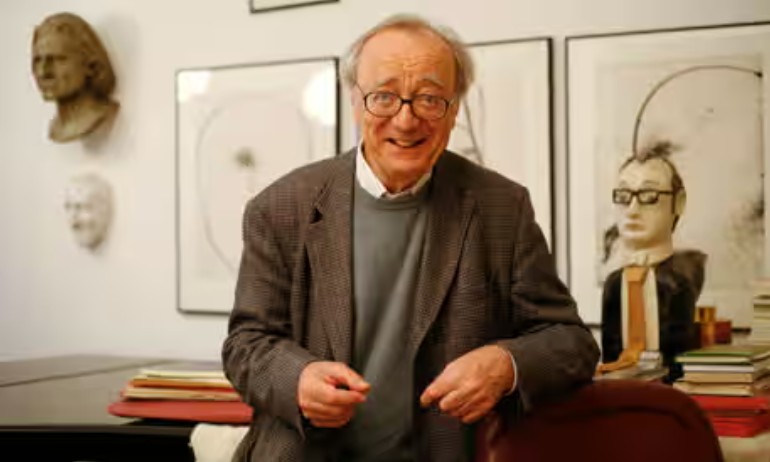
PHOTO: Brendel, flanked by Liszt (left) and Eugene Jardin’s whimsical “Gipsbrendel”
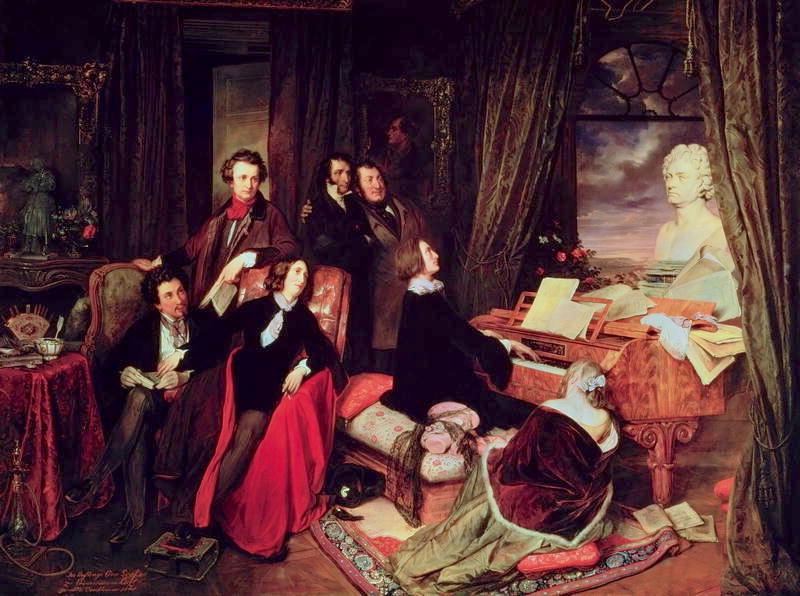
On Beethoven’s birthday, here’s “Liszt at the Piano,” a famous painting, oil on wood, by Josef Danhauser, who lived from 1805 to 1845. Depicted is quite the salon, with, left to right, writers Alexandre Dumas, Victor Hugo, and George Sand; violinist Niccolò Paganini; with his arm around him, composer Gioachino Rossini; at the keyboard, the titular Franz Liszt; and at Liszt’s feet, his mistress during his Paris years, the Comtesse Marie d’Agoult – also a writer (who published under the name Daniel Stern) and the mother of Liszt’s three children. Their daughter Cosima would marry the conductor Hans von Bülow and then leave him for Richard Wagner.
Why am I posting a painting of Liszt and his peeps to celebrate Beethoven? Take a gander at that surreal, luminous bust floating outside the window. Yes, that’s right – it’s the likeness of Ludwig van, remarkably similar to the famous bust sculpted in 1821 by Anton Dietrich.
The painting was completed in 1840, 13 years after Beethoven’s death. Everyone else depicted would have still been alive – actually Paganini died the same year – with the exception of Lord Byron (if you look closely, you’ll see his gilt-framed portrait behind Rossini), who died of fever in 1824, while fighting for the cause of Greek Independence against the Ottoman Empire.
What is the point of this gathering of super-artists? Were they all even ever in the same room together? Where is Sand’s lover, Frédéric Chopin? Why Rossini and not Hector Berlioz, who was a friend and beneficiary of both Paganini and Liszt? (Actually, there is some question as to whether that might not be Berlioz and NOT Hugo between Dumas and Sand.)
I can only assume Rossini’s inclusion is because he actually made the pilgrimage to meet Beethoven, who was inadvertently condescending in praising Rossini’s “The Barber of Seville,” but dismissive of any attempt at serious opera by Italian composers. (Anyone who’s read Berlioz’s Memoirs knows that Beethoven wasn’t alone in this, though Berlioz adored Spontini and Beethoven owed a thing or two to Cherubini.) But beyond that, Rossini’s standing in this company is tenuous at best.
One of the privileges of painting is that an artist can conjure truths that transcend mere photographic realism. (You don’t really think about cameras being around at this time, but Chopin was photographed not too long after.) Obviously, Danhauser intended this as a kind of Pantheon of the Romantics. (Why else include Byron?) All of them are transfixed, enraptured even, by the music conjured by Liszt at the piano. All of them look to Beethoven as a spiritual father.
Beethoven, more than any other composer, was seen as a bridge from 18th century Classicism – the tidy, rational Enlightenment – to a new age of sensation – intensity of feeling, raw passion, and heaven-storming aspiration. His personal struggle was evident. Perfection did not come easily to Beethoven. He grappled with it. And he captured that struggle in his music. In struggling to express what he was compelled to express, he pushed hard through countless trials to forge new paths. Plagued by deafness, he remained defiant. Unbowed, he transcended personal and human limitations to express the sublime in all of us. His indomitable drive and achievement caused him to be perceived by many as the proto-Romantic. The development from his Haydnesque Symphony No. 1 to the Mahler-in-utero Symphony No. 9 is one of the great artistic journeys of all time. And those late string quartets? Fuhgeddaboudit.
One of the scores on Liszt’s piano is the slow movement from Beethoven’s Piano Sonata No. 12. It bears the superscription “Marcia funebre – Sulla morte d’un Eroe” (“Funeral March – On the death of a Hero”).
Beethoven’s heroism has burned with Promethean daring for artists and listeners who, down the ages, have sought affirmation of, and consolation in, the inherent possibility of all that is great in humanity.
That’s my lofty observation. The painting was actually commissioned by Conrad Graf, a piano builder, so it also functions on the more mundane level as an advertisement!
Happy birthday, LvB.
Piano Sonata No. 12, Movement III: “Funeral March – On the death of a Hero”
Some time ago, I also wrote about the meeting of Beethoven and Liszt
Who knew it would turn out to be such a stressful season for so many? To be honest, no matter how things played out, I guess we all knew. We’ll try to dial it down a bit this week on “Sweetness and Light,” and clear our heads for an hour of musical consolations.
No, really. Franz Liszt’s “Consolations” will be among our featured works. So will Scott Joplin’s “Solace.” Composer Rick Sowash reached out to me in the spring to bring to my attention the fact that he had written a piece called “Sweetness and Light.” I thought it would be a good time to include that, too. We’ll find further affirmation in nature, friendship, and a good walk.
At our peaceful core is “Sweetness and Light.” Regain your footing and find your center. It’s a celebration of fragile beauty in a turbulent world, this Saturday morning at 11:00 EST/8:00 PST, exclusively on KWAX, the radio station on the University of Oregon.