Tag: Movie Soundtracks

  • De Palma’s Thrillers Music from Hitchcock’s Heir

    De Palma’s Thrillers Music from Hitchcock’s Heir

    Brian De Palma is an extraordinarily adept filmmaker, who has been criticized for his adherence to “genre trash.” He has always been attracted to suspense and crime thrillers, usually of an especially violent nature, many of them tinged with horror.

    This week on “Picture Perfect,” with Hallowe’en right around the corner, we’ll hear music from four of De Palma’s films.

    It’s hardly surprising that such an admirer of Alfred Hitchcock would also hire Hitch’s signature composer. Bernard Herrmann scored two films for De Palma – “Sisters,” in 1973, and “Obsession,” in 1976.

    “Obsession” is a spin on Hitchcock’s “Vertigo.” A botched rescue attempt results in the death of a businessman’s kidnapped wife. Years later, he encounters someone who could be her doppelganger. The film stars Genevieve Bujold, John Lithgow, and a very tan Cliff Robertson.

    “The Fury,” from 1978, is a supernatural thriller based on a novel by John Farris. Two teenagers, endowed with powers of telekinesis and extra-sensory perception, are targeted by researchers who plan to harness them for their own nefarious ends. For a time, Kirk Douglas has fun as a former CIA agent, and John Cassavetes is a particularly slimy villain. Cassavetes’ comeuppance makes for one of the most memorable movie endings of its era – and we’ll leave it at that!

    Critic Pauline Kael praised the music, which is by none other than John Williams – hot off his third Academy Award, for “Star Wars” – characterizing it as “as elegant and delicately varied a score as any horror film has ever had.”

    Of course, “The Fury” was not the first De Palma film to deal with telekinesis. His adaptation of Stephen King’s “Carrie,” from 1976, became one the decade’s landmark horror films. It broadened King’s popularity and propelled De Palma into the A-list of Hollywood directors. It also essentially launched the careers of Amy Irving, John Travolta, and Nancy Allen, among others. Sissy Spacek was nominated for an Academy Award for her performance in the title role, as was Piper Laurie as Carrie’s overbearing, fundamentalist mother.

    The music was by Pino Donaggio. The director had wanted to continue his collaboration with Herrmann, but the composer died before the film could be completed. Donaggio, though classically trained, made his fortune writing popular songs. His biggest hit was “You Don’t Have to Say You Love Me,” which was recorded by Dusty Springfield and treated to a well-known cover by Elvis Presley. Donnagio went on to become a regular De Palma collaborator, providing the music for seven of his films.

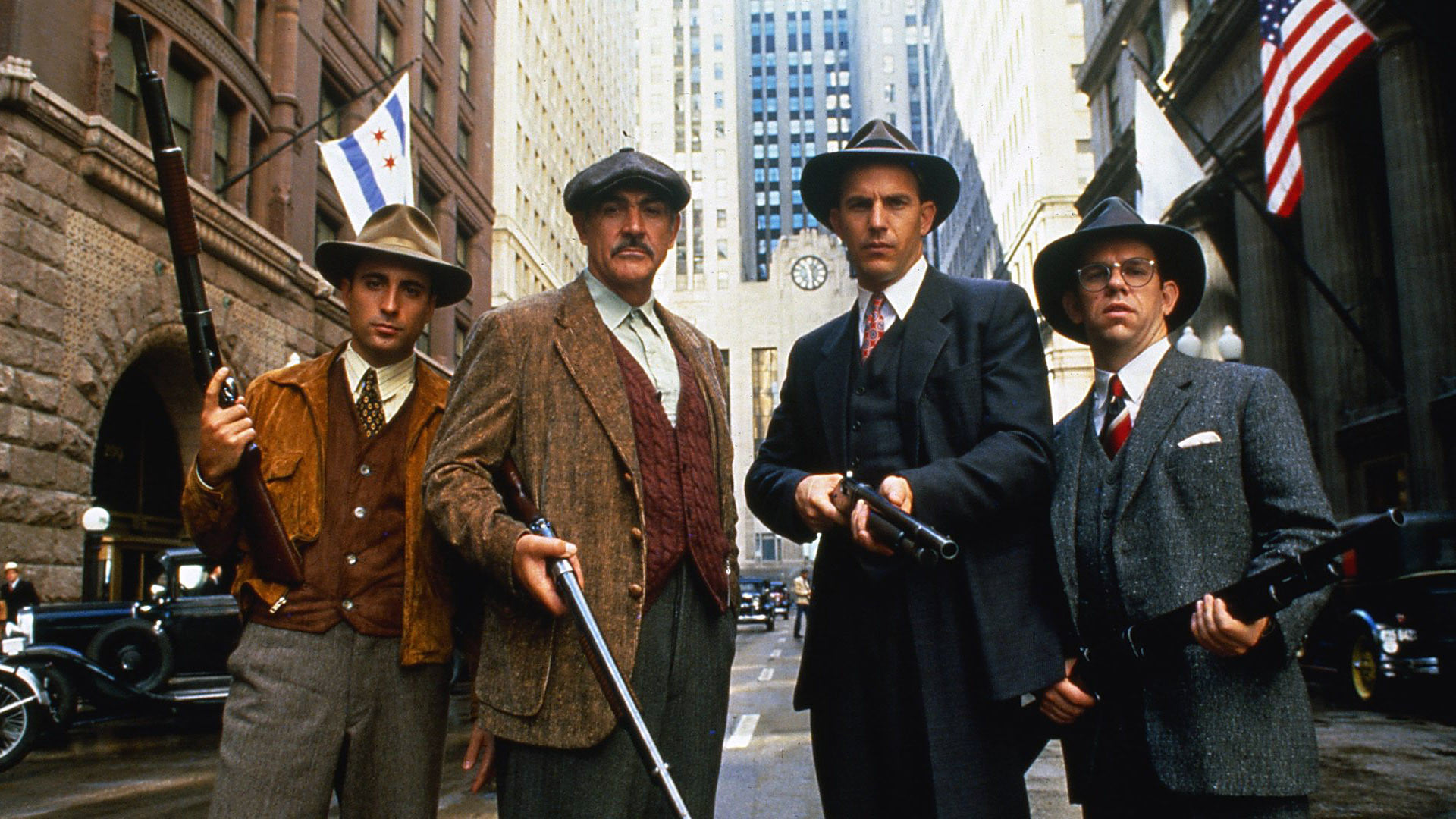
    Finally, we’ll turn our back on horror, to listen to music from a successful period crime thriller, loosely based on the real-life exploits of Eliot Ness and his fellow prohibition agents – “The Untouchables,” from 1987. Kevin Costner plays the by-the-book federal agent who is given a valuable lesson in street smarts by an Irish beat cop played by an Academy Award winning Sean Connery. (“He pulls a knife, you pull a gun. He sends one of yours to the hospital, you send one of his to the morgue. That’s the Chicago way, and that’s how you get Capone.”) Capone is played, incidentally, by a baseball bat wielding Robert De Niro.

    The score is by Ennio Morricone. Morricone, of course, was propelled to fame through his work on Sergio Leone’s spaghetti westerns. He applies some of that same mythmaking skill to this big screen adaptation, which had previously been published as a memoir and developed into a popular television series starring Robert Stack. The high point of the film must be the director’s nail-biting homage to Sergei Eisenstein, a slow motion shoot-out around a baby carriage as it teeters down the stairs of Chicago Union Station.

    Start your weekend with a step in the right direction, with music from the films of Brian De Palma, on “Picture Perfect,” this Friday evening at 6:00 EDT, on WWFM – The Classical Network and wwfm.org.

  • Oscar’s Best Film Scores Celebrate Movie Music

    Oscar’s Best Film Scores Celebrate Movie Music

    And the winner is… us!

    It’s that time of year again.

    Regardless of how you may feel about the current state of the movies, the #AcademyAwards are always an excellent excuse to cast a nostalgic look back on Oscar history.

    This week on “Picture Perfect,” there will be plenty of popcorn and champagne to go around, but true nourishment will be served up in the form of a SPECIAL THREE-HOUR PLAYLIST encompassing the best of the best. We’ll sample from all five of this year’s nominees for Best Original Score, of course, but also revel in music from some of the most honored and beloved classics of all time – including “The Godfather,” “Star Wars,” “Titanic,” “The Lord of the Rings,” “Lawrence of Arabia,” “Ben-Hur,” and “Gone with the Wind.”

    Whether or not the movies’ best days are behind them, we’ll find plenty to celebrate with THREE HOURS OF QUALITY FILM MUSIC, on a special expanded edition of “Picture Perfect” – this Friday only, from 4 to 7 p.m. EST – on WWFM – The Classical Network and wwfm.org.
  • Small Town Secrets Movie Soundtracks

    Small Town Secrets Movie Soundtracks

    This week on “Picture Perfect,” our unifying theme is two-pronged, as we explore the dark underbelly of small-town life and the consequences of bucking conformity.

    The events of “Peyton Place” (1957) unfold in a picturesque New Hampshire town, in which all sorts of sordid goings-on roil beneath the surface. Grace Metalious’ runaway bestseller spawned a film, starring Lana Turner, and also a subsequent TV series, with Mia Farrow. Neither version is nearly as seedy as the original, which was about an idyllic New England community whose residents have more than their share of skeletons in the closet. The score includes one of Franz Waxman’s best-known themes.

    “Far From Heaven” (2002) is set in a Connecticut suburb during the 1950s. Therefore, it makes sense that the filmmakers deliberately attempted to conjure the vibe of a Douglas Sirk film. In common with Sirk melodramas like “All That Heaven Allows” and “Imitation of Life,” “Far From Heaven” deals with social issues, in this instance regarding race, class, gender roles and sexual orientation.

    The score was the last by the great Elmer Bernstein, who had actually been composing for film since the ‘50s. Over the course of his career, he was nominated for 14 Academy Awards. Despite his work on such classics as “The Ten Commandments,” “The Magnificent Seven” and “To Kill a Mockingbird,” his only win would be for “Thoroughly Modern Millie,” of all things, in 1967. He received his final nomination for his work on this film.

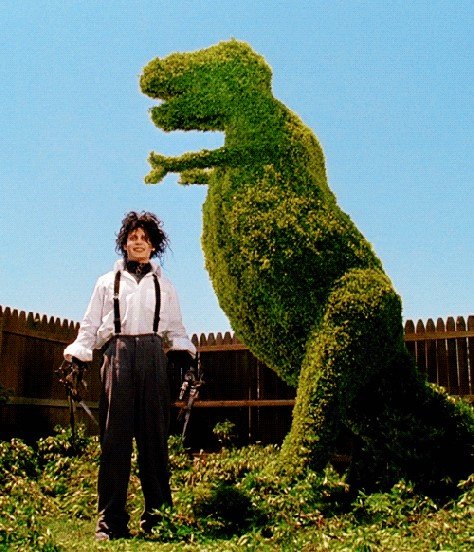
    “Edward Scissorhands” (1990) is Tim Burton’s satirical-yet-touching update of the “Frankenstein” tale, transported to a contemporary American suburb. An artificial man with unusual appendages gradually wins over his suspicious neighbors with his aptitude for hairstyling and lawn sculpture. However, things quickly go south. For the very differences for which Edward was briefly celebrated, he is now hunted by an angry mob.

    Burton presents a cookie-cutter suburbia, simultaneously tacky and anonymous. The houses are painted in faded pastels, and everyone follows the same routine. The score, by Danny Elfman, alternately antic and romantic, has proved to be one of his most memorable.

    Finally, we turn to “Kings Row” (1942), based on the novel by Henry Bellamann. The film is a spiritual forerunner, not only of “Peyton Place,” but also, to an extent, of David Lynch’s “Blue Velvet” and “Twin Peaks,” in the sense that it presents life in an idyllic small town that nonetheless casts some very long shadows.

    The film of “Kings Row” accomplishes a remarkable balancing act, in that it manages to maintain an air of hope and optimism, despite all the horrible things that happen to a number of the characters. In this sense, it pulls some of the punches thrown by the original book, in part as a concession to the Hays Code, which forced some of the rougher themes to be altered, dropped or implied. Bellamann’s novel is a much bleaker experience.

    The score was by Erich Wolfgang Korngold, at this point in his career associated with historical adventure films, as Errol Flynn’s regular composer. He wrote the brash theme music for “Kings Row” wholly in this vein, allegedly on an initial assumption drawn from the film’s title.

    Good fences make good neighbors. Join me for “Suburban and Small Town Blues” this week, on “Picture Perfect,” music for the movies, this Friday evening at 6:00 EDT, on WWFM – The Classical Network and wwfm.org.
  • Aquatic Horror Movie Soundtracks

    Aquatic Horror Movie Soundtracks

    Just when you thought it was safe to go back in the water…

    This week on “Picture Perfect,” it’s an hour of summer bummers, as I play to your fears of what lurks below.

    “Beneath the 12-Mile Reef” (1953) stars Robert Wagner, Terry Moore, and Peter Graves in a Romeo and Juliet story about two families of competing fishermen along the Gulf coast of Florida, one working class and of Greek origin, and the other a family of privileged WASPs. Gilbert Roland is the Greek patriarch who runs afoul of an improbably large octopus. Bernard Herrmann wrote the music, which employs no less than nine harps (one for each arm, and a spare).

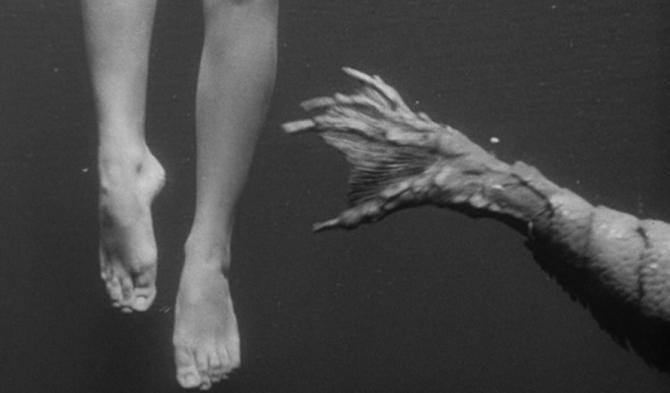
    A young Henry Mancini was one of three composers to work on “Creature from the Black Lagoon” (1954). Mancini, soon to be world famous for “Moon River,” “Baby Elephant Walk,” and “The Pink Panther,” was teamed with veteran film composer Hans J. Salter and Herman Stein. None of the three were credited on screen – typical of what was then considered just another low-budget B-movie.

    What can I say about John Williams’ masterful music for “Jaws” (1975)? It’s right up there with “Psycho” and “The Good, the Bad and the Ugly,” in terms of most recognized and most frequently parodied. Everyone remembers the primal shark theme, but what is sometimes overlooked is that “Jaws” is also one of the great adventure scores, the music effortlessly navigating the choppy waters of suspense, horror, and seafaring swashbuckler. The composer was recognized with a richly-deserved Academy Award (his second of five).

    The conflict in “The Swimmer” (1968) is not a giant octopus, nor a great white shark, nor a prehistoric gill man, but rather the progressive psychological breakdown of an upper middle class Connecticut man who believes he’s living the American Dream.

    Adapted from a short story by John Cheever, “The Swimmer” stars Burt Lancaster as the man, who acts on a quixotic impulse to travel all the way home, across county, by way of a network of suburban swimming pools. The adventure starts out well enough, with Lancaster and everyone he encounters full of optimism and fun; but the further he moves along his allegorical journey, the more the enterprise, the climate, and the people begin to grow cold.

    “The Swimmer” is a decidedly downbeat tale which could make the viewer as reluctant to dip a toe into a chlorinated in-ground swimming pool as the shark-infested waters of Peter Benchley’s Amity Beach. The score is by Marvin Hamlisch, of all people, and it suits the film brilliantly.

    Join me, if you dare, for an hour of aquatic traumas, on “Picture Perfect,” music for the movies, this Friday evening at 6:00 EDT, on WWFM – The Classical Network and wwfm.org.

  • Movie Music for Speed Demons

    Movie Music for Speed Demons

    What’s your hurry?

    This week on “Picture Perfect,” we’ve got the need for speed.

    We’ll hear music from the second of the “Mad Max” movies, “The Road Warrior” (1981), which cleverly changed the course of the series by turning it into a kind of post-apocalyptic Western. Australian composer Brian May wrote the music, as he did for the original. The director, George Miller, specified that he was looking for a gothic, Bernard Herrmann-type mood to underscore his dystopian vision of the Australian Outback.

    Maurice Jarre took over to write the music for the third installment, “Mad Max Beyond Thunderdome.” However, it’s purely by coincidence that we’ll hear selections from another Jarre score built for speed, “Grand Prix” (1966). The film’s international cast featured James Garner, Eva Marie Saint, Yves Montand, and Toshiro Mifune, but the plot’s assorted relationship and business conflicts take a back seat to driver’s-eye views of lapping the track.

    When we remember Steve McQueen, chances are, if he’s not jumping barbed wire on a motorcycle, he’s behind the wheel of his Ford Mustang GT 390 Fastback, tearing up and down the streets of San Francisco in “Bullitt” (1968). The high-octane action sequence became the yardstick against which all big screen car chases were measured (at least until “The French Connection”). Lalo Schifrin provided the jazzy score.

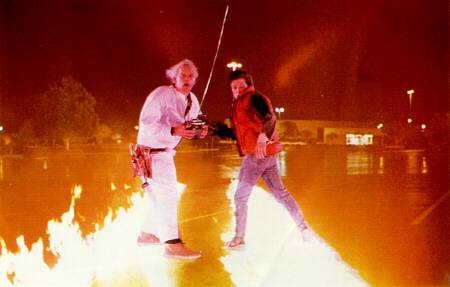
    Finally, Marty McFly and Doc Brown’s time-travelling DeLoreon needs to hit 88 miles per hour in order to get “Back to the Future” (1985). Director Robert Zemeckis had already worked with composer Alan Silvestri on “Romancing the Stone,” but the producer of “Back to the Future,” Steven Spielberg, didn’t care for the music in that film. Zemeckis’ advice to his colleague: go grand and epic, since Spielberg had a marked preference for the music of John Williams. It was a very good choice.

    I hope you’ll join me for an hour of chases and races, on “Picture Perfect,” music for the movies, this Friday evening at 6:00 EDT, on WWFM – The Classical Network and wwfm.org.

    Just be sure you’re not driving when you do!

Tag Cloud

Aaron Copland (92) Beethoven (95) Composer (114) Film Music (120) Film Score (143) Film Scores (255) Halloween (94) John Williams (185) KWAX (229) Leonard Bernstein (100) Marlboro Music Festival (125) Movie Music (135) Opera (198) Philadelphia Orchestra (88) Picture Perfect (174) Princeton Symphony Orchestra (106) Radio (87) Ralph Vaughan Williams (85) Ross Amico (244) Roy's Tie-Dye Sci-Fi Corner (290) The Classical Network (101) The Lost Chord (268) Vaughan Williams (103) WPRB (396) WWFM (881)

DON’T MISS A BEAT

Receive a weekly digest every Sunday at noon by signing up here


RECENT POSTS