Tag: Movie Soundtracks

  • Memorial Day Movie Music Tributes

    Memorial Day Movie Music Tributes

    It’s all about valor and sacrifice this week on “Picture Perfect,” as we anticipate Memorial Day.

    Memorial Day has its roots in Decoration Day, established in 1868 to honor the Civil War dead. We’ll hear music from “Glory” (1989), inspired by the extraordinary courage of Colonel Robert Gould Shaw’s 54th Massachusetts Voluntary Regiment, an all African American outfit that distinguished itself in an impossible assault on Fort Wagner, near Charleston, South Carolina. The outstanding cast features Morgan Freeman, Matthew Broderick, and Cary Elwes, with an Oscar-winning performance by Denzel Washington. The poignant score is by James Horner.

    Gary Cooper had one of his best roles as “Sergeant York” (1941), based on the true story of Alvin C. York, who went from backwoods hell-raiser to devout pacifist. After a period of soul-searching, York was able to reconcile his strong moral convictions with the unfortunate reality that sometimes it really is necessary to fight. He went on to distinguish himself on the battlefield and become one of the most-decorated soldiers of the First World War. The folksy score, evocative of York’s Tennessee roots, is by Max Steiner.

    In director Michael Cimino’s “The Deer Hunter” (1978), three men from a small Pennsylvania steel town serve in Vietnam, then struggle to cope with the war’s psychological impact. The harrowing film, especially memorable for its scenes of Russian roulette in a P.O.W. camp, won five Academy Awards, including Best Picture and Best Director. Christopher Walken was honored with the award for Best Supporting Actor. Stanley Myers wrote the music. We’ll hear his famous “Cavatina,” performed by guitarist John Williams, not to be confused with…

    … composer John Williams, who provided one of his sparser scores for “Saving Private Ryan” (1998). Steven Spielberg’s war-is-hell narrative yet manages to honor the sacrifice of the fighting men of World War II. The opening – a sustained “you-are-there” battle sequence on Omaha Beach – is unforgettable. Remarkably, it is presented wholly without music, Williams preferring to allow the tension of the mise-en-scène to speak for itself. Spielberg picked up his second Academy Award for Best Director. The film, however, inexplicably, lost to “Shakespeare in Love.”

    I hope you’ll join me for music from these cinematic meditations on the costs and consequences of war, as we honor the sacrifice of soldiers who died while serving in America’s armed forces, this Friday evening at 6:00 EDT, on WWFM – The Classical Network and wwfm.org.

  • Academy Awards Film Music Celebration

    Academy Awards Film Music Celebration

    Attention, film music fans: “Picture Perfect” is about to go epic.

    Join me this Friday afternoon on The Classical Network as I mark the 90th anniversary of the Academy Awards with a SPECIAL THREE-HOUR BROADCAST celebrating the history of music in the movies. Hear selections from all five of this year’s nominees for Best Original Score, alongside music from some of the best-loved and most-honored movies of all time – including “The Godfather,” “Star Wars,” “Titanic,” “The Lord of the Rings,” “Lawrence of Arabia,” “Ben-Hur,” and “Gone with the Wind.”

    You provide the popcorn; I’ll provide the music, this Friday from 4 to 7 p.m. EST, on WWFM The Classical Network and wwfm.org.

  • Music Movies Fellini Corigliano Korngold

    Music Movies Fellini Corigliano Korngold

    Get ready for an exercise in postmodern self-reflexivity, this week on “Picture Perfect,” as we take a look at movies about music and musicians.

    Federico Fellini’s “Orchestra Rehearsal” (1978) is a mock-documentary that presents the symphony orchestra as a metaphor for the human condition. Full of political overtones, the film explores the joys, sorrows, frustrations and triumphs of the musicians, who struggle with the concepts of individual liberty, tyranny and the collective good. The project would mark the final collaboration between Fellini and Nino Rota. The two artists first came together in 1952 on Fellini’s “The White Sheik.” They would go on to create such classics as “La Strada,” “Nights of Cabiria,” “La dolce vita” and “8 ½.”

    We’ll also hear music from the Canadian art house hit “The Red Violin” (1998). The film traces the history of the fictional title instrument from its creation in 17th century Cremona to the present day. The violin passes through the hands of a child prodigy, into those of a romantic virtuoso in the Paganini mold; then to China during the Cultural Revolution; and finally to a Canadian auction house. John Corigliano wrote the Academy Award-winning music, which is performed on the soundtrack by violinist Joshua Bell.

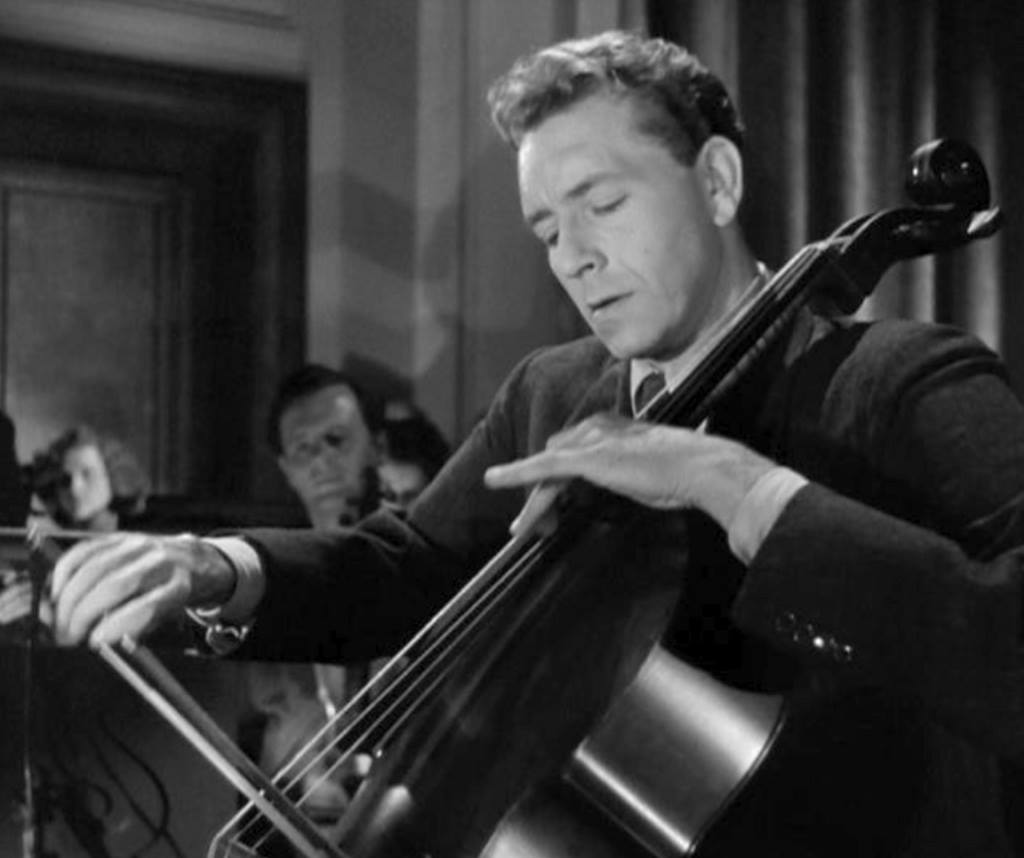
    Finally, we’ll turn to a classical music film noir from Hollywood’s Golden Age. “Deception” (1946) tells the tale of a dangerous love triangle between Bette Davis, Paul Henreid and Claude Rains. Much of the plot hinges on the premiere of a new cello concerto by a celebrated-though-fictional composer, played by Rains, who puts a fragile cellist, his rival in love, played by Henreid, through the psychological ringer. The music, which serves as both underscore and crux of the story, is by Erich Wolfgang Korngold. The composer subsequently published the “fictional” concerto as his Op. 37.

    All aboard the musical ouroboros! Join me for music from movies about music and musicians, this Friday evening at 6:00 EDT, on WWFM – The Classical Network and wwfm.org.

    The overheated trailer for “Deception:”

    PHOTO: Henreid wore a special jacket to accommodate the arms of two professional cellists who stood behind him as he emoted. On the film’s soundtrack the concerto was performed by Eleanor Aller Slatkin, the mother of Leonard Slatkin.

  • Artist Biopics Great Art Great Music

    Artist Biopics Great Art Great Music

    How to translate visual art to the big screen? Generally by focusing on the drama in the artists’ lives, that’s how.

    And what drama!

    This week on “Picture Perfect,” expand your palette with music from movies about the great artists. “The Agony and the Ecstasy,” based on the novel of Irving Stone, dramatizes the friction between Michelangelo (Charlton Heston) and his benefactor, Pope Julius II (Rex Harrison), over the painting of the ceiling of the Sistine Chapel. For his part, Michelangelo would have been perfectly content to stick to sculpture. Alex North’s score is an Early Music banquet, with allusions to – and sometimes outright quotations of – music of the Renaissance.

    Stone had another bestseller in “Lust for Life,” about the tormented Vincent van Gogh. This time Kirk Douglas plays one of his most sympathetic roles – and looks remarkably like the artist. Anthony Quinn turns up as his “frenemy,” the painter Paul Gaugin, and earns an Academy Award for Best Supporting Actor. The great Miklós Rózsa wrote the music, softening up the edges of his brawny Hungarian sound with the softer palette of the French Impressionists.

    John Huston brought Pierre La Mure’s novel about Henri de Toulouse-Lautrec to the big screen as “Moulin Rouge” (not to be confused with the more recent Baz Luhrmann spectacle starring Nicole Kidman and Ewan McGregor, which relegated the artist to a supporting role). José Ferrer dominates the earlier version, spending most of the film walking through off-camera trenches and shuffling along on his knees. Georges Auric, one of the composers of Les Six (which also included Francis Poulenc and Darius Milhaud), captures the spirit of the titular cabaret. The score became one of Auric’s best-known, thanks to the waltz becoming a popular hit, “Where is Your Heart.”

    “The Picasso Summer” is a departure from the usual formula of focusing on the artist himself. Instead, a young couple (played by Albert Finney and Yvette Mimieux), admirers of Picasso’s work, take off on a European adventure in an attempt to track him down. Originally Picasso himself had agreed to appear, but some off-screen drama involving a matador friend and Yul Brynner’s wife drove him off. The film was based on a short story by Ray Bradbury. Bradbury hated the adaptation, as did the studio, and “The Picasso Summer,” after being heavily cut and patched with new footage, was never released theatrically in the United States. The film is striking for its extended animation sequences inspired by Picasso’s paintings, and for its score by Michel Legrand.

    Join me for a brush with greatness – music from movies about the great artists – on “Picture Perfect,” this Friday evening at 6:00 EDT, on WWFM – The Classical Network and wwfm.org.
  • Lost Worlds Movie Music Soundtrack

    Lost Worlds Movie Music Soundtrack

    This week on “Picture Perfect,” I invite you to get lost. It’s all music from movies about lost worlds and forgotten civilizations.

    While the concept of the “Lost World” dates at least as far back as Plato’s Atlantis, it wasn’t until the Victorian Era that the idea really blossomed in the public consciousness. At the time, of course, lost civilizations were genuinely being discovered – which might help explain, in part, the incredible of success of “King Solomon’s Mines.” The author, H. Rider Haggard, wrote the book on a bet that he could churn out an adventure story half as good as Robert Louis Stevenson’s “Treasure Island,” which had been published two years earlier.

    “King Solomon’s Mines” became the literary sensation of 1885. Its protagonist, Allen Quatermain, is a direct ancestor of Indiana Jones. The book inspired reams of sequels and at least five film adaptations.

    The two best known starred Stewart Granger, in 1950, and Paul Robeson, in 1937. Robeson, who played Umbopa, a king in disguise, received top billing. The score was by Mischa Spoliansky.

    Haggard achieved another “Lost World” hit with “She,” first issued in book form in 1887 – another adventure about Europeans in Africa, who meet a seemingly immortal white queen known as the all-powerful “She,” or “She-Who-Must-Be-Obeyed.”

    “She” has been adapted to film six times. The 1965 version starred Ursula Andress, Peter Cushing and Christopher Lee. The music was by Hammer Studios house composer, James Bernard. It’s nice to hear Bernard, who mostly wrote horror scores for the likes of Dracula and Frankenstein, provide something a little more nuanced for a change.

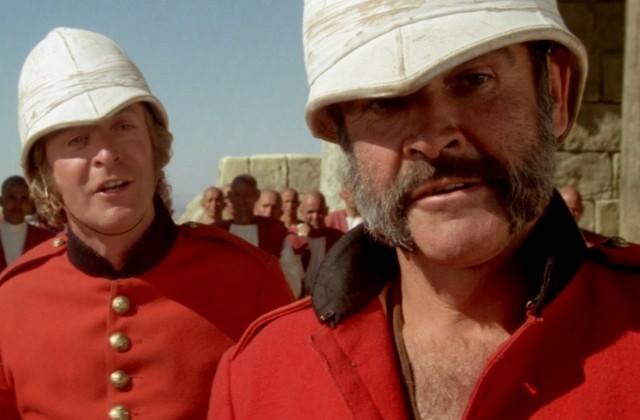
    Rudyard Kipling’s “The Man Who Would Be King,” published in 1888, was clearly influenced by the writings of Haggard. In this case, two British adventurers in India strike out for a remote corner of Afghanistan to set themselves up as kings. The story was made into one of the great adventure films of the 1970s, directed by John Huston, and starring Sean Connery and Michael Caine. That Christopher Plummer appears as Kipling himself is only icing on the cake. Maurice Jarre wrote the rousing score.

    Finally, James Hilton’s “Lost Horizon,” published in 1933, imagines Shangri-La, a Utopian society nestled in a sheltered valley somewhere in the mountains of Tibet. A British diplomat is one of a handful of passengers who survives a plane crash to be taken into the lamasery.

    “Lost Horizon” was made into a film twice. The less said about the 1973 version, a musical with songs by Burt Bacharach, the better. Frank Capra directed the classic 1937 version, which starred Ronald Colman, Jane Wyatt, and outstanding character actors of the day, people like Edward Everett Horton, Thomas Mitchell, Sam Jaffe and H.B. Warner.

    The score, Dimitri Tiomkin’s first major contribution, was also one of his most ambitious. Seldom was it so obvious that he had studied at the St. Petersburg Conservatory under Alexander Glazunov.

    I hope you’ll lose yourself in music for lost civilizations this week, on “Picture Perfect” – music for the movies – this Friday evening at 6:00 EDT, on WWFM – The Classical Network and wwfm.org.


    PHOTO: Connery (right) with the man who would be Caine

Tag Cloud

Aaron Copland (92) Beethoven (95) Composer (114) Film Music (120) Film Score (143) Film Scores (255) Halloween (94) John Williams (185) KWAX (229) Leonard Bernstein (100) Marlboro Music Festival (125) Movie Music (135) Opera (198) Philadelphia Orchestra (88) Picture Perfect (174) Princeton Symphony Orchestra (106) Radio (87) Ralph Vaughan Williams (85) Ross Amico (244) Roy's Tie-Dye Sci-Fi Corner (290) The Classical Network (101) The Lost Chord (268) Vaughan Williams (103) WPRB (396) WWFM (881)

DON’T MISS A BEAT

Receive a weekly digest every Sunday at noon by signing up here


RECENT POSTS