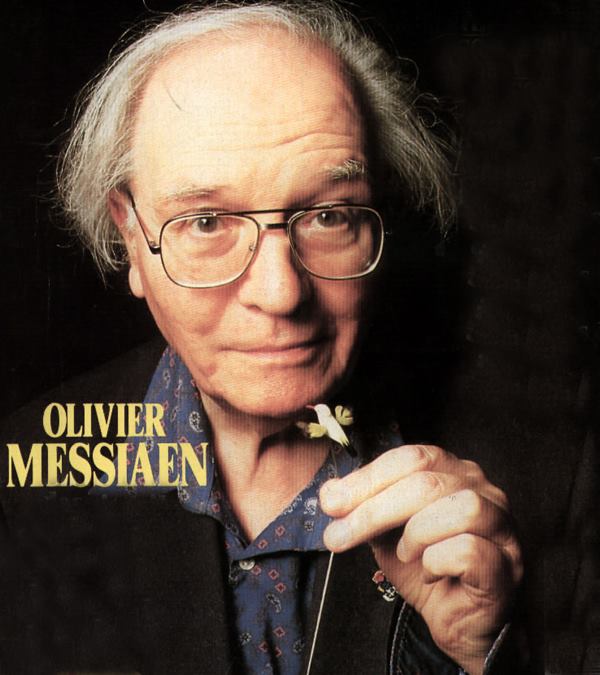
Tag: Olivier Messiaen

  • “The Passion of Scrooge” Documentary Explored

    Here’s a fresh take on an old chestnut, by composer John Deak, filmmaker Paul Moon, baritone William Sharp, and the @[100066833537251:2048:21st Century Consort]. Not just a filmed performance, but a collaborative documentary with dramatic elements.

    Moon, who is perhaps best known from the nationwide broadcast on PBS of his documentary “Samuel Barber: Absolute Beauty,” dropped by the studios of @[100055420854366:2048:WWFM – The Classical Network] a couple of times over the years to chat about his projects. Here’s what he had to say about “The Passion of Scrooge.”

    His documentary “Olivier Messiaen’s Quartet for the End of Time” will be shown at Lincoln Center’s New York Public Library for the Performing Arts’ Bruno Walter Auditorium, tomorrow at 5:30 p.m.

    @[100052005895362:2048:Zen Violence Films]

  • Iannis Xenakis Revolutionary Music Visionary

    Iannis Xenakis Revolutionary Music Visionary

    He was a literal revolutionary who altered our perception of music.

    Iannis Xenakis was a Communist who came from wealth, an intellectual who was half-blinded, disfigured, and broken-jawed by shrapnel from a tank blast while rioting in the streets of Athens. He helped to drive the Axis out of Greece, opposed the restoration of the monarchy by the British, and was sentenced to death in absentia by a conservative regime. He fled the country using forged papers. He settled in Paris, illegally, where was hired by the architect Le Corbusier.

    There, he applied himself seriously to composition. He was refused as a student by Nadia Boulanger and Arthur Honegger. His lessons with Darius Milhaud went nowhere. It was Olivier Messiaen who at last recognized and acknowledged his unique genius. But understanding his special gifts, even Messiaen refused to spoil him with the humdrummery of drills in harmony and counterpoint. Instead, he gave him his benediction.

    “I understood straight away that he was not someone like the others…. He is of superior intelligence…. [T]his was a man so much out of the ordinary that I said… ‘No, you are almost 30, you have the good fortune of being Greek, of being an architect and having studied special mathematics. Take advantage of these things. Do them in your music.’”

    Xenakis took that freedom and ran with it. He explored music from the perspective of architecture, mathematics, and physics, yet his creations could be searingly visceral. He experimented with spatial effects, pushed the boundaries of electroacoustics, and devised computer systems that could translate graphical images into sound.

    Xenakis may have been a towering intellectual, but he was also a force of nature. His death sentence, which had been commuted to a ten-year prison term, was finally lifted in 1974. Finally, he was able to return home, where he was received as the avant-garde Odysseus and intellectual Colossus he was.

    His music has been described as wild, terrifying, raw, primal, primordial, and elemental. He made the serialists of mid-century seem hidebound, which in a sense they were, and positively tame by comparison.

    Is Xenakis a man for all seasons? It depends on how you like your Sunday mornings. Any Xenakis worth playing is worth playing loudly.

    Happy birthday, Iannis Xenakis, on what would have been your 100th birthday.


    “Pléiades” (1979)

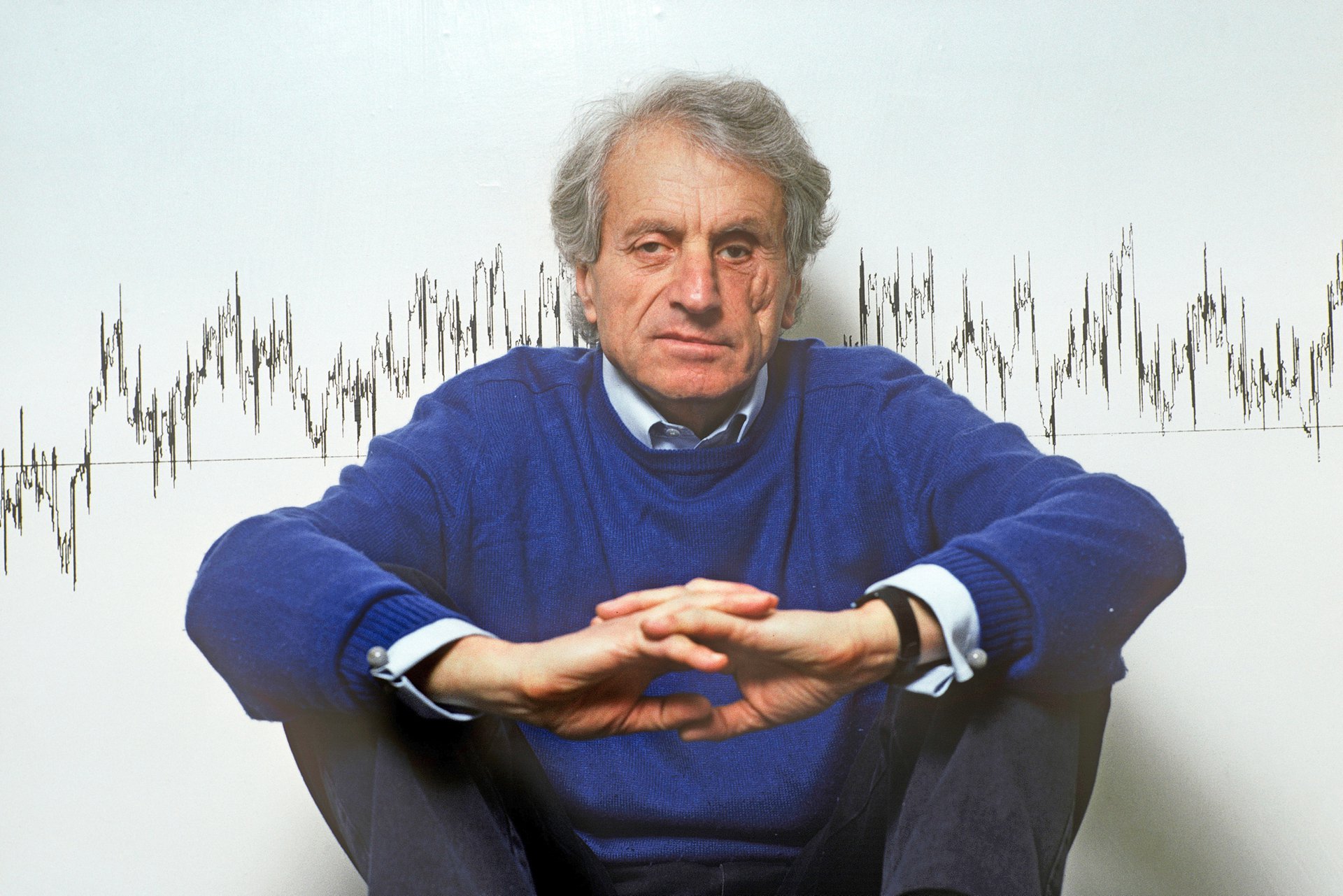
    “Metastasis” (1953-54), with graphical score

    “Pithoprakta” (1955-56), with graphical score

    “Serment-Orkos” (1981)

  • Messiaen’s Quartet: Music from the End of Time

    Messiaen’s Quartet: Music from the End of Time

    As someone who definitely has a problem with managing his time, I am relieved to find it coming to an end, at least musically speaking. I hope you’ll join me for the next “Music from Marlboro,” as we listen to Olivier Messiaen’s “Quartet for the End of Time.”

    Messiaen famously wrote his piece, one of his most frequently performed, in a prisoner of war camp, using the only instruments at his disposal (clarinet, violin, cello, and piano). A sympathetic guard, Karl-Albert Brüll, saw to it that he had pencils, music paper, and plenty of quiet. He also helped to acquire the instruments.

    The piece was first performed in an unheated space, on January 15, 1941, before an audience made up of the camp’s prisoners and guards. Messiaen recollected, “Never was I listened to with such rapt attention and comprehension.” Shortly after the performance, Brüll forged papers, using a potato stamp, and liberated the musicians.

    Many years later, Brüll showed up on Messiaen’s doorstep, but was told the composer would not see him. Perhaps Messiaen didn’t wish to relive the war. But Brüll was no Nazi. In civilian life, he was a lawyer, a cultivated man who spoke fluent French. In the service, he treated his prisoners humanely. Messiaen eventually had a change of heart and sent a message to the man who had helped make his masterpiece possible. But it was too late. Brüll had been hit by a car.

    A devout Catholic, Messiaen drew inspiration for the quartet from the Book of Revelation. The score is prefaced by the following quote:

    “And I saw another mighty angel come down from heaven, clothed with a cloud: and a rainbow was upon his head, and his face was as it were the sun, and his feet as pillars of fire … and he set his right foot upon the sea, and his left foot on the earth…. And the angel which I saw stand upon the sea and upon the earth lifted up his hand to heaven, and sware by him that liveth for ever and ever… that there should be time no longer: But in the days of the voice of the seventh angel, when he shall begin to sound, the mystery of God should be finished…”

    The work falls into eight movements (here in English translation): “Crystal liturgy;” “Vocalise, for the Angel who announces the end of time,” “Abyss of birds;” “Interlude;” “Praise to the eternity of Jesus;” “Dance of fury, for the seven trumpets;” “Tangle of rainbows, for the Angel who announces the end of time;” and “Praise for the Immortality of Jesus.”

    Messiaen being Messiaen, the composer manages to include ample bird calls. Syncopated passages punctuate a kind of mystic yearning so intense that it borders on the erotic.

    During this holiest week on the Christian calendar, and in the wake of the tragedy at Notre Dame, which, thankfully, could have been a lot worse, I thought it only appropriate to revisit Messiaen’s luminous, ecstatic meditations.

    We’ll hear it performed at the 2005 Marlboro Music Festival, by pianist Ieva Jokubaviciute, clarinetist Charles Neidich, violinist Karina Canellakis, and cellist Soo Bae.

    The music will fill the entire hour. But there’s no need for an encore when time is at an end. I hope you’ll join me for the next “Music from Marlboro,” this Wednesday evening at 6:00 EDT, on WWFM – The Classical Network and wwfm.org.

    Marlboro School of Music and Festival: Official Page

  • Mount Messiaen Utah’s Musical Mountain

    Mount Messiaen Utah’s Musical Mountain

    If the mountain will not come to Messiaen, then Messiaen must go to the mountain. Unusually, in this instance, both came to pass.

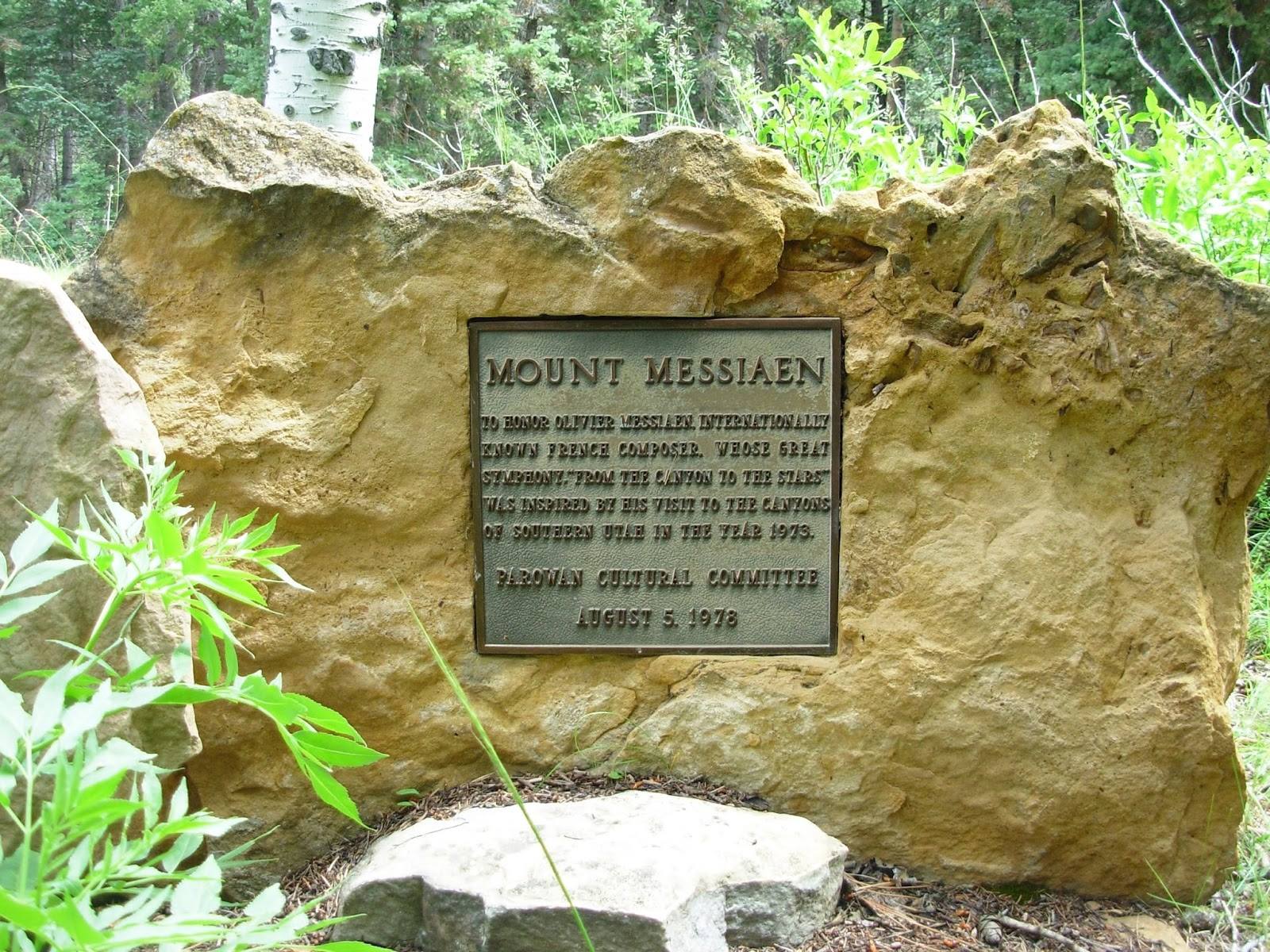
    On this date in 1978, the White Cliffs of southern Utah, formerly known as Lion’s Peak, were renamed by the citizens of Parowan “Mount Messiaen,” in honor of the French composer, who had traveled to Utah in 1973 to lay the groundwork for his sprawling vista in sound, “Des canyons aux étoiles…” (“From the canyons to the stars…”). The work, which spans a good 90 to 100 minutes in performance, had been commissioned for the impending bicentennial of American independence.

    Messiaen was inspired by the natural wonders of the region – its landscape, birdsong and night skies – but most particularly the colorful Bryce Canyon, which played to his sense of synaesthesia (cognitive perception of color in sound). Messiaen regarded it as the most mystical landscape he had ever encountered.

    When asked if it would be all right to dedicate something in his honor, as a token of thanks, the composer thought perhaps a nature trail was in the offing. In the event, a bronze plaque was cast and a sandstone monument erected at the foot of the mountain, and the governor declared August 5 “Olivier Messiaen and the Beauty of Southern Utah Day.” The composer was unable to attend the dedication ceremony and concert. However, he had gone to the mountain, and the mountain had come to him.


    Photos of Mount Messiaen:

    http://kellyricks.blogspot.com/2015/07/mt-messiaen.html

    The music:

    https://www.youtube.com/watch?v=5DjgpPL7RhA

  • Herman Berlinski a Composer’s Life

    Herman Berlinski a Composer’s Life

    Today is the anniversary of the birth of Antonio Salieri (born in 1750), but since he’s used to being dissed anyway, I’ll write about Herman Berlinski.

    Berlinski was born on this date in 1910, in Leipzig, the son of Polish Jews who had fled political instability, with growing discontent in Poland against Russian rule. His family retained its Polish nationality for fear of being declared stateless by the Germans, who were not generous with granting citizenship to outsiders. This at least allowed them to retain the rights of foreigners legally resident in the country.

    Berlinski, the youngest of six children, was brought up in an Orthodox household. His father was a haberdasher, and the family spoke Yiddish. The boy showed an early aptitude for the piano and later the clarinet. A series of private teachers (beginning with his mother) led to his acceptance into the Leipzig Conservatory.

    Berlinski would attend Friday evening concerts at the Thomaskirche, where Johann Sebastian Bach had acted as cantor and given the premiere of so many of his sacred works two centuries earlier. Overhearing Berlinksi rehearse the “Goldberg Variations,” the current cantor, Karl Straube, offered to give him organ lessons at the Institut der Evangelisch-Lutherischen Landeskirche Sachsen, but since Berlinski wasn’t Christian he was denied entrance to the program.

    In 1933, the Nazis took control of Germany, and Berlinski decided to get out while the getting was good. First, he returned to Poland, but since he didn’t speak Polish, he felt himself at a disadvantage and the Jewish community in which he had settled was mired in misery. So he took off for Paris, where he studied with Nadia Boulanger and Alfred Cortot.

    Ultimately, he became dissatisfied with Boulanger’s musical approach. He was much happier studying Jewish liturgical music at the Schola Cantorum. Through studies with Jean-Yves Daniel-Lesur, founder of the group La Jeune France, he met Olivier Messiaen, who encouraged him to explore his Jewish heritage in music, much the way he himself had decided to embrace Catholicism.

    He became an important part of the city’s Yiddish theater community until the outbreak of World War II in 1939, when he enlisted in the Foreign Legion. He survived fighting at the Maginot Line, but when France fell to the Germans, he was declared undesirable and denied the right to work. Fortunately, he was able to get a visa, and he arrived in New York in 1941. There, he reunited with his father and other members of his family who were living in New Jersey.

    Musically, an influential meeting with Moshe Rudinow, cantor of Temple Emanu-El, one of New York’s leading Reform synagogues, led to an invitation in 1944 to join the Jewish Music Forum, a body set up to promote all aspects of Jewish music, including the performance of new works. This brought him into contact with many key musicians, composers and musicologists.

    In the meantime, he met up with Messiaen again at Tanglewood and continued his studies in composition with him. In 1954, he was hired as an organist at Emanu-El, where he composed much music for his instrument and chorus. He undertook post-graduate studies at the Jewish Theological Seminary of America. He also studied privately with Hugo Weisgall. Despite suffering a heart attack, Berlinski was able to complete his doctorate in 1960, becoming the first person ever to earn the highest degree in sacred music from the JTSA.

    In 1963, Berlinski’s career brought him to Washington, DC, where he served as music director of the Reform Hebrew Congregation. This was a fertile period for the composer. He wrote much sacred music, including large scale vocal works and pieces for organ and voice or organ and other instruments. His abilities as an organist brought him back to Europe for recitals at Leipzig’s Thomaskirche and Notre Dame in Paris.

    He retired from the Congregation in 1977, founding the Shir Chadash Chorale, which performed annually at the Kennedy Center and Washington Cathedral.

    Berlinski died in 2001, at the age of 91. He lived long enough to work with the Milken Archive to have some of his works documented and released as part of the Milken Archive of American Jewish Music series, issued on the Naxos label. His music has broader appeal than its ties to the synagogue or the specificity of his Jewish heritage would suggest.

    Here’s Berlinski at the recording sessions for “Avodat Shabbat,” with Gerard Schwarz conducting.

    https://www.youtube.com/watch?v=m2kQVp61CHQ

    Also, Berlinski’s “Symphonic Visions”:

    Mov’t I: https://www.youtube.com/watch?v=PvNfrF6DqGw
    Mov’t II: https://www.youtube.com/watch?v=u6d3HIYu8S0
    Mov’t III: https://www.youtube.com/watch?v=inw6pmQ5KrE

    Happy birthday, Herman Berlinski!
Tag Cloud

Aaron Copland (92) Beethoven (95) Composer (114) Film Music (123) Film Score (143) Film Scores (255) Halloween (94) John Williams (187) KWAX (229) Leonard Bernstein (101) Marlboro Music Festival (125) Movie Music (138) Opera (202) Philadelphia Orchestra (89) Picture Perfect (174) Princeton Symphony Orchestra (106) Radio (87) Ralph Vaughan Williams (85) Ross Amico (244) Roy's Tie-Dye Sci-Fi Corner (290) The Classical Network (101) The Lost Chord (268) Vaughan Williams (103) WPRB (396) WWFM (881)

DON’T MISS A BEAT

Receive a weekly digest every Sunday at noon by signing up here


RECENT POSTS