Tag: Opera

  • Robert Moran’s Unconventional Genius Celebrated Today

    Robert Moran’s Unconventional Genius Celebrated Today

    A work for amplified Volkswagen, played with flashlights. An opera for eleven dogs. A piano piece in which the performer crawls inside the lid and lets the piano play him.

    Move over, Till Eulenspiegel. Today is the birthday of Robert Moran.

    Moran, who’s made his home in Philadelphia for over 30 years, is contemporary music’s merry prankster.

    Following studies in Vienna with Hans Erich Apostel, with whom he “learned to count to twelve” (as in twelve-tone music), Moran attended Mills College, where his teachers were Darius Milhaud and Luciano Berio. His classmates at Mills included Steve Reich, Phil Lesh, and Tom Constanten. Lesh and Constanten went on to play for The Grateful Dead. I wonder what ever happened to Reich?

    While there, Moran became involved with the whole San Francisco scene. He gained notoriety in the late 1960s and early ‘70s through a series of performance pieces incorporating entire cities, including San Francisco, Bethlehem, PA, and Graz, Austria. These involved tens of thousands of performers.

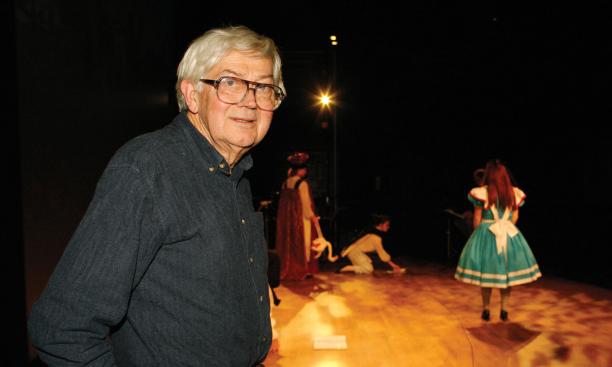
    His many stage works include “Desert of Roses” (after Beauty and the Beast), written for Houston Grand Opera, and “Alice” (after “Alice’s Adventures in Wonderland”), composed for the Scottish Ballet. Maurice Sendak introduced him to the Grimm fairy tale “The Juniper Tree,” which became an operatic collaboration with Philip Glass.

    For the occasion of the tenth anniversary of the terrorist attacks on the World Trade Center, Moran was commissioned to write a work for the youth chorus of Trinity Wall Street, the so-called “Ground Zero” church in Lower Manhattan. “Trinity Requiem,” scored for children’s chorus, four cellos, harp and organ, offers a similar brand of solace to that conjured in the 19th century masterwork by Gabriel Fauré.

    With Moran, you never know what you’re going to get. In his more puckish moments, he might write for harpsichord and electric frying pan. But then there are times when his natural gift for lyricism will melt your heart. Whether he’s writing for Houston Grand Opera, 39 autos, giant puppets, or electric popcorn popper, his music is always vital and worth getting to know.

    Join me today, between 4 and 7 p.m. EST, for music by Robert Moran, among our birthday celebrants, on WWFM – The Classical Network and wwfm.org.


    An aria from “Desert of Roses:”

    Selections from “Trinity Requiem:”

    “Obrigado” for Iowa Percussion:

    Bob introducing his “Lunchbag Opera” for the BBC in 1971:

  • Dmitri Hvorostovsky Remembered

    Dmitri Hvorostovsky Remembered

    Beloved operatic baritone Dmitri Hvorostovsky has died, following a two-and-a-half year battle with brain cancer. His final operatic performance was in December of last year, though he continued to give recitals through at least June. He also made a surprise appearance at the Met’s five-hour 50th anniversary gala in May. At the time of his death, he was 55 years-old.

    I saw him only once, at the Met. He wasn’t singing; he passed me getting off of the elevator at a performance of “Rusalka,” starring his friend Renée Fleming. Even in the lobby, his was a striking presence.

    There “have been many beautiful voices,” Fleming said, “but none more beautiful than Dmitri’s.”

    R.I.P.

    https://www.nytimes.com/2017/11/22/arts/music/dmitri-hvorostovsky-dead.html

    Hvorostovsky and Fleming in “Eugene Onegin:”

    https://www.youtube.com/watch?v=i8mJsowhByo


    PHOTO: The couple during happier times, at a Lyric Opera of Chicago subscriber appreciation concert in 2012

  • Montsalvatge’s Puss in Boots Opera

    Montsalvatge’s Puss in Boots Opera

    You can tune an orchestra, but you can’t tun-a fish. This Sunday night on “The Lost Chord,” we put the “cat” in Catalan music with selections from Xavier Montsalvatge’s one-act opera “Puss in Boots.”

    “Puss in Boots,” Montsalvatge’s first opera, was composed in 1947. We all know the story. The tale, in its best-known guise, was published by Charles Perrault in 1695 as one of the “Tales of Mother Goose.”

    A poor miller laments his inheritance. Most of the family property – the mill and the mules – goes to his elder brothers, and all that’s left for him is an unprepossessing cat. He wonders of what use to him a cat could possibly be. He contemplates eating it, perhaps using the skin to make a hat. The cat, however, promptly endears himself, and offers to gain his master a fortune, a kingdom, and the hand of a beautiful princess. All he asks in exchange is a pair of boots, to spare his feet, a stylish hat with a plume, a cape, and a sword fashioned out of bone.

    Since the cat presents him with a ring from the hand of the princess, the Miller considers it a fair deal, and sets about getting, by hook or by crook, whatever the cat desires.

    Throughout the course of the story, with his cunning and superior wits, the cat is able to deliver on everything he promises.

    We’ll heard selections from a 2004 recording, on the Columna Musica label, with Argentine mezzo-soprano Marisa Martins as Puss (an unusual take on the traditional “trouser role”), and tenor Antonio Comas as the Miller. The Symphony Orchestra of the Gran Teatre del Liceu is conducted by Antoni Ros Marba.

    Listen for the charming cat-like touches in the string-writing and the use of a piano throughout the opera to evoke the style of decorative 18th century recitative.

    That’s “Fur Love and Valor” – highlights from Xavier Montsalvatge’s “Puss in Boots” – this Sunday night at 10:00 EST, on WWFM – The Classical Network and wwfm.org.

  • Peter the Great Tsar Undercover Opera Gem

    Peter the Great Tsar Undercover Opera Gem

    Peter the Great goes slumming in the comic opera “Zar und Zimmermann” (Tsar and Carpenter). Apropos of the title, the Russian Tsar goes undercover as a common laborer in a Dutch shipyard in order to learn shipbuilding techniques to fulfill his dream of making Russia a maritime power.

    The opera is one of the most enduring of Albert Lortzing (1801-1951). Lortzing himself sang the role of “the carpenter” during the work’s premiere. We’ll celebrate Lortzing’s birthday today, as well as that of American composer Ned Rorem, from 4 to 7 p.m. EDT, on WWFM – The Classical Network and wwfm.org.


    PHOTO: Monument of Peter the Great building a boat in St. Petersburg

  • Romeo Cascarino Philly’s Unsung Opera Genius

    Romeo Cascarino Philly’s Unsung Opera Genius

    With a name like Romeo, he had to learn to use his fists.

    Composer Romeo Cascarino grew up in an unforgiving neighborhood in South Philadelphia. While navigating the School of Hard Knocks, he taught himself privately, gleaning the mechanics of music theory from books checked out of the Free Library of Philadelphia. He was discovered by composer Paul Nordoff, who recognized his genius, and the two became more friends than master-disciple.

    For many years, Cascarino was a professor of composition at Combs College of Music. The recipient of two Guggenheim Fellowships, he labored at his magnum opus, the opera “William Penn,” for the better part of three decades. The work received its premiere at Philadelphia’s Academy of Music in 1982 to mark the 300th anniversary of the founding of the city.

    Metropolitan Opera singer bass-baritone John Cheek sang the title role, Cascarino’s wife, soprano Dolores Ferraro, created the part of Gulielma, Penn’s wife, and Christofer Macatsoris conducted the Philadelphia Singers and the Concerto Soloists of Philadelphia.

    Cascarino died in 2002; September 28th would have been his 95th birthday. Ferraro and arts writer Tom DiNardo sat down with me in 2012 to share their reminiscences and insights into Cascarino the man and the composer. I’ve assembled some of their remarks and punctuated the conversation with rare audio from the family archives, as well as studio recordings made by JoAnn Falletta and Sol Schoenbach, former principle bassoonist of the Philadelphia Orchestra.

    A seductive, twilit beauty informs much of Cascarino’s output. If only he had completed “William Penn” 30 years earlier, I believe it would have been as well known as Carlisle Floyd’s “Susanna” or Robert Ward’s “The Crucible.”

    I hope you’ll join me for a rebroadcast of “Remembering Romeo,” this Sunday night at 10:00 EDT, on WWFM – The Classical Network and wwfm.org.

Tag Cloud

Aaron Copland (92) Beethoven (95) Composer (114) Film Music (123) Film Score (143) Film Scores (255) Halloween (94) John Williams (187) KWAX (229) Leonard Bernstein (101) Marlboro Music Festival (125) Movie Music (138) Opera (202) Philadelphia Orchestra (89) Picture Perfect (174) Princeton Symphony Orchestra (106) Radio (87) Ralph Vaughan Williams (85) Ross Amico (244) Roy's Tie-Dye Sci-Fi Corner (290) The Classical Network (101) The Lost Chord (268) Vaughan Williams (103) WPRB (396) WWFM (881)

DON’T MISS A BEAT

Receive a weekly digest every Sunday at noon by signing up here


RECENT POSTS