Today marks the 100th anniversary of the birth of Ingmar Bergman. Bergman, not exactly known for his lightness of spirit, filmed one of the most consistently delightful adaptations of any opera (or singspiel, for that matter) in a Swedish television version of “The Magic Flute” (1975). The production’s Papageno, Håkan Hagegård, went on to enjoy an international career.
“The Magic Flute” also figures in the puppet play featured in “Hour of the Wolf” (1968).
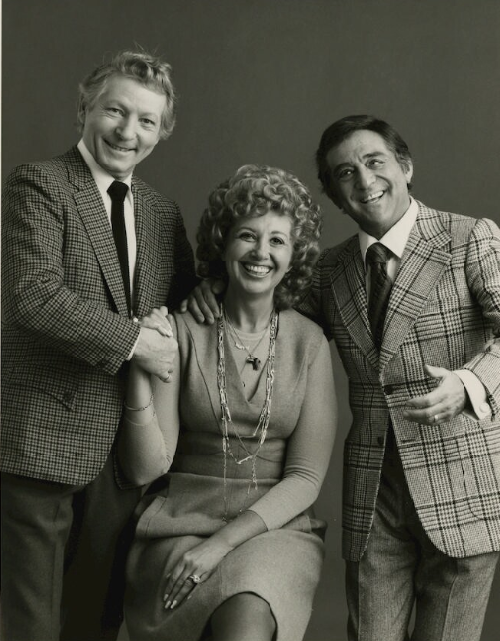
When opera singers were still a part of the fabric of American popular culture – Beverly Sills with Danny Kaye. Does Bubbles really pay tribute to Jimmie Walker?
Here’s the entire broadcast in color (with Turkish subtitles and intro!). The extracted Sills-Kaye routine begins around the 38 minute mark.
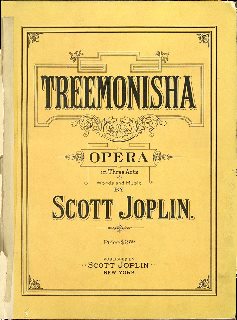
This Sunday morning on WPRB, we’ll defy the elements to bring you Scott Joplin’s most ambitious endeavor, the opera “Treemonisha.”
Joplin, of course, is rightly celebrated as the master of the piano rag, but in “Treemonisha” he aspired for something more – a “serious” opera in the European tradition, though infused with rhythms and melodies that could have come from no one else. In fact, the work is often described erroneously as a “ragtime opera.”
Sadly, Joplin never lived to see his magnum opus fully staged. “Treemonisha” received its sole read-through in 1915, at the Lincoln Theater in Harlem, with the composer at the keyboard. In fact, the work’s existence was virtually unknown until its revival in 1972, in a joint production of the music department of Morehouse College and the Atlanta Symphony Orchestra. The opera went on to be performed by companies all over the United States, making its Broadway debut in 1975. In 1976, Joplin was honored with a posthumous citation from the Pulitzer Prize committee – a mere 59 years after his death.
I hope you’ll join me for Joplin’s “Treemonisha.” The opera will cap three hours of light classics written or influenced by African-American composers – including a performance by the Paragon Ragtime Orchestra, from its ongoing “Black Manhattan” series on New World Records – this Sunday morning, from 7 to 10 EST, on WPRB 103.3 FM and wprb.com. We may be expecting some white stuff overnight, but we’ll be drinking our coffee black, on Classic Ross Amico.
A work for amplified Volkswagen, played with flashlights. An opera for eleven dogs. A piano piece in which the performer crawls inside the lid and lets the piano play him.
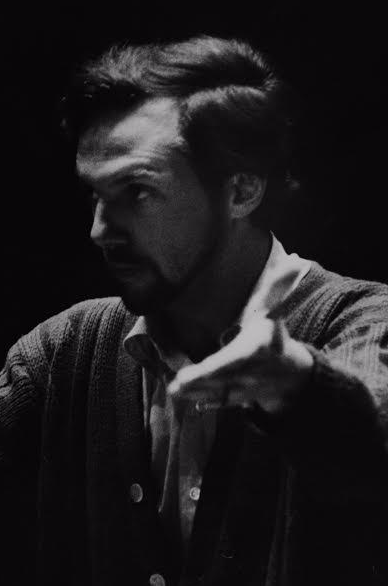
Move over, Till Eulenspiegel. Today is the birthday of Robert Moran.
Moran, who’s made his home in Philadelphia for over 30 years, is contemporary music’s merry prankster.
Following studies in Vienna with Hans Erich Apostel, with whom he “learned to count to twelve” (as in twelve-tone music), Moran attended Mills College, where his teachers were Darius Milhaud and Luciano Berio. His classmates at Mills included Steve Reich, Phil Lesh, and Tom Constanten. Lesh and Constanten went on to play for The Grateful Dead. I wonder what ever happened to Reich?
While there, Moran became involved with the whole San Francisco scene. He gained notoriety in the late 1960s and early ‘70s through a series of performance pieces incorporating entire cities, including San Francisco, Bethlehem, PA, and Graz, Austria. These involved tens of thousands of performers.
His many stage works include “Desert of Roses” (after Beauty and the Beast), written for Houston Grand Opera, and “Alice” (after “Alice’s Adventures in Wonderland”), composed for the Scottish Ballet. Maurice Sendak introduced him to the Grimm fairy tale “The Juniper Tree,” which became an operatic collaboration with Philip Glass.
For the occasion of the tenth anniversary of the terrorist attacks on the World Trade Center, Moran was commissioned to write a work for the youth chorus of Trinity Wall Street, the so-called “Ground Zero” church in Lower Manhattan. “Trinity Requiem,” scored for children’s chorus, four cellos, harp and organ, offers a similar brand of solace to that conjured in the 19th century masterwork by Gabriel Fauré.
With Moran, you never know what you’re going to get. In his more puckish moments, he might write for harpsichord and electric frying pan. But then there are times when his natural gift for lyricism will melt your heart. Whether he’s writing for Houston Grand Opera, 39 autos, giant puppets, or electric popcorn popper, his music is always vital and worth getting to know.
Join me today, between 4 and 7 p.m. EST, for music by Robert Moran, among our birthday celebrants, on WWFM – The Classical Network and wwfm.org.
An aria from “Desert of Roses:”
Selections from “Trinity Requiem:”
“Obrigado” for Iowa Percussion:
Bob introducing his “Lunchbag Opera” for the BBC in 1971:
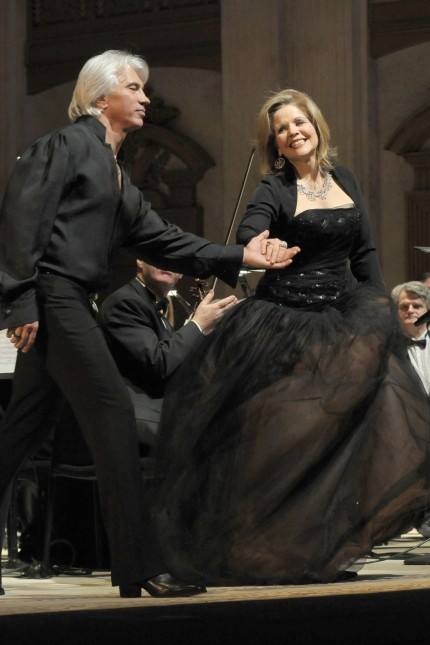
Beloved operatic baritone Dmitri Hvorostovsky has died, following a two-and-a-half year battle with brain cancer. His final operatic performance was in December of last year, though he continued to give recitals through at least June. He also made a surprise appearance at the Met’s five-hour 50th anniversary gala in May. At the time of his death, he was 55 years-old.
I saw him only once, at the Met. He wasn’t singing; he passed me getting off of the elevator at a performance of “Rusalka,” starring his friend Renée Fleming. Even in the lobby, his was a striking presence.
There “have been many beautiful voices,” Fleming said, “but none more beautiful than Dmitri’s.”