Tag: Philadelphia

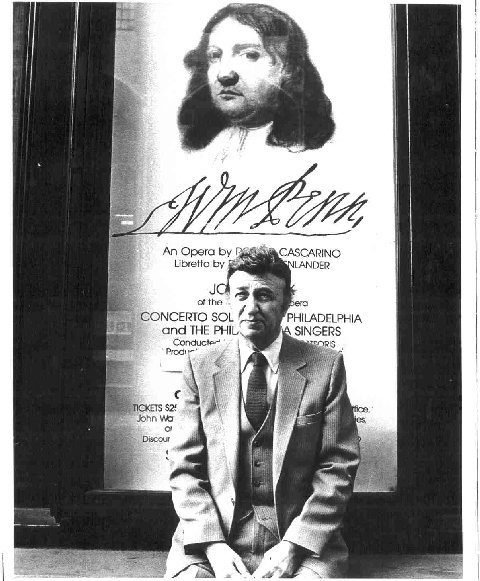
  • Romeo Cascarino Lost American Composer

    Romeo Cascarino Lost American Composer

    O Romeo, Romeo, wherefore art thou Romeo? Why does no one play your music?

    It is well-crafted. It has heart. It is full of beauty. All it lacks is exposure.

    This Sunday night on “The Lost Chord,” we salute Romeo Cascarino, in anticipation of the 100th anniversary of his birth on September 28, 1922.

    Cascarino grew up in an unforgiving neighborhood in South Philadelphia. With a name like Romeo, he had to learn how to use his fists! While navigating the School of Hard Knocks, he taught himself privately, gleaning the mechanics of music theory from books checked out of the Free Library of Philadelphia. He was discovered by composer Paul Nordoff, who recognized his genius, and the two formed a bond that was more like a friendship than master-disciple.

    For many years, Cascarino was a professor of composition at Combs College of Music. The recipient of two Guggenheim Fellowships, he labored at his magnum opus, the opera “William Penn,” for the better part of three decades. The work received its premiere at Philadelphia’s Academy of Music in 1982 to mark the 300th anniversary of the founding of the city.

    Metropolitan Opera singer bass-baritone John Cheek sang the title role, Cascarino’s wife, soprano Dolores Ferraro, created the part of Gulielma, Penn’s wife, and Christofer Macatsoris conducted the Philadelphia Singers and the Concerto Soloists of Philadelphia.

    Ferraro and arts writer Tom Di Nardo will join me to share their reminiscences and insights into Cascarino, the man and the composer, who died in 2002. I’ve assembled some of their remarks and punctuated the conversation with rare audio from the family archives, as well as studio recordings made by JoAnn Falletta and Sol Schoenbach, former principal bassoonist of the Philadelphia Orchestra.

    A seductive, twilit beauty informs much of Cascarino’s output. If only he had completed “William Penn” 30 years earlier, it would now be regarded one of the great American operas of mid-century, spoken of in the same breath as Carlisle Floyd’s “Susanna” and Robert Ward’s “The Crucible.”

    I hope you’ll join us in “Remembering Romeo,” this Sunday night at 10:00 EDT, on WWFM – The Classical Network and wwfm.org

  • Philly Record Store Memories

    Philly Record Store Memories

    As someone who lived and purchased records in Philadelphia for some 32 years, I hope you will enjoy reading this as much as I did. Anyone else remember Simon Roberts, who held court in the basement of Nathan Muchnik’s? I was just thinking about him the other day, recollecting his withering putdown of “deranged Bruckner fanatics,” even though it must be decades since he uttered it. How wonderful record shopping in Philadelphia used to be. Thank you, Princeton Record Exchange, for keeping the spark alive!

    At the core of this blog post, at the first link, is a reminiscence by Mark Obert-Thorn. If you’re unfamiliar with him, look more closely at the credits of any vintage reissues in your collection. Philadelphia-born Obert-Thorn and Ward Marston have dominated the field of historical restoration for decades. I believe Obert-Thorn’s musings, reprinted here, originally ran in the Philadelphia Inquirer in 2016.

    https://digital.nepr.net/music/2016/08/05/shopping-for-classical-music-a-remembrance/

    More about Obert-Thorn

    https://www.naxos.com/historical/engineer_thorn.htm

    His colleague, Ward Marston

    https://www.naxos.com/historical/engineer_marston.htm

    With the impending close of F.Y.E., this elegy for Center City record stores also ran in the Inky in 2016. I believe Peter Dobrin means the Schwann Catalog, not Schaum. I’m linking to Yahoo News, because the article in its Inquirer incarnation is paywalled.

    https://news.yahoo.com/era-ends-last-center-city-120000315.html?guccounter=1&guce_referrer=aHR0cHM6Ly93d3cuZ29vZ2xlLmNvbS8&guce_referrer_sig=AQAAABikwJRcqcCs-gn9RlrwCyTycUO20vdJn73UTAzuSYYzt-NTEgv1Vm215BIDdj5LO719-N_arZC67smrwjJ6wasInymoz8gqddSJhxBXPYLtg4tv2JGb71yc4V4m_vnpK-eVu4eEID5ruR6Kgcoy3jsImyIE3m0iBSZZdWXJULe9

    Personally, I found F.Y.E. a mite soulless. You had to brave whatever head-splitting commercial swill they were pumping into the cavernous primary sales floor in order to reach the classical oasis in the back (once it was ejected from upstairs to make way for DVDs). I did, however, meet Wolfgang Sawallisch there and hear a mini-Liszt recital performed by Lang Lang. Come to think of it, that may have been when the store, located at Broad & Chestnut, was still Tower Records. As it was, that Tower never filled the hole in my heart left by the Tower Records Classical Annex at 6th & South. When that store closed, part of me went with it.

    The line in Dobrin’s article that for me most resonates:

    “Back when music was harder to get, listeners valued it more. When you spent a lot of time hunting for something, you reveled in the triumph of finding it.”

    How many hours I spent on my back as a teenager, just listening to LPs and gazing at the cardboard sleeves, with their liner notes and eye-catching cover art. I learned as much about painting as I did about music back then, I think. When I only had a couple of crates of records, I knew every nuance, every crackle and pop so intimately. And intelligent classical music programming that honored the integrity of the music by broadcasting it in its entirely was available on the radio 24 hours a day. I miss those days so very, very much.

  • Nielsen’s Symphony 3: From Philly Summer

    Nielsen’s Symphony 3: From Philly Summer

    When I first heard Carl Nielsen’s Symphony No. 3, I was sweating it out in a one-room efficiency in West Philadelphia that I shared with two of my classmates, while making up a math course I had flubbed at Temple University.

    It was the summer of ’85, there was no air conditioning, and I studied and slept in a netted hammock suspended from two bicycle hooks I had screwed into the door frames to prevent being surprised by mice. There was always movement in the lone trash bag that sat exposed on the linoleum in the corner of the kitchenette, and to prove a point once I lobbed a sneaker into it, from the safety of my resting place, so that the rodents poured out of it and scurried around the apartment, sending one of my roommates, the one whose name was on the lease, shrieking into his bunk. He had a job canvasing for a political organization, so he was gone all day and would stagger back every night after last-call to sketch with intensity under a bright, exposed lightbulb that shone down in my face. Somewhere along the way, he brought home a turtle, which he kept in the bathtub and fed raw hamburger, until I couldn’t take its imprisonment any longer and finally released it into Fairmount Park.

    The other roommate had the good sense to get a girlfriend, so he was never there. His contribution was a makeshift bunk bed hastily assembled from planks he had plucked from the garbage. The top bunk was usually vacant, due to his absence, and the bottom bunk was where my politically-motivated, alcohol-fueled, musky, mulchy-footed friend slept between me and the sole window fan.

    Occasionally, I’d glimpse a cockroach making its way down one of the ropes of my hammock, and I’d start rocking about, trying to dislodge it. More than once, one of the bike hooks let go. The roaches were everywhere. There were even roaches in the freezer.

    It was under these circumstances, one boxed-in, sweltering afternoon, that I first experienced Carl Nielsen’s Symphony No. 3, subtitled “Sinfonia espansiva.” It was broadcast on WFLN, Philadelphia’s classical music station for nearly 50 years (sadly, now defunct). Nielsen’s aspirational music opened up horizons for me and offered glimpses of larger things.

    The recording was conducted by Leonard Bernstein. For those of you who aren’t familiar with him, Carl Nielsen is Denmark’s most celebrated composer. Yet, internationally, his music has struggled to take root in the shadow of that other great bard of the North, Jean Sibelius. This is a shame, since, far from being a Sibelius knock-off, Nielsen forged his own, immediately-recognizable style. Bernstein believed Nielsen’s rightful place was as Sibelius’ equal.

    “I think many people are in for pleasant surprises as they get to know Nielsen,” he said at a centennial celebration of the composer’s birth, “his rough charm, his swing, his drive, his rhythmic surprises, his strange power of harmonic and tonal relationships – and especially his constant unpredictability – all these are irresistible. I feel confident that Nielsen’s time has come.”

    Hey, he was right about Mahler. But that was in 1965, and Lenny’s prophetic lightning failed to strike twice. Fifty-seven years on, with many more recordings and performances to choose from, Nielsen’s music remains, stubbornly, an acquired taste, if a rewarding one. There really is nothing else quite like it – the puckish wit, the ambiguities, the quirky juxtaposition of seemingly disparate melodies, harmonies, and key signatures, all very often shot through with a sense of hope and optimism that rises above the chaos.

    I only lived in that hell hole for about a month, one summer session, thankfully, just long enough to make-up my credits, and then it was off to the greenery of my hometown to detox. But I was in the process of selling my soul for a piece of parchment, a degree, so in the fall it was back to Philadelphia.

    After the purchase of my first CD-player, in order to feed my habit, I took a part-time job as a clerk at Sam Goody, a record shop then located at 11th and Chestnut Streets, which at the time had the most extensive classical music section in the city. (This was before the arrival of Tower Records.) It was there that I acquired Neeme Järvi’s Prokofiev cycle, Bernard Haitink’s Shostakovich cycle, Adrian Boult’s Vaughan Williams cycle, and my first recording of Nielsen’s Symphony No. 3. Essentially, I signed my paycheck back over to the company in exchange for CDs. I remember my frustration that so much of the good stuff was still only on LP.

    The Nielsen recording was not the classic Leonard Bernstein performance I had heard on the radio – which had yet to be transferred to compact disc – but a newer, digital recording with Myung-Whun Chung and the Gothenburg Symphony Orchestra, on the BIS label. And I have to say, giving all credit to Bernstein for his advocacy of Nielsen’s music, I believe Chung’s recording outshines his in every way. To this day, I find it to be one of the most satisfying Nielsen recordings. It must have been within my first ten CD purchases. I remember when I had so few, I could keep them all in a shoebox. Now I’ve got a library of a good 10,000. You might say it has gone “espansiva.”

    What exactly did Nielsen mean by that choice of subtitle? Robert Simpson wrote that the use of “espansiva” suggests an “outward growth of the mind’s scope.” There is certainly a sensation of expanding horizons about the piece, which includes a pastoral slow movement complete with wordless solos for soprano and baritone. According to Nielsen, the symphony concludes with “a hymn to work and the healthy activity of living.” All I know is that it fills me with optimism and happiness.

    A tip of the blond brush cut to Carl Nielsen on his birthday. Perhaps his time will come. For me, it arrived in a very different climate from that of Copenhagen, in tropical West Philadelphia, in the summer 1985.


    Leonard Bernstein conducts the Royal Danish Orchestra on its own turf

    Myung-Whun Chung and the Gothenburg Symphony

    “Espansiva: A Portrait of Carl Nielsen”

  • Philly Women Composers Revisited

    Philly Women Composers Revisited

    I’m happy to note that in the past several years the idea of month-long celebrations devoted to “Women’s history” or “Black history” has started to seem almost old-fashioned, as the programming of concerts and radio broadcasts has become more and more diverse, so that it’s no longer unusual to encounter music by “minority” composers, with increasing regularity, year-round.

    I feel the historic shift most keenly as I reach back into the “Lost Chord” archive to 2010, when I believe the show that will air this evening was probably already a repeat. (I began the series in 2003.) Time was when one really had to scratch around in order to find enough material to fill out an hour’s theme. Looking back now, over a decade later, recordings have yielded an embarrassment of riches.

    I hope you’ll join me tonight as we revisit some of the selections available in the early years of the 21st century, for a program of music by women composers of Philadelphia.

    Andrea Clearfield (born 1960) was raised in Bala Cynwyd. She studied at Muhlenberg College in Allentown, PA (where, by the way, this particular broadcaster got his start in community radio in 1986). At Muhlenberg, she was mentored by Margaret Garwood. She then studied at Philadelphia College of the Performing Arts (now the University of the Arts) and at Temple University, where among her teachers was Maurice Wright.

    Clearfield herself taught at the University of the Arts from 1986 to 2011 (after this show was recorded, so some of the info may be a little out of date). She is well-known in Center City for a long-running, monthly, multidisciplinary salon held at her studio, located not far from the Kimmel Center for the Performing Arts. Since the pandemic, this has been a virtual event, but the salon has run, more or less uninterrupted, since its inception in 1986.

    Clearfield’s recorded discography has expanded considerably since 2010, but for tonight we’ll sample her work for oboe and piano, “Unremembered Wings,” written in 2001.

    Then we’ll turn to Jennifer Higdon (born in 1962), whose career by this time had already taken off like a rocket. She would be awarded the Pulitzer Prize for Music for her Violin Concerto in 2010. Again, assuming the show was recorded before February of that year, it would have been at least a few months before the honor was bestowed in May.

    Higdon, born in Brooklyn to an artistic family, grew up in Atlanta and Seymour, TN. She studied flute at Bowling Green State University, where she was encouraged to pursue composition. This led her to the Curtis Institute of Music in Philadelphia, where her teachers included David Loeb and Ned Rorem. She also received a Master of Arts and PhD in composition from the University of Pennsylvania, where she studied with George Crumb.

    Parenthetically, we were practically neighbors during my final decade in Philadelphia. Even so, it was only through the station that I finally met her, and I interviewed her for the paper a few years ago.

    Tonight, we’ll hear her “Concerto for Orchestra,” written for the hometown band – the Philadelphia Orchestra – but recorded by the Atlanta Symphony, under the direction of her old friend from Bowling Green, Robert Spano.

    Finally, we’ll turn to Evelyn Simpson-Curenton (born in 1953). Now based in Washington DC, she is music director of the Washington Performing Arts Men and Women of the Gospel and an associate of the Smithsonian Institute. After graduating from Germantown High School, she earned a BM in Music Education and Voice from Temple University. She’s received commissions from George Shirley and Duke Ellington, among others, and provided arrangements of spirituals for Jessye Norman and Kathleen Battle.

    We’ll listen to Simpson-Curenton’s setting of Psalm 91, “My Soul Hath Found Refuge in Thee,” in a performance by the ensemble VocalEssence under the direction of Philip Brunelle.

    Philadelphia is our sister city tonight, on “Sisters of Brotherly Love” – selections for hopefully soon-to-be-outmoded Women’s History Month – this Sunday night at 10:00 EST, on WWFM – The Classical Network and wwfm.org.


    PHOTOS (clockwise from left): Higdon, Clearfield, and Simpson-Curenton

  • Tower Records’ Presidents Day CD Sales

    Tower Records’ Presidents Day CD Sales

    When I was a kid, Presidents Day brought heartfelt patriotic acknowledgements of the contributions of Washington and Lincoln. But in my 20s, it meant the biggest CD sale of the year at Tower Records!

    During its heyday, Tower Records’ Classical Annex, at 6th and South Streets, was a beacon for classical music lovers in Philadelphia. Sure, there was the subterranean crevasse at Nathan Muchnick’s, near 18th and Walnut, where on an average day, the CDs were cheaper. And if Barnes & Noble, at Broad and Chestnut, had a sale, you could certainly pick up a bargain. But Tower was the only record store in Center City that was open until midnight, 365 days a year – which meant you could drop by after Philadelphia Orchestra concerts – and it could be counted on to carry all the new releases and much else beside.

    Furthermore, it introduced a tantalizing cut-out bin that spanned the entire back of the store, in which overstocked items would be marked down to $6.99. In the days when full-priced CDs at Tower averaged around $16.99, this innovation had the effect of sending me into a delirium. How many Czech operas did I mine from that rack? How my pulse would quicken as I flipped through the superfluous blister packs. (Parenthetically, the New York branch at 4th and Broadway, with an entire store devoted to cut-outs, brought me one plane closer to Nirvana!)

    When Tower Records had a sale on a major label (that is to say, Angel/EMI, Deutsche Grammophon, RCA/BMG, or Sony), the prices would drop to $11.99. But Presidents Day was something else entirely. That’s when the store would prop its doors – invariably, it was unseasonably mild, and the sun beating against the glass display windows only lent to the kinetic intensity of the roiling shoppers – and the perspiring crowds would flow in to partake of for-one-day-only, deeply-discounted merchandise, on arcane, seldom-marked-down-ever labels like BIS, Chandos, CPO, Lyrita, and Unicorn-Kanchana. And the majors would be marked-down even further.

    I would scarf a slice of pizza beforehand to keep my blood sugar up and then essentially stage-dive into the crowd. Representatives from all the CD distributors were there, with name tags and ties, and hosts from WFLN, Philadelphia’s now-defunct classical music station, would broadcast live from a platform about three-quarters of the way toward the back of the sales floor.

    On a counter in the front of the store was a kind of ballot box, in which you would stuff slips of paper bearing your personal information, and periodically these would be drawn for giveaways of free stuff. This is how I came to own Christopher Hogwood’s superlative recording of Haydn’s “The Creation,” among other treasures. It was very easy to win. All you had to do, as I explained to my friends, is wait until you saw WFLN’s Henry Varlack pushing toward the front of the store, and then cram in all your slips. Henry never went very deep into the box, and whoever was closest to the top usually walked away with a bounty. One of my friends, who wasn’t even a classical music guy, took home some stereo components.

    Of course, I was still living something of a bohemian existence back then. It was a lot for me to be able to scrape together a hundred or maybe a hundred-twenty dollars to blow on Presidents Day. This was also before secondhand record shops acquired a large influx of used classical CDs. Nowadays, a store like Princeton Record Exchange deals in volume, so to keep up the turnover, most discs are priced only a buck or two.

    Viewed from the perspective of 2022, the Tower Records of decades ago might strike one as rather thin brew by comparison. But in those now-distant times, it was like an invitation to drift through Elysium for a day, and to return home elated with all your purchases and free stuff. There were always abundant catalogues and wish books and plenty of swag.

    Nevermind the white sales. I never changed my sheets, anyway. For me, Presidents Day will always bring with it memories of Tower Records!

Tag Cloud

Aaron Copland (93) Beethoven (95) Composer (114) Film Music (126) Film Score (143) Film Scores (255) Halloween (94) John Williams (189) KWAX (229) Leonard Bernstein (101) Marlboro Music Festival (125) Movie Music (141) Mozart (87) Opera (203) Philadelphia Orchestra (89) Picture Perfect (174) Princeton Symphony Orchestra (107) Radio (87) Ross Amico (244) Roy's Tie-Dye Sci-Fi Corner (290) The Classical Network (101) The Lost Chord (268) Vaughan Williams (103) WPRB (396) WWFM (881)

DON’T MISS A BEAT

Receive a weekly digest every Sunday at noon by signing up here


RECENT POSTS