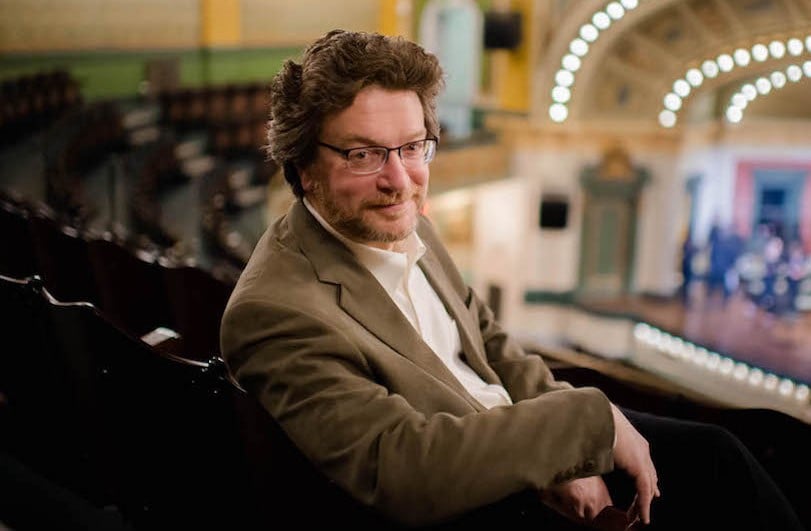
Yesterday, I forgot to mention the world premiere of a new piece by my friend, Kile Smith – “Ave Maris Stella” – to be performed three times this weekend by Piffaro, The Renaissance Band and the vocal ensemble Variant 6. The Center City Philadelphia performance took place last night, but there are still two more chances to hear it live: tonight at 7:30 pm, at the Presbyterian Church of Chestnut Hill (Philadelphia’s “garden district”), and tomorrow at 3 pm, at Sts. Andre and Matthew, 719 N. Shipley St., in Wilmington, DE.
If these times don’t work for you, a concert video will be made available on-demand from 10/16 to 10/26. Access to the video for ticker holders is free.
You’ll find more information about the program at the Piffaro website.
O Romeo, Romeo, wherefore art thou Romeo? Why does no one play your music?
It is well-crafted. It has heart. It is full of beauty.
On the 99th birthday of Romeo Cascarino, I am asking, is there no one out there who might be able to program something to mark the composer’s centenary in 2022?
Cascarino was born into a rough neighborhood in South Philadelphia in 1922. With a name like Romeo, you have to learn how to use your fists! While navigating the School of Hard Knocks, he taught himself privately, gleaning the mechanics of music theory from books checked out of the Free Library of Philadelphia. He was discovered by composer Paul Nordoff, who recognized his genius, and the two became more like friends than master-disciple.
For many years, Cascarino was a professor of composition at Combs College of Music. The recipient of two Guggenheim Fellowships, he labored at his magnum opus, the opera “William Penn,” for the better part of three decades. The work received its premiere at Philadelphia’s Academy of Music in 1982 to mark the 300th anniversary of the founding of the city.
Metropolitan Opera singer bass-baritone John Cheek sang the title role, Cascarino’s wife, soprano Dolores Ferraro, created the part of Penn’s wife, Gulielma, and Christofer Macatsoris conducted the Philadelphia Singers and the Concerto Soloists of Philadelphia.
Cascarino died in 2002, at the age of 79. He left too little music. Fortunately, every piece is a treasure. A seductive, twilit beauty informs much of his output. If only he had completed “William Penn” 30 years earlier, I believe it would be as highly-regarded as Carlisle Floyd’s “Susanna” or Robert Ward’s “The Crucible.”
Here’s hoping for a Cascarino revival, however modest, in 2022.
“Pygmalion,” conducted by JoAnn Falletta
“The Acadian Land,” performed by members of The Chamber Orchestra of Philadelphia
The concise Bassoon Sonata, written for Cascarino’s Army buddy, Sol Schoenbach, for twenty years principal bassoonist of The Philadelphia Orchestra
“Blades of Grass” for English horn and orchestra, after Carl Sandburg, performed by Orchestra 2001
“Little Blue Pigeon,” from “Pathways of Love,” sung by Dolores Ferraro
“Meditation and Elegy,” inspired by Edgar Allan Poe’s “Annabel Lee,” performed by Philadelphia Sinfonia
It’s totally irrational of me, I know, and something I have to work on, but every summer I keep my head down, seclude myself, and rail against the sun, heat, and humidity – all the while, a prayer in my heart for the first day of autumn. Blame it on my 32 years in Philadelphia.
But now that I’m out of the kiln, in the open air, with plenty of greenery, I really need to stop that, because I’m essentially wishing away huge swaths of my life. Also, because of the ingrained negativity, I find I have to work extra hard to throw on the air brakes come September, so that I can slow down, finally, and savor every facet of the ever-changing season. Because if I don’t, I’ll wind up sliding right into Christmas. And I certainly don’t want to miss Halloween.
Autumn arrives this afternoon at 3:20 EDT. Join me in pausing to take a breath and appreciating the shifting light, the emerging colors, and the falling leaves. These are harbingers of good things – the pleasures of baked goods, homemade soups, moody skies, and woodland strolls; of carved pumpkins and black-and-white horror movies, used book sales, sweaters, Brahms, and cozy cups of tea.
Soon enough, the obligations of Thanksgiving and “the holidays” will be upon us. For now, savor September and October. It’s a vibrant time, as nature lives in defiance of decay – the grass finds a little extra something in its stores of green, apples swell, and birds and beasts forage, bask, and play.
But it’s also a reflective one, as a gentle melancholy pervades the softening light. Memories grow thick. Nostalgia stirs in fallen leaves. Reminders all that we are mortal, and time is on the wing.
Perhaps in your haste to escape Philadelphia by way of South 5th Street, en route to the Ben Franklin Bridge, you may have glimpsed the Johann Nepomuk Maelzel commemorative marker at the corner of 5th and St. James, just below Walnut Street.
Maelzel died in the extraordinary act of actually trying to get back to Philadelphia. On the 21st of July, 1838, he was found dead in the berth of a brig returning from the Caribbean. Whether he died of yellow fever or alcohol poisoning is a matter of ambiguity. Maelzel was consigned to a watery grave somewhere off the coast of Charleston, South Carolina.
In his lifetime, Maelzel was a renowned inventor of mechanical wonders. He created machines that could play works of Haydn and Mozart. No doubt his most ambitious achievement in this regard was the panharmonicon, a kind of mechanical orchestra, for which Beethoven composed “Wellington’s Victory.”
Beethoven and Maelzel would quarrel over the division of spoils, and Beethoven would re-orchestrate the work for human performers of a conventional symphony orchestra. Maelzel, seemingly always in debt, would exhibit his creations in his own museum in Vienna, and on tours throughout the United States and the West Indies.
He achieved notoriety for his work with automatons, most notably a mysterious humanoid engine called “The Turk.” The Turk was marketed as a thinking machine that could outmaneuver opponents in a game of chess. And the Turk almost always delivered on his promise. The device captivated figures from Edgar Allan Poe (a skeptic) to S. Weir Mitchell (haunted by it as a child).
Some felt Maelzel had set foot into some pretty murky ethical territory, with arguments prefiguring some in our own day regarding artificial intelligence. This was the era, after all, of Mary Shelley’s “Frankenstein.” Sensible folk speculated it was all humbug and that there was a man hidden somewhere in the vicinity of The Turk. Others thought Maelzel was dabbling in matters best left to God. Maelzel was mum on the subject, and The Turk was destroyed by fire in 1854.
Though no doubt there was a whiff of charlatanism about Maelzel, who schooled no less a figure than P.T. Barnum in the effective use of the press, he had a remarkable talent for finessing and perfecting the ideas of others.
His most enduring legacy is the metronome, which he patented in 1815. Beethoven wrote glowingly of the device and declared that henceforth he would stop using traditional tempo indications in his scores in favor of metronome markings. We all know how well that served him. Seemingly as with anything influenced by Maelzel, Beethoven’s choices of metronome markings continue to be a source of controversy.
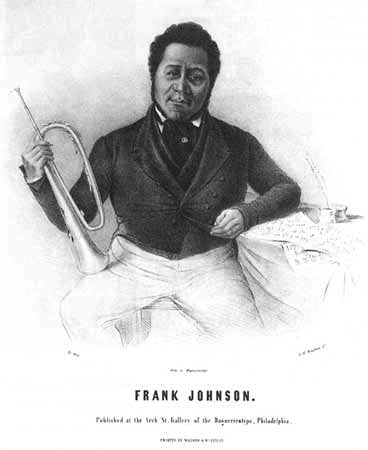
A blue and gold marker erected before his home, at 65 South 4th Street in Philadelphia, describes him as “America’s first native-born master of music.” He was a prolific composer, “trumpeter of 1st Troop, City Cavalry, and Bandmaster, 128th Regiment, Pennsylvania Volunteer Infantry.” He was also the leader of America’s most popular band for more than twenty years. Over a century before Dorothy Maynor and Little Richard, Francis Johnson, born on this date in 1792, was presenting racially-integrated concerts.
Johnson was the first African-American to have his works published as sheet music. He led the first American ensemble, an all-black brass band, in performance abroad. In 1837, he sailed to England to take part in the celebrations surrounding the coronation of Queen Victoria. In gratitude, the Queen presented him with a silver bugle. While there, he was exposed to the promenade concert – a style of informal, outdoor garden entertainment – which he brought back with him to the United States. He returned to Philadelphia in 1838, the year Pennsylvania Hall was burned to ground by an angry mob for hosting a convention of abolitionists.
Indeed, it’s remarkable, in a climate of mounting racial tension and violence, with the Civil War still decades in the future, just how beautifully Johnson’s career flourished. In 1824, he was invited to perform for General Lafayette during Lafayette’s return to the United States. He also taught wealthy European-American students at a studio much-remarked upon for its extensive music library. Over the years, he also amassed an impressive array of instruments. His works were published in compilations alongside those of Beethoven, Brahms, Bellini, Donizetti, Weber, and Czerny.
At the same time, he performed in Philadelphia’s black churches. His style of playing included rhythmic variations that deviated considerably from his written scores. In the 20th century, this might have been described as “jazzing,” but Johnson’s improvisions would have been worlds away from what we now recognize as jazz.
He was also known to have delighted his audiences with certain extended techniques and programmatic elements. His “Bird Waltz” featured a chirrupy flute obbligato, his “New Railroad Gallop” emulated a train, and his “Philadelphia Fireman’s Quadrille” was punctuated by cries of “Fire! Fire!”
Unfortunately, a lot of this music was not fully written-out, with prompts often indicated in his scores. When they were published, it was commonly in arrangements and as piano transcriptions made by other hands. Scholars have reconstructed his performance style to the best of their ability from surviving evidence, including newspaper accounts and other documents describing the effects heard on Johnson’s concerts. The music itself is fairly simple, often a framework to be adorned by improvisation and development.
Johnson died in 1844 at the age of 51. At his funeral, Queen Victoria’s bugle lay atop his casket.