On the night of February 23, 1991, One Meridian Plaza, a high-rise office building located in Center City Philadelphia, burst into flame. It was a serious fire. Lives were lost.
At the time, I was working as a humble clerk at Barnes & Noble, located on Chestnut near Broad, essentially right across the street. When I arrived on Sunday morning, Chestnut was blocked, since it was close enough that debris, and indeed the building itself, could have tumbled down onto the store front. I remember spending the morning over at the Philadelphia Art Museum (back in the days of free admission, Sundays until 1 p.m.), I stood on the steps, immortalized by “Rocky,” watching the smoke billow into the sky.
By Monday, a new work strategy was in place: employees were to go around the back of the bookstore and pound on the fire door (located on Sansom, across from the Union League), to be let into the basement to help out with receiving.
There, we all cheerfully went to seed. Much coffee was consumed, and the menfolk all started in on their solidarity beards. After a week or two, a good friend of mine took a look at me and commented, “Man… that beard makes you look like nobody famous.”
Two weeks into self-isolation, I am now working on my Corona beard, and again, I’m looking like nobody famous. Here are a few photos of some well-known composers who thankfully outgrew their flirtations with facial hair.
CLOCKWISE FROM LEFT: Bearded Mahler, Bernstein, Bartók, and Ravel
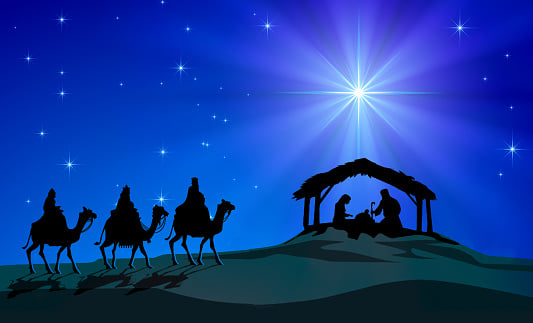
As we anticipate the annual live broadcast of “A Festival of Nine Lessons and Carols” from King’s College, Cambridge (on WWFM – The Classical Network and wwfm.org, at 10:00 this morning EST), here’s a spot of trivia for you: Did you know that one of the most famous of all Christmas carols has its roots in Philadelphia?
Philip Brooks was an Episcopal priest and rector of Church of the Holy Trinity (located on the northwest corner of Rittenhouse Square) at the time he jotted down a poem, in 1868, inspired by a trip he had taken to the Holy Land. He conceived the text for a Sunday school service and requested that his organist, Lewis Redner, come up with a suitable melody.
For whatever reason, the task wasn’t at the top of Redner’s list of priorities. When Brooks checked in with him on his progress on the Friday before the service, Redner still hadn’t done anything with it. Of course, the organist assured him it would be done by Sunday, but it wasn’t until Saturday night, Christmas Eve, that he sat down and devoted any thought to it at all. Alas, his Muse was as lackadaisical as he. Redner wound up surrendering to Morpheus before he could settle on a worthwhile idea.
“I thought more about my Sunday-school lesson that I did about the music,” Redner later recollected. “But I was roused from sleep late in the night hearing an angel-strain whispering in my ear, and seizing a piece of music paper I jotted down the treble of the tune as we now have it, and on Sunday morning before going to church I filled in the harmony.”
The carol was first printed as a leaflet by Richard McCauley, a bookseller on Chestnut Street, west of 13th. One of these found its way to the rector of All Saints’ Church in Worcester, MA, who asked to be able to include it in a hymnal titled “The Church Porch.” He christened the piece “St. Louis.” We know it better by the address of its opening, “O Little Town of Bethlehem.”
In the UK, the text was sung to the hymn tune “Forest Green,’ which had been adapted by Ralph Vaughan Williams from an existing folksong, “The Ploughboy’s Dream.” Vaughan Williams had notated the song while doing fieldwork in Surrey in 1903 and published it three years later in “The English Hymnal.”
H. Walford Davies also set the text, in two versions, as a hymn known as “Wengen” and for choir as “Christmas Carol.” The latter is frequently sung on the Christmas Eve broadcast of Nine Lessons and Carols from King’s College, Cambridge, heard annually all over the world.
It may be the case that Brooks’ original poem is more familiar on the other side of the pond in its settings by these two venerable English composers, but in the United States, Redner’s melody remains one of the most recognizable of the incessantly sung Christmas carols.
Both Brooks and Redner were astonished by the popularity of their creation, which they had intended as a modest one-off for children. Never underestimate the power of procrastination! With a little help from those “angel whispers,” Philadelphia, for once, managed to live up to Penn’s vision of a City of Brotherly Love.
The Church of the Holy Trinity, Rittenhouse Square
Brooks & Redner’s “O Little Town of Bethlehem”:
The Vaughan Williams version (from King’s College, directed by the late Stephen Cleobury):
Boy, do I feel old. One day I wake up, and I realize I’ve been alive long enough for an entire generation of new composers to come of age.
On today’s Noontime Concert, it’s another program featuring musicians from Network for New Music. We’ll hear recent works, including a few premieres, by contemporary composers Rene Orth, Joshua Hey, Sky Macklay, Andrew Hsu, Gabriel Bolaños and Charles Peck, all presented under the unifying theme of “Millennial Music.”
NNM’s mission is to perform new musical works of the highest quality by a diverse array of established and emerging composers; to strengthen the new music community in the Philadelphia region; and to build support for new music by engaging in artistic and institutional collaborations and educational activities.
Founded in 1984, Network for New Music has presented more than 650 works by living composers (of which over 150 they have commissioned) and recorded four CDs for the Albany and Innova labels. The ensemble has held an ongoing residency at Haverford College since 2007.
NNM will present its season opener, “Streams of Sound,” at Philadelphia’s Settlement Music School Mary Louise Curtis Branch, 416 Queen Street, this Sunday at 3 p.m. For more information and a complete schedule, look online at networkfornewmusic.org.
As if a program of millennial music isn’t enough to make me feel acutely the passage of time, our featured work following today’s broadcast concert will be Franz Joseph Haydn’s oratorio “The Seasons.” Haydn’s late masterpiece underpins the cyclical nature of the year with colorful vignettes suggesting the circle of life (and death). I think I’ll just focus on the wit and the wine.
I hope you’ll join me as I stare into the face of my own mortality, from 12 to 4 p.m. EST, on WWFM – The Classical Network and wwfm.org.
Larry Fine was born on this date in 1902. It’s been scientifically proven that all men know who Larry Fine is. For the benefit of the rest of you, Larry Fine was the bushy-haired, reactive Stooge. You know, the guy who stood there and mostly underplayed as Moe slapped the hell out of Curly. Until he himself became collateral damage.
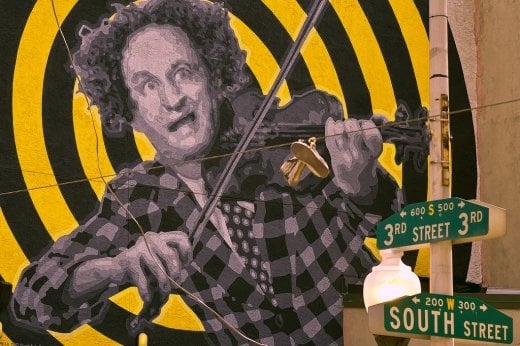
Fine was born Louis Feinberg at 3rd and South Streets in Philadelphia. The son of a watch repairman and jewelry shop owner, he was encouraged to take up the violin to counteract the effects of an acid burn, which damaged the muscles in his forearm when he was boy. The acid had been used by his father to test jewelry for gold content. Young Larry was about to drink the stuff, when his father slapped it away.
Larry showed such dedication to the violin that his parents wanted to send him to study the instrument at a conservatory in Europe, but with the outbreak of World War I, he remained in Philadelphia. He took up boxing to further strengthen his arm and won his only professional fight, before his father put a stop to it.
Larry brought his violin to the vaudeville circuit. It was there that he met Shemp Howard and the problematic Ted Healy. Healy, who was a raging alcoholic and notoriously abusive, would eventually come to a bad end under mysterious circumstances, possibly at the hands of Wallace Beery (the original onscreen “Champ”). These days, Healy is remembered, if at all, as the man who introduced The Three Stooges.
Shemp was looking to take a break from Healy’s act for a few months, so he asked Larry if he might be interested in being a substitute “stooge.” The pay was good (Healy offered him an extra ten dollars a week if he would “throw that fiddle away”), so Larry was amendable.
At first, he was tossed in with Bob Pinkus and Sam “Moody” Braun. Once Shemp returned, however, Larry, Shemp, and Shemp’s brother Moe – who had worked with Healy from the beginning – were brought together for the first time.
Shemp would depart to pursue a solo career in film, working with W.C. Fields, Fatty Arbuckle, and Abbott and Costello. He was replaced by his and Moe’s younger brother, Jerome – better known as Curly.
The reconfigured Stooges followed Healy to the big screen. Soon Healy was being groomed by MGM for a career as a solo comedian. The Stooges signed their own contract with Columbia and left their abrasive former boss in the dust. From the mid-1930s through the late-‘40s, The Three Stooges were the movies’ most popular short subject attractions. Shemp would return to the team after Curly suffered a stroke in 1946.
Larry, Philadelphia’s native Stooge, is commemorated in a mural near his birthplace at 3rd & South. We’re coming up on the 20th anniversary of the original mural’s dedication on October 26, 1999. The mural was overpainted with another Larry mural in 2006.
While we’re on the subject of boxers and violinists, Curly is unstoppable in his ascent to the championship, thanks to Larry’s stirring rendition of “Pop Goes the Weasel,” in “Punch Drunks” (1934):