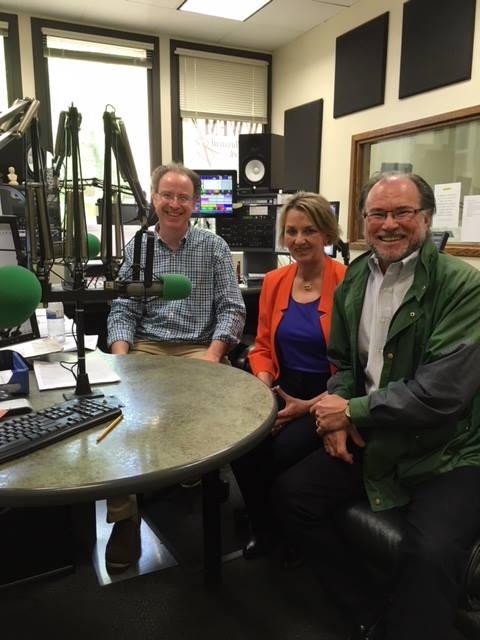
Thanks very much to Denise Kinney for making the drive up from Philadelphia this afternoon to talk with us at WWFM – The Classical Network about Musicopia, an organization that creates opportunities for young people to experience, learn, perform, and appreciate music. Kinney is the organization’s executive director.
As an added bonus, it was great to be able to enjoy a rare visit from, and conversation with, Maestro Mark Laycock, back in Princeton to help promote Musicopia and to tell us about his new composition written specifically for its young performers.
Laycock’s “Musicopia! Suite for String Orchestra” will be given its world premiere as part of a free concert, which will take place this Saturday at 5 p.m. at The Church of the Holy Trinity, Rittenhouse Square, 1904 Walnut Street, in Philadelphia.
A work for amplified Volkswagen, played with flashlights. An opera for eleven dogs. A piano piece in which the performer crawls inside the lid and lets the piano play him.
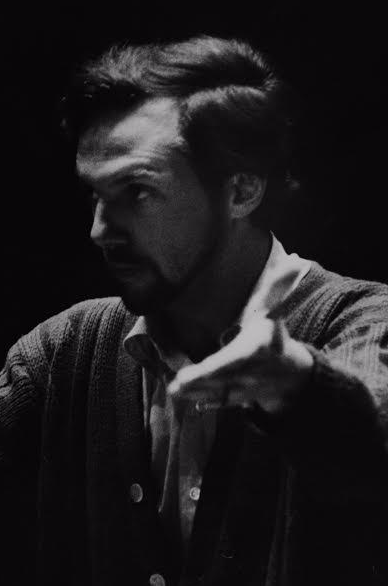
Move over, Till Eulenspiegel. Today is the birthday of Robert Moran.
Moran, who’s made his home in Philadelphia for over 30 years, is contemporary music’s merry prankster.
Following studies in Vienna with Hans Erich Apostel, with whom he “learned to count to twelve” (as in twelve-tone music), Moran attended Mills College, where his teachers were Darius Milhaud and Luciano Berio. His classmates at Mills included Steve Reich, Phil Lesh, and Tom Constanten. Lesh and Constanten went on to play for The Grateful Dead. I wonder what ever happened to Reich?
While there, Moran became involved with the whole San Francisco scene. He gained notoriety in the late 1960s and early ‘70s through a series of performance pieces incorporating entire cities, including San Francisco, Bethlehem, PA, and Graz, Austria. These involved tens of thousands of performers.
His many stage works include “Desert of Roses” (after Beauty and the Beast), written for Houston Grand Opera, and “Alice” (after “Alice’s Adventures in Wonderland”), composed for the Scottish Ballet. Maurice Sendak introduced him to the Grimm fairy tale “The Juniper Tree,” which became an operatic collaboration with Philip Glass.
For the occasion of the tenth anniversary of the terrorist attacks on the World Trade Center, Moran was commissioned to write a work for the youth chorus of Trinity Wall Street, the so-called “Ground Zero” church in Lower Manhattan. “Trinity Requiem,” scored for children’s chorus, four cellos, harp and organ, offers a similar brand of solace to that conjured in the 19th century masterwork by Gabriel Fauré.
With Moran, you never know what you’re going to get. In his more puckish moments, he might write for harpsichord and electric frying pan. But then there are times when his natural gift for lyricism will melt your heart. Whether he’s writing for Houston Grand Opera, 39 autos, giant puppets, or electric popcorn popper, his music is always vital and worth getting to know.
Join me today, between 4 and 7 p.m. EST, for music by Robert Moran, among our birthday celebrants, on WWFM – The Classical Network and wwfm.org.
An aria from “Desert of Roses:”
Selections from “Trinity Requiem:”
“Obrigado” for Iowa Percussion:
Bob introducing his “Lunchbag Opera” for the BBC in 1971:
With a name like Romeo, he had to learn to use his fists.
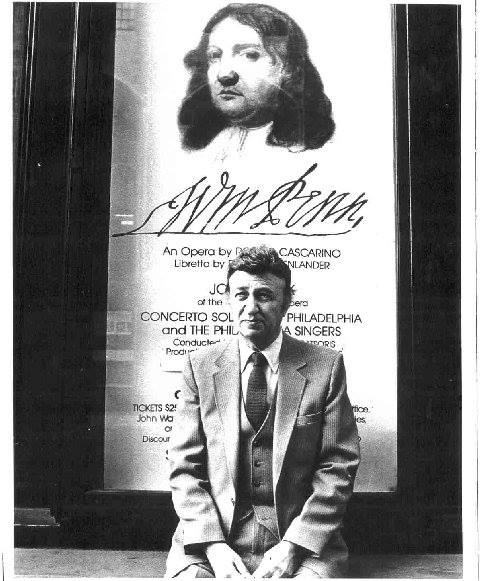
Composer Romeo Cascarino grew up in an unforgiving neighborhood in South Philadelphia. While navigating the School of Hard Knocks, he taught himself privately, gleaning the mechanics of music theory from books checked out of the Free Library of Philadelphia. He was discovered by composer Paul Nordoff, who recognized his genius, and the two became more friends than master-disciple.
For many years, Cascarino was a professor of composition at Combs College of Music. The recipient of two Guggenheim Fellowships, he labored at his magnum opus, the opera “William Penn,” for the better part of three decades. The work received its premiere at Philadelphia’s Academy of Music in 1982 to mark the 300th anniversary of the founding of the city.
Metropolitan Opera singer bass-baritone John Cheek sang the title role, Cascarino’s wife, soprano Dolores Ferraro, created the part of Gulielma, Penn’s wife, and Christofer Macatsoris conducted the Philadelphia Singers and the Concerto Soloists of Philadelphia.
Cascarino died in 2002; September 28th would have been his 95th birthday. Ferraro and arts writer Tom DiNardo sat down with me in 2012 to share their reminiscences and insights into Cascarino the man and the composer. I’ve assembled some of their remarks and punctuated the conversation with rare audio from the family archives, as well as studio recordings made by JoAnn Falletta and Sol Schoenbach, former principle bassoonist of the Philadelphia Orchestra.
A seductive, twilit beauty informs much of Cascarino’s output. If only he had completed “William Penn” 30 years earlier, I believe it would have been as well known as Carlisle Floyd’s “Susanna” or Robert Ward’s “The Crucible.”
I hope you’ll join me for a rebroadcast of “Remembering Romeo,” this Sunday night at 10:00 EDT, on WWFM – The Classical Network and wwfm.org.
When is Saturday “Fry Day?” Why, when it’s the birthday of William Henry Fry, of course!
Fry was born in Philadelphia in 1813. A pioneering figure in American music, he was the first native-born composer to write on a large scale. He composed orchestral works and the first opera by an American to be performed publicly in his lifetime (“Leonora,” in 1845). He was an outspoken advocate of American music – that is, music composed by Americans – at a time when German imports ruled the roost. It would be decades before American music would gain a toehold in the concert halls, which makes Fry an even more remarkable figure.
He studied music with a former bandleader in Napoleon Bonaparte’s army, who went on to become the head of Philadelphia’s Musical Fund Society. Fry himself would become the society’s secretary.
Fry was also a journalist, a writer on music, and the first music critic to write for a major American newspaper. He was a foreign correspondent for the Philadelphia Public Ledger and acted as music critic for the New York Herald Tribune.
He composed seven symphonies, all of them of a descriptive nature. His “Santa Claus Symphony,” after Clement Moore, is more of a Straussian tone poem. My personal favorite is the “Niagara Symphony,” written for P.T. Barnum, conceived for enormous forces augmented by a mindblowing eleven timpani.
Fry died of tuberculosis, “accelerated by exhaustion,” in Santa Cruz (Saint Croix) in the Virgin Islands in 1864, at the age of 51.
There is some discrepancy regarding the date of his birth, with some sources giving August 10, and others August 19. So maybe it’s not Fry Day, after all.
Happy birthday (perhaps belatedly), William Henry Fry.