Tag: Philadelphia

  • Eugene List: Philly Roots, Pianist of Presidents

    Eugene List: Philly Roots, Pianist of Presidents

    Illustrating the adage (coined by me, I believe) that no one can ever get away from Philadelphia forever, the pianist Eugene List – who was born there 100 years ago today – returned from a childhood spent in Los Angeles to study piano with Olga Samaroff. Samaroff herself, of course, was born in Austin, TX, as Lucy Hickenlooper and later married Leopold Stokowski.

    The prodigious List had already made his orchestral debut with the Los Angeles Philharmonic. He rode the bus back to Philly to enter into a competition to study with Samaroff, who would train a remarkable stable of pianists, including Richard Farrell, Natalie Hinderas, William Kapell, Raymond Lewenthal, Rosalyn Tureck, and Alexis Weissenberg. In his second year with Samaroff, he won another competition which allowed him to perform with the Philadelphia Orchestra. At the behest of Stokowski, he ditched his plans to play the Schumann concerto and instead played the American premiere of Shostakovich’s Piano Concerto No. 1.

    While never entirely eschewing the standard Romantic literature, List was renowned for his devotion to neglected repertoire, including underserved works of Edward MacDowell and especially Louis Moreau Gottschalk, a revival of whose music he spearheaded. In particular, he drew attention for recreating some of Gottschalk’s “monster concerts,” which involved enormous numbers of pianists. He gave the American premiere of Carlos Chavez’s Piano Concerto (with the New York Philharmonic). He also edited the complete works of Stephen Foster.

    Motivated by the attack on Pearl Harbor in December of 1941, he promptly enlisted in the US Army at the age of 26. Initially, he was given an office job as a typist at the New York Port of Embarkation, but soon he was transferred to the Army Special Services Division. At the postwar Potsdam Conference, he was asked to play for Harry S. Truman, Winston Churchill, and Joseph Stalin. For Chopin’s Waltz in A-flat, Op. 42, a work he had not memorized, Truman acted as his page-turner. This earned List a reputation as “Pianist of the Presidents.” He played at the White House many times; the last was for Jimmy Carter in 1980.

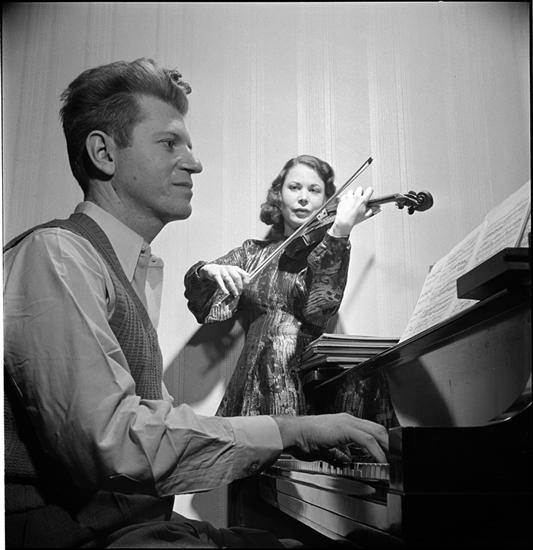
    List’s later life was marred by tragedy. In 1983, after 42 years of marriage, his wife, the violinist Carroll Glenn, slipped into a coma only days after being diagnosed with a brain tumor. Two years later, while planning a recital to mark the 50th anniversary of his Carnegie Hall debut, List fell down the steps of his New York brownstone and broke his neck. He was 66 years-old.

    List was a familiar presence on radio and television, and he even appeared in a movie, “The Bachelor’s Daughters,” in 1946.

    We’ll hear List perform music by Gottschalk and Howard Hanson, alongside observances of the birthdays today of composers Hanns Eisler, Elisabeth Lutyens, and Wenzel Thomas Matiegka, and pianist and conductor Vladimir Ashkenazy – all to come between 4 and 6 p.m. EDT, on WWFM – The Classical Network and wwfm.org.

    Then stick around for music from cinematic adaptations of the books of Jane Austen on “Picture Perfect” at 6!


    PHOTO: Eugene List and Carroll Glenn

  • Eleanor Sokoloff Turns 104

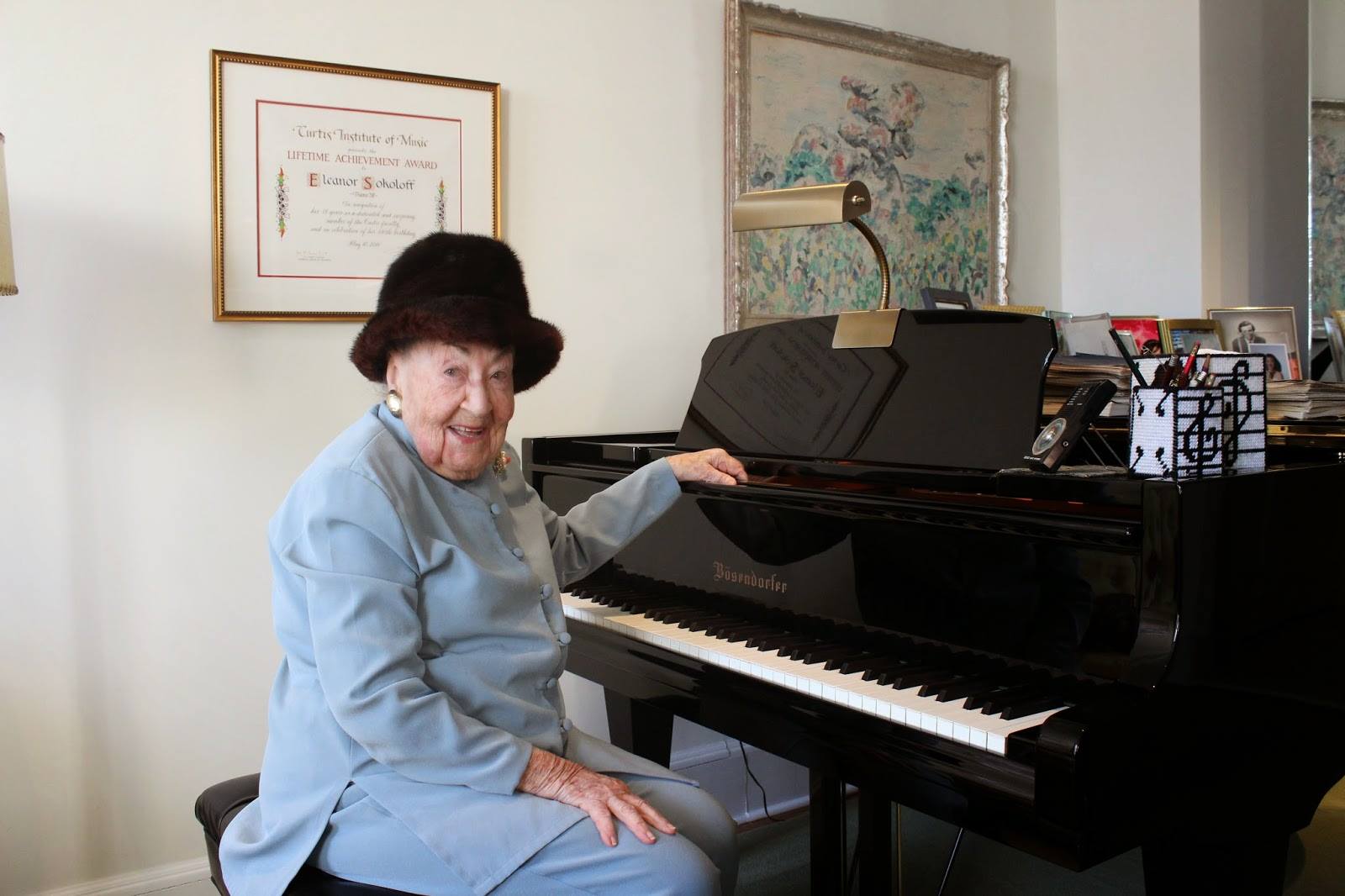
    Eleanor Sokoloff Turns 104

    In very loose connection with an article I am writing about organist Gordon Turk, I happened to google yesterday Eleanor Sokoloff. Turk had studied piano with Sokoloff’s husband, Vladimir, at the Curtis Institute of Music in Philadelphia.

    Eleanor too is a pianist and pedagogue at Curtis. She began teaching there in 1936. Among her countless pupils were Lambert Orkis, Susan Starr, Hugh Sung, Leon McCawley, and Keith Jarrett. Eleanor has nothing at all to do with the article. I was just curious to see if she is still around and what she is up to. Oh, she is still around, all right. Today, Eleanor turns 104.

    I recollect attending concerts at Curtis’ Field Hall, back in the 1980s, and the Sokoloffs were seemingly always in attendance. Vladimir had also served as a pianist with the Philadelphia Orchestra. He died in 1997.

    In 1995, I became Eleanor’s neighbor, when I opened a bookshop on 17th Street, below Latimer. My morning dog walks would take me past the Sokoloff residence, situated between the old Rittenhouse Medical Bookstore (since demolished) and I believe a former residence of Leopold Stokowski, which had been turned into an art gallery. Eleanor would frequently be standing at her front door, and she would always smile and give a friendly wave. When she wasn’t at the door, it meant she had a pupil, and music would flood the streets.

    According to what I can find out about her on the internet, she continues to teach to this very day. Of course, in music there is really no involuntary “retirement,” and Curtis has a history of venerable pedagogues. The pianist Mieczyslaw Horszowski taught there until a few weeks before his death in 1993. But Sokoloff has Horszowski beat. He hadn’t even reached 101.

    Happy birthday, Eleanor. Long may ye reign.

    Here’s a mesmerizing two-part interview with Sokoloff, conducted by Hugh Sung, when she was 100:

  • Philly Composers Gin & Dim Restaurant Lights

    Philly Composers Gin & Dim Restaurant Lights

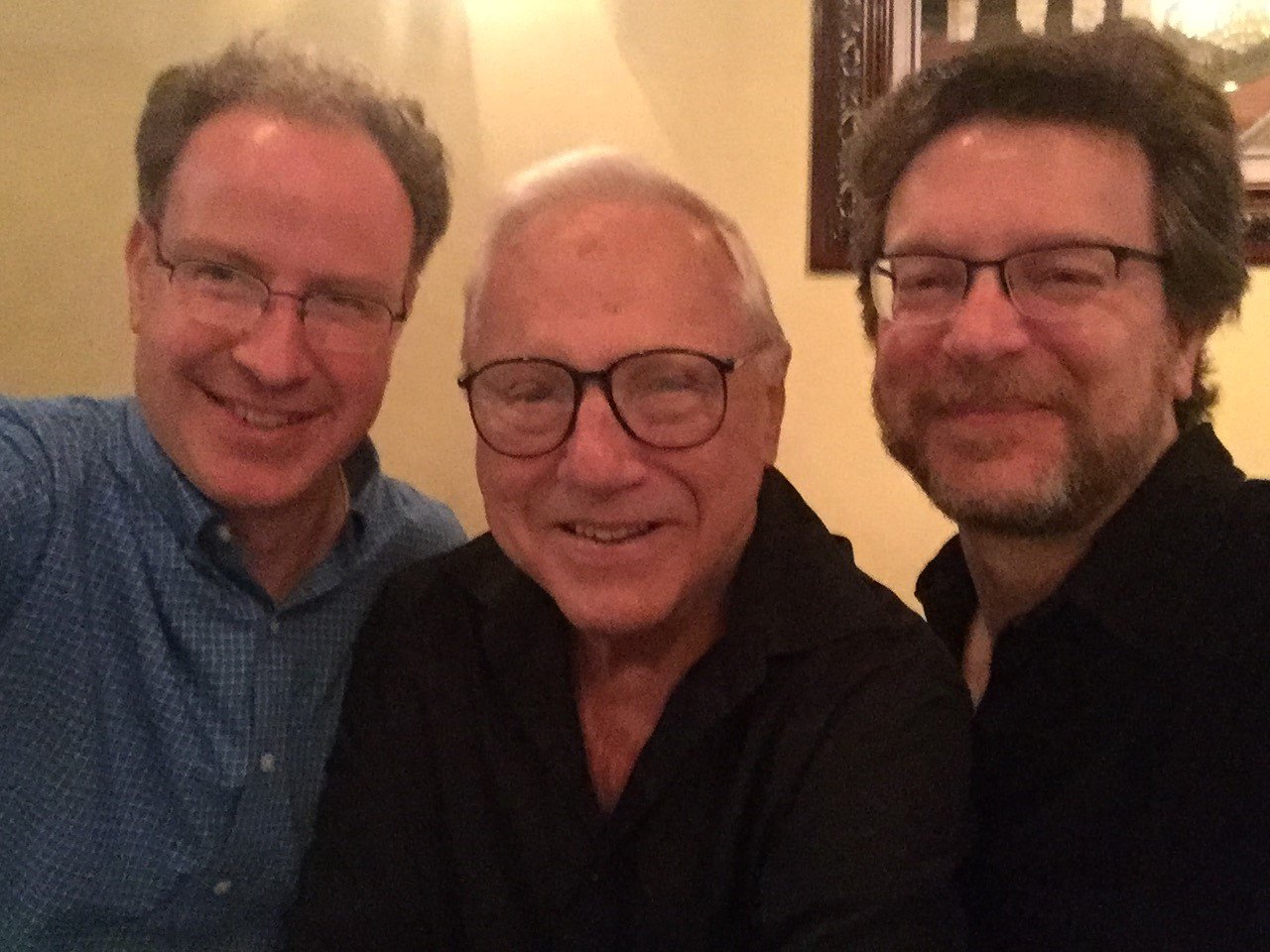
    Restaurant lighting flatters no one, but here I am at the wrong end of a gin-fueled evening with two estimable Philadelphia composers, Robert Moran and Kile Smith. Only one broken glass, and we may have over-tipped, but I think I can say with confidence that a good time was had by all.

  • Musicopia Inspires Young Musicians in Philly

    Musicopia Inspires Young Musicians in Philly

    Thanks very much to Denise Kinney for making the drive up from Philadelphia this afternoon to talk with us at WWFM – The Classical Network about Musicopia, an organization that creates opportunities for young people to experience, learn, perform, and appreciate music. Kinney is the organization’s executive director.

    As an added bonus, it was great to be able to enjoy a rare visit from, and conversation with, Maestro Mark Laycock, back in Princeton to help promote Musicopia and to tell us about his new composition written specifically for its young performers.

    Laycock’s “Musicopia! Suite for String Orchestra” will be given its world premiere as part of a free concert, which will take place this Saturday at 5 p.m. at The Church of the Holy Trinity, Rittenhouse Square, 1904 Walnut Street, in Philadelphia.

    Best wishes to Denise, Mark, and Musicopia!

  • Robert Moran’s Unconventional Genius Celebrated Today

    Robert Moran’s Unconventional Genius Celebrated Today

    A work for amplified Volkswagen, played with flashlights. An opera for eleven dogs. A piano piece in which the performer crawls inside the lid and lets the piano play him.

    Move over, Till Eulenspiegel. Today is the birthday of Robert Moran.

    Moran, who’s made his home in Philadelphia for over 30 years, is contemporary music’s merry prankster.

    Following studies in Vienna with Hans Erich Apostel, with whom he “learned to count to twelve” (as in twelve-tone music), Moran attended Mills College, where his teachers were Darius Milhaud and Luciano Berio. His classmates at Mills included Steve Reich, Phil Lesh, and Tom Constanten. Lesh and Constanten went on to play for The Grateful Dead. I wonder what ever happened to Reich?

    While there, Moran became involved with the whole San Francisco scene. He gained notoriety in the late 1960s and early ‘70s through a series of performance pieces incorporating entire cities, including San Francisco, Bethlehem, PA, and Graz, Austria. These involved tens of thousands of performers.

    His many stage works include “Desert of Roses” (after Beauty and the Beast), written for Houston Grand Opera, and “Alice” (after “Alice’s Adventures in Wonderland”), composed for the Scottish Ballet. Maurice Sendak introduced him to the Grimm fairy tale “The Juniper Tree,” which became an operatic collaboration with Philip Glass.

    For the occasion of the tenth anniversary of the terrorist attacks on the World Trade Center, Moran was commissioned to write a work for the youth chorus of Trinity Wall Street, the so-called “Ground Zero” church in Lower Manhattan. “Trinity Requiem,” scored for children’s chorus, four cellos, harp and organ, offers a similar brand of solace to that conjured in the 19th century masterwork by Gabriel Fauré.

    With Moran, you never know what you’re going to get. In his more puckish moments, he might write for harpsichord and electric frying pan. But then there are times when his natural gift for lyricism will melt your heart. Whether he’s writing for Houston Grand Opera, 39 autos, giant puppets, or electric popcorn popper, his music is always vital and worth getting to know.

    Join me today, between 4 and 7 p.m. EST, for music by Robert Moran, among our birthday celebrants, on WWFM – The Classical Network and wwfm.org.


    An aria from “Desert of Roses:”

    Selections from “Trinity Requiem:”

    “Obrigado” for Iowa Percussion:

    Bob introducing his “Lunchbag Opera” for the BBC in 1971:

Tag Cloud

Aaron Copland (93) Beethoven (95) Composer (114) Film Music (133) Film Score (143) Film Scores (255) Halloween (94) John Williams (193) KWAX (229) Leonard Bernstein (103) Marlboro Music Festival (125) Movie Music (148) Mozart (88) Opera (206) Philadelphia Orchestra (89) Picture Perfect (174) Princeton Symphony Orchestra (108) Radio (88) Ross Amico (244) Roy's Tie-Dye Sci-Fi Corner (290) The Classical Network (101) The Lost Chord (268) Vaughan Williams (103) WPRB (396) WWFM (881)

DON’T MISS A BEAT

Receive a weekly digest every Sunday at noon by signing up here


RECENT POSTS