
Here’s my editor, after I just squandered another day of my life pounding out a 1700-word piece against a 1200-word quota. I won’t spill the beans about it just yet, but it has something to do with a composer who lived in Princeton for about a quarter century, beginning in 1856. You may not know his name, but if you’re at all connected to the university, you know his music. I’m hopeful the article will run in next week’s U.S. 1 newspaper – out on Wednesday – unless it’s waylaid by vampires, extraterrestrials, or Jack the Ripper!
Tag: Princeton University
-
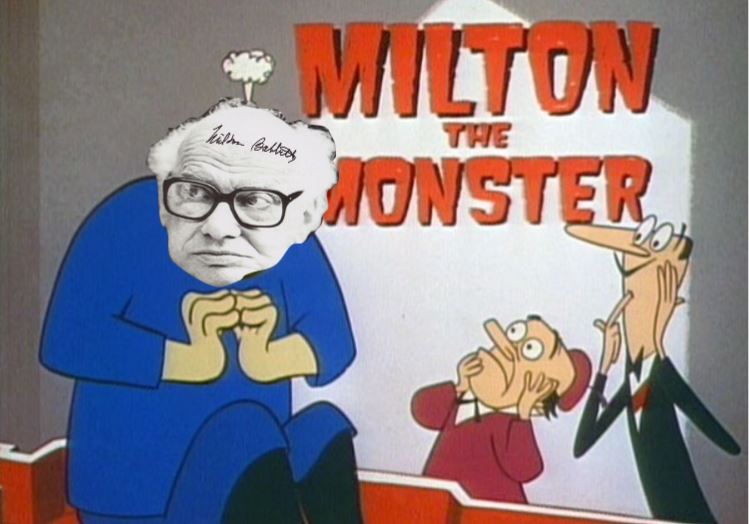
Milton Babbitt Beyond the Monster Myth
The headline read “Who Cares if You Listen?” And the notoriety was instant and long-lasting.
All at once, Milton Babbitt was a musical monster.
Babbitt, a staple at Princeton University for many years, was born in Philadelphia on this date in 1916. He received lasting blowback from angry villagers wielding torches and pitchforks for an essay he wrote for High Fidelity magazine, which bore the title stated above.
Unfortunately, the headline wasn’t Babbitt’s. It was actually an editorial decision. Babbitt’s original title had been “The Composer as Specialist” – not nearly as eye-catching or provocative. Today, we might describe it as clickbait. But it stuck like Karloff’s neck-bolts, as both a source of animation and a signal of abnormality, branding him in the eyes of the superstitious rabble as an outcast to be feared.
Also, it is kind of arrogant.
While it’s true that Babbitt frequently composed in a serial style, which might be off-putting to some coming to it for the first time, his music is often fairly lucid, without undo congestion and with a minimum of soul-crushing dissonances. On the contrary, he often achieved a paradoxical simplicity under the guise of complexity.
In the 1960s, Babbitt became interested in electronic music, apparently for its rhythmic precision, as opposed to any unusual timbral considerations. I find it endearing that he was also fond of jazz and musical theater and that late in life he enjoyed a friendship of sorts with film composer John Williams. (They bonded over Bernard Herrmann.) His one-time student, Stephen Sondheim, characterized him as “a frustrated show composer.”
Babbitt himself was a saxophonist. In 1946, he penned a musical, “Fabulous Voyage,” a retelling of Homer’s “The Odyssey.”
Yes, we all have our off-days, but the lasting impression Babbitt left on his students and colleagues seems to be that he was largely a warm and personable human being. He loved Broadway, beer, and football. Simple pleasures for someone portrayed as so lofty, he didn’t give a hang if you listened.
Babbitt was the recipient of an honorary Pulitzer Prize in 1982. He died in Princeton in 2011, at the age of 94.
Listen to “Penelope’s Night Song” from “Fabulous Voyage” and tell me if it seems to you like the product of a rampaging monster.
“Composition for Twelve Instruments” (1948):
“Reflections” (1974) for piano and synthesized tape:
Milton Babbitt on electronic music:
John Williams talks Babbitt in The New Yorker
If you’re interested in learning more about Princeton’s important role in the history of computer music and haven’t done so yet, do check out this podcast, produced by the Princeton University Engineering Department.
I profiled the podcast’s creator, Aaron Nathans, in September for the Princeton weekly U.S. 1.
A refresher on “Milton the Monster”
Happy birthday, Milton Babbitt!
-
NJ Symphony Celebrates a Century in Princeton
A venerable orchestra, celebrating 100 years this season, will strike a balance with some-things-old and something new, when the @[100046173663486:2048:New Jersey Symphony] returns to Princeton University’s Richardson Auditorium this Friday at 8 p.m.
Established classics by Wolfgang Amadeus Mozart and Anton Bruckner will flank a world premiere by Princeton composer Steven Mackey. Vocal soloists and the Princeton University Glee Club will join the orchestra, led by music director Xian Zhang.
The program will be repeated at the New Jersey Performing Arts Center (NJPAC) in Newark on Saturday at 8 p.m. and at the State Theatre New Brunswick on Sunday at 3:00.
Find out more about the concerts and a little bit of the orchestra’s colorful history in my article in this week’s @[100063792690234:2048:U.S. 1 Newspaper – PrincetonInfo], in area vending machines and local business, or online now.
-
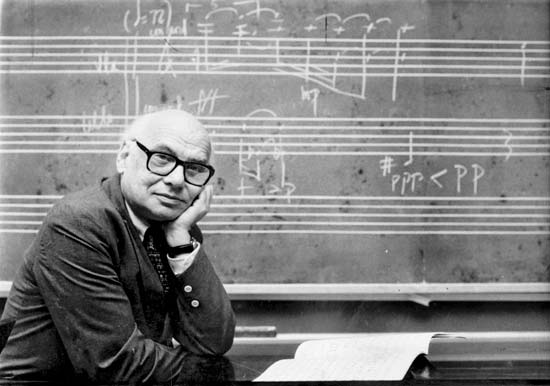
Milton Babbitt Serial Simplicity
Who cares if you read this?
Milton Babbitt, a staple at Princeton University for many years, was born in Philadelphia on this date in 1916. Babbitt gained widespread notoriety for an essay he wrote for High Fidelity magazine, titled “Who Cares If You Listen?” It turns out the provocative stance was actually the result of an editorial decision, and that Babbitt’s original title had been “The Composer as Specialist” – not likely to generate nearly as much controversy.
While he frequently composed in a serial style, Babbitt’s music is often fairly lucid, without undo congestion and with a minimum of soul-crushing dissonances. On the contrary, he often achieved a paradoxical simplicity under the guise of complexity.
In the 1960s, Babbitt became interested in electronic music, apparently for its rhythmic precision, as opposed to any unusual timbral considerations. I find it endearing that he was also fond of jazz and musical theater and that late in life he enjoyed a friendship of sorts with film composer John Williams. (They bonded over Bernard Herrmann.) His one-time student, Stephen Sondheim characterized him as “a frustrated show composer.”
Babbitt himself was a saxophonist. In 1946, he penned a musical, “Fabulous Voyage,” a retelling of Homer’s “The Odyssey.”
He was the recipient of an honorary Pulitzer Prize in 1982. Babbitt died in Princeton in 2011, at the age of 94.
Listen here for “Penelope’s Night Song” from “Fabulous Voyage”:
https://soundcloud.com/phillipc…/penelopes-night-song-from
“Composition for Twelve Instruments” (1948):
“Reflections” (1974) for piano and synthesized tape:
Milton Babbitt on electronic music:
John Williams talks Babbitt in The New Yorker
If you’re interested in learning more about Princeton’s important role in the history of computer music and haven’t done so yet, do check out this podcast, produced by the Princeton University Engineering Department.
I profiled the podcast’s creator, Aaron Nathans, in September for the Princeton weekly U.S. 1.
Happy birthday, Milton Babbitt!
-
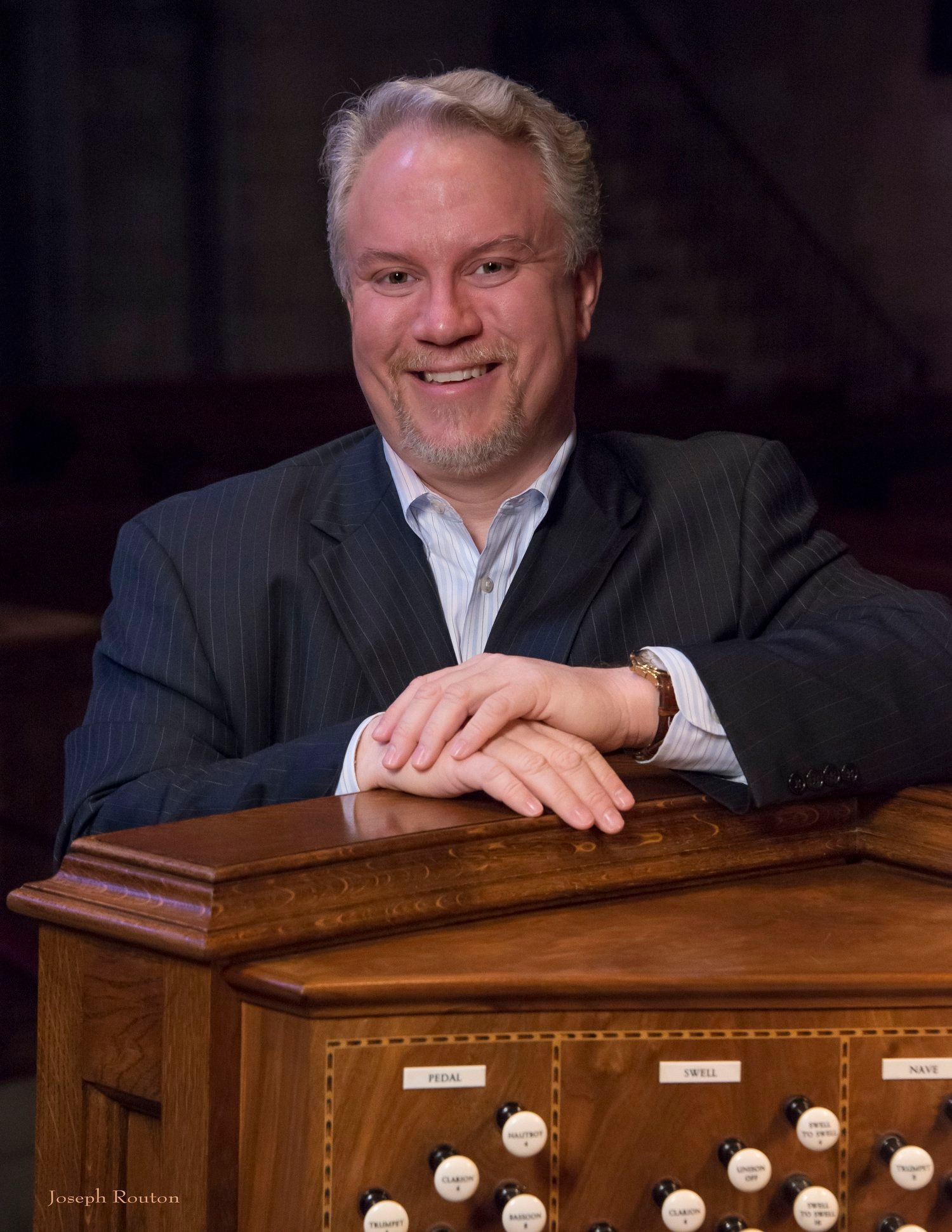
Eric Plutz Vierne Symphonies New Recording
I just completed an epic Zoom interview with Eric Plutz (while we were both doing laundry). Plutz, University Organist of Princeton University, has been deeply involved in the local music scene for years, so this conversation was long overdue.
Just released is a new CD set of the complete organ symphonies of Louis Vierne, performed by Plutz, and recorded on six different organs across this great nation of ours by John C. Baker of Affetto Records.
You can look forward to an in-depth profile and learn more about Eric (and Vierne) in my article in an upcoming edition of the Princeton weekly newspaper U.S. 1.
Watch this space for further developments. And thank you for your time, Eric Plutz!
Tag Cloud
Aaron Copland (94) Beethoven (95) Composer (114) Film Music (150) Film Score (143) Film Scores (255) Halloween (102) John Williams (198) KWAX (233) Leonard Bernstein (105) Marlboro Music Festival (125) Movie Music (165) Mozart (91) Opera (215) Philadelphia Orchestra (90) Picture Perfect (174) Princeton Symphony Orchestra (110) Radio (90) Ross Amico (244) Roy's Tie-Dye Sci-Fi Corner (290) The Classical Network (101) The Lost Chord (269) Vaughan Williams (107) WPRB (397) WWFM (881)