Tag: Psycho

  • Israel Baker From THX 1138 to Hitchcock

    Israel Baker From THX 1138 to Hitchcock

    In researching the music for tonight’s discussion of “THX 1138” on Roy’s Tie-Dye Sci-Fi Corner, I was interested to note Israel Baker among the film’s musical personnel. In addition to working in the movies, Baker made many recordings for Columbia Records (now Sony), with the likes Jascha Heifetz, Bruno Walter, Glenn Gould, and Igor Stravinsky.

    At different points of his career, he was concertmaster of Stokowski’s All-American Youth Orchestra, a member of Toscanini’s NBC Symphony (where he would have played with flutist Carmine Coppola – father of Francis Ford Coppola – also listed among the “THX” personnel), leader of the Los Angeles Chamber Orchestra, and concertmaster of the Columbia Symphony. In addition, he led the classical and jazz ensembles at Capitol Records.

    Baker was Stravinsky’s first choice to record his Violin Concerto, but Columbia overruled in favor of the more marketable Isaac Stern. Alongside his work in the film and classical music fields, Baker appeared on hundreds of recordings by artists such as Benny Carter, Ella Fitzgerald, Johnny Mathis, Frank Sinatra, Barbra Streisand, Mel Tormé, Sarah Vaughan, Tom Waits, and The Dameans.

    Perhaps his most notorious contribution to film was as concertmaster at the recording sessions for Bernard Herrmann’s score to Alfred Hitchcock’s “Psycho” (in which capacity he played in the infamous shower scene). Baker also worked with Alfred Newman, Franz Waxman, André Previn, Elmer Bernstein, Maurice Jarre, John Barry, John Williams, and – in the case of “THX 1138” – Lalo Schifrin.

    He died on Christmas Day, 2012, at the age of 92.


    Baker plays the opening of “Scheherazade” with Erich Leinsdorf and the Concert Arts Orchestra

    Stravinsky’s “Pastorale”

    The dream team of Jascha Heifetz, Israel Baker, William Primrose, Gregor Piatigorsky, and Leonard Pennario, in César Franck’s Piano Quintet in F minor

    Playing Schoenberg with Glenn Gould

    An interview with Baker at the age of 90

    More about tonight’s discussion of “THX 1138”


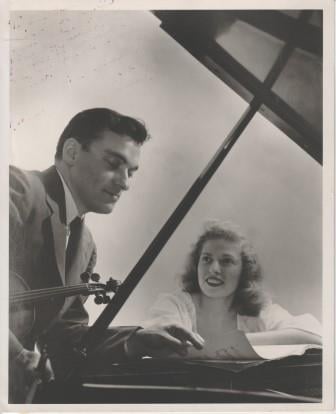
    PHOTO: Baker with his frequent duo partner, Yaltah Menuhin, sister of the famed violinist Yehudi Menuhin
  • Bernard Herrmann: America’s Greatest Film Composer?

    Bernard Herrmann: America’s Greatest Film Composer?

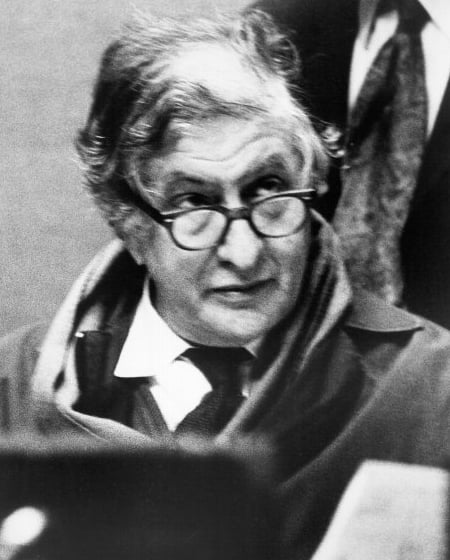
    He was irascible, outspoken, and, for those unaccustomed to his quirks, probably a trial to be around. Of course, he was also usually right. Was Bernard Herrmann America’s greatest film composer? When I listen for pleasure, his scores are not always the first that I turn to, but I can’t think of anyone else who so perfectly understood the most effective use of music in film.

    This interview – conducted in a noisy cocktail lounge at New York’s Regency Hotel (home of Maxfield Parrish’s Old King Cole mural) – does a pretty good job of conveying the composer in all his ill-humored glory. Herrmann has no hesitation in telling us exactly what he thinks.

    At least he has good things to say (after his fashion) about Copland and Korngold. A shame the “Citizen Kane” record with Orson Welles and Joan Sutherland never came to fruition. Also, the idea of a Ravel “Salome” is fascinating.

    http://www.bernardherrmann.org/articles/an-interview-with-bernard-herrmann/

    Happy birthday, Bernard Herrmann.


    Herrmann records “The Day the Earth Stood Still” (1951)

    “The Ghost and Mrs. Muir” (1947)

    Duel with the skeleton from “The Seventh Voyage of Sinbad” (1958)

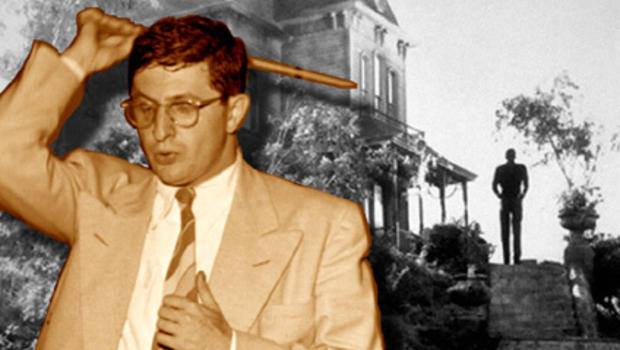
    Opening credits to “Psycho” (1960)

    Final scene of “Obsession” (1976)

  • Bernard Herrmann Greatest Film Composer?

    Bernard Herrmann Greatest Film Composer?

    Is Bernard Herrmann the greatest film composer who ever lived?

    I can’t think of a single other composer who had a more assured sense of precisely what sound would perfectly complement a specific onscreen image. Most scores by film composers of Hollywood’s Golden Age were melody driven, and while Herrmann certainly could write a heart-rending melody with the best of them, he seemed to be more interested in timbre. What sounds could he create, no matter how outlandish, that would best convey the experience of fighting a giant crab?

    Only Herrmann would resolve to score a film like “The Day the Earth Stood Still” using two theremins, two Hammond organs, a large studio electric organ, three vibraphones, two glockenspiels, marimba, tam-tam, two bass drums, three sets of timpani, two pianos, celesta, two harps, electric strings and brass. On paper and in execution, it was the height of lunacy. Yet all at once, the theremin became shorthand for 1950s science fiction.

    Despite his stand-apart genius, Herrmann was honored with only a single Academy Award, in 1941 – the same year he followed Orson Welles to Hollywood to write the music for “Citizen Kane” – for “The Devil and Daniel Webster” (also known as “All That Money Can Buy”). He was nominated for his work on “Kane,” and then late in life for the music he wrote for Brian De Palma’s “Obsession” and Martin Scorsese’s “Taxi Driver” (both 1976). He died in his sleep only hours after completing the recording sessions for the latter.

    Yet he left behind dozens of beloved and classic scores for films like “The Magnificent Ambersons,” “Jane Eyre,” “The Ghost and Mrs. Muir,” “The Day the Earth Stood Still,” “The Seventh Voyage of Sinbad,” and “Jason and the Argonauts,” to say nothing of those from his landmark association with Alfred Hitchcock, for films like “North by Northwest,” “Vertigo” and “Psycho.” How could “Psycho” not have received an Academy Award? It wasn’t even nominated!

    Almost certainly the reason for Herrmann’s neglect on the part of the establishment had less to do with his talent than with his prickly personality. He was a notorious crank. Many found him intimidating, but his acerbic behavior made for some great stories. Steven Spielberg, who had recently enjoyed his first great success with “Jaws,” met Herrmann at the recording session for “Taxi Driver.” When the young director expressed his admiration for the veteran composer’s work, the cantankerous Herrmann shot back, “Then why do you always hire John Williams?” He disagreed violently with studio executives and cab drivers alike – in fact seemed to go out of his way to do so – but many also attested to his kindness and warmth in private.

    Curiously, though his concert works have their moments, they don’t grip me from start to finish in a way that certain pieces by fellow film composers Erich Wolfgang Korngold, Miklós Rózsa, and Jerome Moross do. His was a peculiar kind of genius. He was perhaps the greatest film composer who ever lived.

    Happy birthday, Bernard Herrmann (1911-1975)!


    “The Day the Earth Stood Still” (1951):

    “The Ghost and Mrs. Muir” (1947):

    “Jason and the Argonauts” (1963):

    “Psycho” (1960):

Tag Cloud

Aaron Copland (92) Beethoven (94) Composer (114) Film Music (117) Film Score (143) Film Scores (255) Halloween (94) John Williams (185) KWAX (228) Leonard Bernstein (99) Marlboro Music Festival (125) Movie Music (132) Opera (197) Philadelphia Orchestra (86) Picture Perfect (174) Princeton Symphony Orchestra (106) Radio (86) Ralph Vaughan Williams (85) Ross Amico (244) Roy's Tie-Dye Sci-Fi Corner (290) The Classical Network (101) The Lost Chord (268) Vaughan Williams (99) WPRB (396) WWFM (881)

DON’T MISS A BEAT

Receive a weekly digest every Sunday at noon by signing up here


RECENT POSTS