Tag: Pulitzer Prize

  • George Walker Pulitzer Winner Remembrance

    George Walker Pulitzer Winner Remembrance

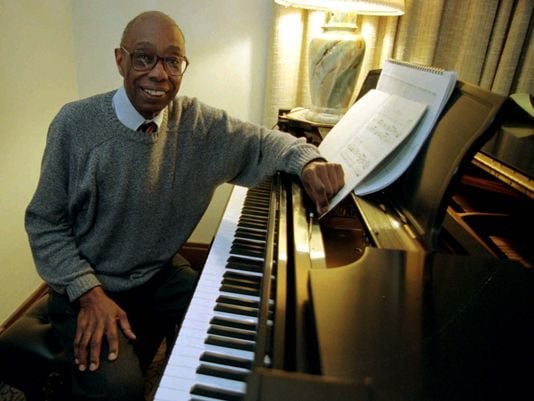
    George Walker would have been 99 years-old today.

    Walker was the first African-American recipient of the Pulitzer Prize for Music – as recently as 1996 – for “Lilacs for Voice and Orchestra.” He was the first black pianist to present a solo recital at New York’s Town Hall (in 1945). He was the first black performer to appear as soloist with the Philadelphia Orchestra (performing Rachmaninoff’s Piano Concerto No. 3). He was the first black musician to graduate from the Curtis Institute of Music (where he studied with Rudolf Serkin and Rosario Scalero).

    Walker died on August 23, 2018, at the age of 96. This Sunday night on “The Lost Chord,” we’ll celebrate this trailblazing artist with a program of four of his original works, including his Piano Sonata No. 2 (with the composer himself at the keyboard), the award-winning “Lilacs” (after poetry of Walt Whitman), “Address for Orchestra” (his first major orchestral work), and “Lyric for Strings” (his most famous music, in its original version for string quartet).

    Born in Washington, D.C., Walker was a longtime resident of Montclair, NJ. His father emigrated from Kingston, Jamaica, to study at Temple University School of Medicine; Walker’s mother supervised his first piano lessons. He was admitted to the Oberlin School of Music at the age of 14. He was then admitted to the Curtis Institute in Philadelphia, and later attended the Eastman School. For two years, he studied in Paris with famed pedagogue Nadia Boulanger.

    Walker’s own academic career included posts with Dillard University in New Orleans, the Dalcroze School of Music, the New School for Social Research, Smith College, the University of Colorado Boulder, Rutgers University (where he served as chairman of the music department), the Peabody Institute of John Hopkins University, and the University of Delaware.

    He was the father of two sons, violinist and composer Gregory T.S. Walker and playwright Ian Walker. His sister was the pianist Frances Walker-Slocum.

    By his own assessment, Walker was a composer more interested in building “elegant structures” than in “creating beauty.” Depending on one’s sensibility, it could be argued that he achieved both.

    I hope you’ll join me in “Perambulating with Walker,” this Sunday night at 10:00 EDT, on WWFM – The Classical Network and wwfm.org.


    A fascinating interview with Walker by Frank J. Oteri, which, among other things, lends an added dimension to Walker’s most frequently performed music (the “Lyric”) and offers insights into his life and musical philosophy. Also, some great photos!

    https://nmbx.newmusicusa.org/george-walker-concise-and-precise/


    Do you enjoy exploring unusual and neglected repertoire like that offered on “The Lost Chord?” Whatever it is you appreciate about WWFM The Classical Network, we hope you will help support it with your contribution today. Make a donation through Wednesday, June 30 (the end of our fiscal year), and help balance our budget, at wwfm.org.

    We couldn’t do it without enthusiastic and committed listeners like you. Thank you for all that you do to keep classical music on the radio!

    https://wwwfm.secureallegiance.com/wwfm/WebModule/Donate.aspx?P=DEFAULT&PAGETYPE=PLG&CHECK=vOU2bz5JCWmgCDbf53nm9ezWDeZ%2beA1M

  • Tania León Wins Pulitzer for “Stride”

    Tania León Wins Pulitzer for “Stride”

    Here, with all the hullabaloo, I forgot all about the Pulitzers being announced yesterday. Congratulations to Tania León, the recipient of this year’s prize for music, for her composition “Stride.”

    “Stride” received its world premiere by the New York Philharmonic on February 13, 2020. The music is a response to the orchestra’s “Project 19” commissioning program, for which 19 women wrote works to mark the centennial of the ratification of the 19th Amendment, which guaranteed a woman’s right to vote. The inspiration for León’s piece was Susan B. Anthony.

    León discusses “Stride”

    The work in rehearsal:

    You’ll find an interview with the composer, in which she talks about the piece, here:

    https://www.npr.org/sections/deceptivecadence/2021/06/11/1005649919/tania-leon-wins-music-pulitzer-for-stride-a-celebration-of-womens-suffrage

    León, born in Havana, settled in New York in 1967. Among her teachers was Ursula Mamlok.

    This year’s other finalists in the category were Ted Hearne, for “Place,” and Maria Schneider, for “Data Lords.”

    It’s a good thing it’s still breakfast, because I really feel like I’ve got egg on my face for having forgotten, especially after devoting this past Sunday’s “The Lost Chord” to Pulitzer Prize winning music! If you missed it, you can still catch the show as a webcast at the link below. The playlist includes works by William Schuman (the very first recipient of the music prize), William Bolcom, and Caroline Shaw (the category’s youngest honoree).

    https://www.wwfm.org/post/lost-chord-june-6-further-pulitzer-surprises

  • Forgotten Pulitzer Music: Beyond the Familiar

    Forgotten Pulitzer Music: Beyond the Familiar

    Beyond Aaron Copland’s “Appalachian Spring” and Charles Ives’ Symphony No. 3, how many Pulitzer Prize winners are actually known to the average concertgoer? Sure, the operas of Gian Carlo Menotti and Robert Ward get revived from time to time, and Jennifer Higdon has been exceptionally fortunate for a composer in her prime. But most Pulitzer winners tend to languish in relative obscurity.

    This Sunday night on “The Lost Chord,” in advance of Friday’s announcement of this year’s winners and nominees, we’ll take another look back on Pulitzer history and sample three honored works.

    The very earliest recipient in the music category, in 1943, was William Schuman’s “A Free Song.” Schuman sets a text drawn from Walt Whitman’s “Drum Taps,” verse which grew out of the poet’s Civil War experiences, but also spoke with vigor and optimism to a country once again caught in the throes of conflict. The work was recorded for the first time only in 2011.

    Also on the program will be music by William Bolcom. Bolcom, who only just turned 83, is a composer at home in all genres. His cabaret recitals with his wife, Joan Morris, have always been great favorites; his rag, “Graceful Ghost,” receives heavy air time around Halloween; and his magnum opus, “Songs of Innocence and of Experience,” is a kaleidoscopic, two-and-a-half-hour journey enlivened by bluegrass, country, soul, folk, vaudeville, rock, reggae, and classical influences. We’ll hear selections from Bolcom’s “12 New Etudes for Piano,” the Pulitzer-winner from 1988, performed by the unflappable Marc-André Hamelin.

    Finally, we’ll turn to Caroline Shaw and her extraordinary “Partita for 8 Voices,” which was awarded the Pulitzer in 2013. Shaw, the youngest recipient of the prize for music, was only 30 years-old at the time and a doctoral candidate at Princeton University. Her “Partita” navigates a dizzying array of genres and techniques. The piece will be presented in a flabbergastingly virtuosic performance by the a cappella ensemble Roomful of Teeth, of which Shaw is a founding member.

    I hope you’ll join me for an hour of prized Pulitzer music. That’s “Further Pulitzer Surprises,” this Sunday night at 10:00 EDT, on WWFM – The Classical Network and wwfm.org.


    PHOTO: Caroline Shaw (front left) with Roomful of Teeth

  • Bob Dylan at 80: Musical Influences

    Bob Dylan at 80: Musical Influences

    Happy birthday to Bob Dylan, 80 years-old today.

    Dylan sings “Blowin’ in the Wind” (television, 1963):

    George Crumb’s “Blowin’ in the Wind,” from his “American Songbook VI: Voices from the Morning of the Earth” (2008):

    Dylan sings “Mr. Tambourine Man” (Newport Folk Festival, 1964):

    John Corigliano’s “Mr. Tambourine Man: Seven Poems of Bob Dylan” (2000):

    As the title indicates, there are seven songs in all, original settings of Dylan’s verse. If you let it run too long, it will go into Corigliano’s music for “Altered States.”

    Both Crumb and Corigliano are Pulitzer Prize winners. Dylan said hold my beer – in 2016, he was awarded the Nobel Prize for Literature.

    The times they are a-changin’.

  • Ellen Zwilich Peanuts Pulitzer Winner!

    Ellen Zwilich Peanuts Pulitzer Winner!

    Ellen Taaffe Zwilich was born on this date in 1939. Zwilich made history when she became the first female recipient of the Pulitzer Prize for Music, in 1983, for her Symphony No. 1.

    Seven years later, she made history for a second time for being perhaps the only living classical music composer – and to my knowledge the only woman – to be referenced in Charles Schulz’s beloved comic strip “Peanuts.”

    In the first of three panels, Peppermint Patty and Marcie are shown attending a concert. Marcie, holding a program, says to Patty, half-asleep, that the next piece will be a Concerto for Flute and Orchestra. In the second panel, she notes, “It was composed by Ellen Zwilich who, incidentally, just happens to be a woman!” Patty springs awake, and in the last panel, she’s standing on her chair. As Marcie slumps into her seat in evident embarrassment, Patty cries, “GOOD GOING, ELLEN!” (The original strip is posted in the comments section below.)

    Turnabout is fair play, and in 1996, Zwilich composed a concertino of sorts, for piano and orchestra, titled “Peanuts Gallery.” The work includes movements inspired by Schroeder, Linus, Snoopy, Charlie Brown, Lucy, and Peppermint Patty and Marcie. It was given its premiere on a Carnegie Hall children’s concert, by the pianist Albert Kim and the Orpheus Chamber Orchestra.

    The piece was recorded for the Naxos label, with pianist Jeffrey Biegel and the Florida State University Symphony Orchestra. The movements are posted individually on YouTube. I have it cued up so that you can let them all play through, continuously, here:

    As an alternative, here’s the entire work, performed without break, with actors and dancers, in a reduction for two pianos:

    “Peanuts Gallery” became the subject of a prize-winning PBS documentary. A second Zwilich documentary was produced to trace the development of her “Gardens” Symphony:

    https://www.pbs.org/video/the-gardens-birth-of-a-symphony-xfgoh6/

    Birthdays are a time for celebration. Go ahead and go (Pea)nuts for Ellen Taaffe Zwilich.


    “Celebration”

    The Pulitzer-winning Symphony No. 1 (in three movements)

    Peppermint Patty’s revelation: the Concerto for Flute and Orchestra

Tag Cloud

Aaron Copland (92) Beethoven (95) Composer (114) Film Music (119) Film Score (143) Film Scores (255) Halloween (94) John Williams (185) KWAX (229) Leonard Bernstein (99) Marlboro Music Festival (125) Movie Music (134) Opera (198) Philadelphia Orchestra (87) Picture Perfect (174) Princeton Symphony Orchestra (106) Radio (87) Ralph Vaughan Williams (85) Ross Amico (244) Roy's Tie-Dye Sci-Fi Corner (290) The Classical Network (101) The Lost Chord (268) Vaughan Williams (102) WPRB (396) WWFM (881)

DON’T MISS A BEAT

Receive a weekly digest every Sunday at noon by signing up here


RECENT POSTS