Dylan sings “Blowin’ in the Wind” (television, 1963):
George Crumb’s “Blowin’ in the Wind,” from his “American Songbook VI: Voices from the Morning of the Earth” (2008):
Dylan sings “Mr. Tambourine Man” (Newport Folk Festival, 1964):
John Corigliano’s “Mr. Tambourine Man: Seven Poems of Bob Dylan” (2000):
As the title indicates, there are seven songs in all, original settings of Dylan’s verse. If you let it run too long, it will go into Corigliano’s music for “Altered States.”
Both Crumb and Corigliano are Pulitzer Prize winners. Dylan said hold my beer – in 2016, he was awarded the Nobel Prize for Literature.
Ellen Taaffe Zwilich was born on this date in 1939. Zwilich made history when she became the first female recipient of the Pulitzer Prize for Music, in 1983, for her Symphony No. 1.
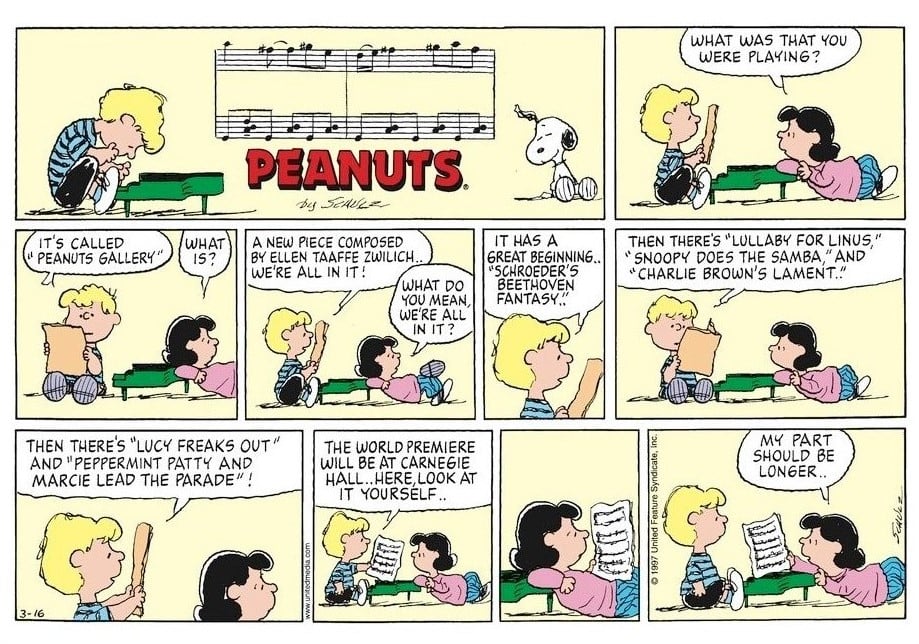
Seven years later, she made history for a second time for being perhaps the only living classical music composer – and to my knowledge the only woman – to be referenced in Charles Schulz’s beloved comic strip “Peanuts.”
In the first of three panels, Peppermint Patty and Marcie are shown attending a concert. Marcie, holding a program, says to Patty, half-asleep, that the next piece will be a Concerto for Flute and Orchestra. In the second panel, she notes, “It was composed by Ellen Zwilich who, incidentally, just happens to be a woman!” Patty springs awake, and in the last panel, she’s standing on her chair. As Marcie slumps into her seat in evident embarrassment, Patty cries, “GOOD GOING, ELLEN!” (The original strip is posted in the comments section below.)
Turnabout is fair play, and in 1996, Zwilich composed a concertino of sorts, for piano and orchestra, titled “Peanuts Gallery.” The work includes movements inspired by Schroeder, Linus, Snoopy, Charlie Brown, Lucy, and Peppermint Patty and Marcie. It was given its premiere on a Carnegie Hall children’s concert, by the pianist Albert Kim and the Orpheus Chamber Orchestra.
The piece was recorded for the Naxos label, with pianist Jeffrey Biegel and the Florida State University Symphony Orchestra. The movements are posted individually on YouTube. I have it cued up so that you can let them all play through, continuously, here:
As an alternative, here’s the entire work, performed without break, with actors and dancers, in a reduction for two pianos:
“Peanuts Gallery” became the subject of a prize-winning PBS documentary. A second Zwilich documentary was produced to trace the development of her “Gardens” Symphony:
It could hardly be more appropriate to celebrate a composer named John Adams on Presidents Day.
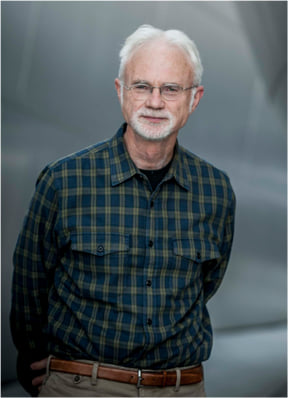
No relation to our second president, Adams is considered by some to be America’s preeminent living composer. He emerged from the haze of minimalism to become the most versatile and substantial of early proponents of the style. In 2003, he was awarded the Pulitzer Prize for Music for his 9/11 memorial “On the Transmigration of Souls.”
Personally I’ve always been divided on Adams’ music. Some of it I find fun (“Short Ride in a Fast Machine,” “Grand Pianola Music”), some of it I find to be quite good (“Shaker Loops,” “El Niño”), some of it I find to be boring, clumsy, or downright embarrassing (“Harmonium,” for as much as I could stand of “Doctor Atomic”).
I concede that these are subjective evaluations. There’s no arguing against Adams’ influence or his standing. Happy birthday to John Adams on his 74th birthday, and congratulations on his long-term success.
“Shaker Loops” (1983):
Also born on this date was Christopher Rouse. Rouse was the recipient of a Pulitzer Prize for his Trombone Concerto in 1993. In 2002, his guitar concerto, “Concerto de Gaudi,” was recognized with a Grammy, in the category of Best Classical Contemporary Composition. He served as composer-in-residence with the New York Philharmonic from 2012 to 2015, the year of his death at the age of 70. His music was quoted extensively in a 2017 documentary, “The Devil and Father Amorth,” by “The Exorcist” director William Friedkin.
Rouse’s Flute Concerto (1993) is dedicated to the memory of James Bulger, a toddler murdered by two ten year-old boys.
Finally, on this American holiday, I also wanted to acknowledge composer Stephen Albert, whose birthday anniversary I noticed on February 6, but didn’t get around to sharing news of it here.
Albert would have been 80 years-old this year. His Symphony No. 1, “RiverRun,” earned him the Pulitzer Prize in 1985. Sadly, he was killed in an automobile accident seven years later. In 1995, a posthumous Grammy was awarded, for Best Classical Contemporary Composition, for Yo-Yo Ma’s recording of Albert’s Cello Concerto.
My favorite Albert piece also happens to be his last, the Symphony No. 2 (1992), commissioned by the New York Philharmonic. It doesn’t hurt that it reminds me of Sibelius and, at times, even John Williams. The orchestration was left incomplete at the time of Albert’s death, so it fell to Sebastian Currier to supply the finishing touches. It’s a beautiful, valedictory work, from a composer who, at 51, left us in his prime.
Interestingly, the slow movement of Rouse’s own Symphony No. 2 is dedicated to Albert’s memory.
All worthwhile music to enjoy on this Presidents Day.
Clockwise from left: John Adams, Christopher Rouse, and Stephen Albert (with Mstislav Rostropovich)
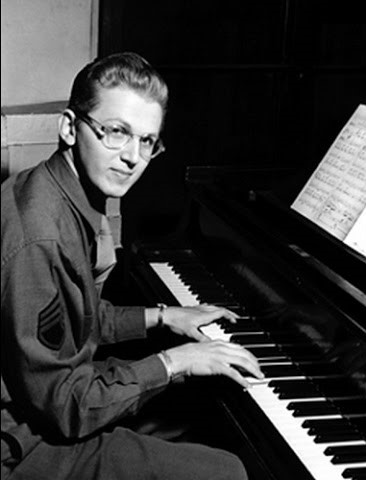
On this Veterans Day, here’s a pleasant discovery: Mel Powell’s “Homage to Debussy.”
Powell served with (and played with) Glenn Miller during World War II. He also collaborated with Benny Goodman, Raymond Scott, and Django Reinhardt, among others. Hearing Goodman perform for the first time is what shifted his focus, for a period, from classical music to jazz. After the war, he wound up writing music for movies and cartoons, including Tom and Jerry.
Muscular dystrophy effectively ended his career as a traveling musician. Instead, he returned to his classical roots, studying composition at Yale with Paul Hindemith. His early works were conceived in a neoclassical style. Gradually, however, he began to push into atonality and serialism. He taught at Mannes College of Music and Queens College, in New York, then succeeded Hindemith as chair of the Yale composition faculty. There, he also directed one of the country’s first electronic music studios. But he never completely turned his back on jazz.
Powell was living in California, where he had served as provost and professor of music at CalArts, when he was awarded the Pulitzer Prize for Music in 1990. The honored work, “Duplicates: A Concerto for Two Pianos and Orchestra,” was inspired by a conversation he had over four decades earlier, while serving in the U.S. Army Air Force .
“… I was in Paris and met an old musician who knew Debussy and would regale us with anecdotes. I’ve forgotten most of the stories, but one thing he told me has come back to me frequently over the years. It was about a time he and Debussy were having a glass of wine at the Chat Noir, and Debussy said: ‘Do you know what the perfect music would be? A perpetual cadenza. It would be like a chain of gold coins, each like the other, but different enough to claim independence.’ I’ve never forgotten that. And that became my goal for ‘Duplicates.’”
Sadly, there doesn’t appear to be an audio file of the work posted online.
Powell died in 1998, at the age of 75. He was married to Martha Scott, an actress probably best-remembered for playing Charlton Heston’s mother in both “The Ten Commandments” and “Ben-Hur.” She also played Emily in the original Broadway production of “Our Town” and in the film version, opposite William Holden.
We may not have access to “Duplicates,” but there’s certainly plenty of Powell to enjoy, when following the links below:
“The Earl” (1941)
Art Clokey’s “Gumbasia” (1955), which employs a cut from Powell’s “Thigamigig”
Goodman and Powell in 1976
From “The Return of Mel Powell” (1987)
Sonatina for Piano (1952)
“Filigree Settings for String Quartet” (1959)
“Three Synthesizer Settings” (1979/1980)
“Recitative and Toccata Percossa” (1951) introduced and performed by harpsichordist Mahan Esfahani
The Pulitzer Prize Board has decided to postpone the announcement of this year’s award recipients, originally scheduled for today, until May 4. If I’m among the winners, you’ll be the first to know.