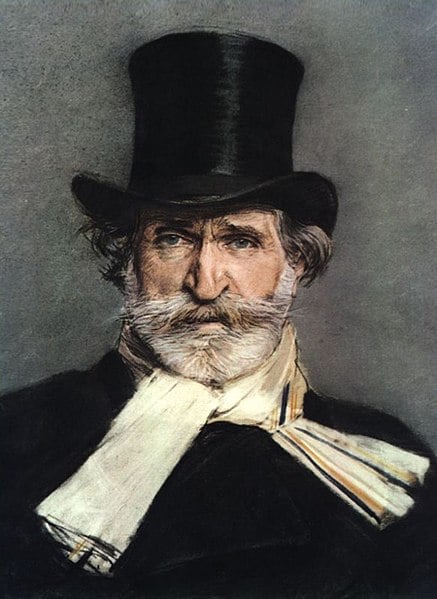
Happy birthday to classical music’s most renowned “leap baby,” Gioachino Rossini, born on this date in 1792. Rossini shared with young Frederic of the “The Pirates of Penzance” the most ingenious paradox of celebrating a birthday every four years. So, despite the fact that 232 years have passed since his natal day, if we go by actual birthday anniversaries, it’s really only been 56.
Rossini’s furiously productive operatic career spanned less than 20 years, in which he amassed 39 lucrative works for the stage. He retired a wealthy man at the age of 37. He spent his last 35 years living the good life and composing when and what he wanted, including the occasional sacred work and a fair amount of salon music – what he wryly termed his “sins of old age.”
I can tell by your furrowed brow that you’re trying to check my math. Before you quibble, you had better have a look at this, posted four years ago, because I’m certainly not going to take the trouble to explain it myself.
Think you don’t know “The Barber of Seville?” Rossini’s comic opera is one of the most famous of all time. Even if you’ve never seen it, it’s been referenced and parodied in countless movies, cartoons, television shows, and commercials. I’ve included ten such examples at the bottom of this post.
You’ll have three chances to laugh, delight, and walk out humming its hit tunes, tonight, Sunday, and Tuesday at The Princeton Festival, now taking place on the grounds of Morven Museum & Garden, at 55 Stockton Street/Route 206.
The opera will be presented in an all-new production, stage-directed by James Marvel, with fun, Cubist set designs by Blair Mielnik suggesting the timeless, madcap nature of the story. Rossen Milanov will conduct the Princeton Symphony Orchestra.
Andrew Garland will portray the resourceful barber and jack-of-all-trades, Nicholas Nestorak the lovestruck and resolute Almaviva, and Kelly Guerra the beautiful and game Rosina, with Steven Condy providing the requisite impediment to young love as the slow-witted and lascivious Dr. Bartolo. Filling out the cast will be Festival veterans Eric Delagrange and Cody Müller, along with Kaitlyn Costello-Fain and the Festival Opera Chorus. Elaborate disguises, conspiracy, and close shaves inform the action, set to Rossini’s spritely and dynamic score.
Tonight’s presentation, under the festival pavilion, will begin at 7:00. The opera will be repeated on Sunday at 4 p.m. and Tuesday at 7 p.m. A pre-concert talk, “The Funny Thing About Figaro,” will be offered by Dr. Timothy Urban at Morven’s Stockton Education Center at 3:00, prior to the Sunday performance.
The Princeton Festival will continue through June 25. Yet to come: a program for string quartet and interpretive dance featuring the Attacca Quartet and members of American Repertory Ballet; a recital of songs by Black composers sung by Metropolitan Opera singer Will Liverman; a “Mazel Tov Cocktail Party” with klezmer clarinetist David Krakauer and friends; Vivaldi’s “The Four Seasons” performed by The Sebastians (across the street at Trinity Church Princeton); Andrew Lippa’s musical theater oratorio “I Am Harvey Milk;” and a vaudeville-inspired family concert including “Peter and the Wolf” with Michael Boudewyns of Really Inventive Stuff.
Ancillary events, including talks, a film screening, an art installation, Yoga in the Garden sessions, and kid-friendly activities, will also be offered.
The festival’s state-of-the-art pavilion is 11,000 square-feet, clear-span (no poles or obstructed views), and open-sided, allowing for easy access to refreshments, ample picnicking opportunities, a garden stroll, or the simple enjoyment of a late-spring/early-summer evening.
The Princeton Festival is the premier summer arts program of the Princeton Symphony Orchestra. For more information, tickets, and a complete schedule, visit princetonsymphony.org/festival.
Did you know:
Rossini’s “The Barber of Seville” (1816) is frequently confused with Mozart’s “The Marriage of Figaro” (1786). Both operas were based on comedies by the French playwright Pierre Beaumarchais, which were considered subversive, even politically incendiary, when they were written in the last quarter of the 18th century, a time of roiling social unrest, as they enact a kind of class warfare, with wily servants getting over on their aristocratic masters. “The Marriage of Figaro” was particularly edgy, facing challenges from censors and causing many a noble’s head to rest uneasily on his satin pillow. A third play, called “The Guilty Mother,” followed in 1791, by which time the Ancien Régime had already been abolished and the French Revolution was in full swing.
All the principal characters of Rossini’s opera appear in Mozart’s. Though Mozart’s was written first – 30 years earlier, in fact – it’s actually based on the second of Beaumarchais’ “Figaro” plays, so the action takes place later, AFTER that of “The Barber of Seville.” Got it?
Other operas to include characters from Beaumarchais’ trilogy include Jules Massenet’s “Chérubin,” Darius Milhaud’s “La mère coupable,” and John Corigliano’s “The Ghosts of Versailles.” There was also an earlier opera based on “The Barber of Seville,” from 1782, by Giovanni Paisiello.
But Rossini’s is far and away the most famous musical adaptation of Beaumarchais’ “Barber,” and now regarded as his quintessential work. It is quicksilver, farcical, and often very silly – the archetypal opera buffa.
It also contains some of the most recognizable and oft-referenced music in all of opera. Figaro’s “Largo al factotum” (Fi-ga-ro! Fi-ga-ro!), Rosina’s “Una voce poco fa,” and of course the overture are most frequently encountered. Here are ten instances of their use and abuse:
More than just a pretty voice, soprano superstar Pretty Yende will display her versatility in Princeton this weekend, on a pair of concerts presented by the Princeton Symphony Orchestra.
The second half of the program, as might be expected, will feature sparkling arias from Rossini’s “The Barber of Seville” and Verdi’s “La traviata;” but the first half of the concert, devoted to American music, will include Yende’s soulful rendition of Samuel Barber’s nostalgic and poignant “Knoxville: Summer of 1915.” Also on the program will be overtures from Rossini and Verdi operas and Aaron Copland’s Pulitzer Prize winning masterwork, “Appalachian Spring.”
Put a spring in your step with the Princeton Symphony Orchestra, at Richardson Auditorium this Saturday evening at 8:00 and Sunday afternoon at 4:00. Sunday’s performance will be a preceded by an onstage conversation with music director Rossen Milanov at 3:00. For tickets and information, visit princetonsymphony.org.
Curious to learn more about “Knoxville?” The PSO will host musicologist Austin Stewart, as he reflects on the backgrounds of both Barber’s composition and the James Agee text upon which it is based, at Princeton Public Library this Thursday evening at 7:00. The library event is free and open to the public.
I received a note from a cousin living in Palermo that her orchestra, the Orchestra Sinfonica Nazionale dei Conservatori Italiani (ONCI), was chosen to represent Italy at the Dubai Expo last month. As the name suggests, musicians were selected by audition from conservatories across the country. Last night, I finally settled in to enjoy their committed performances of music by Rossini, Donizetti, Bellini, Mascagni, Puccini, and Verdi. Perhaps you will too. Here’s the complete concert, presented on December 14:
“Viva VERDI!” – the cry of Italian patriots on the eve of unification.
Italy of the 1850s was but a conglomerate of individual states, many of them still under foreign rule. The slogan “Viva VERDI!” was coined in 1859, following the premiere of the composer’s politically sensitive opera “Un ballo in maschera.”
Verdi’s ongoing troubles with the censors are well-known. It’s a safe bet that when he undertook an opera about a political assassination, he had a pretty good idea what to expect. The name VERDI was taken up by firebrands of the Risorgimento as an acronym for “Vittorio Emanuele, Re D’Italia.” King Vittorio Emanuele II of Piedmont was seen by many as the best hope for a free and united Italy.
This Sunday night on “The Lost Chord,” we’ll refrain for delving too much into Italy’s Second War for Independence, or of Garibaldi’s struggles with the Bourbons. Instead, we’ll enjoy examples of MUSICAL unification – various composers of Italian origin coming together to attempt cohesive works of art.
There are those who believe the serenata “Andromeda Liberata” may have been composed entirely by Antonio Vivaldi – but perhaps not. The likely impetus for its creation was the return to Rome of one Cardinal Ottobone, who was also a patron of both Arcangelo Corelli and Alessandro Scarlatti.
The story is that of Perseus and Andromeda. Andromeda has already been rescued from the sea serpent at the start of the piece, which mostly explores the ambiguous feelings of its characters, with a few extraneous love interests tossed into the mix to provide romantic conflict.
The two-hour entertainment contains in its second part a single aria known definitively to have been composed by Vivaldi. The authorship of the rest remains in doubt. The long-lost manuscript, dating from 1726, was rediscovered as recently as 2002.
In 1868, Verdi’s great operatic predecessor, the long-retired Gioachino Rossini, died. Rossini had completed his last opera nearly forty years before. Verdi undertook to bring together 12 of his contemporaries, now largely forgotten. The oldest, Carlo Coccia, at age 87, was actually a decade Rossini’s senior!
Within the year, a collaborative mass was compiled in Rossini’s memory, for which Verdi provided the concluding “Libera me.” In fact, the music looks forward to Verdi’s own masterful Requiem. The completed work doesn’t attain anywhere near the lofty heights of Verdi’s solo run. However, it’s an interesting compendium of contemporary styles, and even the music of lesser talents serves to cast Verdi’s genius in a new light.
Remarkably, the work lay unperformed in Verdi’s lifetime. Talk about politics! Here was Verdi, a Milanese, trying to kindle some sort of enthusiasm in Bologna (the location of Rossini’s earliest successes), for a project which was to bring together a bunch compositional dinosaurs, to salute a figure who, for all intents and purposes, had retired from public life some four decades earlier. Bologna at the time was in the process of becoming a stronghold of the musical avant-garde.
All these factors, along with puzzling stipulations, such as the work being locked away after its first performance, to be trotted out only on special occasions, doomed the project virtually from the start. It remained unheard for another 120 years, resurrected only in 1988.
I hope you’ll join me for “Viva VERDI!” – Italian unification through music – on Verdi’s birthday, this Sunday night at 10:00 EDT, on WWFM – The Classical Network and wwfm.org.