Tag: Russian Music

  • César Cui: The Forgotten Mighty Handful

    César Cui: The Forgotten Mighty Handful

    Among the followers of Mily Balakirev that collectively came to be known as “The Mighty Handful” or “The Five,” unquestionably the least well-known is César Cui. Nikolai Rimsky-Korsakov, Modest Mussorgsky, and Alexander Borodin all went on to attain a kind of immortality in Russian music, each having left his indelible mark.

    Cui wrote 15 operas, believe it or not – one of them, “William Ratcliff,” earning the highest praise from Franz Liszt – but today, he is remembered, if at all, as a miniaturist, or perhaps as a composer of art song, and at that, the least Russian-sounding of the five.

    He shared in common with the others the fact that for him music was an avocation. He paid his bills as a military engineer. Beyond that, however, he was a bit of an outsider – born in Vilnius (now in Lithuania) to a father who had been a general in Napoleon’s army, who stayed and married a local. In addition to Russian, Cui grew up speaking French, Polish and Lithuanian. Perhaps this broader cultural perspective led to a more cosmopolitan approach to music.

    As a critic, he was prolific, and he could be blistering in his sarcasm. Perhaps most notorious was his reception of Rachmaninoff’s First Symphony:

    “If there were a conservatory in Hell, and if one of its talented students were to compose a program symphony based on the story of the Ten Plagues of Egypt, and if he were to compose a symphony like Mr. Rachmaninoff’s, then he would have fulfilled his task brilliantly and would delight the inhabitants of Hell. To us this music leaves an evil impression with its broken rhythms, obscurity and vagueness of form, meaningless repetition of the same short tricks, the nasal sound of the orchestra, the strained crash of the brass, and above all its sickly perverse harmonization and quasi-melodic outlines, the complete absence of simplicity and naturalness, the complete absence of themes.”

    The assessment plunged Rachmaninoff into a two-year depression, during which he was unable to compose until being lifted out of his funk by hypnotic therapy. Of course, today everyone knows Rachmaninoff’s music (if not his First Symphony). How many, I wonder, know Cui’s?

    On the anniversary of Cui’s birth, enjoy his “Deux morceaux” for cello and orchestra.

    25 Preludes for Piano, Op. 64

    Nocturne in F-sharp minor

    Suite No. 3 “In modo populari”

    Cui’s greatest hit? Perhaps “Orientale” from his collection for violin and piano “Kaleidoscope,” for many years a popular encore. Here are two contrasting treatments.

    Efrem Zimbalist

    and Midori

    Finally, the Carmen Dragon treatment

    A work that’s received a lot of notice since Covid: the one-act opera “A Feast in Time of Plague”

    Happy birthday, César Cui!


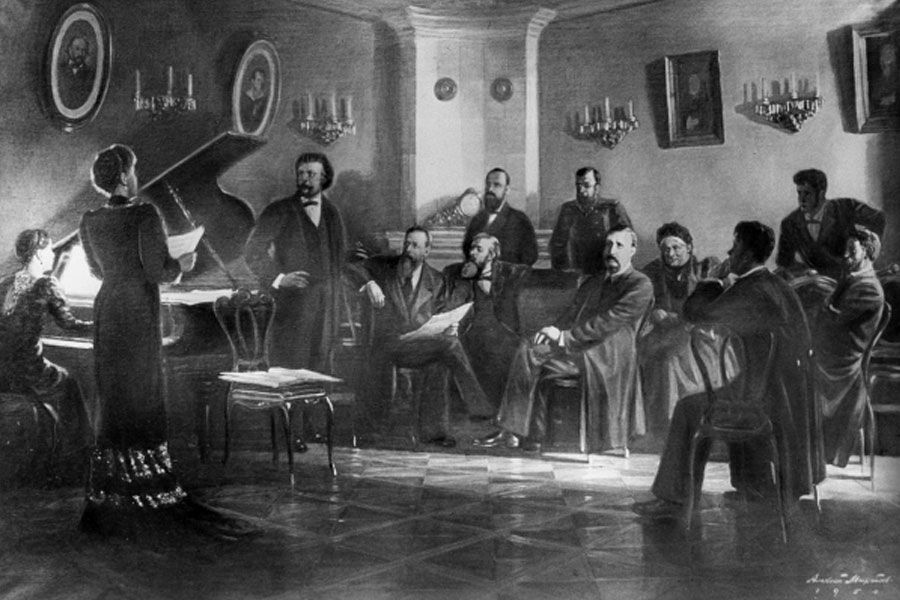
    IMAGE: With so many whiskers in the room, you know you must be in the company of The Five. Center, left to right: Modest Mussorgsky (standing, by the piano), Nikolai Rimsky-Korsakov, critic and champion Vladimir Stasov (seated), Mily Balakirev (standing behind), César Cui (standing, with spectacles), and Alexander Borodin (seated).
  • César Cui Birthday Rediscovering the Forgotten Five

    César Cui Birthday Rediscovering the Forgotten Five

    It’s January 18. Get queasy on Cui, for his birthday!

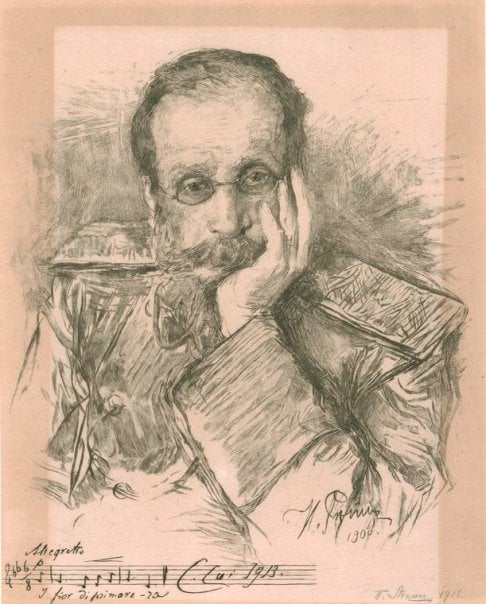
    Among the followers of Mily Balakirev that collectively came to be known as “The Mighty Handful,” or “The Five,” unquestionably the least well-known is César Cui (1835-1918). Nikolai Rimsky-Korsakov, Modest Mussorgsky, and Alexander Borodin all went on to attain a kind of immortality in Russian music, each having left his indelible mark.

    Cui wrote 15 operas, believe it or not – one of them, “William Ratcliff,” earning the highest praise from Franz Liszt – but today, he is remembered, if at all, as a miniaturist, or perhaps as a composer of art song, and at that, the least Russian-sounding of the five.

    He shared in common with the others the fact that for him music was an avocation. He paid his bills as a military engineer. Beyond that, however, he was a bit of an outsider – born in Vilnius (now in Lithuania) to a father who had been a general in Napoleon’s army, who stayed and married a local. In addition to Russian, Cui grew up speaking French, Polish and Lithuanian. Perhaps this broader cultural perspective led to a more cosmopolitan approach to music.

    As a critic, he was prolific, and he could be blistering in his sarcasm. Perhaps most notorious was his reception of Rachmaninoff’s First Symphony:

    “If there were a conservatory in Hell, and if one of its talented students were to compose a program symphony based on the story of the Ten Plagues of Egypt, and if he were to compose a symphony like Mr. Rachmaninoff’s, then he would have fulfilled his task brilliantly and would delight the inhabitants of Hell. To us this music leaves an evil impression with its broken rhythms, obscurity and vagueness of form, meaningless repetition of the same short tricks, the nasal sound of the orchestra, the strained crash of the brass, and above all its sickly perverse harmonization and quasi-melodic outlines, the complete absence of simplicity and naturalness, the complete absence of themes.”

    His assessment plunged Rachmaninoff into a two-year depression, during which he was unable to compose until lifted out of his funk by hypnotic therapy. Of course, today everyone knows Rachmaninoff’s music (if not his First Symphony). How many, I wonder, know Cui’s?


    2 Morceaux for cello and orchestra, Op. 36

    3 Morceaux for piano duo, Op. 69 (with Yakov Flier and Emil Gilels)

    Orchestral Suite No. 3, Op. 43, “In modo populari”

    Mischa Elman plays “Orientale”

    “A Feast in Time of Plague” (which has gotten a lot of play, suddenly, since 2020)

    Rachmaninoff, Symphony No. 1 (which Cui compared to the 12 plagues of Egypt)

    https://www.youtube.com/watch?v=hOzcmIQ37Qw

    Cui, “Everywhere Snow”

  • Rediscovering Glazunov’s Genius

    Rediscovering Glazunov’s Genius

    Okay, I admit it, I have a sweet tooth. And perhaps, at a time when I have no intention of getting a haircut, much less going to the dentist, that predilection could cost me. But damn it, here it is, dental health to the dogs: I do like the music of Alexander Glazunov!

    Glazunov is one of those composers I’ve always felt a little sheepish about liking. I remember sitting at a listening bar at a record shop in Philadelphia and asking to preview a recording of Glazunov ballet music. “I know I’m not supposed to like this stuff,” I offered, apologetically.

    Admittedly, at the time, other than the Violin Concerto, I didn’t really know a lot of great recordings of his music. I found the Marco Polo releases that I had heard, with the Hong Kong Philharmonic, to be underwhelming, and these prejudiced me against the composer for years. But Neeme Järvi’s performances on Chandos were revelatory. Then of course I eventually got my hands on the Melodiya issues with Gennady Rozhdestvensky and Evgeny Svetlanov. I know it’s going to make somebody cry to read this, but I currently have in my collection four complete cycles of Glazunov’s symphonies. Not even I know how that happened.

    Okay, so he isn’t Beethoven. Who is? But at his best, his music is well-crafted, attractive (to me, anyway), and marked by an abundance of memorable melodies that would make any honest composer jealous.

    As a person, he was not without his faults. He had a real problem with alcohol, which may have contributed to his disastrous performance as conductor at the premiere of Rachmaninoff’s First Symphony, a real train-wreck that elicited a savage review from Cesar Cui and plunged the younger composer into creative paralysis.

    But Glazunov was also generous, almost to a fault. As director of the Petrograd Conservatory, he was in a position to pull strings so that a young Dmitri Shostakovich didn’t have to deal with preparatory theory and instead could plunge right into the business of composition.

    Also, after the death of Alexander Borodin, Glazunov stepped up (with Rimsky-Korsakov) to help complete Borodin’s unfinished masterpiece, the opera “Prince Igor.” Legend has it that he wrote out the overture from memory, having heard Borodin play through it a couple of times on the piano.

    So maybe you don’t want this guy on the podium during a performance of your music, but put him on a piano bench with a bottle of vodka, and you’re in good hands.

    Glazunov’s own music can be full of serene lyricism, generously melodic, and, yes, often quite beautiful.

    Happy birthday, Alexander Glazunov! You won’t catch me going to a custard stand during COVID, but surely this is the next best thing.


    Symphony No. 4

    String Quintet in A major

    Violin Concerto

    The symphonic poem “Stenka Razin”

    “Raymonda” (selections)
    https://www.youtube.com/watch?v=nAs9mcGhtgg

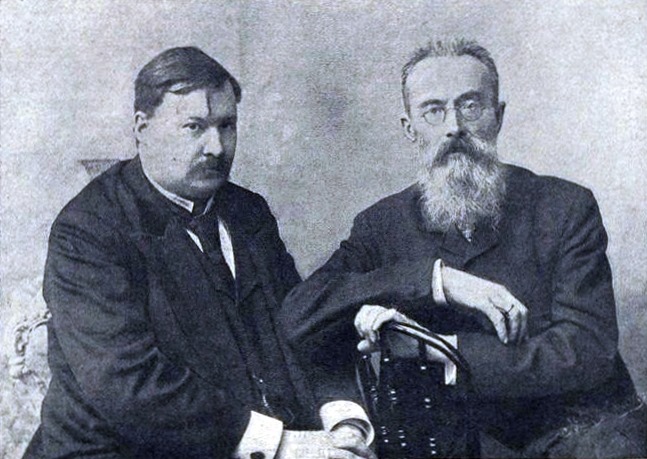
    PHOTO: Glazunov (left), hanging out with Rimsky-Korsakov

  • Rimsky-Korsakov Birthday My Favorite Music

    Rimsky-Korsakov Birthday My Favorite Music

    Happy birthday, Nikolai Rimsky-Korsakov! I’ve always been a fan.


    Recommended Rimsky playlist:

    Ormandy and the “Procession of the Nobles” from “Mlada”

    Song of the Viking Guest from “Sadko,” with Mark Reizen

    Lots of intoxicating music in this staged performance of “Sadko” (complete, Gergiev conducting)

    Ernest Ansermet conducts the Symphony No. 2 “Antar,” a haunting work, full of beautiful melodies, that was once much better known

    Leopold Stokowski conducts the “Russian Easter Festival Overture,” employing a bass-baritone in place of a trombone solo, for maximum liturgical effect

    Evgeny Mravinsky conducts a suite from “The Invisible City of Kitezh”

    Mikhail Pletnev in Rimsky’s little-known gem, the Quintet for Piano and Winds

    Lily Pons sings the “Hymn to the Sun” from “Le coq d’or”

    Leif Segerstam conducts “Scheherazade,” with a highly unconventional, piratical conclusion

    “Flight of the Bumblebee” with real bees (!), courtesy of The Lost Fingers

  • Bard’s Rimsky-Korsakov Festival Explored

    Bard’s Rimsky-Korsakov Festival Explored

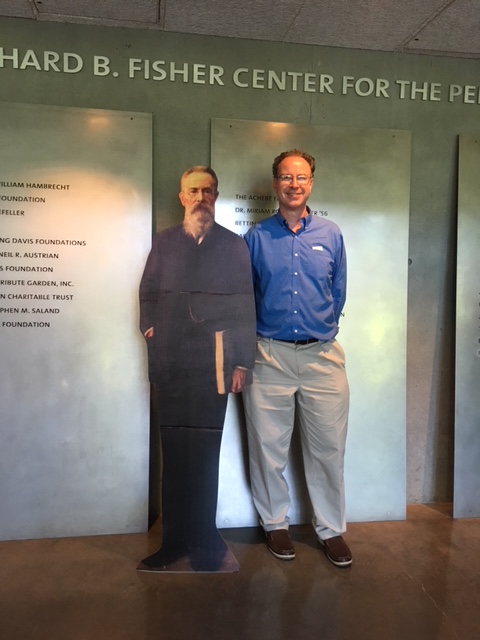
    Fresh off the stalk of this year’s Bard Music Festival, it’s Nikolai Rimsky Korn-on-the-kob. Okay, it’s really Rimsky-Korsakov, but after a weekend in rural Upstate New York, how could I resist?

    “Rimsky-Korsakov and His World” is the focus of this year’s festival, Bard’s 29th. In classic Bard fashion, artistic co-directors Leon Botstein – president of Bard College, music director of the American Symphony Orchestra, and founder of The Orchestra Now – and musicologist Christopher H. Gibbs have assembled two weekends’ worth of stimulating programs, slanted toward lesser-known repertoire by its subject, his contemporaries, his influences, and those he influenced, with a few of his imperishable classics (“Scheherazade,” the “Russian Easter Festival Overture”) tossed into the mix. Highlights are too many to list, but the festival will conclude its second weekend on Sunday with a concert performance of “The Tsar’s Bride,” one of Rimsky’s 15 operas. How often do we get to hear it?

    Join me this afternoon, following today’s Noontime Concert, for some of the repertoire presented on this year’s 29th Annual Bard Music Festival: Rimsky-Korsakov and His World, including Rimsky’s Piano Concerto, Mikhail Glinka’s Sextet in E-flat major, Sergei Taneyev’s Symphony No. 4, and Modest Mussorgsky’s “Pictures at an Exhibition,” in its original version, which I’ll be featuring in a new recording with Clipper Erickson, piano.

    You’ll find more information about this one-of-a-kind festival, which skillfully walks the line between scholarship and entertainment, by visiting fishercenter.bard.edu/bmf/

    The music may not be in a hurry, but it’s definitely Russian, this afternoon between 1 and 4 p.m. EDT, on WWFM – The Classical Network and wwfm.org.

    Next summer’s focus: Erich Wolfgang KORNgold!

Tag Cloud

Aaron Copland (92) Beethoven (95) Composer (114) Film Music (123) Film Score (143) Film Scores (255) Halloween (94) John Williams (187) KWAX (229) Leonard Bernstein (101) Marlboro Music Festival (125) Movie Music (138) Opera (202) Philadelphia Orchestra (89) Picture Perfect (174) Princeton Symphony Orchestra (106) Radio (87) Ralph Vaughan Williams (85) Ross Amico (244) Roy's Tie-Dye Sci-Fi Corner (290) The Classical Network (101) The Lost Chord (268) Vaughan Williams (103) WPRB (396) WWFM (881)

DON’T MISS A BEAT

Receive a weekly digest every Sunday at noon by signing up here


RECENT POSTS