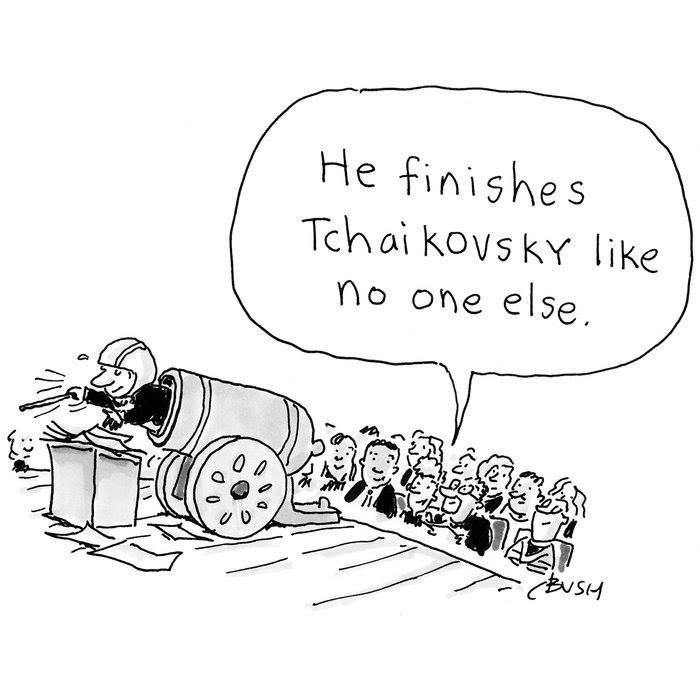
Come on, folks! Help us out, won’t you? Coming up in just a few minutes, it’s a whole lot of artillery, courtesy of the U.S. Military Academy at West Point. Make a donation now in honor of Tchaikovsky or Brahms, on their birthdays, at 1-888-232-1212 or wwfm.org. Here’s hoping the music lights your fuse, at WWFM – The Classical Network.
Tag: Tchaikovsky
-
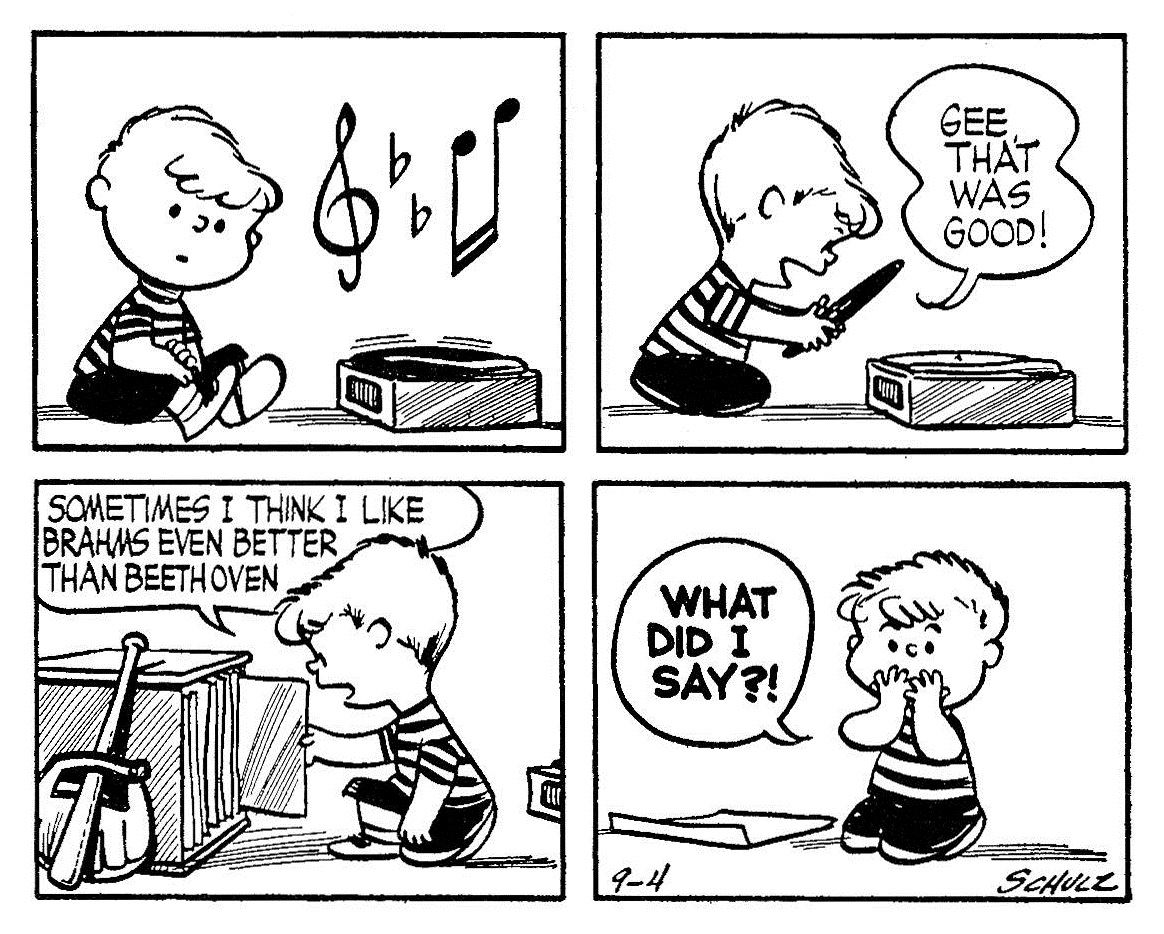
Brahms Tchaikovsky Birthday Broadcast
Going on the air with the Princeton University Chapel Choir and Orchestra performing Brahms’ “Ein Deutsches Requiem” at noon. It’s all Brahms and Tchaikovsky through 7:00 EDT, as we celebrate both composers’ birthdays by raising funds to ensure a future of great classical music on the radio. Call us now at 1-888-232-1212, or donate online at wwfm.org. Thank you for your support of WWFM – The Classical Network!
-
Brahms vs. Tchaikovsky: A Classical Clash of Titans
This is a contest not just between two titanic composers, but a veritable struggle between the gods.
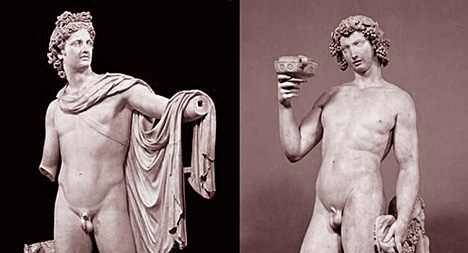
Of the two mighty artists who were born on this date, Johannes Brahms (b. 1833), the great classicist among Romantics, was wreathed by the laurels of Apollo’s ordered rationality, and Peter Ilych Tchaikovsky (b. 1840), ever heart-on-the-sleeve, was fueled by the wine of Dionysus’ emotional truth.
We pit these musical champions against one another in the arena of public opinion today on The Classical Network, as we humbly submit to the stern judgment of our listeners. And of course, we’re hoping to raise a little money in the process.
Which of these composer rates higher in your estimation?
So as to maintain balance and not to incur the wrath of any higher powers (since, historically, the gods have been poor losers), we are looking to divide the spoils. In our quest to attain a single-day goal of $7000, for this May 7, we are asking you to contribute, in whatever amount, toward $3500 for EITHER composer.
Subjectivity is akin to voting with the heart, which should appeal very much to Dionysus, yet balance will be achieved, which, as day follows night, would surely earn the approval of Apollo. After all, both composers have earned a place in the pantheon.
A highlight of today’s broadcast will be a special Noontime Concert, in which Brahms’ “Ein Deutsches Requiem” will be presented in its entirety, in a performance by the Princeton University Chapel Choir and Orchestra, under the direction of Penna Rose.
The concert, which took place last month, was dedicated to the memory of Professor Henry Stainken Horn, Princeton Professor of Ecology and Evolutionary Biology from 1966 to 2019. Professor Horn was a member of the Chapel Choir from 1990 until his passing.
In line with our Classical argument, the performance will be prefaced by a reading from Tennyson’s “Ulysses,” by Christopher Parton, a graduate student from Princeton’s music department. Professor Horn himself read the poem to introduce last year’s Milbank Memorial Concert.
Apollonian Brahms or Dionysian Tchaikovsky? If you simply cannot decide, why not hedge your bets and leave a little offering for both? Call us at 1-888-232-1212, or contribute online at wwfm.org (click on “donate”). Then join us for TEN HOURS of Brahms and Tchaikovsky, today from 9 a.m. to 7 p.m. EDT. Thank you for your support of WWFM – The Classical Network!
PHOTOS: Apollo and Dionysus and Brahms and Tchaikovsky – game on!
-

Sergei Taneyev Honest Russian Composer
Never one to hold back or sugar-coat the truth, Sergei Taneyev (1856-1915) could be brutally honest and in fact generally was. He managed to offend every one of the musicians of the Mighty Handful (Mily Balakirev, Alexander Borodin, César Cui, Modest Mussorgsky, and Nikolai Rimsky-Korsakov) with his blunt assessments. Yet somehow Peter Ilych Tchaikovsky, who was probably the most sensitive composer in all of Russia, actually went out of his way to invite Taneyev’s criticism, even when it threw him into fits of despair.
On this week’s “Music from Marlboro,” we’ll have music by this most forthright of Russian composers, alongside a delightful caprice by a Frenchman, based on Danish and Russian airs.
Tchaikovsky valued Taneyev’s keen insight and transparent honesty, perhaps in part because he knew, as Taneyev’s teacher at the Moscow Conservatory, that Taneyev was equally hard on himself. Also, there was little doubt of his disciple’s devotion. Taneyev was the soloist in the Moscow premiere of Tchaikovsky’s Piano Concerto No. 1, and in the Russian premiere of his Piano Concerto No. 2. After Tchaikovsky’s death, Taneyev completed several of his master’s works from sketches left in various states of completion, including the Piano Concerto No. 3. In turn, Tchaikovsky dedicated his symphonic fantasy, “Francesca da Rimini,” to Taneyev.
Taneyev entered the Moscow Conservatory at the age of nine. His characteristic diligence and impeccable craftsmanship revealed themselves early, and through their application he rose quickly in the estimation of his professors. Tchaikovsky rated Taneyev as Russia’s greatest master of counterpoint and questioned if there was anyone, even in the West, who could match him in this regard.
When Tchaikovsky resigned his post at the conservatory in 1878, Taneyev was appointed in his place to teach harmony and orchestration. Soon, he was also teaching piano and composition. Finally, he served as the conservatory’s director from 1885 to 1889. Among his own pupils were Sergei Rachmaninoff, Nikolai Medtner, and Alexander Scriabin. (FUN FACT: Taneyev died in 1915 after catching pneumonia at Scriabin’s funeral.)
For the most part, Taneyev’s life was as orderly as his music. He never married; all his needs were tended to by his childhood nanny. He even managed to remain oblivious when the wife of his friend, Leo Tolstoy, basically threw herself at him. He preferred study to relaxation, passing countless hours poring over volumes on natural and social science, history, mathematics, Plato and Spinoza. He also taught himself Esperanto.
Perhaps he could have used a little of Tchaikovsky’s spontaneity, both in his life and in his music. Tchaikovsky was more of an impulsive artist, always allowing his creativity and emotion to lead the way, while Taneyev tended to hold his raw materials in balance, carefully considering his ideas and themes, subjecting them to intensive analysis before committing them to manuscript. For as dry as that may sound, his music is still rewarding to listen to!
Taneyev’s String Quintet in G major, Op. 14, dates from 1901. We’ll hear it performed at the 2005 Marlboro Music Festival by violinists Lily Francis and David Bowlin, violist Yu Jin, and cellists Michael Nicholas and David Soyer.
By way of introduction, the program will open with a “Caprice on Danish and Russian Airs” by Camille Saint-Saëns (1835-1921). Scored for flute, oboe, clarinet, and piano, the work was composed for a series of concerts organized by the Russian Red Cross that were held in St. Petersburg during Easter Week, 1887. The piece was dedicated to the the Tsarina, Maria Feodorovna, formerly Princess Sophie Frederika Dagmar, daughter of the King of Denmark – hence, Saint-Saëns’ use of Danish and Russian themes.
We’ll hear it performed at Marlboro in 1968 by pianist Ruth Laredo, flutist Paula Robison, oboist John Mack, and clarinetist Larry Combs.
No doubt Taneyev would decline my invitation – and he wouldn’t hesitate to tell me why – but there is nothing to keep us from reckless enjoyment of the next “Music from Marlboro,” this Wednesday evening at 6:00 EST, on WWFM – The Classical Network and wwfm.org.
Marlboro School of Music and Festival: Official Page
PHOTO: Tell us what you really think, Sergei.
-
Orthodox Christmas Gogol Tchaikovsky Rimsky-Korsakov
Here we go again! Just as we in the West conclude the Twelve Days of Christmas, adherents of the Eastern Orthodox Church today commence their celebrations of Orthodox Christmas. Chalk it up to the old Julian calendar.
Ukrainian Christmas Eve can be a solemn occasion, marked by fasts and sacred services. Meatless dishes are served for the Holy Night supper. But there are also carols. And the caroling is no simple singing of Christmas songs. Similar to mumming traditions of the British Isles, there is also a little play involved, with ritualistic dancing and the participation of a live goat. As in the West, pre-Christian symbols and rituals are embraced in the celebration of Christmas, to lend cheer to the shortest days and hope for a fertile spring.
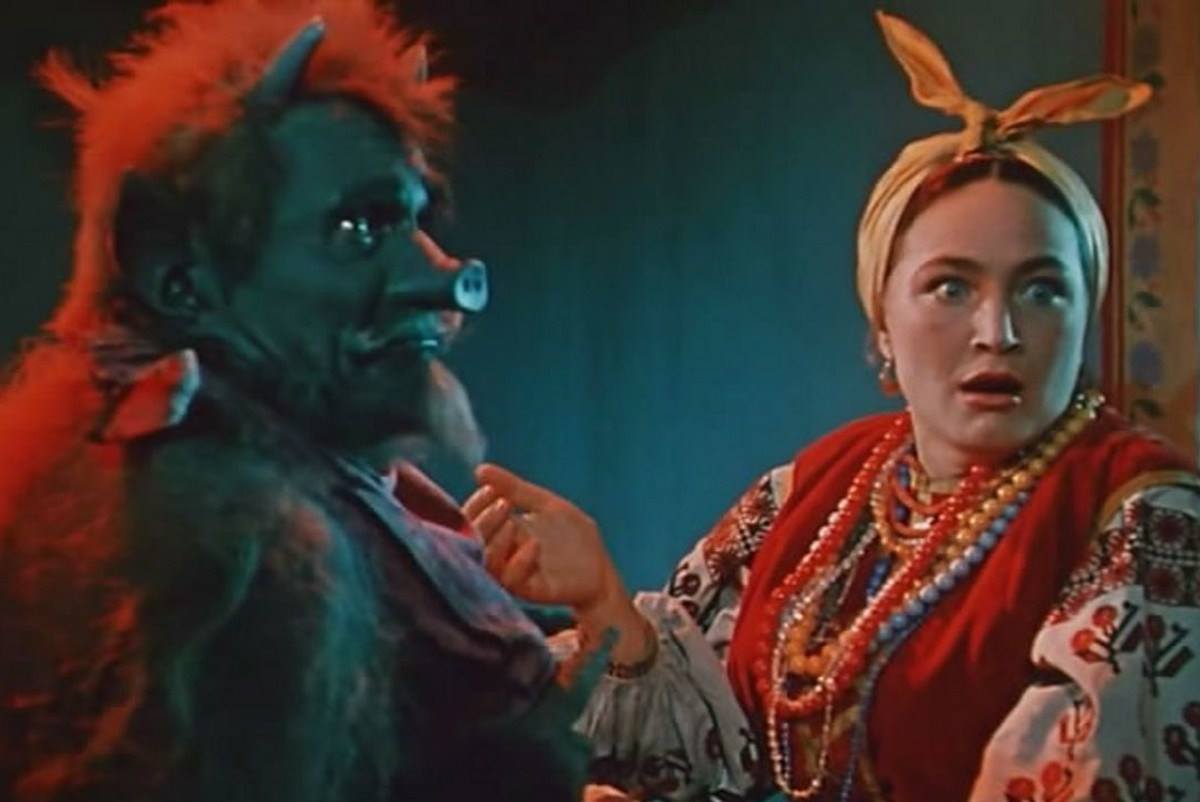
Nikolai Gogol’s “Christmas Eve,” from his collection of stories, “Evenings on a Farm Near Dikanka,” emerges from these folk traditions. Part fairy tale and part farce, Gogol’s story features such incidentals as the theft of the moon, amorous peasants secreting themselves in burlap sacks, and a ride through the air on the Devil’s back to collect the Tsarina’s slippers.
“Christmas Eve” drew musical responses from both Peter Ilych Tchaikovsky and Nikolai Rimsky-Korsakov. The two composers shared a complicated rivalry. In public, each was supportive of the other, while in private they were nagged by suspicion and envy. Tchaikovsky felt sufficiently threatened to swear his publisher to secrecy about his use of the then newly-minted celesta in “The Nutcracker,” lest Rimsky steal his thunder. Equally intimidated by Tchaikovsky, Rimsky held off on adapting “Christmas Eve” until 1895. Tchaikovsky had set his version ten years before, a revision of an even earlier opera, “Vakula the Smith,” written in 1871. By the time Rimsky’s “Christmas Eve” received its premiere, Tchaikovsky had been safely in the grave for two years.
We’ll hear selections from both composer’s operas today on The Classical Network, alongside observances of the birthdays of composers William Hurlstone, Ulysses Kay, and Francis Poulenc; conductors David Porcelijn and Gunter Wand; pianist Clara Haskil; violinist and conductor Iona Brown; and choral director Robert DeCormier.
Z Rizdvom Khrystovym! Good triumphs over evil, but the devil gets his due, from 4 to 7 p.m. EST, on WWFM – The Classical Network and wwfm.org.
An animated version of Gogol’s tale, incorporating some of Rimsky’s music:
https://www.wilderutopia.com/performance/literary/nikolai-gogol-witches-and-devils-on-christmas-eve/
A fun live-action version from 1961:
https://www.youtube.com/watch?v=9MFoyMwfnlc
A 1913 silent version (but you’ll have to provide your own soundtrack):
Tag Cloud
Aaron Copland (94) Beethoven (95) Composer (114) Film Music (150) Film Score (143) Film Scores (255) Halloween (102) John Williams (198) KWAX (233) Leonard Bernstein (105) Marlboro Music Festival (125) Movie Music (165) Mozart (91) Opera (215) Philadelphia Orchestra (90) Picture Perfect (174) Princeton Symphony Orchestra (110) Radio (90) Ross Amico (244) Roy's Tie-Dye Sci-Fi Corner (290) The Classical Network (101) The Lost Chord (269) Vaughan Williams (107) WPRB (397) WWFM (881)