Tag: Vaughan Williams

  • Bard Music Festival Book Preview Vaughan Williams

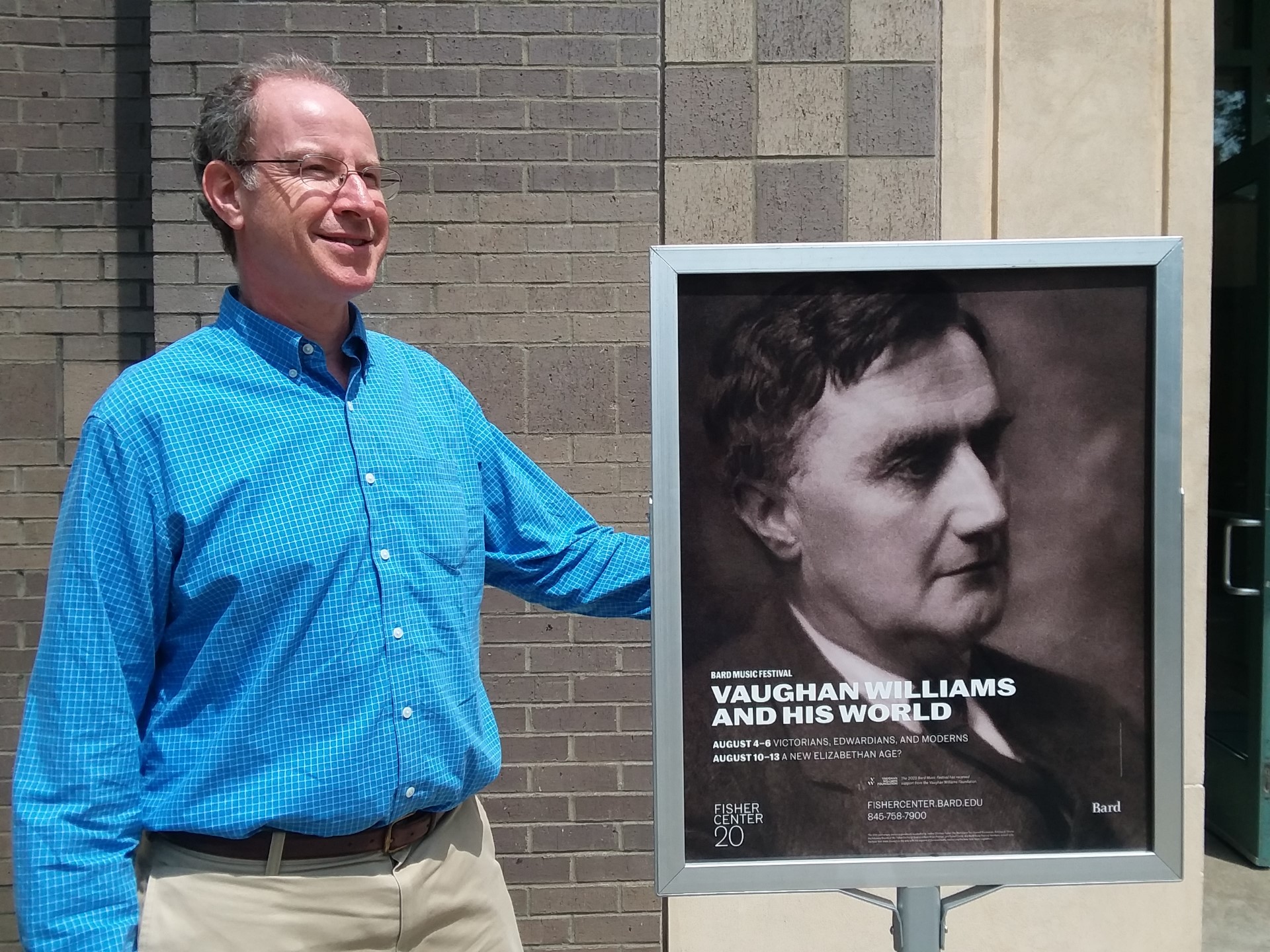
    Here’s a glimpse at this year’s tie-in volume to the Bard Music Festival, coming up at Bard College in Annandale-on-Hudson, NY, August 4-13. The Bard books offer scholarly perspectives on the highlighted composer’s life and works. Also included is Vaughan Williams’ lecture on the “St. Matthew Passion.” Looking forward to picking up my copy this weekend! More information on the book’s contents by following the link to @[100063452955898:2048:University of Chicago Press] in the @[100063807330266:2048:Fisher Center at Bard]’s post.

  • Vaughan Williams’ Amanuensis: The Invisible Hand of Roy Douglas

    Vaughan Williams’ Amanuensis: The Invisible Hand of Roy Douglas

    Massive respect to Roy Douglas.

    In preparation for this year’s Bard Music Festival, devoted to Ralph Vaughan Williams (finally!), I just burned through Douglas’ book of correspondence with the composer (“Working with Vaughan Williams,” 1988). From 1947 to 1958, Douglas served as Vaughan Williams’ closest associate, next perhaps to Ursula Vaughan Williams (née Wood), the composer’s wife. I forgot I’d even acquired it, so I’m happy I didn’t buy it twice!

    More on Douglas in a moment, but before I lose your attention, I hasten to add that the festival this year begins this Friday, August 4, and runs through Sunday, August 13, on the idyllic campus of Bard College in Annandale-on-Hudson, NY. Each summer, Bard, under the artistic directorship of Leon Botstein and Christopher H. Gibbs, presents two weekends of a specific composer’s music, in the context of his or her “world” – their contemporaries, those they were influenced by, and those they influenced. Vaughan Williams is the 33rd such composer to be so honored.

    Highlights will include performances of “Job, A Masque for Dancing,” the “Sinfonia Antartica” [sic], the Symphonies Nos. 4 & 8, the Concerto for Two Pianos, the Concerto Accademico for violin and orchestra, “Flos Campi” for viola, chorus and orchestra, and a concert performance of the Falstaff opera “Sir John in Love,” alongside old favorites like “The Lark Ascending,” the “Fantasia on a Theme by Thomas Tallis,” “Five Variants of Dives and Lazarus,” and the “Serenade to Music.”

    With the composer largely neglected in the United States during his sesquicentennial year, I am especially excited for this opportunity to hear so much of his music live.

    Of course, there will be works by many other composers, as well, though all of the music will be connected in one way or another with RVW.

    The Bard Music Festival is an intensive regimen of concerts, panels, and pre-concert talks. One basically gets out of it whatever one puts into it. If total immersion is what you desire, there’s no place like Bard for a scholarly crash course. But if you prefer to cherry-pick and just go and casually experience some worthwhile, often rarely-heard music, you can do that, too.

    Lots more to do at Bard all summer long, as the music festival is but the cultural diadem upon the brow of a larger Bard SummerScape that incorporates a number of other artistic disciplines.

    For tickets and information, visit here:

    https://fishercenter.bard.edu/whats-on/programs/summerscape/


    For a self-trained musician, Roy Douglas achieved a remarkable level of expertise as a composer himself, so much so that he was enlisted as not only the personal assistant of Vaughan Williams, but also that of William Walton. He served as a proofer and copiest for both composers – no mean feat in the case of RVW, who, as an aging leftie in a right-handed world rendered his scores in a near indecipherable scrawl (according to Douglas, sometimes worse!). The Douglas-RVW correspondence is full of questions and clarifications about the composer’s intentions, as Douglas serves as a second set of eyes, often pushing himself hard through long hours and holidays to meet impending deadlines for performances.

    A rumor began to circulate, thanks to Vaughan Williams’ frequent quip when introducing Douglas to others as “the man who writes my music,” that Douglas’ duties actually extended beyond that of amanuensis, but Douglas does his best to clear up any misunderstandings, asserting that in his entire 11 years’ service with the composer he could be said to have inserted only one note into any of his symphonies, in the “Sinfonia Antartica” [sic], and that to felicitate a less jarring transition after RVW made the cut of a few bars.

    He also completed the composer’s final work, the Christmas pageant “The First Nowell,” after Vaughan Williams’ death in 1958, right in the middle of his harmonization of “How Brightly Shines the Morning Star.” Since the piece was undertaken for charity (for the relief of refugee children), Douglas and Ursula felt Ralph would have wanted to fulfill the commission. As it was, the work was nearly finished, with the composer having already orchestrated three quarters of the piece. Even so, there was considerable ingenuity exhibited on Douglas’ part in his seamlessly matching the composer’s efforts. I must say, he did a fabulous job, and the work remains one of my favorite Christmas pieces, a delight for anyone who loves Vaughan Williams’ more frequently encountered “Fantasia on Christmas Carols.”

    Beyond that, Douglas was firm in his insistence not to complete any sketches left unfinished at the composer’s death, even first drafts of a Cello Concerto and an opera, “Thomas the Rhymer,” which exist in “fair copy” only, with piano accompaniment and no orchestration, as Douglas was familiar enough with RVW’s working methods to know that he continually revised throughout the process of creation, revision, and polishing, so that a finished work would be a very different piece from that of its initial conception.

    He did, however, continue, as he had when the composer was alive and with his authorization, to arrange some of Vaughan Williams’ more extravagantly scored pieces for more modest forces so that performances could be more easily undertaken by community ensembles.

    Douglas’ humility and selflessness and are not to be undersold. It’s remarkable for a composer to recognize his own limitations and to give himself over to the service of a greater one. Douglas continued to create original works when he could, but he had no illusions as to the music’s merit in the larger scheme.

    He is best known for his arrangement of Chopin keyboard works into the ballet “Les Sylphides,” from which he continued to draw some pretty sweet royalty checks for the rest of his life. He also assisted Richard Addinsell on many of his film scores. His was the invisible hand that crafted Addinsell’s music for “Dangerous Moonlight” (U.S. title “Suicide Squadron”) into the ever-popular “Warsaw Concerto.” All in all, he did pretty well for himself, though he certainly had to push himself very hard to keep up with the deadlines. One of the opportunities he was forced to decline was to work with Gerald Finzi, who hoped to enlist him to proof his own Cello Concerto.

    Douglas remained a invaluable resource for anyone with questions about RVW’s intentions in his music. Until the day of his death, he served as vice president of the Ralph Vaughan Williams Society. Douglas died in 2015 at the age of 107!

    Now… should I move on to Ursula Vaughan Williams’ biography of her husband or Eric Saylor’s recent book, both for Oxford University Press (RVW’s publisher)? I’m cramming hard for Bard!

    Fisher Center at Bard


    PHOTO: Roy Douglas (with pipe) and RVW in 1953

  • Summer Reading List Rainy Day Reads

    Summer Reading List Rainy Day Reads

    It’s been so nice and cool the past couple of days, it’s been kind of hard for me to put myself in a summer frame of mind. (Not complaining!) With a lot of rain in the forecast for the coming week, it’s a good time to get started on your summer reading. Anything special piling up on your nightstand?

    I’m nearly finished with the “Kalevala,” the Finnish national epic (the first time all the way through for this Sibelius lover).

    Then, just in time for the Fourth of July, I’ll be moving on to George Plimpton’s “Fireworks: A History and Celebration.” Supposedly Plimpton, in addition to being an entertaining writer, was a kind of pyrotechnical evil genius.

    I may also finally get around to reading S. Weir Mitchell’s “Hugh Wynne: Free Quaker.” Or I suppose I could save it for the “America 250” celebrations in 2025. Set during the American Revolution, the book became one of the bestselling novels of 1898. My edition still has the Howard Pyle illustrations.

    I’ll also want to bone up on my Vaughan Williams, in advance of this summer’s Bard Music Festival in August, including Eric Saylor’s recent book on the composer. For lack of a better title, I suppose, it’s called (wait for it) “Vaughan Williams.”

    Somewhere along the away, I’ll also want to indulge in some good old-fashioned “boy’s adventure” stories, so perhaps it’s time to enlist with P.C. Wren’s Foreign Legion opus, “Beau Geste,” which has been adapted to film many times, but I’ve yet to read the book.

    Too many others to contemplate. I’ve got stacks and shelves of books I will probably never read. Some of my most satisfying summer memories have been in tackling a great book. Lord, I wish I were a faster reader and didn’t waste so much time on the internet!

    How about you? Is there a book you’d like to read on a rainy summer’s day, as opposed to slow-roasting, slathered in suntan lotion, on the beach?

  • Vaughan Williams Easter Songs Review

    For me, it’s never Easter until I listen to Vaughan Williams’ “Five Mystical Songs” with John Shirley-Quirk. Especially the first one, titled – appropriately enough – “Easter.”

  • Hovhaness Mysterious Mountain in Space

    Hovhaness Mysterious Mountain in Space

    Alan Hovhaness’ music has frequently been described as transporting. But did you know that one of his symphonies actually went to space?

    According to astronaut Rusty Schweickart, each of the crewmen who took part in NASA’s Apollo 9 mission were allowed to bring their own cassettes, which could be played in special players to keep the tapes from unraveling in zero gravity. Schweickart’s mix-tape included works by Ralph Vaughan Williams and Alan Hovhaness. One would assume from his choice of Hovhaness – the Symphony No. 2, “Mysterious Mountain” – that the Vaughan Williams must have been the “Fantasia on a Theme by Thomas Tallis,” with which there is a certain spiritual kinship. Great music with which to reflect on the majesty and mystery of space.

    However, “mysteriously,” Schweikart was unable to locate his cassette until about the ninth day of the ten-day mission. He later noted, wryly, that his crewmates were not enthusiastic about his playlist.

    Given the time frame of the Apollo 9 mission, which took place from March 3-13, 1969, Schweikart’s “Mysterious Mountain” would have been the classic recording made by Fritz Reiner and the Chicago Symphony Orchestra (at the time the only commercial recording of the work in existence). It’s interesting to contemplate that, in 1969, both composers, Hovhaness and Vaughan Williams, would have been considered contemporary. “Mysterious Mountain” was composed in 1955.

    I don’t know for certain about the inclusion of the “Tallis Fantasia,” but a Google search has turned up a book, “Foothold in the Heavens” by Ben Evans. The content is paywalled, but from a blurb in the description it looks as if Schweikart’s cassette might actually have included Vaughan Williams’ Christmas cantata “Hodie,” composed in 1953-54. As a dyed-in-the-wool Vaughan Williams fanatic, I happen to love the piece, but if this is true, no wonder it drove his shipmates to “lose” the tape!

    Listen for yourself:

    Hovhaness, “Mysterious Mountain”

    Vaughan Williams, “Fantasia on a Theme by Thomas Tallis”

    Vaughan Williams, “Hodie”

    Happy birthday, Alan Hovhaness. Your music was literally out of this world!

Tag Cloud

Aaron Copland (92) Beethoven (95) Composer (114) Film Music (123) Film Score (143) Film Scores (255) Halloween (94) John Williams (187) KWAX (229) Leonard Bernstein (101) Marlboro Music Festival (125) Movie Music (138) Opera (202) Philadelphia Orchestra (89) Picture Perfect (174) Princeton Symphony Orchestra (106) Radio (87) Ralph Vaughan Williams (85) Ross Amico (244) Roy's Tie-Dye Sci-Fi Corner (290) The Classical Network (101) The Lost Chord (268) Vaughan Williams (103) WPRB (396) WWFM (881)

DON’T MISS A BEAT

Receive a weekly digest every Sunday at noon by signing up here


RECENT POSTS