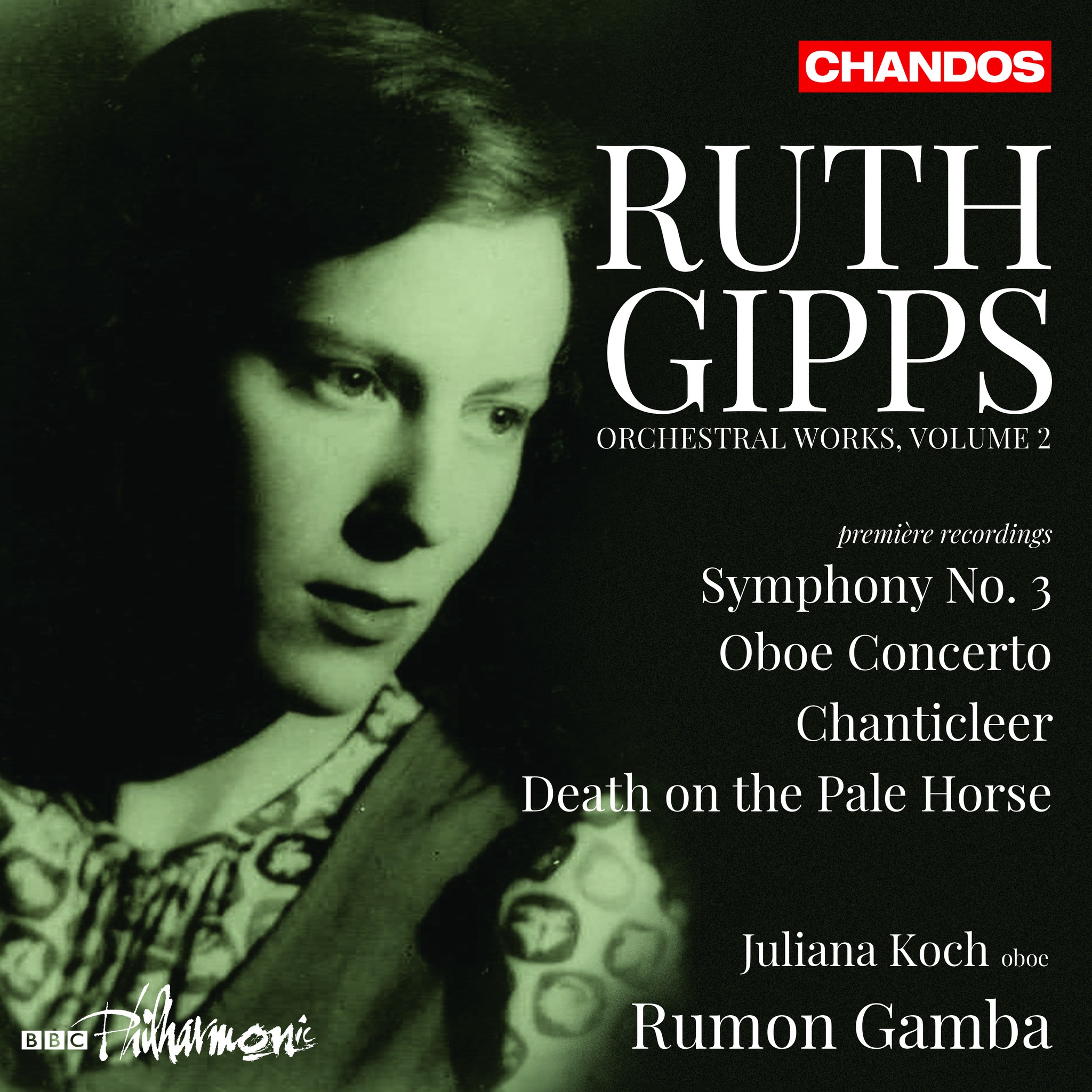
Too late to post anything of substance today, so I’m just sharing some highlights from my Christmas booty: two CDs of unusual and neglected repertoire (orchestral works by English composer Ruth Gipps and piano music by Norwegian composer Agathe Backer Grøndahl) and two books (“Mad Music: Charles Ives, the Nostalgic Rebel” by Stephen Budiansky and “Vaughan Williams” by Eric Saylor) — all new except the Ives bio, which was issued in 2014. Something must have happened to Santa’s naughty list!
Tag: Vaughan Williams
-
Christmas Music Parry Vaughan Williams WWFM
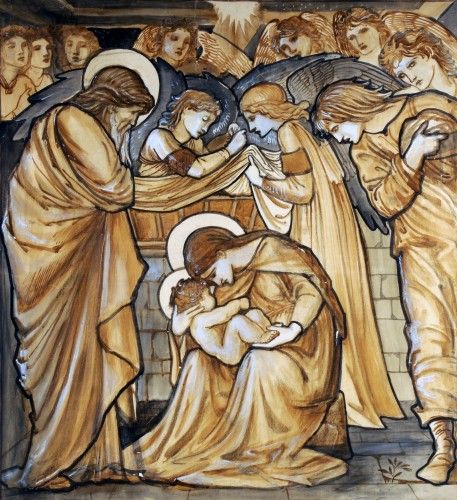
Later tonight, with all the cooking, conviviality, and hopefully clean-up winding down, settle in for an hour of reflection, with two works by English composers inspired by the Nativity.
Alongside Sir Charles Villiers Stanford and Sir Edward Elgar, Sir Hubert Parry was one of the key figures of the so-called “English Musical Renaissance.” He influenced a whole generation of much better-known composers, including Ralph Vaughan Williams and Gustav Holst. We’ll hear his “Ode on the Nativity,” given its first performance on the same concert, at the Hereford Three Choirs Festival in 1912, as Vaughan Williams’ “Fantasia on Christmas Carols.”
Vaughan Williams, the great-nephew of Charles Darwin, and an atheist in his youth, later softened into a kind of “cheerful agnosticism.” He dearly loved the King James Bible, and he especially enjoyed Christmas. Of course, he wrote much music on the subject. In fact, his very last composition was “The First Nowell.” He worked diligently at the piece, inspired by medieval pageants, during his final month, but died suddenly before its completion.
However, even at 85 years-old, RVW retained a remarkable level of concentration. He managed to pound out the whole thing in short score in only a few weeks. Furthermore, he had fully orchestrated the first two-thirds. The finishing touches were applied by his assistant, Roy Douglas – he of “Les Sylphides” fame.
If you like the “Fantasia on Christmas Carols,” I think you’ll really enjoy this. It’s pastoral music for a pastoral scene. I hope you’ll join me for “A Play in a Manger,” THIS SUNDAY NIGHT, ONE HOUR LATER THAN USUAL, AT 11:00 EST, on WWFM – The Classical Network and wwfm.org.
Until then, best wishes for a happy and meaningful Christmas!
-

All Saints Day Music Vaughan Williams Sine Nomine
November 1st. Time to put away the vampires and get all saintly and thankful. To this end, here’s Vaughan Williams’ “Sine Nomine” (“For All the Saints”), performed by the Choir of Trinity College, Cambridge, the composer’s alma mater.
-
Vaughan Williams Late Bloom Colorful Genius
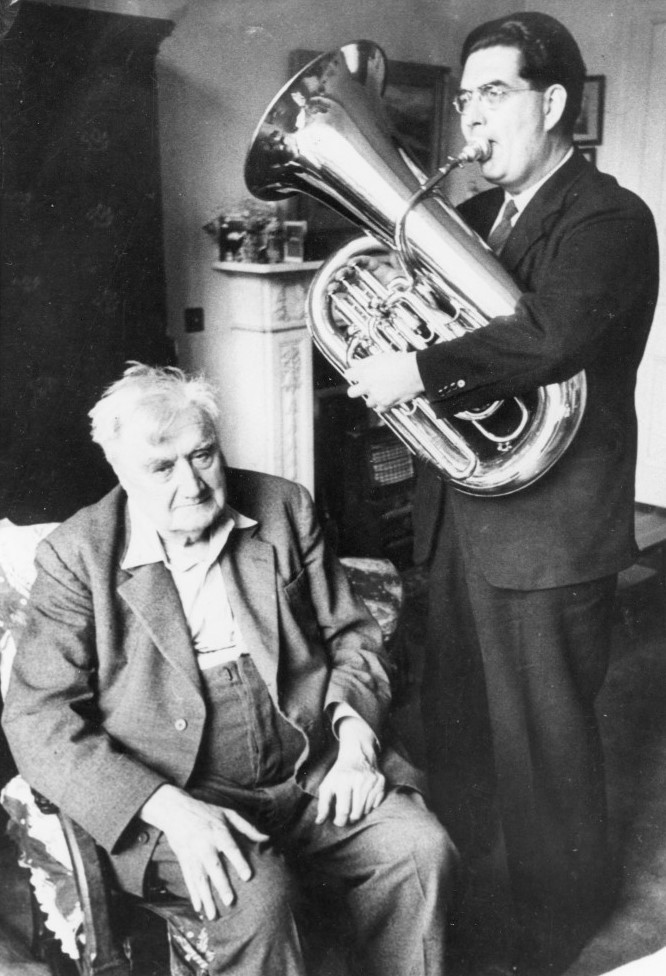
Here’s Ralph Vaughan Williams, looking as miserable as you would imagine, being serenaded by the tuba. The composer wrote the first ever concerto for the instrument in 1954. A late and unusual work, the piece was dedicated to Philip Catelinet, principal tubist of the London Symphony Orchestra. “Glorious John” Barbirolli conducted the premiere. These are the forces heard on the work’s first recording. Listen here, for a tubby start to your Friday.
BONUS! Vaughan Williams’ “Romance for Harmonica,” composed in 1952.
Vaughan Williams seemed often to be in search of unusual timbres in his later years. Rather ironic, since by then he was severely deaf, the result of prolonged exposure to heavy artillery during World War I. But he was a true composer, a master of his craft, who didn’t have to hear what he wrote in order to know the sound. Moreover, as a pupil of Maurice Ravel, he never lost his sense of color.
Take for example the exotic percussion in the outer movements of his Symphony No. 8, composed in 1953-54. (The second movement is scored for brass and the third for strings alone.) It’s heard here in a superb performance from perhaps an unlikely source, given the pervasive claims that the music of this quintessentially English composer does not “travel.” Nobody told Charles Munch and the Boston Symphony Orchestra.
Or the insinuating saxophones and mysterious harps in the valedictory Symphony No. 9, written in 1956-57. Vaughan Williams died on the eve of the first recording session, with Sir Adrian Boult and the London Philharmonic Orchestra. Boult’s brief eulogy appears at the beginning of this world premiere recording.
It’s extraordinary that a composer in his 80s would remain so vital and so full of invention. (RVW was 80 back when 80 was REALLY 80!) His symphonies, in particular, are among the greatest of the 20th century. And he never repeated himself. All nine have such a distinctive character, and there’s not a weak link in the bunch. Would that more of our music directors would get to know them.
-
Vaughan Williams: Passion, Love & Music
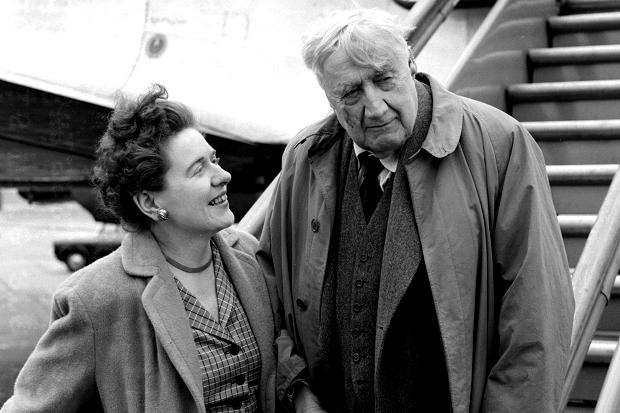
Interestingly, this is a topic that has been on my mind for the past week or so. Perhaps because, after a conversation with Paul Moon, I was thinking of Vaughan Williams’ “Epithalamion,” the first work VW wrote in collaboration with the poet Ursula Wood. Perhaps because, in flipping through photos of the composer in advance of his birthday, I came across this snapshot from years later, in which he and Ursula, by then his second wife, look affectionate and happy.
Whichever the case, yesterday, on the 150th anniversary of VW’s birth, I discovered a documentary, which I am now very curious to view. You’ll find a link to “The Passions of Vaughan Williams” at the bottom of this post.
In the modern sense, “passion” is frequently used to suggest ardor or enthusiasm. But as you may know, the word itself has its roots in the Latin “passio” and the Greek “pathos,” both of them tied to suffering.
So just how “pastoral” was the world of Ralph Vaughan Williams?
Wood was a young drama student at the Old Vic, when she caught a performance of Vaughan Williams’ masque, “Job.” She was greatly impressed by the piece. So much so, she contacted him to share her own idea for a ballet. But Ralph was not keen on it. Undeterred, she then suggested doing something based on the poetry of Edmund Spenser. This intrigued him and led to their fateful meeting. They got together for lunch in 1938 and fell immediately in love. There was only one problem – well, two actually – they both were already married.
At 24, Vaughan Williams, himself the great-nephew of Charles Darwin, had married Adeline Fisher, a cousin of Virginia Woolf. The marriage was not a passionate one. The couple had no children, Adeline was very much wrapped up in the concerns of her birth family, and after her brother was killed in action during World War I, she determined to wear black for the remainder of her life. In the meantime, she was gradually invalided by crippling arthritis. For her health, the Vaughan Williamses left the vibrant cultural center of London, on which Ralph thrived, to settle in the countryside of Dorking, Surrey.
Ursula’s impediment was the first to be resolved. Michael Wood would die of a heart attack while serving in the army in 1942. She was promptly invited by the Vaughan Williamses to come stay with them at their rural address, and there their lives became further entwined. When Ursula took paid employment in London, Adeline was relieved to know that when Ralph was in town, Ursula would be there to care of him. Ursula’s relationship with Vaughan Williams became an open, though perhaps unspoken secret. After all, Adeline was no fool. For Ralph’s part, he would never abandon his wife.
During a tense night in 1944, the height of Hitler’s “doodlebug” raids, the Vaughan Williamses lay in twin beds, with Ursula on a mattress on the floor between them, all of them listening for V-1 planes as Ursula held their hands. This peculiar ménage continued for 13 years. In a professional capacity, Ursula acted as Vaughan Williams’ assistant and literary advisor. But personally, the two had already developed a very deep bond.
Adeline died in 1951. Ursula and Ralph married in February 1953. It was to be a happy union, as Ursula kept RVW active, expansive, and productive. I should mention, there was a 38-year difference between them. At the time of their wedding, Vaughan Williams was 80 and Ursula was 41. But before you jump to conclusions, there wasn’t anything “ick” about it.
Ursula was an inspiration for Ralph from the day they met. Ralph would set a number of her texts to music, beginning with the Spenser collaboration, the masque “Epithalamion,” composed in 1938-9 (as “The Bridal Day”). With the outbreak of World War II, the work was put away in a trunk, its premiere postponed indefinitely. It was eventually revived and televised on June 5, 1953.
Further, the romantic glow that characterizes so much of Vaughan Williams’ output (as in the “Serenade to Music”) may be attributed to the composer’s ardor. Certainly, Ursula steered his path in a positive direction. It’s hard to imagine that he would have enjoyed the vitality he did in his golden years without her.
Vaughan Williams died in 1958 at the age of 85. He was active to the very end, leaving several ambitious projects (including a cello concerto, an opera, and a Christmas pageant) incomplete at the time of his death. Ursula would outlive him by nearly 50 years.
In 1964, she published “RVW: A Biography of Ralph Vaughan Williams.” She followed that with a candid volume of autobiography, “Paradise Remember,” in 1972, but deferred its publication until 2002. She died in 2007 at the age of 96. Clearly, she loved Ralph and did much in the half century since his passing to ensure and illuminate his legacy.
Ironically, because of the enduring popularity of works like the “Fantasia on a Theme by Thomas Tallis” and “The Lark Ascending,” a stereotype has taken root of Vaughan Williams as a kind of Bilbo Baggins, contentedly smoking his pipe and growing portly in the Shire. But the composer’s achievement transcends what some blithely perceive as a pastoral wallow. There was a great deal of turbulence and passion underlying both his life and music.
Ralph and Ursula’s “Epithalamion”
“The Passions of Vaughan Williams”
PHOTO: Ralph Vaughan Williams, babe magnet
Tag Cloud
Aaron Copland (94) Beethoven (95) Composer (114) Film Music (148) Film Score (143) Film Scores (255) Halloween (97) John Williams (196) KWAX (232) Leonard Bernstein (105) Marlboro Music Festival (125) Movie Music (163) Mozart (91) Opera (215) Philadelphia Orchestra (90) Picture Perfect (174) Princeton Symphony Orchestra (110) Radio (90) Ross Amico (244) Roy's Tie-Dye Sci-Fi Corner (290) The Classical Network (101) The Lost Chord (269) Vaughan Williams (107) WPRB (397) WWFM (881)