Tag: Vaughan Williams

  • Vaughan Williams’ Antartica Symphony: Ice and Tragedy

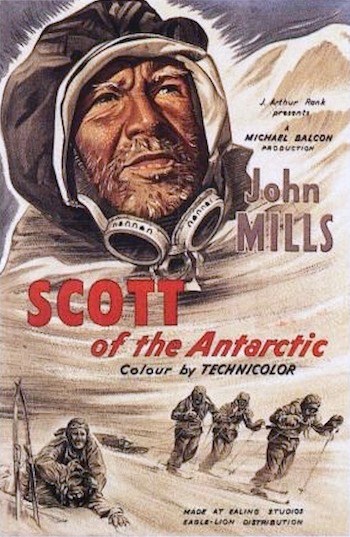
    Think cool thoughts with Ralph Vaughan Williams’ “Sinfonia Antartica” – his Symphony No. 7 – spun off of his score for the Ealing Studios film “Scott of the Antarctic” (1948).

    The fatal polar expedition of Robert Falcon Scott and his companions enthralled the composer, who responded with music evocative of ice and wind, penguins and whales, and inexorable snows. Vaughan Williams wrote most of the score before even seeing the film.

    The symphony is scored for large orchestra, including vibraphone, pianoforte, organ, and wind machine, with wordless women’s chorus and soprano soloist.

    It falls into five movements – Prelude, Scherzo, Landscape, Intermezzo, and Epilogue – with the third movement leading directly into the fourth. The scherzo is propelled by whales and penguins. The “landscape” in question is the icy wasteland of Ross Island.

    The score itself includes brief literary quotations – from Shelley, the Biblical Book of Psalms, Coleridge, Donne, and Captain Scott’s Last Journal – at the head of each movement. These are sometimes declaimed in performance and recordings, though the composer did not indicate that they were intended to be spoken.

    The title of the work is frequently misspelled, since the composer opts for the Italian “Antartica” (spelled with only one “c”) – a decision he made at the last minute, so as to keep it consistent with his use of the Italian word “Sinfonia.”

    Vaughan Williams was 80 years-old when he completed the symphony in 1952. It received its first public performance on January 14, 1953. Sir John Barbirolli conducted the Hallé Orchestra.

    The tragic dimension of the overall tone of the symphony is unmistakable, with man’s endeavors insignificant in the face of implacable nature.

    Here’s hoping your reception is a chilly one!

  • George Butterworth: More Than a War Casualty

    George Butterworth: More Than a War Casualty

    As a classical music radio host of many years, it’s easy to fall back on the same biographical details whenever I come to announce a given composer’s works. This is especially true when the composer’s life contains some particularly lurid or poignant detail.

    But is it really fair to define someone by the manner of his or her death? After all, composers lived rounded lives like the rest of us, full of joys and sorrows. There must be some laughter even in a life weighted with misery, and tears in the make-up of any clown.

    So it was with George Butterworth. If we hear anything at all in the minute or two it takes to set up the broadcast of one of his works, it’s that Butterworth was cut down by a sniper during the Battle of the Somme at the age of 31. Of course, it doesn’t help that his compositions make one’s heart ache from their exquisite beauty.

    A few years ago, I was doing some quick research on Butterworth, born on this date in 1885, when I stumbled across this webpage and sat transfixed, as I viewed for the first time rare footage of him folk dancing with Cecil Sharp. It put a human face on this composer every bit as poignant as the recollection of his untimely death. It’s especially amusing to see the two men get tangled up in their choreography and then continue on their merry way.

    https://www.warcomposers.co.uk/butterworthbio

    It’s also worth mentioning, in Vaughan Williams’ sesquicentennial year, that it was Butterworth who first suggested to his friend that he tackle a purely orchestral symphony. (RVW’s first symphony, “A Sea Symphony,” had been scored for chorus and orchestra.) The result was “A London Symphony,” Vaughan Williams’ Second, which he dedicated to Butterworth before his untimely demise.

    Vaughan Williams remembered, “We were talking together one day when he said in his gruff, abrupt manner: ‘You know, you ought to write a symphony.’ I answered… that I’d never written a symphony and never intended to… I suppose Butterworth’s words stung me and, anyhow, I looked out some sketches I had made for… a symphonic poem about London and decided to throw it into symphonic form… From that moment, the idea of a symphony dominated my mind. I showed the sketches to George bit by bit as they were finished, and it was then that I realised that he possessed in common with very few composers a wonderful power of criticism of other men’s work and insight into their ideas and motives. I can never feel too grateful to him for all he did for me over this work and his help did not stop short at criticism.”

    RVW’s “A London Symphony”

    If you’re unfamiliar with Butterworth’s own music, here are a few examples. Those inspired by the poems of A.E. Housman are especially moving.

    “The Banks of Green Willow”

    “A Shropshire Lad” (orchestral rhapsody)

    “A Shropshire Lad” (song cycle):

    https://www.youtube.com/watch?v=e3fgjfi8OCs


    PHOTO: Butterworth the morris dancer (second from left)

  • Happy Easter Vaughan Williams’ Mystical Songs

    Happy Easter Vaughan Williams’ Mystical Songs

    Happy Easter!

    Look who’s in this week’s Country Life. Some-bunny very special, for his sesquicentenary (Vaughan Williams, born October 12, 1872).

    https://www.countrylife.co.uk/out-and-about/theatre-film-music/in-focus-vaughan-williams-the-composer-who-wrote-the-worlds-most-beautiful-melody-237631?fbclid=IwAR2TjTSnOUlQ74njTfvc1HaGWY7K1eXwTqUUzDEdB4dQAPT5iKLP_1U-xH0.

    To me, it’s never really Easter, until I listen to John Shirley-Quirk and the Choir of King’s College, Cambridge, sing RVW’s “Five Mystical Songs,” which opens with – appropriately enough – “Easter.”

  • Vaughan Williams Library Discards Rare Find

    Vaughan Williams Library Discards Rare Find

    One man’s meat is another man’s poison.

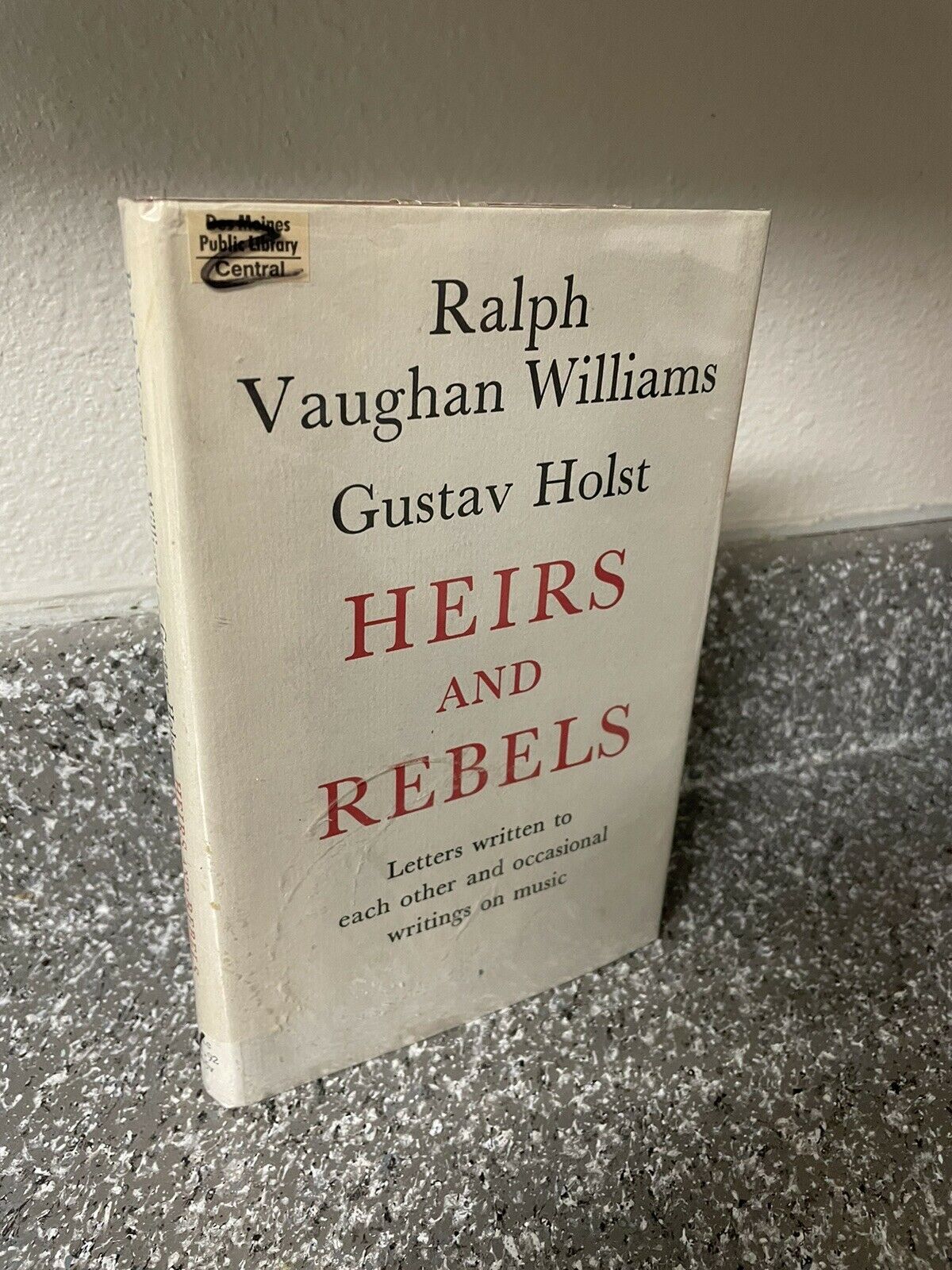
    Fresh on the heels of my acquisition of Ursula Vaughan Williams’ biography of her husband, famed English composer Ralph Vaughan Williams, as a discard from the Des Moines Public Library, comes this gem, now in the mail. Both books are quite pricey on the secondhand market; hence my snapping them up as library rejects.

    Previously, I posted about my stunned reaction to Ursula’s “RVW” being turned loose, given Vaughan Williams’ significance as a composer and the fact that there could be increased interest in his work, given that this is his sesquicentennial year. (He was born on October 12, 1872.) Then I remembered my copy of Vaughan Williams’ “Beethoven’s Choral Symphony and Other Writings” is a discard from Princeton University!

    The Des Moines Public Library’s “collection management” policy can be found here, under “Collection Development and Programming.”

    https://www.dmpl.org/connect/what-we-do/services-policies

    I’m guessing there’s not a great demand for Vaughan Williams in Des Moines.

  • Vaughan Williams Research Des Moines Library No Luck

    Vaughan Williams Research Des Moines Library No Luck

    This arrived in the mail the other day. Anyone hoping to research Vaughan Williams at the Des Moines Public Library is out of luck.

Tag Cloud

Aaron Copland (92) Beethoven (95) Composer (114) Film Music (123) Film Score (143) Film Scores (255) Halloween (94) John Williams (187) KWAX (229) Leonard Bernstein (101) Marlboro Music Festival (125) Movie Music (138) Opera (202) Philadelphia Orchestra (89) Picture Perfect (174) Princeton Symphony Orchestra (106) Radio (87) Ralph Vaughan Williams (85) Ross Amico (244) Roy's Tie-Dye Sci-Fi Corner (290) The Classical Network (101) The Lost Chord (268) Vaughan Williams (103) WPRB (396) WWFM (881)

DON’T MISS A BEAT

Receive a weekly digest every Sunday at noon by signing up here


RECENT POSTS