Tag: WWFM

  • Bach 500 Fundraiser Help Keep Classical Music Alive

    Bach 500 Fundraiser Help Keep Classical Music Alive

    As someone who has worked in public radio for over three decades, I can tell you that nothing makes a classical music host happier than a listener who reacts to our membership pleas with a donation, as a kind of Pavlovian response. They know the drill.

    Those are the listeners that not only understand the necessity of our meeting our financial goals, but also the fact that the sooner we do, the sooner we can get back to the unalloyed enjoyment of what we all love – the music!

    Okay, so we had a slow start on our Bach 500 fundraiser. But we’re getting there. And we have to keep going until we do. Fortunately, we are less than 200 donations away for the end of this campaign.

    In case you’re only just hearing about it, here’s how it works. Every year, in honor of Bach’s birthday (March 21, 1685), we ask for 500 listeners to please make a gift to the station in any amount. Give whatever you can. Once we reach 500 donations, the pitching stops, and we all celebrate with a Bach blowout. There is much rejoicing, and then we get back to the panacea of uninterrupted music.

    So why not toss us a bone? The sooner we meet our goal of 500 contributions, the sooner we get “Bach” to the music.

    If you enjoy listening to the station, and you haven’t had a chance to donate yet, and you’re in a position to do so, please make a commitment in the form of your contribution today, by calling 1-888-232-1212, or by joining the Bach 500 at wwfm.org.

    If you have already given, thank you so much for your support of WWFM – The Classical Network! WOOF!

    https://wwwfm.secureallegiance.com/wwfm/WebModule/Donate.aspx?P=DEFAULT&PAGETYPE=PLG&CHECK=vOU2bz5JCWmgCDbf53nm9ezWDeZ%2beA1M

  • Bach 500 Fueling Classical Music on WWFM

    Bach 500 Fueling Classical Music on WWFM

    Johann Sebastian Bach once traveled 250 miles on foot to hear Dietrich Buxtehude play the organ. Then he got himself a race car…

    The WWFM Bach 500 is underway!

    In celebration of the 337th anniversary of Bach’s birth (on March 21st, 1685), The Classical Network presents its annual Bach fundraiser.

    We’re looking for 500 listeners to step up and make a contribution IN ANY AMOUNT. You set the level. Once we reach 500 donations, we’ll tally in the funds from our Bach Pot – contributions solicited in advance from some especially ardent supporters. Then the pitching stops, and Bach’s music continues uninterrupted.

    You can do your part to make that happen by donating online right now at wwfm.org or calling 1-888-232-1212. While you’re over there at the WWFM website, you can monitor our progress by consulting the Bach 500 membership thermometer.

    Your donation is like a blast of nitrous oxide, but we’re definitely built for speed. Put the pedal to the metal, and thank you for your support of WWFM – The Classical Network!

    https://wwwfm.secureallegiance.com/wwfm/WebModule/Donate.aspx?P=DEFAULT&PAGETYPE=PLG&CHECK=vOU2bz5JCWmgCDbf53nm9ezWDeZ%2beA1M

  • Spring Awakening Loeffler & Bax on WWFM

    Spring Awakening Loeffler & Bax on WWFM

    Spring arrives at 11:33 a.m. EDT.

    This Sunday night on “The Lost Chord,” we’ll welcome the vernal equinox with two works steeped in mythological lore.

    Charles Martin Loeffler (1861-1935) long claimed to be of Alsation birth. In actuality, he was born outside Berlin. The composer turned against Germany after his father died in prison, where he had been sent for his subversive writings, when Loeffler was only 12 years-old.

    Loeffler was a fastidious artist, who cut his teeth in Berlin and Paris, and indeed he is frequently identified as French-American. He settled in Boston in 1881, where he shared the first desk with the concertmaster of the Boston Symphony Orchestra and became an important figure in the city’s musical life. A man of wide culture and refined taste, he founded the Boston Opera Company. In 1887, he left the Symphony to devote himself wholly to composition.

    Loeffler’s symphonic poem of 1906, titled “A Pagan Poem,” was inspired by the eighth Eclogue of Virgil, in which a maiden of Thessaly, abandoned by her lover, revives his ardor through the use of sorcery.

    The work was first performed by the Boston Symphony, under Karl Muck. It was later championed by Leopold Stokowski, who recorded it for EMI. The piano plays such a prominent role, the piece sounds at times as if it could be a piano concerto.

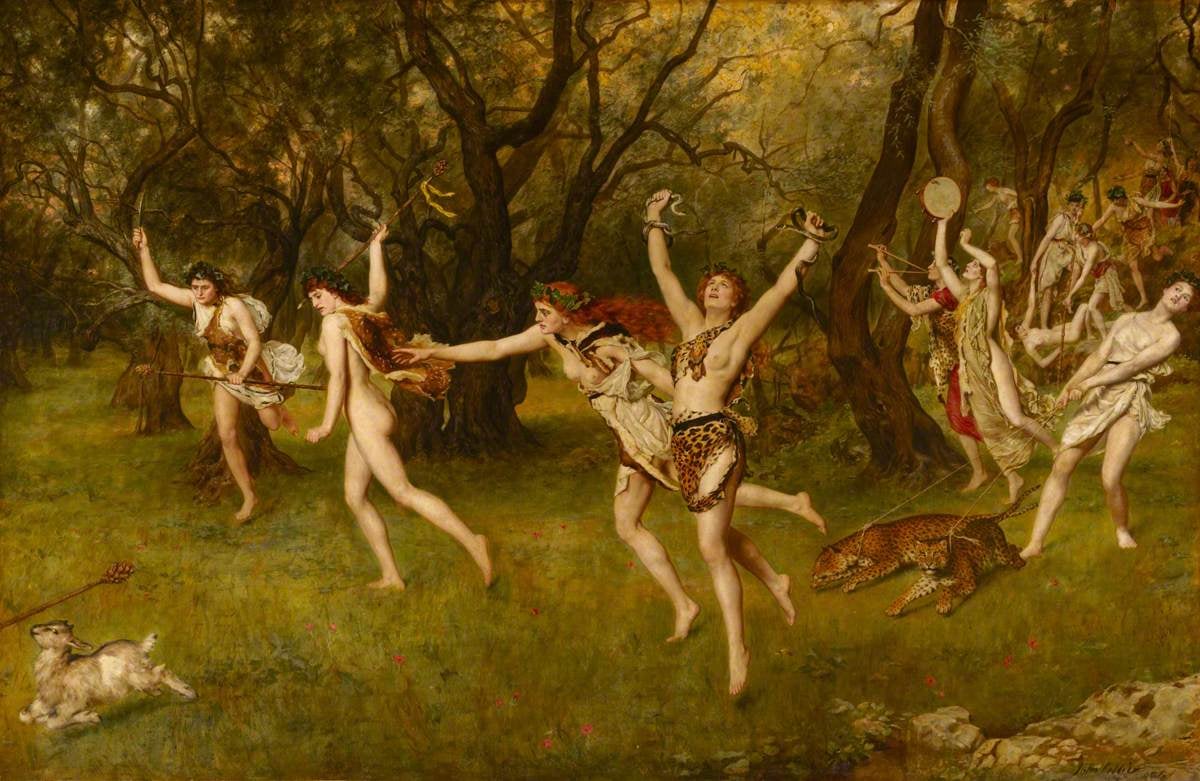
    “Spring Fire” from 1913-14, one of the earliest programmatic works by the English composer Arnold Bax (1883-1953), is meant to suggest the awakening of mythological beings in early spring.

    The choice of subject matter was an attempt to cash in on the fashionable “paganism craze” sparked by the Ballets Russes and its composers. Bax’s affection for the writings of Algernon Swinburne had recently yielded the symphonic poem “Nympholept.” Quotations from Swinburne also adorn portions of the score to “Spring Fire.”

    The piece was scheduled for performance several times, but repeatedly cancelled, first because of the outbreak of war, then because of the work’s difficulty. Ultimately, it would never be performed during Bax’s lifetime. The manuscript was consumed in a fire in 1964, and all hope of ever hearing the score vanished. Fortunately, a copy was discovered, and the piece was finally recorded in 1986.

    “Spring Fire” is meant to reflect a woodland sunrise in early spring, as ancient denizens of the forest shrug off their winter sleep. Half-human shapes skip with mad antics down the glades. Forest lovers loll in their ecstatic dreams, until they are rudely awakened by a turbulent rout of satyrs and maenads.

    It’s shaping up to be a “Hot Spring,” on “The Lost Chord,” this Sunday night at 10:00 EDT, on WWFM – The Classical Network and wwfm.org.

  • WWFM Radio Silence Two Years and Counting

    WWFM Radio Silence Two Years and Counting

    By nature, I am not a superstitious person. But perhaps there is something to looking over one’s shoulder around the Ides of March.

    On the other hand, when it comes to something like COVID-19, what’s the difference?

    I noticed the other day that it’s been two years since I last set foot in the WWFM studios. Early in March 2020, with the whitetips of the coronavirus tsunami already visible on the horizon, all hosts of recorded specialty programs were asked to prepare five “evergreen” shows – shows that are not time-specific – to be aired over the coming weeks. That way, we could all hunker down in our homes until the coast was clear. Needless to say, this proved to be an underestimate.

    Though the campus of Mercer County Community College has since reopened, and classes have resumed – even the college gym has been accessible for quite some time – part-time staff is unlikely to be called back anytime soon. I suspect it’s more of a budgetary than a safety issue at this point.

    In any case, it’s unfortunate to have had my live air shifts curtailed in this way, and to not have access to a studio in order to be able to produce new recorded shows. At least I can dip into the archive for rebroadcasts of past episodes. That said, those stored on the station’s hard drive only go back as far as 2010, with perhaps a stray episode from 2009. I can make minor tweaks to these, if necessary, on my laptop, pending actually setting up a home studio, which I suppose I really should have done two years ago. I think WWFM must be the only radio station not to have it hosts continue broadcasting remotely, be it from a basement or a bedroom closet.

    My last live air shift was on March 11, 2020. I didn’t know that it would be my last, so it was a show pretty much like any other, marked by a number of birthday observations (in this case, remembering composers Henry Cowell, Carl Ruggles, Anthony Philip Heinrich, Astor Piazzolla, and Xavier Monstalvatge). Here’s the playlist for the first two hours:

    4:00 HENRY COWELL, Hymn and Fuguing Tune No. 10
    4:10 CARL RUGGLES, Men and Mountains
    4:23 HENRY COWELL, The Fairy Answer
    4:32 ANTHONY PHILIP HEINRICH, The Ornithological Combat of Kings (Grand Symphony)

    5:03 ASTOR PIAZZOLLA – Histoire du Tango
    5:25 JOHANN SEBASTIAN BACH (arr. Marcilio Lopes) – Partita No. 4 in D major, BWV 828: Gigue
    5:34 XAVIER MONTSALVATGE – Concerto breve

    That was followed, at 6:00, by my weekly Wednesday feature, “Music from Marlboro,” programmed from the archive of live performances and commercially-released recordings from the Marlboro Music Festival. For this particular installment, I played the following:

    6:04 JOHANNES BRAHMS – String Sextet No. 2 in G major
    6:52 JOHANN SEBASTIAN BACH – Orchestral Suite No. 3 in D major: Air

    I was back in the station later in the week, to put some finishing touches on my production work, to be sure that all my evergreen shows were in place. That was on Friday the 13th. (I know, right?) The layoff notice arrived by email later that night.

    I made my debut on WWFM all the way back on September 28, 1995. The 20th century! As with any job, at times it could be a bit of a wild ride, and I think I proved myself to be quite the tenacious bronco buster. In the end, it would take nothing less than a world health emergency to finally dislodge me. Six months shy of my Silver Jubilee, too!

    Everything has been up in the air since then. But I’ve long since stopped holding my breath for the phone to ring. Repeated shows ensure that I continue to have somewhat of an air presence. But they are no substitute for assembling creative programs for live broadcast, the reward of spontaneously sharing music I love, and being able to respond in a meaningful way to current events on a somewhat daily basis.

    I hate to think what my work mailbox must look like at this point. Beware the Ides of March!

  • Edward Collins Irish Echoes

    Edward Collins Irish Echoes

    “Oh! The praties they grow small over here…”

    Edward Joseph Collins (1886-1951) was born to Irish-American parents in Joliet, Illinois. Though he studied abroad with Max Bruch and Engelbert Humperdinck, it was in Chicago that he made his career. Nearly a generation older than Copland and Gershwin, he too found inspiration in African-American spirituals, cowboy songs, and jazz.

    Collins’ relationship to the Irish was a complex one. Nonetheless, he could not escape the pull of his heritage and its music. This week on “The Lost Chord,” the composer remembers the land of his forebears with three meditations on Irish folk song for St. Patrick’s Day. That’s “Irish Ties Are Smiling,” this Sunday night at 10:00 EDT, on WWFM – The Classical Network and wwfm.org.

Tag Cloud

Aaron Copland (92) Beethoven (95) Composer (114) Film Music (123) Film Score (143) Film Scores (255) Halloween (94) John Williams (187) KWAX (229) Leonard Bernstein (101) Marlboro Music Festival (125) Movie Music (138) Opera (202) Philadelphia Orchestra (89) Picture Perfect (174) Princeton Symphony Orchestra (106) Radio (87) Ralph Vaughan Williams (85) Ross Amico (244) Roy's Tie-Dye Sci-Fi Corner (290) The Classical Network (101) The Lost Chord (268) Vaughan Williams (103) WPRB (396) WWFM (881)

DON’T MISS A BEAT

Receive a weekly digest every Sunday at noon by signing up here


RECENT POSTS