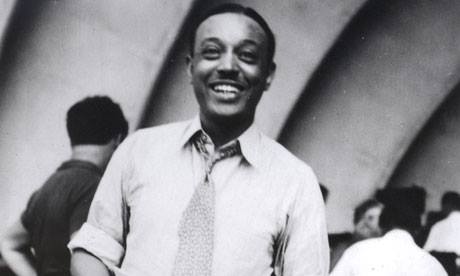
He’s Still the one.
Today is the birthday of William Grant Still (1895-1978), the so-called “Dean of Afro-American Composers.” Still emerged from unlikely circumstances (born in Woodville, Mississippi; raised in Little Rock, Arkansas) to become a major force in American music.
Having abandoned a career in medicine for studies at the Oberlin Conservatory of Music and the New England Conservatory in Boston (where he studied with George Whitefield Chadwick), Still was a “first” in many ways.
His was the first symphony written by a black composer to be performed by a major orchestra (the Eastman-Rochester). He was the first to be given the opportunity to conduct a major orchestra (the Los Angeles Philharmonic, at the Hollywood Bowl). His opera, “Troubled Island,” became the first to be produced by a major company (the New York City Opera). Another of his operas, “A Bayou Legend,” was the first to be performed on national television (as late as 1981).
Any of these would be significant in and of themselves, but it just so happens that Still was a damn fine composer. Perhaps the least likely pupil of Edgard Varèse, he incorporated jazz and blues elements into his concert music, which also frequently reflected the African and African-American experiences.
He cut his teeth writing arrangements for Paul Whiteman, W.C. Handy and Artie Shaw. According to Eubie Blake, one of Still’s improvisations in the pit band during Blake’s revue “Shuffle Along” became the basis for Gershwin’s hit tune “I Got Rhythm.” Still didn’t appear to be bitter about it, and in fact the two composers were on friendly terms and made it a point to attend performances of one another’s music.
Still quotes the melody in the third movement of his Symphony No. 1, otherwise known as the “Afro-American Symphony.” In fact, it had always been his intention to do so, before Gershwin popularized it. (Blake went on to say the swipe was probably inadvertent, but Still had definitely gotten there first.)
I’ve always been fond of the symphony, from the very first time I heard it. To me, it is every bit as much of a portrait of an artist as a young man as Virgil Thomson’s “Symphony on a Hymn Tune.” It’s a beautiful and wistful piece, built on lovely daydreams and uptempo, banjo-like riffs. This is the kind of music that Dvořák would have loved.
Here it is, in a pioneering recording by Karl Krueger and the Royal Philharmonic Orchestra, after all these years, still my favorite:
Mov’t I: https://www.youtube.com/watch?v=5s7o8UfKsV0
Mov’t II: https://www.youtube.com/watch?v=xSQUrW8eBhU
Mov’t III: https://www.youtube.com/watch?v=iEeaLvX82Lw
Mov’t IV: https://www.youtube.com/watch?v=Fu_qzX5K39g
And just to prove it was no accident, here’s the second movement of his Symphony No. 2, “Song of a New Race,” with Neeme Järvi and the Detroit Symphony:
https://www.youtube.com/watch?v=uaHe5hvWu6w
Now tell me Gershwin wouldn’t have killed to write that!
Happy birthday, William Grant Still.
Leave a Reply