Once again, you’ve got to love the Golden Age of Hollywood. In terms of music, movies from that era just seemed so… inclusive.
On the one hand, you could have crooner Rudy Vallée acting in Preston Sturges comedies (and not singing a note); on the other, you could have Leopold Stokowski shaking hands with Mickey Mouse. There seemed to be a wider acceptance of musicians of all stripes as equally valid entertainers, and an assumption that the general public would understand (or at least not be put off by) a line of dialogue about Delius or Sibelius. When the Three Stooges weren’t flipping fruit into opera singers’ mouths, that is.
This is especially fascinating when viewed from the perspective of the present, when seemingly the bar is set lower and lower all the time, with everyone racing to the lowest common denominator so as not to seem too pointy-headed. Wouldn’t it make sense that people of any era would want to aspire to be more? That they would want to be led, represented and entertained by the most talented, most intelligent people? It’s a very strange world we live in.
José Iturbi was one of the seemingly unlikely cinematic superstars of the 1940s. Like Oscar Levant, Iturbi was a serious pianist. In the ‘20s, he had made a name for himself as a barnstorming virtuoso who toured Europe, Asia, Africa and South America. He made his North American debut with the Philadelphia Orchestra under Stokowski.
Eventually, he made the transition to conducting, which had long been his dream. He led the great symphony orchestras of Philadelphia and New York, the London Symphony, the orchestra of La Scala Milan, and the Concertgebouw Orchestra of Amsterdam. He would serve as music director of the Rochester Philharmonic.
Iturbi generally played himself in Hollywood musicals, including “Thousands Cheer” (1943), “Anchors Away” (1945) and especially “Three Daring Daughters” (1948), in which he was actually the lead.
For all his talent and charisma, however, Iturbi was always churning up controversy, making provocative remarks and losing his temper. Ironically, for a musician who owed so much of his fame to his absorption into popular culture, he made a big hullabaloo about appearing on concert programs that included both classical and popular music. It wasn’t popular music he objected to, particularly; it was the mixing of the two. This is particularly puzzling from a pianist who studied at the Valencia and Paris Conservatories, yet played jazz and boogie-woogie in innumerable film shorts.
His private life was equally turbulent, perhaps even more so, with tragic results. His wife died of accidental poisoning. He sued his daughter, claiming she was an unfit mother to his grandchildren. The daughter later committed suicide.
Iturbi could be a brilliant pianist, though he sometimes drew criticism that he was diluting his talents through his involvement with Hollywood, and a number of his concerto recordings, which he conducted himself from the keyboard, don’t really seem to take flight. Even so, there are gems among his recorded repertoire, and the part he played in keeping classical music in the mainstream is to be lauded.
It’s a vine that is now severely withered. I wonder if Luciano Pavarotti’s “Yes, Giorgio” (1982) was the last in the line of dubious movies featuring great classical musicians.
Happy birthday, José Iturbi (1895-1980).
Iturbi in “Holiday in Mexico” (1946):
Insane take on Liszt’s “Hungarian Rhapsody No. 2” from “Anchors Aweigh” (1945):
Iturbi plays Mozart with his sister, while conducting the Rochester Philharmonic, in 1946:
Iturbi plays Albeniz, Granados and Navarro, from 1933:
Oscar Levant in “The Barkleys of Broadway” (1949):
Lauritz Melchior with Esther Williams and Van Johnson in “Thrill of a Romance” (1945):
The Three Stooges menacing an opera singer in “Pardon my Scotch” (1935):
https://www.youtube.com/watch?v=95EsngNGpIg
The pie fight from “Yes, Giorgio”:
Website of the José Iturbi Foundation:
http://www.joseiturbifoundation.org/
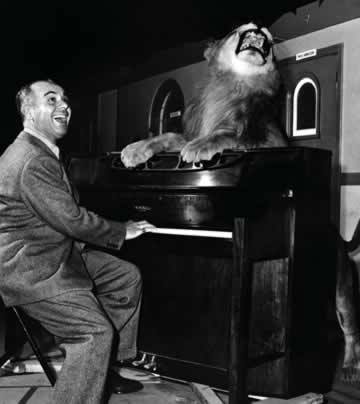
PHOTO: Iturbi accompanying the MGM lion
Leave a Reply