Tag: Hollywood

  • Bernstein’s Waterfront A Hollywood Contender

    Bernstein’s Waterfront A Hollywood Contender

    “I coulda had class. I coulda been a contender. I coulda been somebody – instead of a bum, which is what I am.”

    We’ve all had those kinds of days, haven’t we?

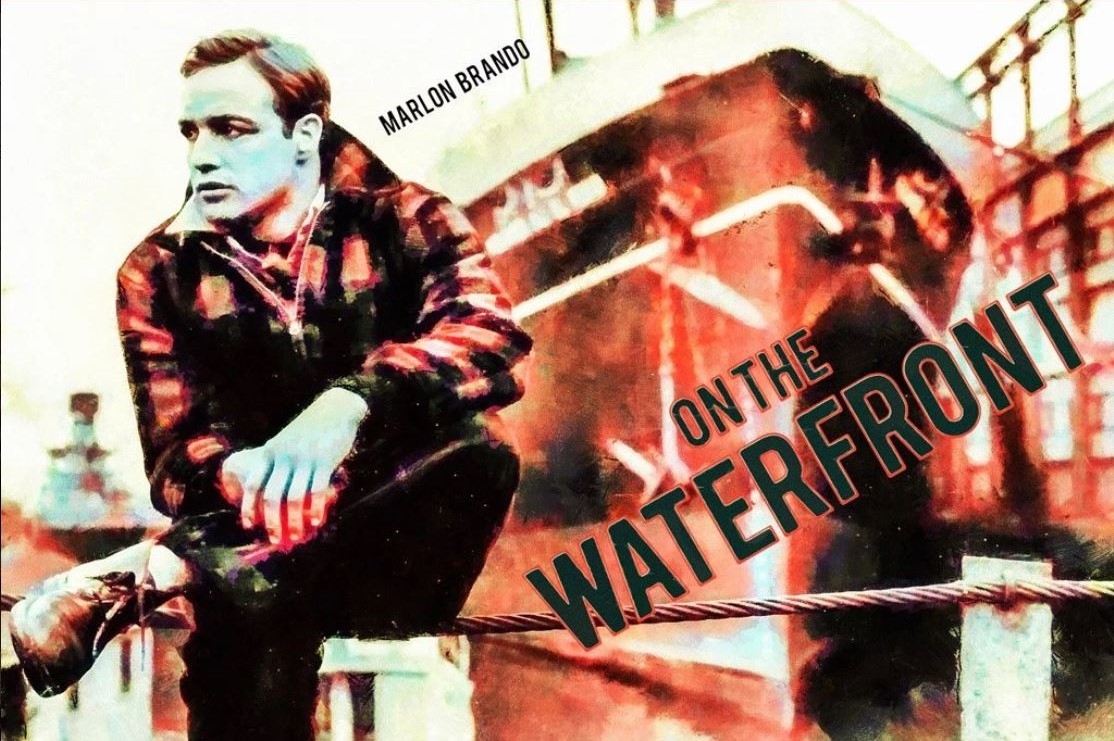
    Yet Leonard Bernstein’s score for “On the Waterfront” (1954) was always a contender, even if at times the composer found himself on the ropes.

    “On the Waterfront” was the only original film score composed by Bernstein (the screen adaptations of his stage musicals were adapted by other hands). Narrative film, of course, is a collaborative effort, in which music is usually the last to the table and the first to go. Bernstein’s score was edited and dialed down to suit the overall needs of the film.

    Unused to such rough treatment, Bernstein found his brush with Hollywood to be dispiriting, to say the least. He arranged his music into a concert suite, over which he had complete control, and the work has gone on to become one of his better-known pieces. That said, what can be heard in the film remains a powerful statement, and one of the great film scores.

    The original recordings, as they appear in the film, were long believed to have been lost. However, in the course of restoration of “On the Waterfront” for release on BluRay, it was discovered that audio had been preserved on acetate discs used for playback during the original recording sessions. Material from these were issued for the first time in 2014, on the Intrada label.

    Bernstein’s music would be nominated for an Academy Award, one of twelve total nominations for the film. “On the Waterfront” would win in eight categories, including Best Picture, Best Actor (Marlon Brando), and Best Director (Elia Kazan). Bernstein may have lost out to Dimitri Tiomkin for his work on “The High and the Mighty.” However, like Brando’s Terry Malloy, his score to “On the Waterfront” proves itself a champion.

    We’ll hear selections, alongside some of Aaron Copland’s music for “The Red Pony” (1949), once again, from the film’s original elements; dances from the only film score ever to be awarded the Pulitzer Prize for Music, “Louisiana Story” (1948), by Virgil Thomson; and the music that lends “Picture Perfect” its signature tune, “They Came to Cordura” (1959), by Elie Siegmeister.

    It’s an hour of New York composers in Hollywood this week, on “Picture Perfect,” music for the movies, now in syndication on KWAX, the radio station of the University of Oregon!


    Clip and save the start times for all three of my recorded shows:

    PICTURE PERFECT, the movie music show – Friday at 8:00 PM EDT/5:00 PM PDT

    SWEETNESS AND LIGHT, the light music program – Saturday at 11:00 AM EDT/8:00 AM PDT

    THE LOST CHORD, unusual and neglected rep – Saturday at 7:00 PM EDT/4:00 PM PDT

    Stream them, wherever you are, at the link!

    https://kwax.uoregon.edu/

  • Mahler in Hollywood Ken Russell’s Biopic

    Mahler in Hollywood Ken Russell’s Biopic

    If you ever thought Mahler sounds an awful lot like film music, well, a lot of composers of Hollywood’s Golden Age – Max Steiner and Erich Wolfgang Korngold spring to mind – were forged in Mahler’s Vienna. They shared his sensibility, to some extent, and boiled it down into a pop cultural gulasch when they settled in Hollywood.

    Ken Russell’s “Mahler” (1974) goes one step further in marrying Mahler’s actual music to the director’s poetic fancies and metaphorical musings about the composer and his life. So don’t look at it as strict biography, though there are certainly truths to be divined from it.

    Next to some of Russell’s other composer biopics (“Lisztomania,” for example), this one is positively restrained by comparison. Still, Russell being Russell, he couldn’t help but interpolate a Nazi dominatrix – presented as a silent movie parody, no less.

    Happy birthday (?), Gustav Mahler!

    https://www.youtube.com/watch?v=PGq7TFoxB4E

    Watch for Oliver Reed in a brief cameo as a train conductor. Allegedly, his payment was three bottles of Dom Perignon.

  • José Iturbi Hollywood’s Forgotten Maestro

    José Iturbi Hollywood’s Forgotten Maestro

    In my Leopold Stokowski post on April 18, I wondered (not for the first time) what the hell happened to my country. This was while reflecting on how classical music, while perhaps never entirely mainstream, was once heard and recognized by the populace, and the most celebrated musicians were household names. Toscanini, Paderewski, Caruso, Paganini. Some of these were already in the grave, but thanks to radio and cinema, in the 1940s, they were names everyone knew. The sextet from “Lucia” was familiar enough that it could be parodied. A lot. Then came television, which continued to keep everyone culturally literate, or at least aware. For a few decades, anyway.

    At a point, José Iturbi entered the conversation, in a comment beneath my post, with a lament that today he is nearly forgotten. Which is probably true, except for classic movie buffs. But wouldn’t you know it, just a few months ago, Sony Classical reissued Iturbi’s recordings made for the RCA label.

    Here’s a post I wrote in 2015 on Iturbi and how classical music was once an expected – and accepted – part of our culture. I’ve included a link to the new Iturbi set at the very end.


    Once again, you’ve got to love the Golden Age of Hollywood. In terms of music, movies from that era just seemed so… inclusive.

    On the one hand, you could have crooner Rudy Vallée acting in Preston Sturges comedies (and not singing a note); on the other, you could have Leopold Stokowski shaking hands with Mickey Mouse. There seemed to be a wider acceptance of musicians of all stripes as equally valid entertainers, and an assumption that the general public would understand (or at least not be put off by) a line of dialogue about Delius or Sibelius. When the Three Stooges weren’t flipping fruit into opera singers’ mouths, that is.

    This is especially fascinating when viewed from the perspective of the present, when seemingly the bar is set lower and lower all the time, with everyone racing to the lowest common denominator so as not to seem too pointy-headed. Wouldn’t it make sense that people of any era would want to aspire to be more? That they would want to be led, represented and entertained by the most talented, most intelligent people? It’s a very strange world we live in.

    José Iturbi (1895-1980) was one of the seemingly unlikely cinematic superstars of the 1940s. Like Oscar Levant, Iturbi was a serious pianist. In the ‘20s, he had made a name for himself as a barnstorming virtuoso who toured Europe, Asia, Africa and South America. He made his North American debut with the Philadelphia Orchestra under Stokowski.

    Eventually, he made the transition to conducting, which had long been his dream. He led the great symphony orchestras of Philadelphia and New York, the London Symphony, the orchestra of La Scala Milan, and the Concertgebouw Orchestra of Amsterdam. He would serve as music director of the Rochester Philharmonic.

    Iturbi generally played himself in Hollywood musicals, including “Thousands Cheer” (1943), “Anchors Away” (1945) and especially “Three Daring Daughters” (1948), in which he was actually the lead.

    For all his talent and charisma, however, Iturbi was always churning up controversy, making provocative remarks and losing his temper. Ironically, for a musician who owed so much of his fame to his absorption into popular culture, he made a big hullabaloo about appearing on concert programs that included both classical and popular music. It wasn’t popular music he objected to, particularly; it was the mixing of the two. This is especially puzzling from a pianist who studied at the Valencia and Paris Conservatories, yet played jazz and boogie-woogie in innumerable film shorts.

    His private life was equally turbulent, perhaps even more so, with tragic results. His wife died of accidental poisoning. He sued his daughter, claiming she was an unfit mother to his grandchildren. The daughter later committed suicide.

    Iturbi could be a brilliant pianist, though he sometimes drew criticism that he was diluting his talents through his involvement with Hollywood, and a number of his concerto recordings, which he conducted himself from the keyboard, don’t really seem to take flight. Even so, there are gems among his recorded repertoire, and the part he played in keeping classical music in the mainstream is to be lauded.

    It’s a vine that is now severely withered. I wonder if Luciano Pavarotti’s “Yes, Giorgio” (1982) was the last in the line of dubious movies featuring great classical musicians.


    Iturbi in “Holiday in Mexico” (1946)

    Insane take on Liszt’s “Hungarian Rhapsody No. 2” from “Anchors Aweigh” (1945)

    Iturbi plays Mozart with his sister, while conducting the Rochester Philharmonic, in 1946

    Iturbi plays Albeniz, Granados and Navarro, from 1933

    Oscar Levant in “The Barkleys of Broadway” (1949)

    Lauritz Melchior with Esther Williams and Van Johnson in “Thrill of a Romance” (1945)

    “Unfaithfully Yours” (1948): “No one handles Handel like you handle Handel!”

    The Three Stooges, “Voices of Spring,” and “Lucia di Lammermoor” in “Micro-Phonies” (1945)

    https://www.youtube.com/watch?v=l6HSu6I8hBg

    The pie fight from “Yes, Giorgio” (1982)

    Website of the José Iturbi Foundation

    https://www.joseiturbifoundation.org/index.php

    Recent Iturbi box set

    The Rediscovered RCA Victor Recordings / José Iturbi


    PHOTO: Iturbi accompanying the MGM lion

  • Bernstein’s Waterfront A Hollywood Contender

    Bernstein’s Waterfront A Hollywood Contender

    “I coulda had class. I coulda been a contender. I coulda been somebody – instead of a bum, which is what I am.”

    We’ve all had those kinds of days, haven’t we?

    Yet Leonard Bernstein’s score for “On the Waterfront” (1954) was always a contender, even if at times the composer found himself on the ropes.

    “On the Waterfront” was the only original film score composed by Bernstein (the screen adaptations of his stage musicals were adapted by other hands). Narrative film, of course, is a collaborative effort, in which music is usually the last to the table and the first to go. Bernstein’s score was edited and dialed down to suit the overall needs of the film.

    Unused to such rough treatment, Bernstein found his brush with Hollywood to be dispiriting, to say the least. He arranged his music into a concert suite, over which he had complete control, and the work has gone on to become one of his better-known pieces. That said, what can be heard in the film remains a powerful statement, and one of the great film scores.

    The original recordings, as they appear in the film, were long believed to have been lost. However, in the course of restoration of “On the Waterfront” for release on BluRay, it was discovered that audio had been preserved on acetate discs used for playback during the original recording sessions. Material from these were issued for the first time in 2014, on the Intrada label.

    Bernstein’s music would be nominated for an Academy Award, one of “On the Waterfront”s twelve nominations. The film would be recognized with wins in eight categories, including Best Picture, Best Actor (Marlon Brando), and Best Director (Elia Kazan). Bernstein may have lost out to Dimitri Tiomkin for his work on “The High and the Mighty.” However, like Brando’s Terry Malloy, his score to “On the Waterfront” proves itself a champion.

    We’ll hear selections, alongside some of Aaron Copland’s music for “The Red Pony” (1949), once again, from the film’s original elements; dances from the only film score ever to be awarded the Pulitzer Prize for Music, “Louisiana Story” (1948), by Virgil Thomson; and the music that lends “Picture Perfect” its signature tune, “They Came to Cordura” (1959), by Elie Siegmeister.

    It’s an hour of New York composers in Hollywood this week, on “Picture Perfect,” music for the movies, this Saturday evening at 6:00 EDT, on WWFM – The Classical Network and wwfm.org.

Tag Cloud

Aaron Copland (92) Beethoven (95) Composer (114) Film Music (123) Film Score (143) Film Scores (255) Halloween (94) John Williams (187) KWAX (229) Leonard Bernstein (101) Marlboro Music Festival (125) Movie Music (138) Opera (202) Philadelphia Orchestra (89) Picture Perfect (174) Princeton Symphony Orchestra (106) Radio (87) Ralph Vaughan Williams (85) Ross Amico (244) Roy's Tie-Dye Sci-Fi Corner (290) The Classical Network (101) The Lost Chord (268) Vaughan Williams (103) WPRB (396) WWFM (881)

DON’T MISS A BEAT

Receive a weekly digest every Sunday at noon by signing up here


RECENT POSTS