Tag: Hollywood

  • Hollywood Behind the Scenes Academy Awards Weekend

    Hollywood Behind the Scenes Academy Awards Weekend

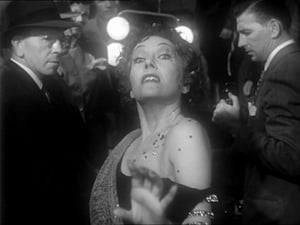
    “All right, Mr. DeMille, I’m ready for my close-up.”

    This week on “Picture Perfect,” on Academy Awards weekend, we take a look behind the scenes at self-reflexive movies that offer glimpses beneath the industry’s glamorous veneer.

    We’ll hear music from Billy Wilder’s “Sunset Boulevard” (1950), a film that’s been called the greatest movie about Hollywood ever made. Gloria Swanson plays Norma Desmond, a faded silent movie actress who believes she’s still “big; it’s the pictures that got small,” and William Holden is an unsuccessful screenwriter-turned-gigolo. Real life director Erich von Stroheim appears in an interesting role as Desmond’s butler – who was once a director! There are also cameos by Cecile B. DeMille and Hedda Hopper, who play themselves. Franz Waxman wrote the Academy Award winning score.

    Vincent Minnelli’s “The Bad and the Beautiful” (1952) stars Kirk Douglas as a ruthless producer, who uses and abuses everyone around him – including Lana Turner, Walter Pigeon, Dick Powell, and Gloria Grahame. Yet everyone’s career seems to blossom from exposure to this S.O.B. The music is by Philadelphia-born David Raksin, who is best-remembered for his theme to the all-time noir classic “Laura.” His theme for “The Bad and the Beautiful” has also become a jazz standard.

    Peter O’Toole dominates “The Stunt Man” (1980) as a tyrannical director who blackmails a fugitive from the law into acting as a stunt man in his current film. The line between fantasy and reality begins to blur. Dominic Frontiere wrote the music. It’s probably not what anyone wants to be remembered for, but I always find it interesting that Frontiere served time for scalping tickets to the Super Bowl! Of course, he scalped a half-million dollars’ worth, and his wife owned the Los Angeles Rams.

    Finally, director Michel Hazanavicius succeeds brilliantly in his virtuosic homage to classic American cinema, “The Artist” (2011). To my knowledge, if we discount Mel Brooks’ “Silent Movie,” from 1976, “The Artist” was the first silent feature to be released since Charlie Chaplin’s “Modern Times,” which was already an anachronism in 1936. “The Artist” was the recipient of five Academy Awards – half of its ten nominations – including one for Best Picture.

    The story deals with “A Star is Born”-type dynamic, with a fading actor of the silent era gradually eclipsed by the success of a rising young actress. Yet Hazanavicius manages to turn it around to come up with an honest-to-goodness, feel-good movie, a real rarity in contemporary cinema.

    Ludovic Bource’s Oscar-winning score is evocative of time and place, breezy, yet when necessary poignant, with moments of spectacular action music which could have been written by Alfred Newman or Franz Waxman. For a classic movie lover, the first five minutes alone are priceless. And love that Uggie!

    Stars are born and celebrities fade this week, on “Picture Perfect,” music for the movies, this Saturday evening at 6:00 EDT, on WWFM – The Classical Network and wwfm.org.
  • Hollywood Writers Music on Film

    Hollywood Writers Music on Film

    Words on the printed page captivate us so completely that it’s natural to assume that the lives of writers must be rich, full of incident, and very dramatic indeed. Surely that is sometimes the case. Who among us could keep up with a Byron or a Pushkin or a Poe?

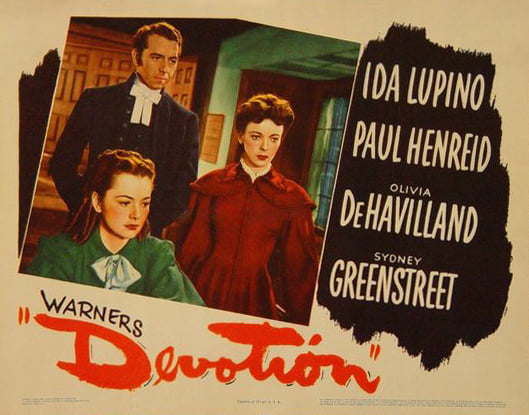
    Yet, with even the most outlandish writers, Hollywood for some reason often feels the need to fabricate. How else to explain “Devotion” (1943), Warner Brothers’ salute to the Brontës? Then again, the temptation must be strong to characterize the sisters who penned “Jane Eyre” and “Wuthering Heights” as tortured Romantics.

    Ida Lupino plays Emily, the creator of Cathy and Heathcliff, and Olivia de Havilland, Charlotte, who conceived Jane and Rochester. Nancy Coleman is their sister Anne, who wrote “The Tenant of Wildfell Hall,” and Arthur Kennedy, their dissolute brother Branwell. The film also features Sidney Greenstreet as William Makepeace Thackeray, Paul Henreid as an Irish priest, and – well, you get the idea. The casting, at times, strains credulity.

    However, the music by Erich Wolfgang Korngold is up to the composer’s usual high standard. Korngold himself became so enamored of one of its themes that he recycled it for use in the first movement of his Violin Concerto. This week on “Picture Perfect,” we’ll have chance to sample some of it.

    We’ll also hear selections from movies about Iris Murdoch (“Iris,” with music by James Horner), the Bard of Avon (“Shakespeare in Love,” with an Academy Award-winning score by Stephen Warbeck), and Samuel Clemens (“The Adventures of Mark Twain,” by Max Steiner).

    Writers are such characters, especially when they’re depicted on the big screen. Everything’s writ large, on “Picture Perfect,” music for the movies, this Saturday evening at 6:00 EDT, on WWFM – The Classical Network and wwfm.org.
  • Leopold Stokowski Birthday & Hollywood

    Leopold Stokowski Birthday & Hollywood

    Today is the birthday of Leopold Stokowski.

    And since the comments section is bound to be filled with gasps of “LEOPOLD,” we may as well get this out of the way right now. (Then read on!)

    The snapping of the baton is a little bit of an in-joke, since Stokowski made it a point to lead not with a stick, but rather using his expressive, mesmerizing hands.

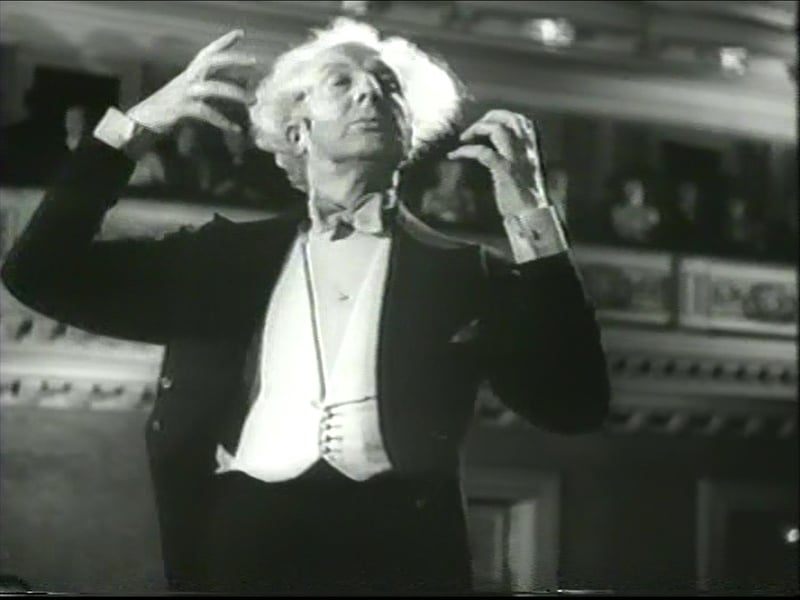
    Here he is in “Carnegie Hall” (1947), real junk food for the classical music lover. Forget about the plot, which is total hokum – a brash young American pianist turns the classical music world on its ear with the debut of his corny “jazz” concerto (with Harry James, no less, playing trumpet obbligato) – the main draw is a parade of real-life classical music superstars.

    The director Edgar G. Ulmer, emerged from German Expressionist cinema (he claimed to have worked on “Metropolis” and “M”), to direct atmospheric Hollywood films like “The Black Cat” and “Detour.”

    The experience obviously prepared him for this showcase of Stokowski, who in the film’s best sequence conducts a movement from Tchaikovsky’s Symphony No. 5. The camera angles are striking, the lighting dramatic, and Stoky’s hair just keeps getting bigger… and bigger… and bigger.

    Stokowski also shared screen time with Deanna Durbin in “One Hundred Men and a Girl” (1937). In case you’re curious, Charles Previn, credited as associate musical director, was the second-cousin of Andre Previn. Stokowski conducts the finale of the same Tchaikovsky symphony. Also, Deanna Durbin sings from “La Traviata.”

    Naturally, there’s the obligatory shot of a bored husband (character actor Eugene Pallette) dozing in the audience, and a boy-next-store shouting from a balcony, just to keep it all comfortably “regular guy.”

    But it goes without saying that the most enduring artifact of Hollywood’s romance with Stoky was the conductor’s work on Walt Disney’s “Fantasia” (1940), including this iconic handshake with Mickey Mouse:

    Stokowski recorded the soundtrack in experimental stereo, captured by 33 microphones and three million feet of sound film, at Philadelphia’s Academy of Music in 1939. Stokowski served as the Philadelphia Orchestra’s music director from 1912 to 1938. Here he directs Bach’s “Toccata and Fugue in D minor,” from a Spanish print of the film:

    Finally, Stokowski talks about his experiences in Hollywood, most specifically his work on “Fantasia,” in an interview given in the 1960s:

    https://www.youtube.com/watch?v=RCGdRntUJ0M

    Notoriously, the accent is totally phony baloney. Stokowski’s grandfather was Polish, but he himself was a second-generation Londoner. But Stoky always did have a whiff of P.T. Barnum about him. He may have been a visionary, but, first and foremost, he knew how to captivate an audience.

    I hope you’ll join me tonight for “The Lost Chord,” as I’ll be highlighting some of Stokowski’s early Wagner recordings with the Philadelphia Orchestra. The program, “Magic Fire,” will air at 10:00 EDT on WWFM – The Classical Network and wwfm.org.

  • Max Steiner: Hollywood’s Epic Composer

    Max Steiner: Hollywood’s Epic Composer

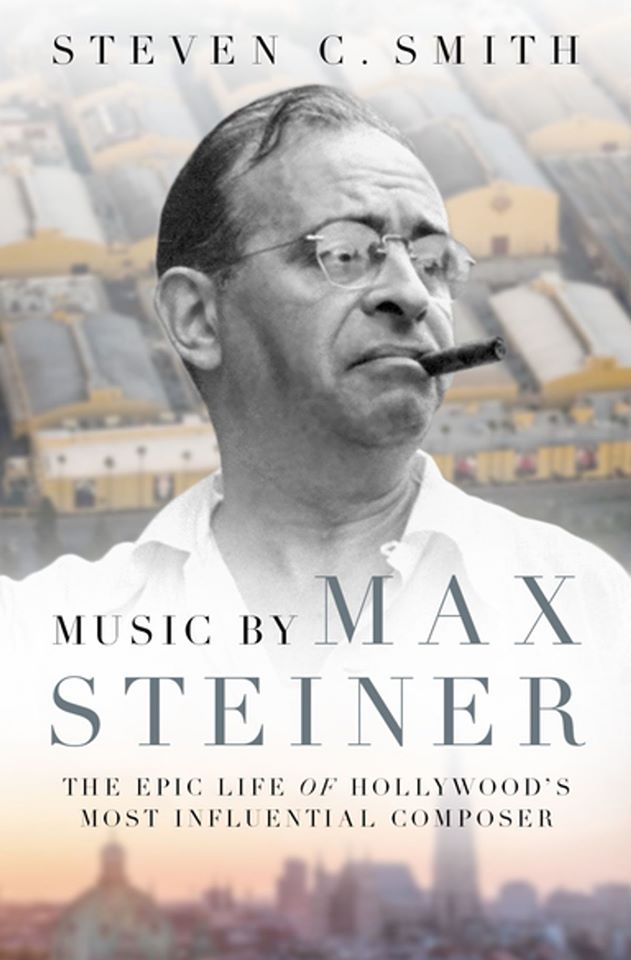
    It’s an unfortunate coincidence that I happened to finish this book on the anniversary of Olivia de Havilland’s death. De Havilland was one of the dozens of subjects interviewed or researched for this authoritative biography of Max Steiner, unbelievably the first full-length treatment of one of the movies’ most celebrated composers.

    Steiner might be said to have had one foot in Vienna and one on the Great White Way. His grandfather, for whom he was named, was a formative influence on the development of Viennese operetta, and his father, also very much involved with the theater, built an entertainment city within the city, which included among its wonders the Riesenrad, the giant Ferris wheel used so memorably in “The Third Man.” In the New World, Steiner worked as music director for the Gershwins, Jerome Kern, and others. But it was in Hollywood, at the dawn of talking pictures, that he was to make his greatest mark.

    Steiner pioneered the concept of the Wagnerian-Straussian underscore, in films such as “Bird of Paradise,” “King Kong,” and “She,” an approach that would set the industry standard for decades. Indeed, many of Steiner’s technical, if not musical, innovations are still employed in the process of adding music to film.

    You’d think that, for being such a powerful and lucrative asset to RKO, Warner Brothers, and David O. Selznick (for whom he scored “Gone with the Wind”), Steiner would have been better appreciated, even seen as indispensable – and to an extent he was, whenever a prestige picture needed a little added luster, or a middling one some emergency TLC.

    Sadly, the studio system began to crumble sooner than one might think. Already in the late ‘40s, contracts were not being renewed, and Steiner, in common with many of the legendary actors and directors he had worked with, all at once found himself a free agent. This meant that he had to scramble for much of his later work.

    Also, despite being well paid – or well enough, by the day’s standards – he had all sorts of drains on his income. An appreciation for the good life, several alimonies, the support of his parents, unchecked generosity, and a profligate child left him scrambling. In fact, he was nearly always saddled with enormous debt and literally working around the clock to meet impossible deadlines. This continued until a late-in-life miracle, the theme to “A Summer Place” becoming an unexpectedly popular hit, brought him financial security.

    But life is strife, and Steiner still had his share of personal miseries. He struggled with failing eyesight for his entire adulthood (he scored at least one of his films while legally blind, though thankfully cataract surgery brought him back to the point where he could at least see), and a rocky relationship with his son led the kind of heartbreak that is every parent’s nightmare.

    Music remained a refuge. Steiner was a man who clearly took joy in the act of composing, and he was a master at solving the puzzle of how to match just the right kind of music to a particular kind of film. His home life could be volatile, the hours were certainly terrible, but he kept up a playful, almost child-like disposition. His scores are peppered with outrageous puns and side-notes to his orchestrators, many of them of an astonishingly bawdy nature.

    While some of his music may seem a little old fashioned today, at times mawkish and even a little cartoon-like (“Mickey Mousing,” or matching music too closely to an onscreen action, was one of Steiner’s weaknesses), he was undeniably a force to be reckoned with. Personally, I still find his idiom highly attractive. There would be no “Star Wars” or “The Lord of the Rings” without Max Steiner.

    Steven C. Smith’s “Music by Max Steiner: The Epic Life of Hollywood’s Most Influential Composer” is published by Oxford University Press. The study is generously annotated, with a bibliography, for those of a scholarly bent, but also compellingly written, so as to satisfy the more casual reader. If you’re at all curious about the art of film scoring, or simply a classic movie buff – Steiner knew everyone from Johann Strauss II to Frank Sinatra – this book is for you.

    Smith is also the author of “A Heart at Fire’s Center: The Life and Music of Bernard Herrmann” (1991). Let’s hope it’s not another 30 years before he tackles Franz Waxman, Alfred Newman, or someone equally worthy!

    Oxford Academic (Oxford University Press)

  • Remembering Oscar Levant’s Genius

    Remembering Oscar Levant’s Genius

    “Happiness isn’t something you experience; it’s something you remember.”

    Bearing in mind the words of Oscar Levant, I hope that you had a happy Christmas.

    Levant was born in Pittsburgh on this date in 1906 to Orthodox Jewish parents from Russia. It was his father’s desire that his sons become either doctors or dentists. Ever the contrarian, Levant opted to become everything else instead.

    A preternaturally talented musician, Levant studied in New York with the great Polish pedagogue Zygmunt Stojowski. By his early 20s, he was in Hollywood, where he met and befriended George Gershwin. With Gershwin’s death, Levant became regarded as the foremost interpreter of the composer’s piano music.

    Levant himself was a composer of talent. In Hollywood, he scored over 20 films. He also wrote and co-wrote popular songs, including the enduring “Blame It on My Youth.” Determined to become a “serious” composer, he sought out and undertook private studies with Arnold Schoenberg. He also found work as a Broadway composer and conductor.

    But it was likely through his memorable appearances on radio and television that he became best known, as a brilliant panelist possessed of impeccable timing and an acid wit. His remarks were invariably off the cuff, and this spontaneity would sometimes throw the sponsors into a panic. A show was cancelled after he remarked, “Now that Marilyn Monroe is kosher, Arthur Miller can eat her.”

    Now a certified – some would say certifiable – celebrity himself, Levant appeared in a number of feature films, including “An American in Paris” (1951) and “The Band Wagon” (1953). He played himself in the Gershwin biopic “Rhapsody in Blue” (1945). He would receive a star on the Hollywood Walk of Fame in recognition of his recording career.

    On top of everything else, Levant wrote three books: “A Smattering of Ignorance” (1940), “The Memoirs of an Amnesiac” (1965), and “The Unimportance of Being Oscar” (1968).

    Levant was as famous for his neuroses and hypochondria as he was for any of his actual talents. He smoked prolifically, became addicted to prescription drugs, and was frequently in and out of mental institutions. He died of a heart attack in 1972, at the age of 65.

    “There is a fine line between genius and insanity,” he once quipped. “I have erased this line.”

    Happy birthday, Oscar Levant – even if only in remembrance.


    Levant plays Gershwin:

    Levant on “The Tonight Show” with Jack Paar:
    https://www.youtube.com/watch?v=nVOl49AHD6Q

    Levant plays his Sonatina:

    Levant in “An American in Paris:”

Tag Cloud

Aaron Copland (92) Beethoven (95) Composer (114) Film Music (123) Film Score (143) Film Scores (255) Halloween (94) John Williams (187) KWAX (229) Leonard Bernstein (101) Marlboro Music Festival (125) Movie Music (138) Opera (202) Philadelphia Orchestra (89) Picture Perfect (174) Princeton Symphony Orchestra (106) Radio (87) Ralph Vaughan Williams (85) Ross Amico (244) Roy's Tie-Dye Sci-Fi Corner (290) The Classical Network (101) The Lost Chord (268) Vaughan Williams (103) WPRB (396) WWFM (881)

DON’T MISS A BEAT

Receive a weekly digest every Sunday at noon by signing up here


RECENT POSTS