We don’t know for sure when he was born (he was baptized on April 26, 1564), but April 23 is the day the world has chosen to celebrate Shakespeare.
Rather than pummel you with more music inspired by the Bard, I thought I would take a circuitous approach, this Sunday night on “The Lost Chord,” and present Constant Lambert’s 1924-25 ballet, “Romeo and Juliet.” Do not go into it expecting the star-cross’d lovers of Shakespeare’s immortal tragedy. Lambert’s version takes a look at a ballet company. In the process of preparing an adaptation of the play, the two leads fall in love. They flee a rehearsal, and are glimpsed eloping in an aeroplane!
Lambert was only 20 years-old when he wrote the music, which is cheeky and burlesque, evocative of commedia dell’arte and perhaps influenced by contemporaneous displays of joie de vivre by composers of the Parisian collective, Les Six.
“Romeo and Juliet” was one of only two ballets commissioned from English composers by Serge Diaghilev for his Ballets Russes. The other was “The Triumph of Neptune,” written in 1926 by Gerald Hugh Tirwhitt-Wilson, 14th Baron Berners.
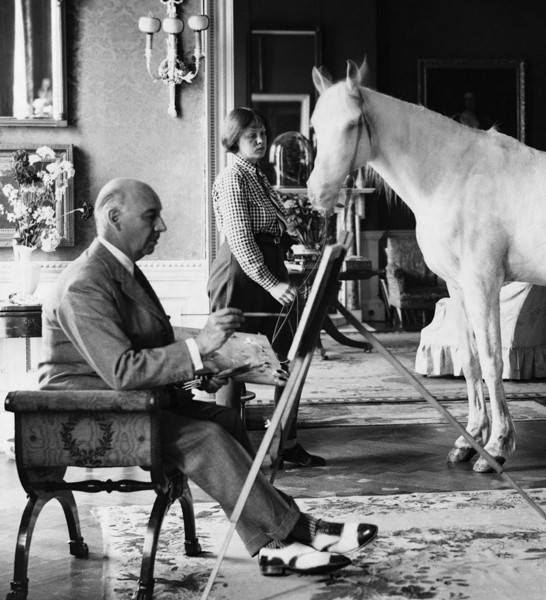
Berners was an exemplar of a certain tradition of English eccentricity, in which a lord might invite a giraffe to an outdoor tea party or a horse would be given license to roam the indoors to mingle with his guests. His garden was full of paper flowers, his dogs wore pearl necklaces, and he built a hundred foot folly tower, allegedly just to annoy the neighbors.
Berners was gifted in so many areas – as a composer, of course, but also as a writer (his stories and autobiographical musings have been brought back into print) and a painter (he loved to include mustaches in his portraits, whether the sitter had one or not). He liked ballet best of all, since it allowed him to write the scenarios and design the backdrops, in addition to composing the music.
“The Triumph of Neptune” is Berners’ best-known piece. In this instance, it was Sacheverell Sitwell who devised the scenario, which sprang from their mutual enchantment with 19th century theatrical prints. An English sailor is shipwrecked en route to Fairyland. He is saved by Britannia, who dances a hornpipe. He returns home in spirit form, to find his wife carrying on with a well-dressed villain. But all ends happily, as he is turned into a prince and marries Neptune’s daughter.
The choreography was by George Balanchine, and the work became a great favorite of Sir Thomas Beecham.
I hope you’ll join me for “England à la Russe” – music written by English composers for the Ballets Russes – this Sunday night at 10:00 EDT, on WWFM – The Classical Network and at wwfm.org.
PHOTOS: Berners paints a horse; Lambert pushes a car
Leave a Reply to pinup-aviator.sagana.kz/Cancel reply