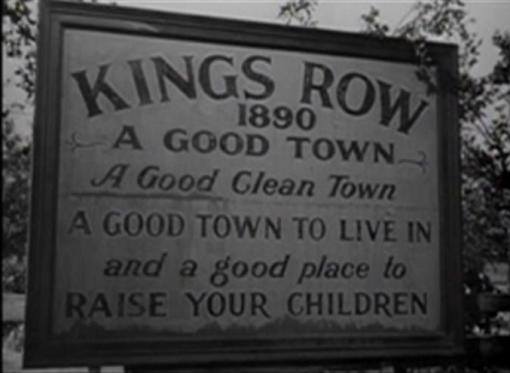
This week on “Picture Perfect, with a new “Star Wars” right around the corner, we’ll hear an extensive suite from one of John Williams’ acknowledged influences, Erich Wolfgang Korngold’s “Kings Row” (1942). The settings of the two films couldn’t be more different – “Kings Row’s” struggle of decency against sinister impulses takes place in a small Midwestern town – but Korngold’s opulently orchestrated score brims with romance and heroism. Check out that opening fanfare!
Although he was one of the great musical prodigies – celebrated in Vienna in his teens and 20s, especially for his operas – Korngold’s name was kept alive for decades after his death largely because of his work on a number of classic Warner Brothers films of the 1930s and ’40s. His music for the Errol Flynn swashbucklers has been particularly well-loved.
He had already written music for “Captain Blood,” “The Prince and the Pauper,” “The Adventures of Robin Hood,” “The Private Lives of Elizabeth and Essex” and “The Sea Hawk” by the time he was offered work on “Kings Row.” Without knowing anything more about the project than the title, he commenced writing music for the main theme, on the assumption that the film was going to be another costume picture. In reality, it was a turn-of-the-century soap opera based in America’s heartland.
Korngold’s approach couldn’t have been more fortuitous, since it led him to compose one of his grandest themes. It punctuates the action of the film like a cinematic “Ein Heldenleben” – which should come as little surprise, since Korngold actually knew Richard Strauss.
“Kings Row” was based on the bestseller by Henry Bellamann. The book reveals a kind of dark underbelly to the civility of small town American life. The subject matter was ahead of its time, laying the groundwork for the novel “Peyton Place,” the film “Blue Velvet,” and television series such as “Twin Peaks” and “Desperate Housewives.” Yet at its core is the fundamental decency of its protagonist, Parris Mitchell, and his circle of friends. It is Mitchell’s ambition to become a doctor, and he heads to Vienna to study a new branch of science known as psychology.
Mitchell was played in the film by Robert Cummings, his best friend Drake by Ronald Reagan, and Randy, a former tomboy from a family of railroad workers, by Ann Sheridan, who received top billing. The studio filled out the cast with a superb ensemble, including Claude Rains, Judith Anderson, Charles Coburn, Harry Davenport and even Maria Ouspenskaya, best known as Maleva the gypsy woman from “The Wolf Man.”
It’s a grand piece of entertainment, if you can get into the spirit of it, depending on your tolerance for incest, sadism, involuntary amputation, wrongful commitment to an insane asylum and suicide. This is the film in which Reagan exclaims the immortal line, “Where’s the rest of me?”
Thanks to the Hays Code, the screen adaptation was considerably toned down from – and more upbeat than – the novel. The emphasis is on Mitchell’s idealism in the face of a cruel, and at times horrifying, world. Along the way, there are several amusing (from our perspective) explanations of that mysterious new discipline, the study of the mind.
I hope you’ll join me for an hour of music from “Kings Row,” by the King of Film Composers, Erich Wolfgang Korngold, this Friday evening at 6:00 EST, on WWFM – The Classical Network and wwfm.org.
Leave a Reply to avCancel reply