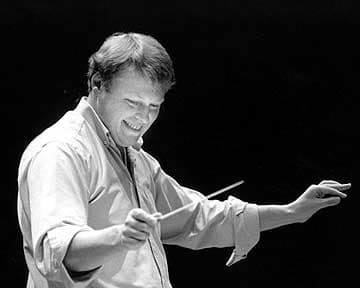
It’s sobering to think that Richard Hickox would have been 70 years-old today. Hickox, one of the great champions of English music, died of a dissecting thoracic aneurysm, suffered while recording Gustav Holst’s “First Choral Symphony,” in 2008.
For decades, Hickox applied his indefatigable zeal to filling out the catalogue with fine recordings of established classics and poor stepchildren. His early passing came especially hard at the end of what seemed like a run on great British conductors – Bryden Thomson (died in 1991), Sir Alexander Gibson (1995), and Vernon Handley (2008, only two months before) – that kept alive a venerable tradition too often dismissed abroad.
Hickox was the founder of the City of London Sinfonia and Collegium Musicum 90. He was also choral director of the London Symphony Orchestra, artistic director of the Northern Sinfonia, and principal conductor of the BBC National Orchestra of Wales. At the time of his death, he was music director of Opera Australia.
Hickox recorded prolifically – orchestral works, oratorios, and operas – for the EMI and Chandos labels. The recipient of many honours and awards, he was also president of the Elgar Society. He was the only conductor ever to program the complete symphonies of Ralph Vaughan Williams as a series in concert. Who knows how much more he would have accomplished had he lived another 20 or 25 years?
This afternoon on The Classical Network, we’ll remember Hickox and the Spanish conductor Jesús López-Cobos, who died on Friday at the age of 78. López-Cobos will conduct music of Heitor Villa-Lobos on the anniversary of the birth of Brazil’s most famous composer. I hope you’ll join me from 4 to 7 p.m. EST, on WWFM – The Classical Network and wwfm.org.
Leave a Reply