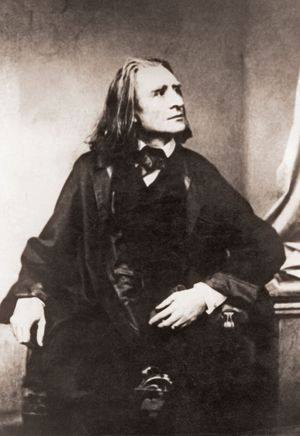
He is one of history’s most influential and undersold composers.
A champion of program music (music intended to express extramusical ideas), the inventor of the symphonic poem, a pioneer of structural innovation, and an explorer of strange new harmonies, Franz Liszt seldom gets the credit he deserves. By contrast, a composer like Richard Wagner (Liszt’s son-in-law) is revered for the “Tristan chord,” a kind of shot-heard-‘round-the-world that is said to have changed music. It’s seldom noted that it was but one of the ideas Wagner “borrowed” from Liszt.
As a conductor, Liszt’s energetic promotion of composers like Hector Berlioz and Wagner – then a political fugitive – marred with scandal and intrigues his tenure at the Weimar court. For his pains, he was frequently attacked by critics, derided by his peers, and undercut by his own showmanship.
No one seems to contest that he was one of the most remarkable pianists who ever lived, but the assessment is often tempered by charges of vulgarity, of crass pandering to sensation and to the mob.
Liszt played benefit concerts for victims of flood and fire, as well as for political refugees, spearheaded the creation of a monument to and festival for Beethoven in Bonn, never charged a fee for his lessons to his many pupils, and selflessly promoted the works of others, including (beside Berlioz and Wagner) Grieg, Smetana, Debussy, Saint-Saëns, Fauré, and Borodin.
This is the thanks he gets?
At the very least, I think he deserves three hours of airplay on his birthday. I hope you’ll join me this afternoon for a mix of piano and orchestral works, choral music and lieder, and transcriptions and fantasies of famous works by other composers.
It will be an all-Liszt playlist, from 4 to 7 p.m. EDT, on WWFM – The Classical Network and wwfm.org.
Leave a Reply to ลดต้นทุนโรงงานCancel reply