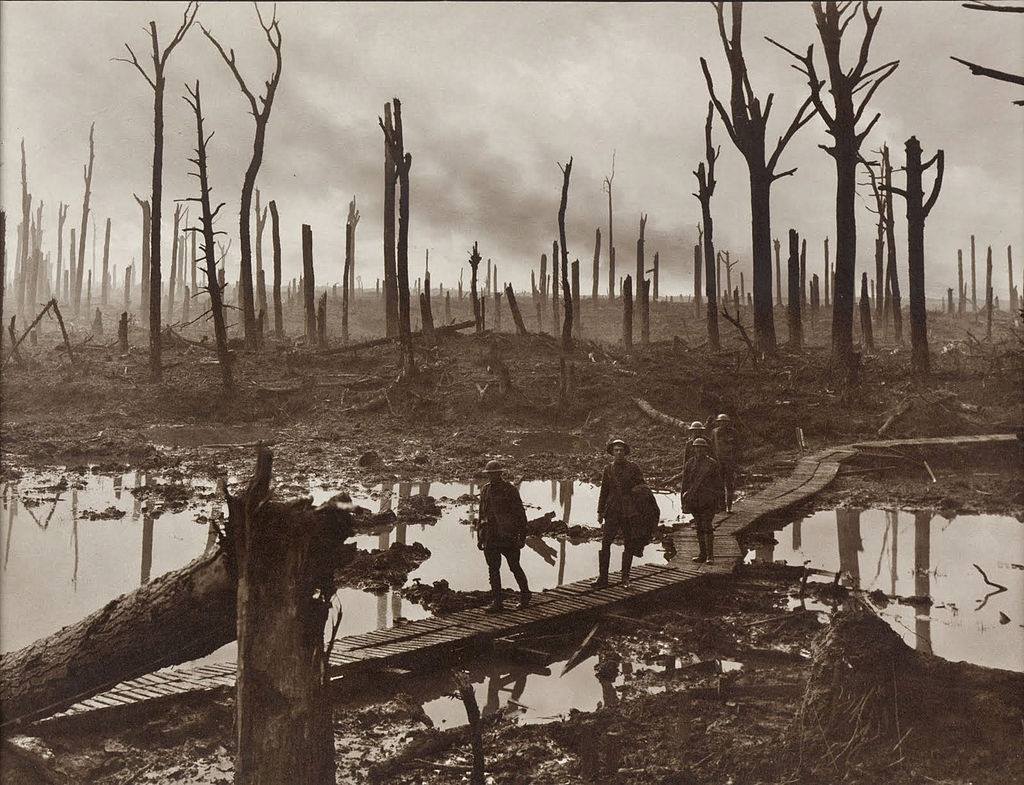
John Foulds conceived “A World Requiem” in the wake of World War I as a memorial to the dead of all nations. This Sunday night on “The Lost Chord,” we’ll conclude our two-part commemoration of the signing of the 1918 Armistice by highlighting the second half of this epic, 90-minute work for vocal soloists, massed choirs – including children’s choirs – large symphony orchestra, off-stage instrumentalists, and organ.
The Requiem’s texts were derived from various spiritual sources by the composer’s wife, Maud MacCarthy, built on fragments from the Requiem Mass, as well as writings of John Bunyan and the Hindu poet Kabir. Its overall tone is more Brahms than Britten. The second part conveys radiant visions of paradise.
“A World Requiem” was given its first performance on Armistice Day, November 11th, 1923, then performed annually for the next four years. After that, it lay unheard for some eight decades, until revived by conductor Leon Botstein. Botstein has dusted off more than his share of worthy curiosities, though few are more ambitious than “A World Requiem.” This world premiere recording, on Chandos Records, was taken from a live concert presented on Armistice Day, 2007, at the venue in which the work was first heard, Royal Albert Hall London.
We’ll round out the hour with music by Cecil Coles, one of the many (too many) artists who lost their lives in combat. Coles was born in Scotland in 1888. He studied at Edinburgh University, the London College of Music, and Morley College; then in Stuttgart, where he remained as assistant conductor at the Stuttgart Royal Opera House. Forced to return to England before the outbreak of war, he enlisted for overseas service and was sent to the trenches in 1915. Coles was killed near the Somme on April 26, 1918, during a heroic attempt to rescue some wounded comrades.
Coles had continued to compose even on the front lines. His manuscripts of the period, some still embedded with shrapnel, have been painstakingly reconstructed for a recording on Hyperion Records. We’ll hear one of the surviving movements from “Behind the Lines,” titled “Cortège” – a military funeral procession – especially poignant, given the composer’s fate. Coles was just 29 at the time of his death.
“The War to End All Wars” was a lesson that won’t be learned, apparently, but it’s healthy to reflect on the horror, the heroism, the waste, and the sacrifice. Join me in marking the centenary of the Armistice, on “A Farewell to Arms, Part II,” this Sunday night at 10:00 EST, on WWFM – The Classical Network and wwfm.org.
Leave a Reply