While Walt Whitman has attained a venerable status here in the United States, as essentially America’s national poet, more surprising, perhaps, was his impact on composers of the British Isles.
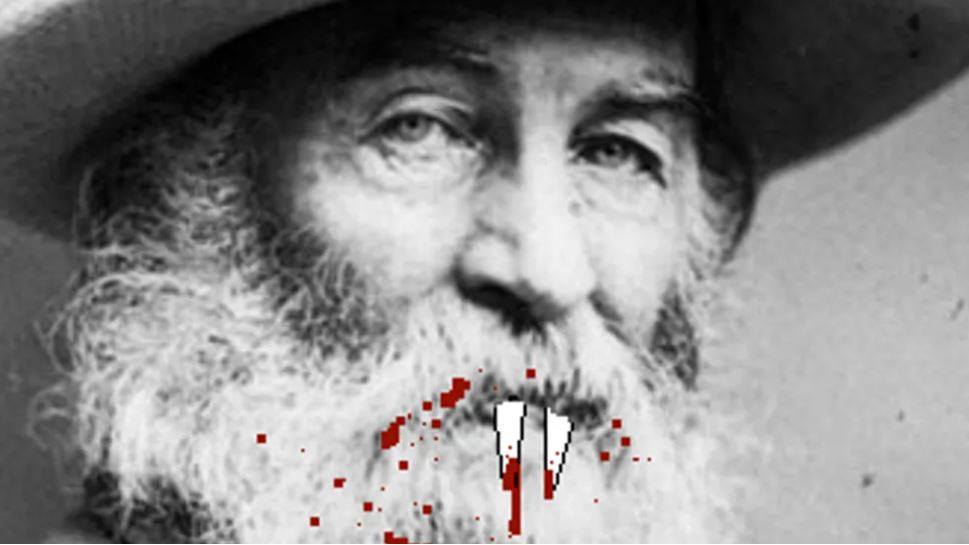
Whitman was beloved by artists in the U.K. Interestingly, I learned in doing some reading in preparation for these shows that writer Bram Stoker was so taken with Whitman, the man, that allegedly he modeled his characterization of Dracula upon him (for more, follow the links below). And he meant it as a compliment! Stoker viewed Whitman as the quintessential man and kept up a correspondence with him until the poet’s death.
More to our purposes, this Sunday night on “The Lost Chord,” we’ll hear two works by Gustav Holst, composer of “The Planets:” the “Walt Whitman Overture,” written in 1899, when Holst was about 25 years-old, and “The Mystic Trumpeter” from 1904.
Holst first encountered Whitman’s poetry while still a student at the Royal College of Music. He would go on to set a number of Whitman texts. “The Mystic Trumpeter” made a particularly strong impression on him. His musical response was an important stepping stone in the composer’s artistic development, emerging as he was from a decade of Wagner worship and not yet giving himself over to the absorption of folk English material. Still, there are certainly glimpses of the mature artist to come.
Holst’s good friend and colleague, Ralph Vaughan Williams, was also influenced by Whitman, not only in the writing of his frequently recorded “A Sea Symphony,” portions of his cantata “Dona nobis pacem,” and his work for chorus and orchestra, “Toward the Unknown Region,” but also in the less frequently encountered mini song cycle, “Three Poems by Walt Whitman.” The set consists of “Nocturne,” “A Clear Midnight,” and “Joy, Shipmate, Joy!” Written in 1925, the songs are products of Vaughan Williams’ maturity. The composer was around 53 years-old.
Frederick Delius was yet another English composer deeply influenced by Whitman. Delius’ settings for baritone, chorus, and orchestra, titled “Sea Drift,” from 1903-04, are collectively regarded as one of the composer’s finest achievements. “Sea Drift” was composed at the peak of Delius’ vitality.
His “Songs of Farewell,” however, were produced under quite different circumstances. Delius was both blind and paralyzed, suffering from the effects of advanced syphilis, when he received an unexpected gift in the arrival of a young musician by the name of Eric Fenby, who offered his services as an amanuensis. The result was a rekindling of Delius’ creativity.
“Songs of Farewell,” a cycle of dreamy choral settings after Whitman, was dictated to Fenby by Delius in 1929-30. There are five songs: “How sweet the silent backward tracings;” “I stand as on some mighty eagle’s beak;” “Passage to you;” “Joy, shipmate, joy!;” and “Now finale to the shore.”
We continue our celebration of “the good gray poet,” all month long, for the occasion of the bicentennial of his birth. Whitman was born in Huntingdon, NY, on Long Island, on May 31, 1819, and he died in Camden, NJ, on March 26, 1892.
“Walk out with me toward the unknown region…” Join me for “The Mystic Trumpeter,” the second of four programs, this Sunday night at 10:00 EDT, on WWFM – The Classical Network and wwfm.org.
Read Bram Stoker’s effusive letter to Whitman here:
https://www.brainpickings.org/2019/01/09/bram-stoker-walt-whitman-letter/
Walt Whitman’s influence on “Dracula” and (possibly) the 1931 “Frankenstein:”
https://bigthink.com/book-think/walt-whitman-frankenstein-dracula-and-the-afterlife
Leave a Reply